The pace of collective bargaining agreement (CBA) negotiations has picked up considerably over the last three weeks. The league sent the WNBPA its latest counterproposal on Sunday, just two days after the union sent its own and seven days after the news that the 2025 season triggered revenue-sharing payouts.
At least five proposals have been exchanged since early February, a major uptick after a six-week standoff that included all of January. This change in cadence comes amid the league’s message to players and teams that the 2026 schedule would be impacted without a handshake agreement by March 10.
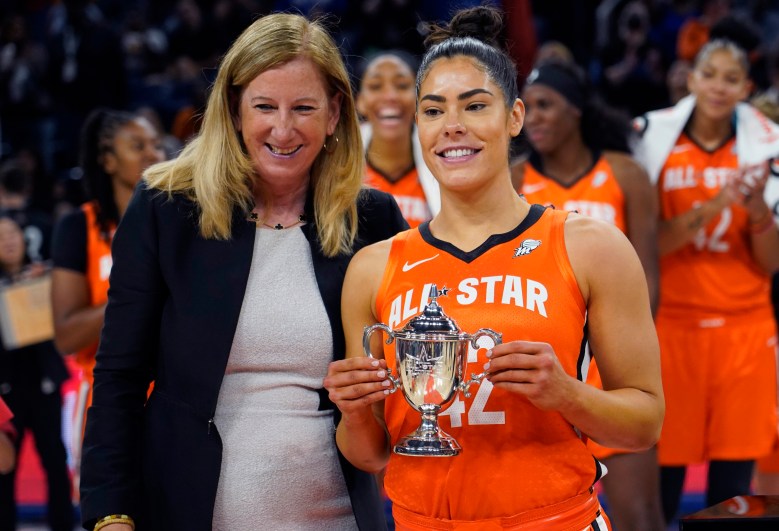
Recent comments from multiple players — including Breanna Stewart and Kelsey Plum — also mark an interesting shift in public messaging, with both expressing openness to the league’s revenue-sharing mechanisms, as long as the resulting revenue remains acceptable to the players.
Stewart, in an interview with Fox News Digital, made a direct reference to what she called shared basketball income (SBI) in the league’s offer. Stewart referred to SBI as something “you negotiate how much money goes into that pot and that’s shared to players.”
That definition of SBI aligns with what has been reported about the league’s proposal: the system is based on net revenue, with some wiggle room on what does and doesn’t count as an expense, in addition to what percent of that net revenue goes to the players. Plum echoed this during Monday’s media availability at Unrivaled, using the term “expense credits” to explain the exceptions to expense calculations.
“At the end of the day … we’ve negotiated over 70% net revenue,” Plum told reporters. “That’s a significant win, right? And I think that as we continue to go, we can continue to negotiate the expense credits that the league gets in their proposal.”
Both Stewart and Plum also stressed that the players are not done pressing for their own preferred system, merely that they are open to whichever path best serves the union, especially if it can be reached without cutting into the 2026 season.
This recent messaging isn’t surprising. A source familiar with the union’s thinking expressed the same sentiment to The IX Basketball just last week. The union’s goal has been to get the players paid an amount that starts fair and grows as the league’s business grows, which both sides have accounted for in their proposals.
However, the timing is interesting, and the public mention of directly negotiating changes to the league’s preferred system is a new development. It is especially interesting in light of the other comments Stewart and Plum made at Unrivaled, which stressed the opportunity cost of a strike that could offset some of the gains a strike may yield.
None of which is to say the players would avoid a strike at all costs, as Alysha Clark explained in an exchange on Threads. “Players expressing personal opinion on not loving the idea of a strike vs. it being taken off the table are very different,” Clark said in the post. “I know some of the other interviews I’ve watched also said we’re prepared and have been preparing should one be called.”
Grey area
What actually constitutes growth — and what the starting point should be — remains up for debate.
To summarize where each offer stands, the league continues to propose a system of revenue sharing that is determined by net revenue, which is revenue minus expenses. To this point, the players have been countering with revenue sharing based on gross revenue.
As mentioned, the players aren’t inherently opposed to a system that looks more like the league’s, as long as the amounts produced by the formula are acceptable. In that vein, both proposed systems have their strengths and weaknesses for each side.
The league’s 70% of net revenue model can be a major boon for players in seasons when net revenue is growing rapidly. If revenue outperforms expectations without a jump in expenses, each additional dollar in net revenue would go nearly three times as far as that same dollar in the players’ gross revenue model.
The risk for players is that, after the new 11-year, $2.2-billion media rights deal kicks in, the largest revenue bumps will likely come from the team revenue of expansion teams. All revenue is good revenue in the players’ proposal, but using net revenue, an expansion team isn’t even guaranteed to break even in Year 1.
The league has shifted some of the projected revenue-sharing money directly into the salary cap, but has made minimal concessions in total compensation since the middle of December. In the league’s recent offer, players are projected to receive an average compensation of approximately $540,000 in 2026. That amount is up slightly from projections of an average 2026 salary of $530,000, reported by ESPN as early as Dec. 18.
Since that Dec. 18 update, the union has reduced its proposed share of gross revenue over the life of the agreement from approximately 31% to 26%, as of its Feb. 27 offer. Per ESPN and Front Office Sports, that 5% decrease has equated to approximately $340 million in revenue. That is derived from the league’s internal revenue projections, which estimated $700 million in losses for the league and its teams when the players requested 31%.
That implies the projections account for approximately $6.8 billion in gross revenue1 from 2026 to 2031, and that an agreement in the ballpark of 20% might be a happy middle. Without the league’s expense projections, however, it is not feasible to calculate the league’s expected profit under its own offer. That means we cannot validate that middle-ground figure, nor can we reverse engineer a formula using net revenue that yields 20% for the players.
Listen now to The IX Sports Podcast and Women’s Sports Daily
We are excited to announce the launch of TWO new podcasts for all the women’s sports fans out there looking for a daily dose of women’s sports news and analysis. Stream on Spotify, Apple Podcasts or anywhere you listen to podcasts, and make sure to subscribe!
On the fringes
The league, rather than ceding ground on revenue sharing, has been focusing its counteroffers on peripheral benefits in recent proposals. Most recently, the league has proposed a path for players on rookie-scale contracts reaching top-tier salaries earlier in their careers.
The path is similar to the 2020 CBA’s rules, in that early eligibility is determined by being named MVP or on the All-WNBA First or Second Team — in this case, winning MVP qualifies a player for the supermax in Year 4 of their rookie deal, while All-WNBA qualifies the player for the regular maximum. Where this plan differs, though, is that players extended under this rule would not be allowed to be cored after the extension ends.
The core designation — often likened to the NFL’s franchise tag — is intended to give teams a shortcut to retaining their own top impending free agents, as long as they are comfortable making a qualifying offer worth the supermax.
Players have sought to remove or rework the core designation. It restricts player movement in free agency and frequently fails to reward players with a fast track to a supermax, amid growing pressure to take team-friendly deals for the sake of competitiveness.
Housing has made up a large share of the league’s back-and-forth with the union in recent negotiations. As of Friday, the union proposed that housing remain guaranteed for players earning below 75% of the maximum salary.
The league has offered to retain housing only for first-year rookies, minimum-salary players and developmental players. Both proposals are intended to provide stability for players in the league who would be most affected by cuts to housing.
On the topic of supporting young players, a source with knowledge of the negotiations tells The IX Basketball that players still on rookie-scale contracts this offseason can expect their salaries to be bumped up beyond the new minimum. This is different from the 2020 CBA, where any player under contract for less than the minimum salary was only bumped up to their respective minimum.
Exactly how much those players’ contracts will increase by the time an agreement is signed is unknown. But no matter the increase, this will ensure that even more players benefit from the higher salaries in Year 1.
Jackie Powell contributed reporting to this story.
“Becoming Caitlin Clark” is available now!
Howard Megdal’s newest book is here! “Becoming Caitlin Clark: The Unknown Origin Story of a Modern Basketball Superstar” captures both the historic nature of Clark’s rise and the critical context over the previous century that helped make it possible.
- 1% of gross revenue = $340M / 5 = $68.0M ↩︎