FORT WORTH, Texas — The clock ticked under 31 seconds in regulation inside Dickies Arena when UConn head coach Geno Auriemma turned to his bench and emptied his starters. An 18-point lead had already sealed the Elite Eight clash.
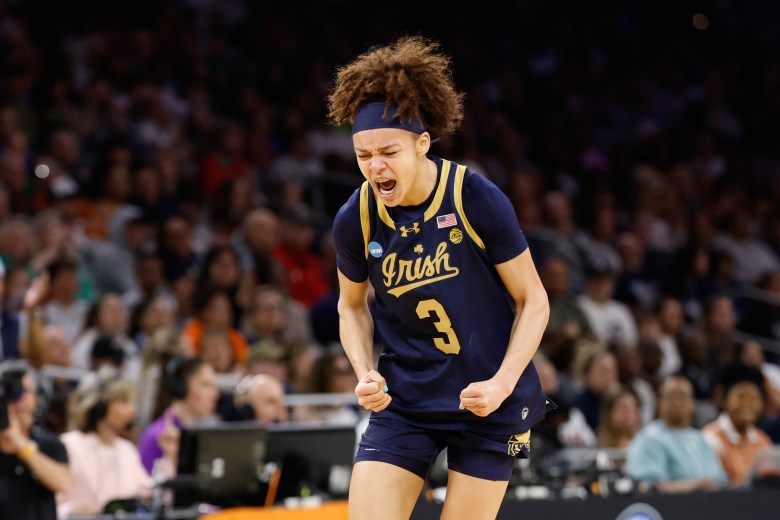
Across the floor, Hannah Hidalgo and her Notre Dame teammates didn’t bow their heads. No tears. No visible unraveling. Just a quiet acceptance from a group that had already defied expectations simply by arriving.
Most never expected the Fighting Irish to get here. Not after a January that nearly broke them. Not after a 3-6 stretch, an unranked slide and an 80-69 loss at California that seemed to confirm the doubts. Injuries disrupted rotations. Chemistry wavered.
But then, something shifted.
“I think it took us a while to really trust ourselves,” Hidalgo told a group of reporters. “I think we would say it. We believed we could do something big. But there were moments where we just didn’t trust ourselves and really believe that we could do something big. And [then] it came to a certain point where it just clicked.”
That shift came after Notre Dame’s loss to Virginia on Feb. 8, according to Irish guard KK Bransford.
“The things that we were preaching in the locker room started to show out on the court,” Bransford told the IX Basketball in the locker room postgame.
By February, Notre Dame trusted again. By March, it surged, winning seven of its final eight games entering the ACC Tournament. The Irish carried that belief into the NCAA Tournament, defeating Fairfield, upsetting Ohio State and then shocking Vanderbilt in the Sweet 16 to earn a rematch with one of the sport’s most dominant force, an undefeated UConn.
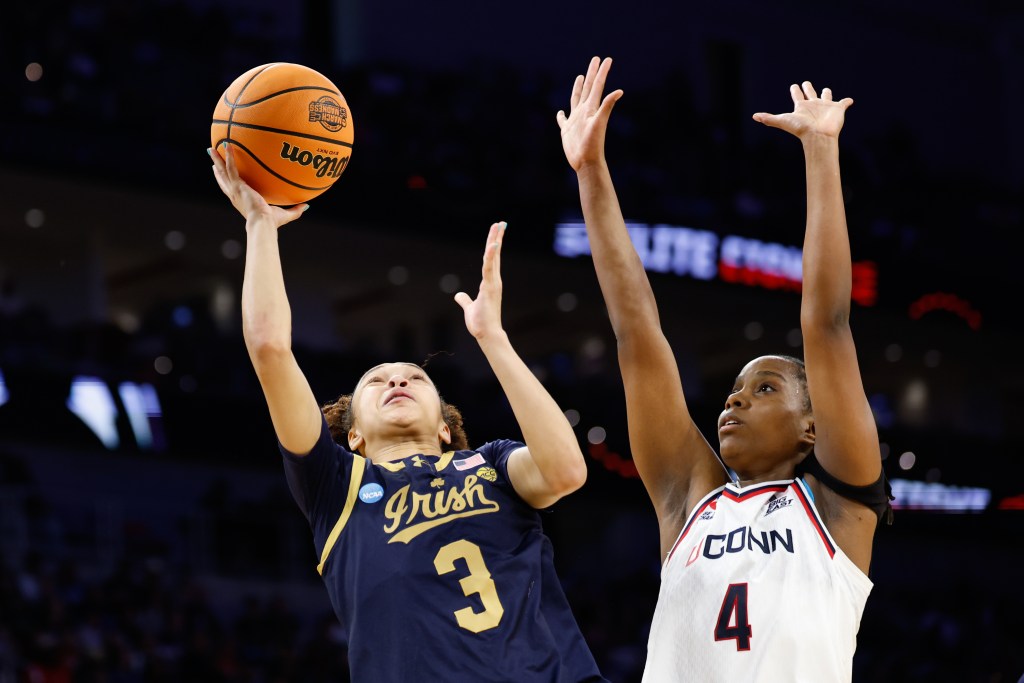
For a while Sunday, belief looked justified for the Irish. Notre Dame trailed by nine after the first quarter but refused to fade. It chipped away, slicing the deficit to four midway through the second. At halftime, the gap stood at seven. Even deep into the third quarter, the Irish lingered within reach, trailing by single digits and forcing UConn to work.
The Irish weren’t overwhelmed this time, not like the 85-47 shellacking in January. They were competing.
Then the dam broke.
Azzi Fudd and Sarah Strong, quiet for the most part in the first half, found rhythm when it mattered most. After combining for just 10 points before halftime, the duo erupted in the fourth quarter, scoring 17 of UConn’s 23 points.
But the difference had already begun to take shape earlier. Blanca Quiñonez, the Huskies’ freshman forward, emerged as the unexpected constant. She carried UConn through the first half and never cooled, finishing with 20 points and prevented Notre Dame from seizing control when opportunity lingered.
By the final minutes, UConn’s depth and composure overwhelmed the Irish, sealing a 70-52 victory and a trip to the Final Four.
Still, Notre Dame never unraveled.

Stay plugged in with women’s sports
Get smart, reliable coverage delivered straight to your inbox — with the context that makes every game matter.
For head coach Niele Ivey, who guided the program to its first Elite Eight appearance since 2019, the ending carried something deeper than disappointment. Inside the locker room, players sat near their cubicles, not in silence, but in gratitude.
“We wanted to contain Sarah [Strong] and Azzi [Fudd], make it a really tough night, but we had to make sure no one else was a factor and it was,” Ivey said postgame. “Blanca [Quiñonez] was a big factor, having 20 points. … She did a great job. Their [UConn] supporting did a great job, but she was the X factor for them. We, unfortunately, let her loose and she got going.
“… In the first half, containing Sarah and Azzi, they [UConn] still ended up with three [players] in double figures. I thought we were physical. I have always talked about us having toughness [but] it was a tough situation apparently in the second half.”
The season ended there — short of the Final Four, but far beyond where many believed it would.
Here are three takeaways from Notre Dame’s season-ending loss on Sunday.
Notre Dame couldn’t contain Blanca Quiñonez
Quiñonez didn’t arrive Sunday as an unknown, but she became the problem Notre Dame never solved. While much of the defensive focus centered on UConn’s stars, the freshman forward from Milagro, Ecuador, consistently found space and made the Irish pay for it.
Even Geno Auriemma anticipated her impact before tipoff.
Quiñonez entered the Elite Eight as one of UConn’s most reliable contributors, averaging 10.6 points per game while filling in the margins with rebounds, assists and steals. More than that, she anchored a deep and active bench unit, one capable of shifting games when needed.
Days earlier, Quiñonez delivered 16 points and four steals in a Sweet 16 win against North Carolina. Against Notre Dame, she elevated again, finishing one shy of her career high, and hitting four 3-pointers.
Notre Dame’s game plan centered on limiting Fudd and Strong. For stretches, it worked. But in the space created by that focus, Quiñonez thrived. She moved freely and found open looks.
By the time Fudd and Strong found their rhythm late, the damage had already been done.
“Blanca [Quiñonez] is something that didn’t happen the first time around,” Niele Ivey said postgame. “She had a great game. … They’re deep, and anybody can step up if others are not playing well. I mean, their two best players still ended with double figures. They are a very physical, very confident team.”
Mistakes mounted, but Notre Dame’s growth remained undeniable
For long stretches Sunday, offense came in fragments.
Both teams stumbled through scoring droughts, searching for rhythm. But as the game wore on, those empty trips weighed heavier on Notre Dame.
The third quarter revealed the shift. UConn tightened defensively, limited space and held Notre Dame to 11 points, mirroring another 11-point statline in the first quarter.
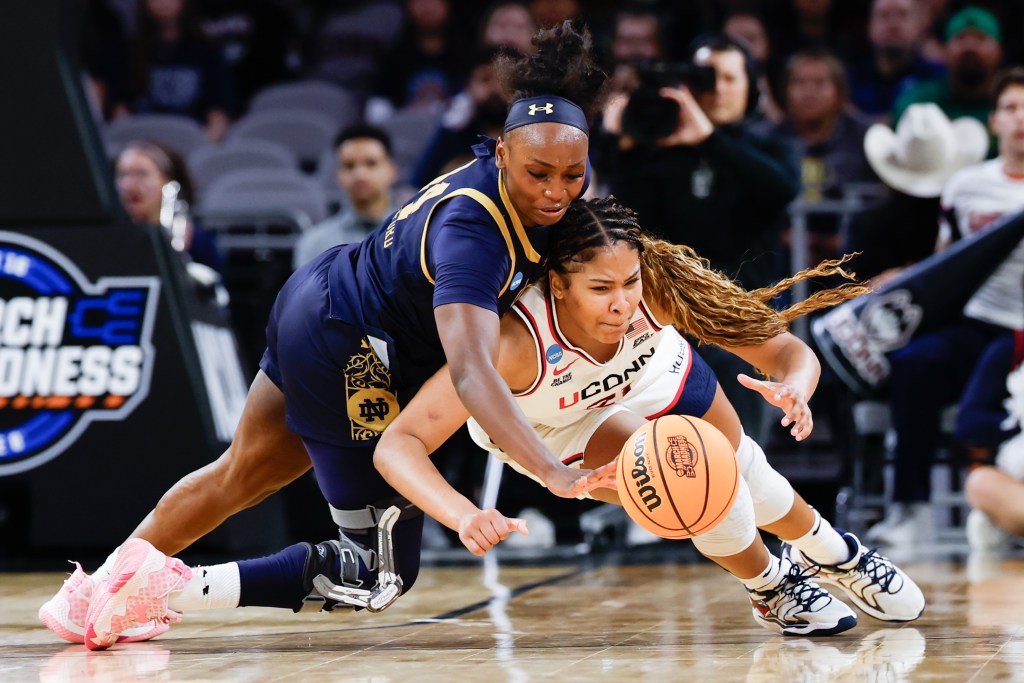
Mistakes compounded the problem. Notre Dame committed 18 turnovers, three more than in January’s meeting, leading directly to 19 UConn points. Against a team built to punish every lapse, the margin for error disappeared quickly.
Listen now to The IX Sports Podcast and Women’s Sports Daily
We are excited to announce the launch of TWO new podcasts for all the women’s sports fans out there looking for a daily dose of women’s sports news and analysis. Stream on Spotify, Apple Podcasts or anywhere you listen to podcasts, and make sure to subscribe!
“You can’t really make a whole lot of mistakes against them, because they capitalize on them,” Bransford told the IX Basketball inside the locker room after the game.
UConn won the glass, 35-29. Its bench dominated, outscoring Notre Dame 32-7. The Huskies controlled transition, finishing with a 14-0 edge in fast-break points, and disrupted passing lanes with 14 steals. Even in areas where Notre Dame typically excelled — entering ranked ninth nationally in steals — UConn dictated the terms.
Individually, the Irish searched for consistency. Iyana Moore, one of the team’s most reliable shooters, went 0-for-6 from beyond the arc and finished with seven points. Bransford, playing against UConn for the first time after missing 12 games with a right knee injury, added seven points. Cassandre Prosper, the ACC’s Most Improved Player, scored four before fouling out.
Vanessa de Jesus contributed eight points and five rebounds, but the engine remained Hidalgo. She recorded her 11th double-double of the season with 22 points, 11 rebounds, three assists and three steals, her 36th double-digit scoring performance. It followed a historic outing against Vanderbilt, where she posted 31 points, 11 rebounds, 10 steals and seven assists, joining Caitlin Clark as the only players to record a 30-point triple-double in NCAA Tournament history.
Still, Sunday wasn’t about what went wrong as much as what had been built.
This Notre Dame team began the season as a collection of unfamiliar pieces, one returning starter, five returning players and seven newcomers trying to find cohesion. Early on, it showed. By March, it transformed.
The loss ended Notre Dame’s tourney run, but it didn’t define it.
“People called me delusional for what I saw in this team and we’re here and we did it [deep into the NCAA Tournament],” Bransford told the IX Basketball.
Iyana Moore saw the same evolution.
“The belief that we had in our locker room and the belief that our coaches had was all that we needed to continue to just grow and be ourselves,” she told the IX Basketball. “We knew we had a new team. In the beginning [of season], it was kind of like playing pickup [basketball] with random people. But as you continue to play, continue to grow with each other, it gets more and more comfortable. We started clicking at the right time, which is what got us here [to Elite Eight].”

Hidalgo’s leadership became Notre Dame’s foundation and it’s future
Hidalgo delivered once again Sunday, filling the box score and setting the tone. That part no longer surprises. What changed — what defined Notre Dame’s season — unfolded beyond the numbers.
Moments after the loss, Hidalgo sat at the podium smiling, composed and reflective. The electricity that fuels her game remained, but so did something deeper.
The ACC Player of the Year and Defensive Player of the Year — the first player in league history to win both honors in consecutive seasons — evolved into more than a scorer or defensive disruptor. She became the connective force for a team searching for identity early in the season.
“I feel like in the beginning of the season, I didn’t instill as much trust in [teammates] as I should have, or as much confidence as I should have,” Hidalgo told the IX Basketball. “I think that was really the turning point where it’s like, I need every single one of my teammates in order to win. I need to get every single player involved.
That realization reshaped Notre Dame. The shift crystallized late in the regular season, when the Irish stunned Louisville and reignited their belief. Hidalgo pointed to that moment as part of the spark that carried Notre Dame through March.
“When everybody was counting us out, we trusted and believed,” Hidalgo told a group of reporters postgame in the locker room. “We knew that we had played Louisville before [on Jan. 15], and that we were going to go out and we were going to really shock the world. And we did that.
“From that moment, we really started to play together, and of course, when KK [Bransford] came back, just what she brings to the team is something that we really lacked when she was gone, and so having everybody back and healthy from injuries was really big. I think that really helped us in our confidence.”
By season’s end, Notre Dame no longer looked like a team piecing itself together. It moved with purpose, trust and shared responsibility.
Hidalgo’s leadership did not go unnoticed. Bransford watched Hidalgo grow from a talented freshman into the voice the team needed.
“I’ve had the privilege to know her since she was a freshman,” Bransford told the IX Basketball. “How she’s grown throughout all three of these years has been amazing. She’s a very fiery leader, but she really found that balance. I think she really got to know everybody on a personal level so she could have that fiery kind of leadership. I told her time and time again, like we need you to have that voice. We need you to have that intensity, and it rubbed off on everyone.”
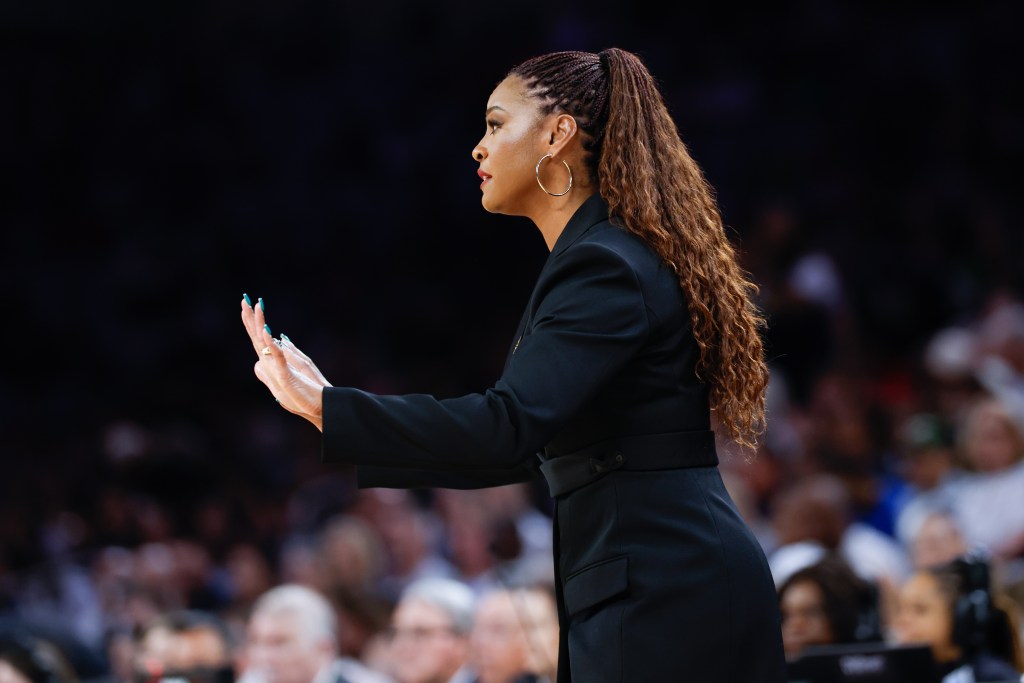
Head coach Niele Ivey sees the next step already forming.
“I think she’s [Hidalgo] still going to continue to grow with her leadership,” Ivey said postgame. “I think that was the biggest separator for her maturity. I think you’re going to see her being even more poised, more composed.
“We’re going to work on that this summer as far as continuing to build that trust with a brand new team. But she knows what to do now. She’s had a year under her belt of being that vocal leader for us.”
Notre Dame’s season ended short of its ultimate goal.
But with Hidalgo at its center — no longer just a playmaker, but a leader forged through adversity — the Irish leave with something just as valuable, a foundation that suggests this run may not be the peak, but the beginning.