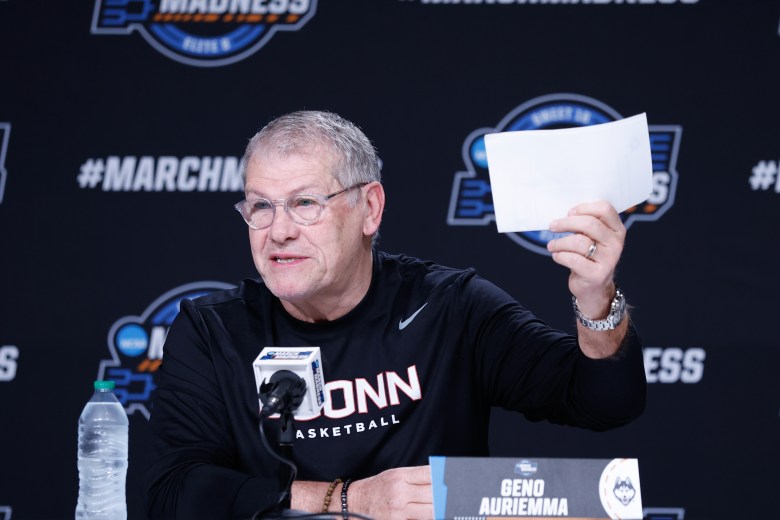
FORT WORTH, Texas — The morning after UConn advanced to the Elite Eight was an early one for the Huskies. Coach Geno Auriemma was scheduled to meet with the media at 9:30 a.m. CT. The previous morning, they started practice around 6 a.m.
He started his availability by rattling off shooting statistics from the four Sweet 16 games from the day before, when teams averaged a combined 24% from beyond the arc. And yes, that includes his Huskies, who defeated North Carolina 63-42, despite shooting 4-for-20 from long distance.
“How many arenas are we going to sell out with that bullshit?” the 12-time national champion asked from the dais.
The IX Daily: Six different women’s sports in your inbox every week!
Subscribe now and join us, just $6 a month or $60 a year. It’s the women’s sports media network we all wished for, and now it’s here! Soccer Monday, Tennis Tuesday, Basketball Wednesday, Golf Thursday, Hockey Friday – powered by The Ice Garden — and Gymnastics Saturday.
That’s when he began to detail his team’s schedule, including timestamps from when he passed other coaches in the hallway on the way to or from practice. Despite speaking this morning and holding a half-hour of open locker room access, his Huskies aren’t scheduled to practice until 6:30 p.m.
UConn’s next opponent, Notre Dame, talked with the media at 8:30 a.m. and practices at 4:30 p.m. after the day’s two Sweet 16 matchups conclude.
This is definitely not a new topic for Auriemma, who discussed some of his concerns on Thursday before regional play even started.
“There are still things that I think, as we experience these growing pains, are going to have to be kind of re-evaluated and go back to what makes the most sense to get our players, everybody’s players, feeling like it’s about them still,” Auriemma told reporters ahead of UConn’s Sweet 16 game.
Back in 2025, he told reporters that “whoever came up with this super regional stuff, and I know who they are, ruined the game.”
While postseason schedules are a natural departure from a team’s established routine, Auriemma narrowed his concerns to two main points: the decision to condense to two rather than four regional locations and the lack of coaches’ influence.
“I think the first question you’d have to ask is why did they go from four to two,” Auriemma asked from the dais. “What was the rationale? If they can explain it legitimately and then prove that it works, then great. So what was the reason?”
Listen now to The IX Sports Podcast & Women’s Sports Daily
We are excited to announce the launch of TWO new podcasts for all the women’s sports fans out there looking for a daily dose of women’s sports news and analysis.
Stream on Spotify, Apple Podcasts, or anywhere you listen to your podcasts and make sure to subscribe!
The NCAA debuted its new format in 2023 with a goal to increase attendance with games held on alternating days. ESPN reported on March 17 that the NCAA has committed to this format for the next five years.
“Total attendance yesterday at both places, 18,000,” Auriemma said. “If we have four regions and you got a minimum 5,000 people… I think that comes out to 20,000. So what are we doing here?”
The NCAA did tell ESPN that attendance has increased since the change, with 84,754 showing up for the regional rounds in 2025. They also reported a previous high of 73,954 as the highest under the four-site model.
Combining the regional sites also means that eight teams, rather than four, are battling for space and court time as they prepare for the biggest games of the year.
“I would just say it’s not ideal,” UConn fifth-year guard Azzi Fudd said. “Like the schedule waking up early to do media and then can’t come back to this arena until later, just little things like that… We’re making it work, but it definitely isn’t the most ideal setup.”
Your business can reach women’s sports fans who share your passion!
Here at The IX Sports, our audience is a collection of the smartest, most passionate women’s sports fans in the world. If your business has a mission to serve these fans, you should reach out to our team at BAlarie@theixsports.com to discuss ways to work together in 2026.
As for the issue of coach input, Auriemma did acknowledge that the NCAA sends representatives to schools at the end of the tournament each season, but he’s not convinced that they’re really being heard.
“This is not about us, because you know, we’ve managed to go to the Final Four and win national championships no matter where they’re played, when they’re played, what time they’re played, whatever,” Auriemma said to end his press conference.
“I think there is a level of frustration right now among the coaches that’s higher than any time I’ve ever seen it.”
While other coaches have not been as vocal this weekend, UConn’s athletic director David Benedict did repost a video of Auriemma’s press conference and appeared to echo some of his sentiments saying: “But it’s about the student athletes! @NCAA continues to make decisions that clearly don’t represent what’s best for the student athletes!”
UCLA coach Cori Close did field a question about the two-regional format on Saturday morning, admitting that she was initially in favor of the change, but thought reevaluation might be appropriate.
“I think we always have to look at that tug and pull of getting great coverage and then what sets up the game to be successful from a really high level of basketball being played,” Close told reporters from the other regional location in Sacramento, Calif.
“But I think it’s really hard to evaluate in the moment. But I do think it deserves to have some significant stakeholders after it’s over go, hey, can we have some input on how it’s affecting us? And let’s have some collaboration about how we can continue to move our game forward.”
One tweak the NCAA did make this year was adding an additional day of rest for the region’s top seed (or their opponent), who now play their Elite Eight games on Sunday rather than Monday night.
“Becoming Caitlin Clark” is available now!
Howard Megdal’s newest book is here! “Becoming Caitlin Clark: The Unknown Origin Story of a Modern Basketball Superstar” captures both the historic nature of Clark’s rise and the critical context over the previous century that helped make it possible.