

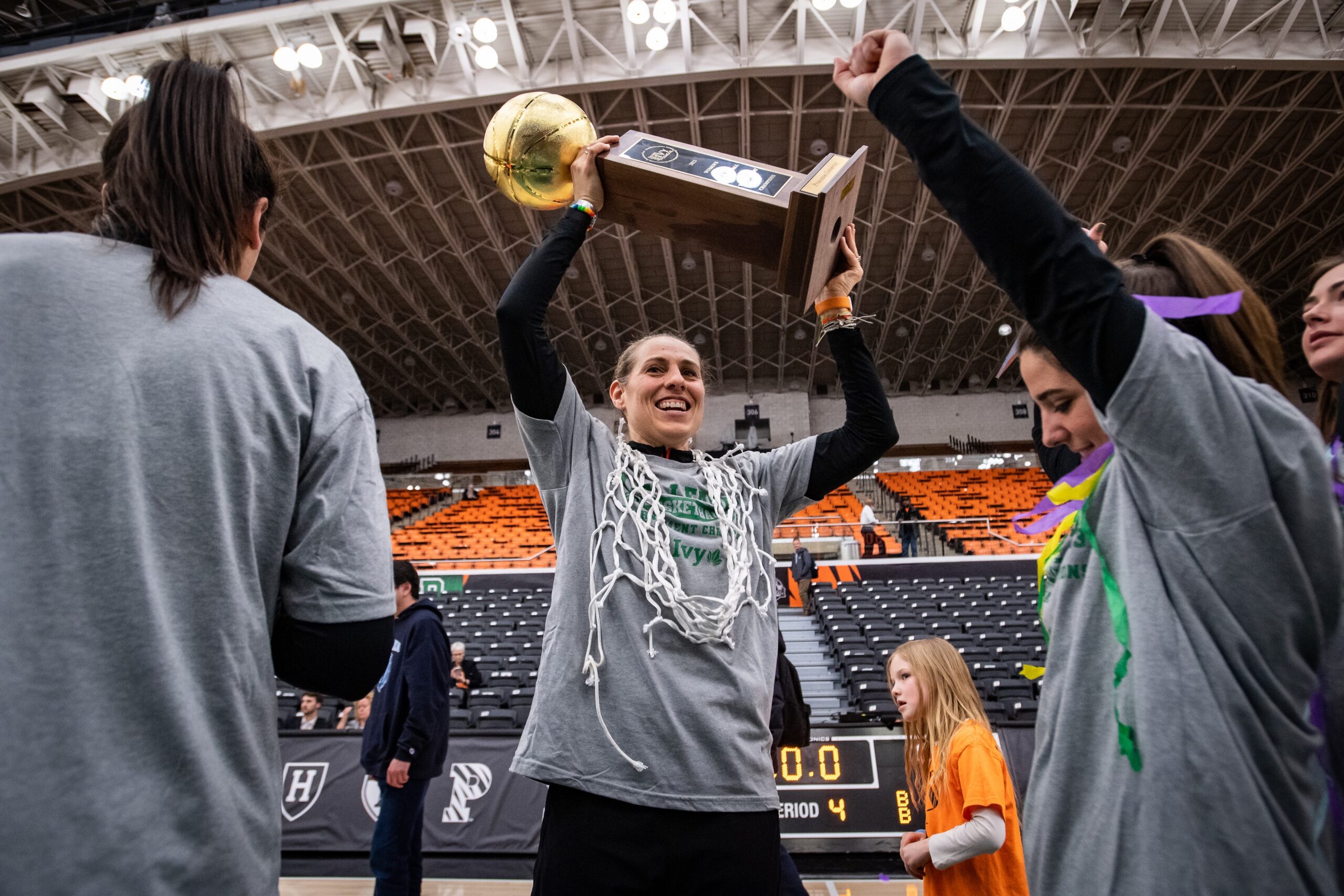
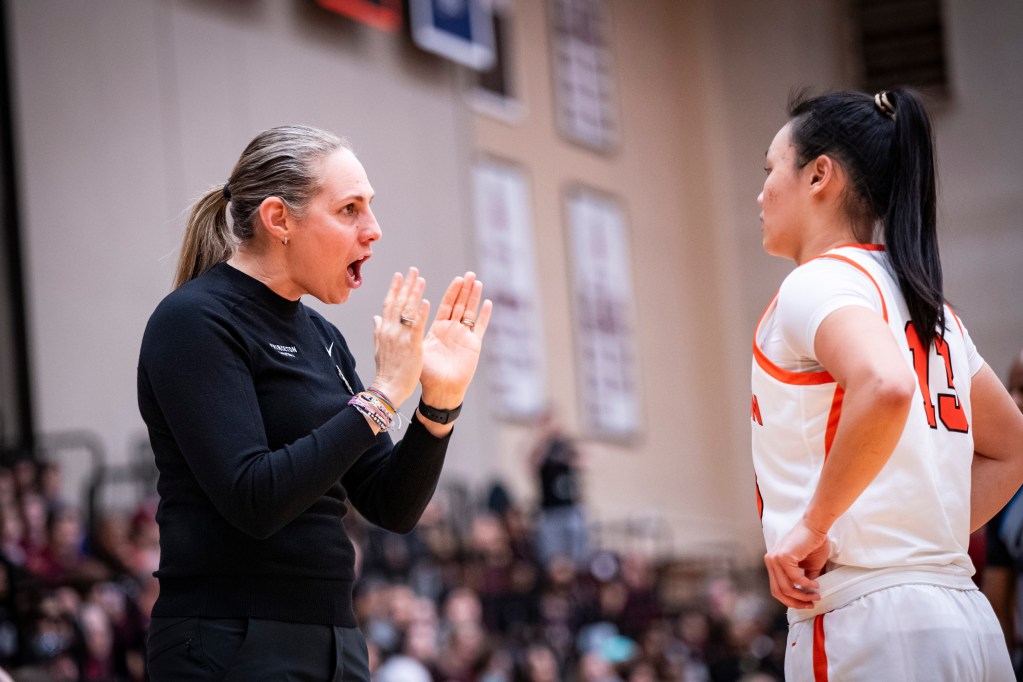
Carla Berube has “no clue” how the superstition started. But now it’s the stuff of legend for Princeton women’s basketball.
The day before each game, Berube starts practice by making a halfcourt shot, which she launches like she’s throwing a football. Her assistant coaches rebound her misses and encourage her as the players warm up on the other half of the court. And once Berube makes it, all the coaches run down the court and lob alley-oops off the backboard to each other, finishing with an alley-oop layup.
“There’s some [days] where she’s nailed it on the first try this year — first, second or third,” assistant coach Jordan Edwards told The IX Basketball. “… Those are those days where you feel really good.”
Berube estimates that the tradition started in 2010 or 2011, about halfway through her tenure at Division III Tufts. About 15 years later, it’s entrenched alongside her many other superstitions, from ordering the same pregame coffee to changing players’ hotel roommates after a road loss.
“Even as a high school player, I had superstitions or routines,” Berube told The IX Basketball. “So it’s just been a part of me. It makes me feel just relaxed, that I’m doing the right things.”
Superstitions are also often about good luck, and the irony is that Berube is one of the least likely coaches at any level of basketball to need luck on her side. After winning a national championship as a player at UConn in 1995, she spent two seasons as an assistant coach at Providence before getting the Tufts job in 2002. She stayed until 2019, going 384-96 (0.800) and making two DIII national championship games and nine Sweet 16 appearances.
Then she took over a Princeton program that had become an Ivy League power under Courtney Banghart — and hasn’t missed a beat. In her six seasons, Berube has gone 140-27 (0.838) overall, including the postseason, and has never lost more than eight games in a season. Her record in Ivy League games is equally absurd: 78-7, with four regular-season titles in five tries and three Ivy Madness titles in four tries. (Because of the COVID-19 pandemic, the Ivy League did not have a season in 2020-21 or conference tournaments in 2020 or 2021.)
Berube already ranks in the top 10 in Ivy League women’s basketball history for overall and conference wins, and her winning percentages are the best of anyone who’s coached at least four seasons. She is also the only Ivy women’s basketball coach to win multiple NCAA Tournament games, pulling off first-round upsets in 2022 and 2023.
Some coaches go their entire careers looking for consistency. Berube has bottled it everywhere she’s been.
Catching the coaching ‘bug’ — on the West Coast
Berube’s coaching career didn’t start with a plan. In fact, it started with a complete lack of one.
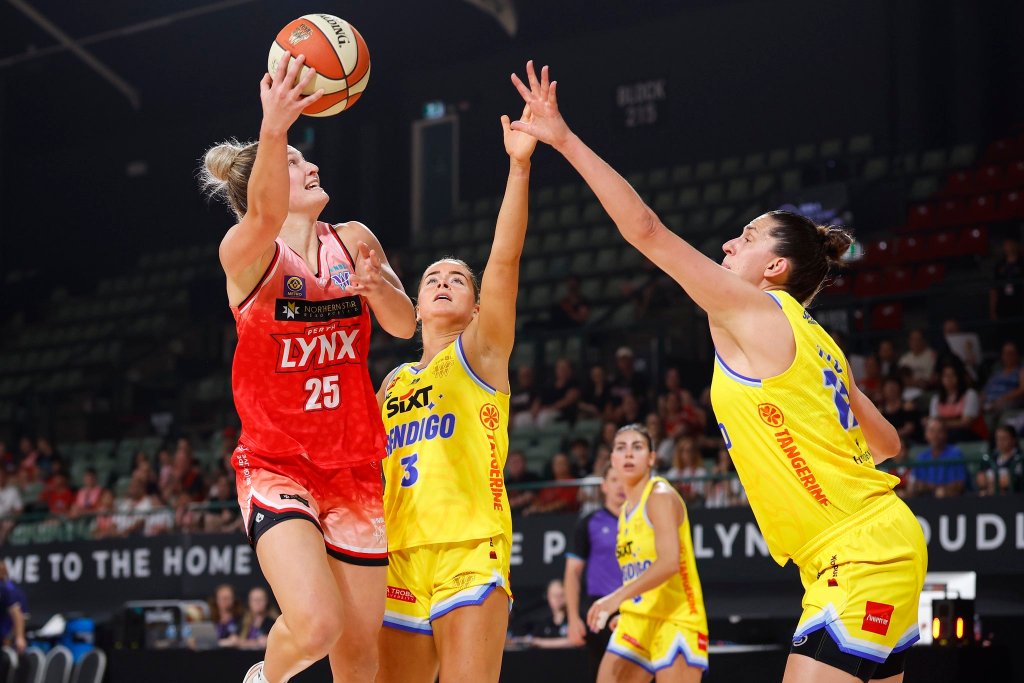
After graduating from UConn in 1997, she played professionally for the New England Blizzard in the American Basketball League until it folded in December 1998. The Blizzard were based in Hartford, so she was still living in Connecticut, and two friends of hers from UConn were considering moving to California.
“I’m not doing anything,” she told them. “I’d love to go, too.”
So the trio moved west to San Luis Obispo — a long way from Connecticut and from Berube’s home state of Massachusetts. She worked odd jobs for a while, “trying to figure out what I was going to do with my life,” she said.
Then she got an idea. She was living very close to Cal Poly, so she asked women’s basketball coach Faith Mimnaugh if she needed any help. Mimnaugh said yes, and Berube became a volunteer assistant.
“It was the offseason,” Berube said, “so I did some postseason workouts. I … [worked] on coming up with, actually, a strength training sort of program for the team, which I had no experience in. …
“And so I caught the bug. I loved working with the players and just being on the court with them and being in the weight room with them, and knew that’s what I wanted to try to do for a living.”
Berube applied for assistant coaching positions on the West Coast but didn’t land any of them. So she asked her former coaches at UConn if they knew of any openings back east, and they connected her with Providence head coach Jim Jabir.
“I was stupid lucky,” Jabir told The IX Basketball about landing Berube. “I mean, [UConn head coach] Geno [Auriemma] recommended her, and I really needed somebody. And I thought [her] coming from UConn would give us some gravitas … because we needed all the gravitas we could get.”
The job wasn’t glamorous. Providence had few resources, to the point that Jabir recalled using a former janitor’s closet as a locker room. It lost to UConn three times while Berube was there by an average of 48 points per game. But Berube learned what it took to be a college coach, developed her tactical knowledge and started to form her own coaching philosophy.
After Berube’s first season at Providence in 2000-01, Division III Connecticut College contacted her about its open head coaching position. Berube ultimately decided that she wanted more experience as an assistant coach first. But that planted the seed in her mind that Division III, and specifically the high-academic New England Small College Athletic Conference (NESCAC), would be a great fit for her.
“To go from … being a player to a coach is difficult,” Jabir said. “And you could hear her voice and the authority in her voice grow the second year, and she sounded more sure of herself when she spoke. She seemed more confident.”
When the Tufts job opened up after Berube’s second season at Providence, she felt more prepared.
“Was I ready? No,” she said. “But I definitely faked it for a bit.”
“I think she was more than ready,” Jabir said, “and she proved that she was more than ready. … I mean, she went Division III and built a juggernaut.”
When she got to Tufts, Berube suddenly had to implement her own systems and lead a program, all at just 26 years old. She did it well, going 35-13 in her first two seasons, but she admits now that her life then was “eat, breathe, sleep, basketball.” It took until she and her wife, Meghan, had their son Parker in October 2013 for her to find a balance.
Coincidentally or not, the 2013-14 season ended with the Jumbos making their first of four straight Final Four appearances.
From Tufts to Princeton
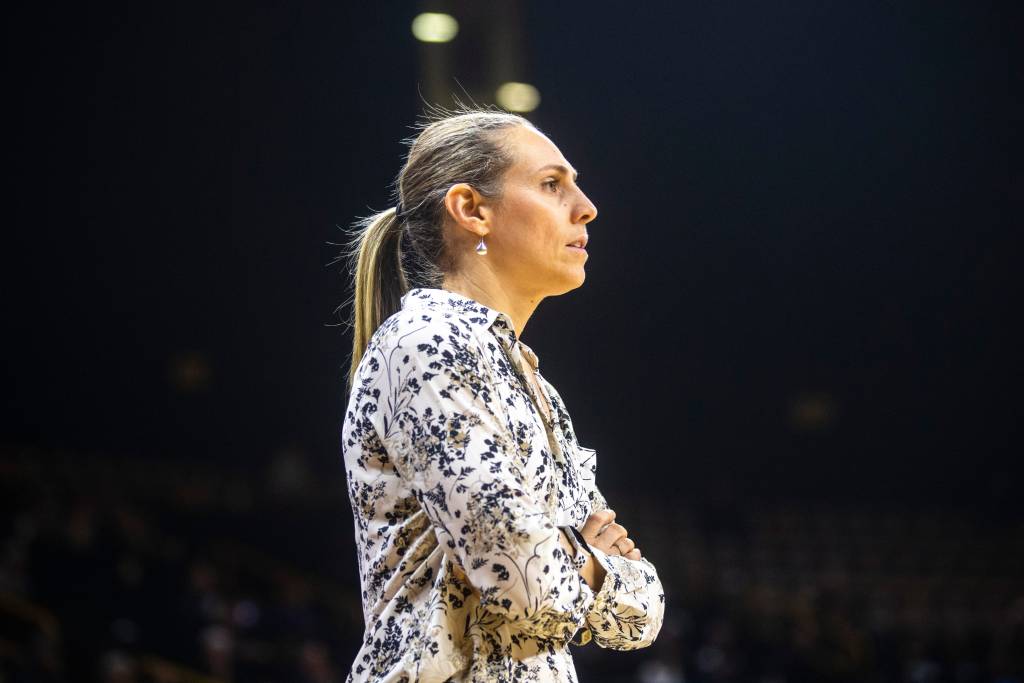
In 2018-19, Tufts made the Elite Eight, and Berube was optimistic that her team could be even better in 2019-20. But then Banghart left Princeton for North Carolina.
Berube had long figured that if she ever left Tufts, it would be for the Ivy League. The Brown job had opened after the 2013-14 season, but the timing hadn’t felt right. This time, it did, even with her third child on the way. (Her daughter, Brogan, was born in October 2016.)
Berube arrived at Princeton on the heels of the program’s fourth NCAA Tournament appearance in five seasons. The Tigers had been a No. 11 seed and lost to No. 6 seed Kentucky by just 5 points, and they were returning five of their top seven scorers for 2019-20.
“When [Banghart] left, I was worried about who would come and follow and kind of fill those footsteps, because we had such a special group, and we had such high expectations for what we could do,” three-time Ivy League Player of the Year Bella Alarie told The IX Basketball. Alarie was a rising senior when Berube was hired (and, full disclosure, is now the senior vice president of sales/marketing at The IX Basketball).
Rising sophomore Abby Meyers, who’d taken the 2018-19 year off from Princeton, and incoming first-year Ellie Mitchell also wondered where they’d stand with a new coaching staff.
“I was like, ‘Well, who’s gonna be this new person?’” Meyers told The IX Basketball. “‘I have to prove myself all over again.’ …
“So I was, I would say, scared and a little unsure of how that transition with a new coach would be. But I was confident that the athletic department was going to choose a winning mindset coach, a competitive coach, a coach that’s all about family first.”
Berube and Meghan welcomed their son Caden just days after Berube accepted the job. From the hospital, she started calling her Princeton players a few days later.
Alarie said she had a good rapport with Berube from their first phone call, which put her at ease. But for other players, it took time to get to know Berube and see her personality come through. When Berube cracked jokes in practice early that first season, it caught players off guard because they’d only seen her serious side.
“We all would look at each other like, ‘Wait, is she messing around right now?’” Carlie Littlefield, a junior on the 2019-20 team, told The IX Basketball.
But the team bought into Berube’s leadership right away, wanting to make the 2019-20 season the best it could be and sensing that she was the real deal.
“Her defensive plan, her offensive plan, the way that she led a team, it was just incredible,” Julia Cunningham, a sophomore at the time, told The IX Basketball. “So it was hard not to kind of buy into her mindset.”
The players immediately noticed that Berube focused more on defense than Banghart had. At one point, Banghart’s Princeton teams had ranked in the top 20 nationally in points scored per 100 possessions for seven straight seasons. Berube’s Jumbos, meanwhile, had ranked 13th and 10th in her last two seasons in points allowed per 100 possessions.
The Tigers ended up holding opponents to just 47.9 points per game in 2019-20, the best mark in the country. That propelled them to a 26-1 record — losing only at Iowa in overtime — before the COVID-19 pandemic canceled the postseason.
Berube could easily have lost that momentum in 2020-21, when the Ivy League didn’t play amid the pandemic and some players took the year off from school to preserve their eligibility. Instead, she kept the team together from afar by assigning books to read, having a holiday party and watching film on Zoom, and giving players and staff members a rotating buddy to check in with each week.
When play finally resumed in November 2021, the Tigers’ culture was intact, and they kept rolling. They even notched their first top-25 win since 1978 at Florida Gulf Coast University (FGCU) on Dec. 1.
From her first season through the pandemic, Berube showed how committed she was to building relationships that were independent of basketball. That hasn’t changed, and people close to her say it’s a big reason why her teams excel.
‘One big family trying to get to the mountaintop’
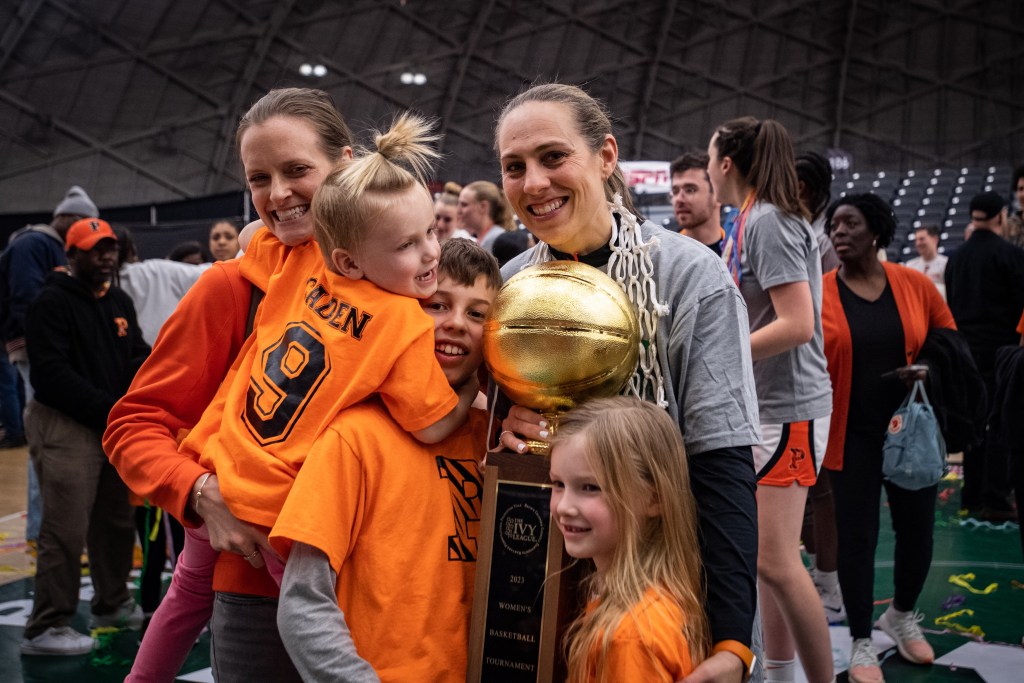
During Berube’s first season, Meyers remembers Berube hosting barbecues at her house with her family and, once, hiring an ice cream truck. “It was a little surprise that she had for us,” Meyers said.
Berube’s wife and children are often around the program, including joining the team on its foreign tour in 2023. Berube encourages her players to build airtight bonds, too, which shows on the court.
“We like to spend time together, and the closer you get with your team, the more natural it becomes, right?” Mitchell told The IX Basketball. “If it feels like you’re playing with a stranger, it’s like, ‘Oh, they got beat. That sucks for them.’ But these are some of your closest friends, your family. You want them to be successful.”
When recruits visit campus, they can often sense that culture, and they can see how much Berube cares about Princeton.
“You sit across that table and you’re like, ‘Wow, I want to come to Princeton. I want to come to Tufts. I want to play for this person,’” Princeton assistant coach Lauren Dillon, who also played for and coached alongside Berube at Tufts, told The IX Basketball. “And I think it’s the way that she talks about her teams, the way she talks about the school and how much pride she has for it. And it’s very authentic. You know she’s not blowing smoke.”
Once players join the team, Berube is good at gauging what each one needs and how to motivate them. For example, sometimes she’d tell Cunningham, “You’re not being competitive,” because that would fire up Cunningham to prove her wrong.
When Littlefield went through a scoring slump as a junior, Berube took a different tactic: She brought Dillon into a meeting with Littlefield. Dillon and Littlefield both felt pressure to excel as upperclassmen, so Dillon could explain how she’d handled it under the same coach.
“I think that I broke out of the slump immediately after that talk,” Littlefield said, “and then it kind of became a weekly check-in, a little point guard meeting between the three of us. … So that was a really cool way to build relationships with the both of them.”
That’s just one example of how communication undergirds everything Berube does. In fact, communication tops her list of “Tiger principles.” So her meetings with players are often as much about building relationships with them as they are about making them better basketball players.
Because of that approach, players trust her and want to play hard for her. And after they graduate, Berube is still there as “a friend for life,” Alarie said. She even attended Littlefield’s wedding last fall.
Berube builds strong relationships on her staff, too, which rarely turns over and includes two former players in Dillon and director of basketball operations Lilly Paro. Dillon and associate head coach Lauren Gosselin followed Berube from Tufts and have worked for her for eight years, and Berube calls them two of her best friends.
One reason Gosselin, Dillon and Paro have stayed so long is how Berube empowers and collaborates with her staff. Gosselin said she has “a lot of head coach responsibilities,” which helps her feel challenged in and excited about her job.
“She trusts everybody that she works with and lets them roll with things,” Paro told The IX Basketball. “… She’s not our micromanager whatsoever.”
“I am not that coach that you hear 100% of the time in a practice,” Berube said. “It is really divided among all of us.”
Edwards, who is in her second season at Princeton, quickly noticed how Berube wants her staff to help create the daily practice plan, not just follow whatever she writes down. And if Edwards is quiet as the youngest coach on staff, Berube asks for her opinion, wanting to hear everyone’s ideas.
Berube’s emphasis on relationships extends beyond the players and staff, too. Paro, who played for Berube at Tufts, said her parents still talk about Berube and their relationship with her. And Berube welcomes back alumni who predated her, including current Seattle Storm head coach and 1996 Tufts graduate Sonia Raman. Raman reached out when Berube got the Tufts job, and now they’re extremely close friends.
“You really feel like she values those players that came before all the players that she’s coached in general, and that everybody’s kind of pulling towards the same thing,” Raman told The IX Basketball. “And it’s one big family trying to get to the mountaintop year after year. … There’s a huge group of the players that played for Carla at Tufts that are … rooting on the Princeton Tigers just as hard as they did rooting on Tufts.”
The standard
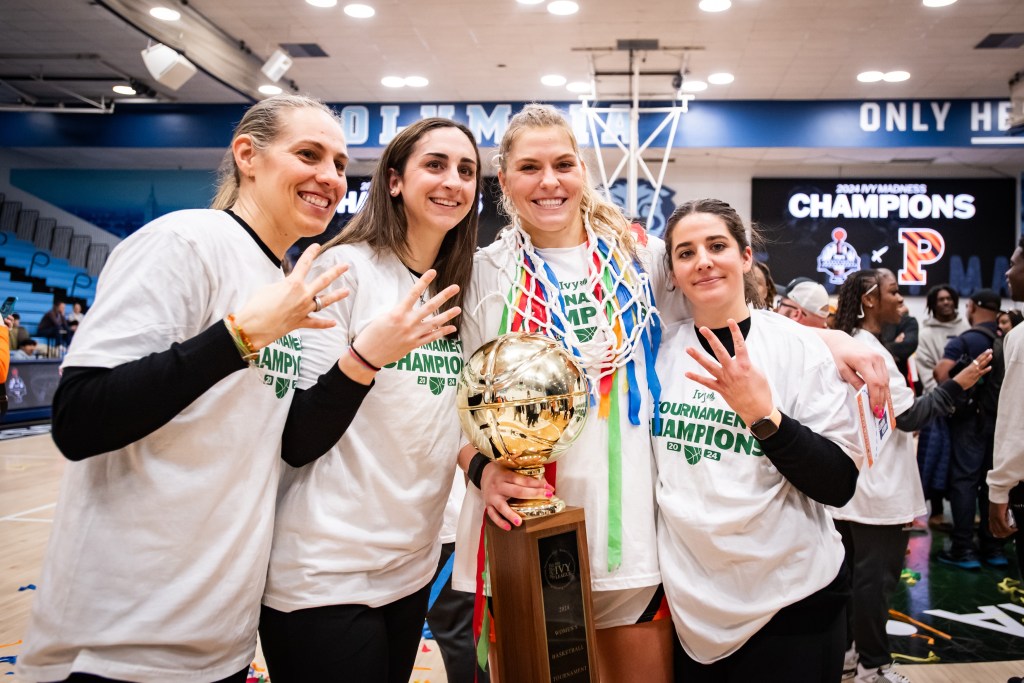
Every year at Tufts and Princeton, Berube holds her players to certain standards regardless of how talented they are. Those standards are all things they can control: having a positive attitude, communicating, bringing energy, being a good teammate, working hard, being focused and being willing to take feedback.
She also insists that everyone approach each game the same way, whether it’s nonconference play or the Ivy League Tournament.
“No matter who we play, we play like it’s our last game of the season, and we pull out the game no matter what,” Princeton junior guard Ashley Chea told The IX Basketball.
Many coaches stress that, but Berube makes it happen by preparing her team for every game the same way. Her practices are very consistent day to day and haven’t changed much from Tufts, with familiar drills and a heavy focus on defense.
“I think if you expect your team to be consistent in games, you have to be consistent in practice,” Berube told reporters at the 2024 Ivy League Tournament. “So I think I expect them to be working at a high level every single day. … They just know when it comes to game time, you need to be locked in, you need to be ready, we need to be prepared. And … my staff and I try to prepare them as much as we can.”
Your business can reach over 3 million women’s sports fans every single month!
Here at The IX Basketball and The IX Sports, our audience is a collection of the smartest, most passionate women’s sports fans in the world. If your business has a mission to serve these fans, reach out to our team at BAlarie@theixsports.com to discuss ways to work together.
Berube continually emphasizes details like where players’ hands are on defense, whether they huddle with their teammates during stoppages and how much they’re communicating. She once subbed out Alarie for not running down the court to rebound Cunningham’s missed fast-break layup in a blowout win. She gets frustrated if players repeat mistakes in practice. (“Steam starts coming out of her ears,” Cunningham said, and sprints often follow.) And when Princeton took team photos this fall, Berube had her players tuck in their jerseys — a move straight from the playbook of UConn associate head coach Chris Dailey.
Princeton “values the same things that we value and coaches and teaches the same things that that we teach,” Auriemma told reporters at the 2025 Final Four. “Maybe in a different way, but still, it’s the same.”
“The way that [Berube] values the little things and the details kind of translates to how we are forced to then value all the little things,” junior guard Skye Belker told The IX Basketball.
Because of those details, it’s easy for Berube to pinpoint where her team needs to get better. And because of the relationships she’s built, her players understand that her relentless drive to improve is part of her investment in them, not just someone constantly harping on their shortcomings.
“We’re almost conditioned that, ‘Oh, it’s not good enough yet. It’s not good enough yet,’” Dillon said. “And I think that comes from her. … She’s seen what it takes to go all the way. And I think she believes that any Princeton team can do that, can go really far … no matter who’s on our roster. So I think just the standards and never feeling satisfied in what we’ve accomplished is something that she really just breeds in this team [and] this culture.”
‘I want defense first’
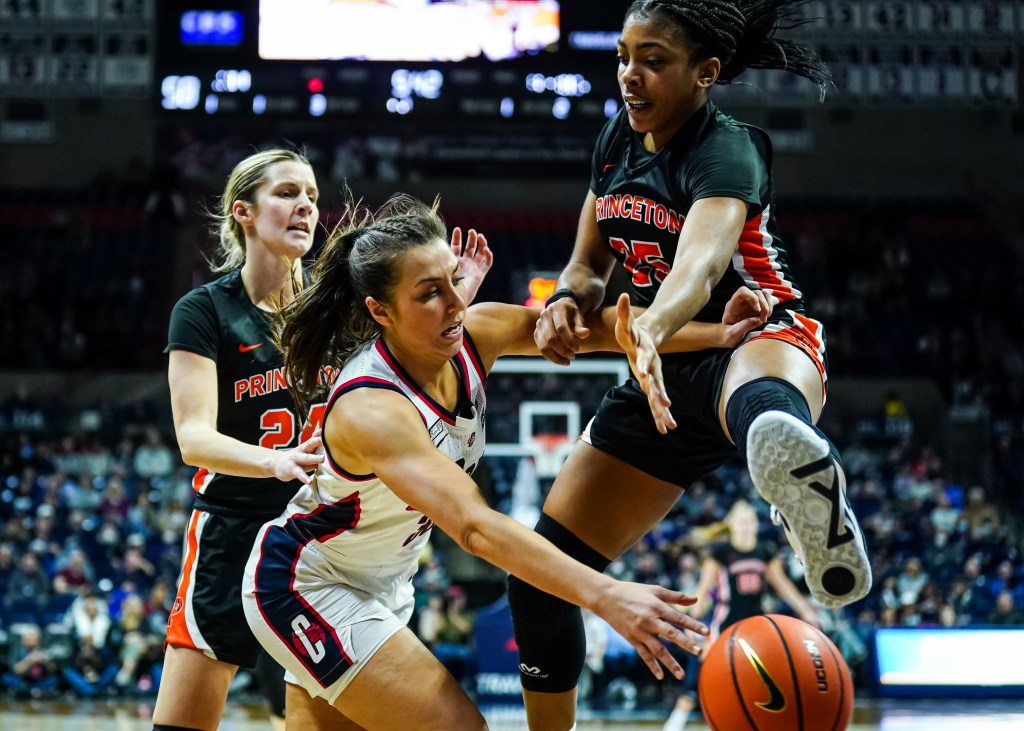
When Berube got to Princeton, she knew exactly how she wanted her team to defend. She was willing to adapt offensively to her players’ strengths, but their defensive approach was non-negotiable and would set the tone for the program. The schemes aren’t that different from some other programs, but the importance Princeton places on defense is.
Berube’s emphasis on defense comes partly from her UConn days and partly from the constraints of the Division III schedule. At Tufts, she only got two weeks of preseason, and she decided it’d be easier to make her teams good defensively than offensively in such a short period of time.
At Princeton, Berube taught her defense by breaking it down into manageable pieces. There was lots of shell drill, which teaches on- and off-ball positioning, and close-out drills. Paro describes Berube’s approach as, “We’re going until we get it right, and then once you get that right, we’re building habits.”
“We would play 45 minutes of shell a day,” Cunningham said. “Just four-on-four, just work on your defense. And that’s like everybody’s worst nightmare as a college basketball player.”
Even now, Gosselin told The IX Basketball, “We never get to everything that’s on the practice plan, and usually that’s because we spend too much time on defense.”
Younger players typically improve defensively from getting reps in practice, watching the upperclassmen do it and studying film. This year, Berube has held weekly meetings with first-years Sarah Lessig and Grace O’Sullivan to help them learn the defense. Many weeks they watch film, sometimes they get more on-court reps, and other times it’s less about defense at all and more of a personal check-in.
One of the biggest adjustments for many first-years is how Berube teaches team defense. In high school, defense often centers on guarding your individual matchup. At Princeton, that only gets you a fraction of the way to playing time.
“You’re responsible for helping everyone else guard their people as well, and so … if someone else gets scored on, it’s almost just as much your fault as it is theirs,” Mitchell said. “So I think just getting used to learning how to anticipate, how to move, how to make sure that you’re in the right position to not only cover yours but [also] be helpful, that takes a lot of work and a lot of repetition.”
It can also take time for players to learn to communicate as much as Berube wants. It may not feel natural directing older teammates, but it’s necessary for the defense to be as synchronized as Berube demands.
“In high school, communication wasn’t really that big of a thing, but in college, communication is huge,” senior guard Madison St. Rose, who helped make a game-winning defensive stop as a first-year against North Carolina State in the NCAA Tournament, told The IX Basketball. “… I don’t remember my freshman year games that much, but I obviously remember March Madness. And I just remember how connected I felt with all the seniors and juniors because … they were constantly talking to me.”
Though the drills can feel repetitive, Princeton players generally end up loving defense. One reason why is because Berube often makes it competitive. A drill might be won based on defensive stops, not points scored.
“When you play a scrimmage and it’s like, ‘OK, who wants to be on offense first?’ the Princeton player is gonna be like, ‘I want defense first’ because they ingrain that defense-first mentality,” Meyers said.
Handling the pressure
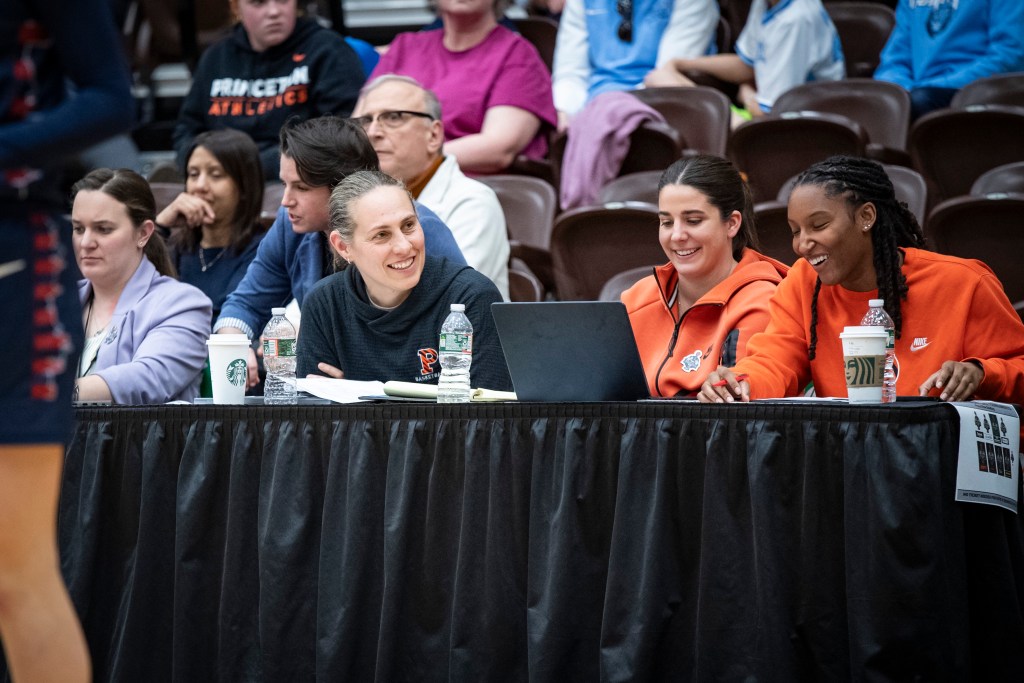
Every year that Berube adds another Ivy League title or NCAA Tournament appearance to her resume, external expectations grow for her to keep doing it. But the pressure that disrupts her sleep every preseason is internal, not external. It comes from her own expectations and her drive to make sure the team maximizes its potential. She knows it’s on her if the Tigers underachieve or have regrets.
“My fear is always that we’re not going to play to the level that we’re capable of playing,” she said. “So I’m always thinking about, ‘What can we do better as a team? And each individual player, what can I help them … with to make sure that they are playing to their potential?’”
Yet Berube has learned to put that pressure in perspective. Though she jokes that she has “27 too many” losses at Princeton, wins will never be as important to her as making sure her players enjoy their college careers. So she also does her best to keep them from feeling any external pressure.
Just like how Berube teaches defense by starting small, she builds her teams up to achieve big things by forcing them to focus on smaller things — things that feel less daunting than winning a championship. For example, before a game, she might write on the whiteboard that the goal is to get 15 offensive rebounds or hold the opponent under 50 points.
And Berube doesn’t treat losses like the end of the world, even if they reverberate around the league or in national top-25 voting. She’s quick to rewatch games and find lessons in the film, but she doesn’t dwell on losses like she might’ve earlier in her career.
“Every coach, you’re gonna watch the film and you’re gonna say, ‘Could have done this, I should have done this’ … and all those things,” Berube said after losing by 5 points at UConn in December 2022. “But also, I try to look at it like, ‘Wow, I’m really, really proud of my players, my team. This is a game that we’ll learn from.’ … The should’ve, could’ve, would’ve, I think that’s the old Carla.”
Listen now to The IX Sports Podcast and Women’s Sports Daily
We are excited to announce the launch of TWO new podcasts for all the women’s sports fans out there looking for a daily dose of women’s sports news and analysis. Stream on Spotify, Apple Podcasts or anywhere you listen to podcasts, and make sure to subscribe!
When the Tigers lost consecutive games to open Ivy League play in 2022-23, Cunningham said she was “self-imploding.” But Berube wasn’t. She knew the Tigers’ Ivy-record 42-game conference winning streak had to end sometime, and she just wanted to start a new one.
“She wasn’t like, ‘Oh, there goes the season,’” Paro said. “She’s like, ‘All right, nope. This team deserves more. These seniors deserve more. So we’re going to figure it out right now.’”
After that, Princeton didn’t lose again until the second round of the NCAA Tournament — rattling off 16 straight wins.
“I feel like she has a lot [of] really forward-minded thinking, and she doesn’t really like to harp on the past,” said St. Rose. “But instead, she uses the past as a way to improve in the future. And I feel like that’s why we have been able to come out and win a lot of close games, because of the fact that she brings us forward.”
Even though Berube likes structure and consistency, she isn’t afraid to change things midseason or in the offseason to get better results. For instance, she had a big frontcourt last season with 6’4 forward Parker Hill starting and 6’4 forward Tabitha Amanze in reserve. But after Hill graduated and Amanze transferred, Berube knew she’d need to adapt over the summer.
So she called Raman, who was then an assistant coach with the New York Liberty, and asked to watch practice. She and her staff were looking for fresh ideas for the 2025-26 team, which has lots of high-scoring, dynamic guards and wings.
“In the past, some of our offense was very dictated of like, ‘This needs to happen in this order of events to get the shot we want,’” Gosselin said on Princeton’s podcast, which is called “Get Stops” in honor of the program’s motto. “But I think the mind shift this year is we have really great scorers at all five spots … so we don’t need to do anything that’s too much. We just need to put them in positions where they can do what they do best. And I think obviously in the WNBA, you see that, because they’re all so good.”
There is also a comfort for Berube in her relationships. She’s constantly working with her staff, so she never shoulders the pressure alone. And though she knows she can’t prepare her players for every possible scenario, she trusts them to use the tools she’s given them and figure it out.
“As much as we all look up to her, I think she leans on all of us just as much,” Gosselin said. “… And I think that’s the sign of a really elite leader.”
Sights on a Sweet 16
In hindsight, the win over FGCU in December 2021 proved that Berube’s Tigers had staying power. They weren’t going to fade after Banghart’s recruits graduated; Berube was reloading.
The game also gave Princeton’s players — many of whom were inexperienced at the time — the confidence that would be a defining feature of the program in the years to come.
“It just gave our players the confidence to know that we can compete with anyone,” Gosselin said. “… It was a packed house with really talented players on the opposing side. But winning that game, I think, just paved the way to get even bigger wins since.”
The 2021-22 team went on to win the first NCAA Tournament game in Berube’s tenure by upsetting No. 6 seed Kentucky. Then it fell by just 1 point to No. 3 seed Indiana in the second round. In 2022-23, the Tigers beat No. 7 seed NC State and nearly ousted No. 2 seed Utah. Princeton has now made four straight NCAA Tournaments under Berube.
Even on the national stage, it’s hard to force Princeton away from its strengths. If it’s facing a mismatch, like the size of 6’5 NC State center River Baldwin or the strength of Utah forward Alissa Pili, the Tigers have faith that they can exploit it on the other end, too. That self-belief is what makes Princeton scariest in March.
“It’s shown the world who Princeton is,” Dillon said of the NCAA Tournament success. “… I think that’s what sets us apart is our national success, and not just one year, but consistently. … Winning that first game has been awesome. [I] wouldn’t trade it for anything. But that’s not our goal anymore. Our goal is to win that second and third game.”
It doesn’t matter to anyone at Princeton that an Ivy League women’s team has never made the Sweet 16. In fact, that might make it even more appealing. And the confidence within the program is so high now that players fully believe they’ll win even when the math gives them less than a 1% chance, as it did before their last-gasp comeback at George Mason in December.
Princeton is now a program that knows what it is. Berube, in her 24th year as a head coach, knows who she is, too.
And no matter the stage, Berube will stick to the routines that got her here. Most fans won’t get to see her halfcourt shots, but watch closely and you’ll see another ritual. Before every game and again at halftime, Dillon passes Berube two pieces of Trident Original gum — the same kind Berube’s grandfather always chewed.
That handoff takes only a second or two. But it sums up what separates Princeton under Berube: efficiency, consistency and an ever-present family feel.
