

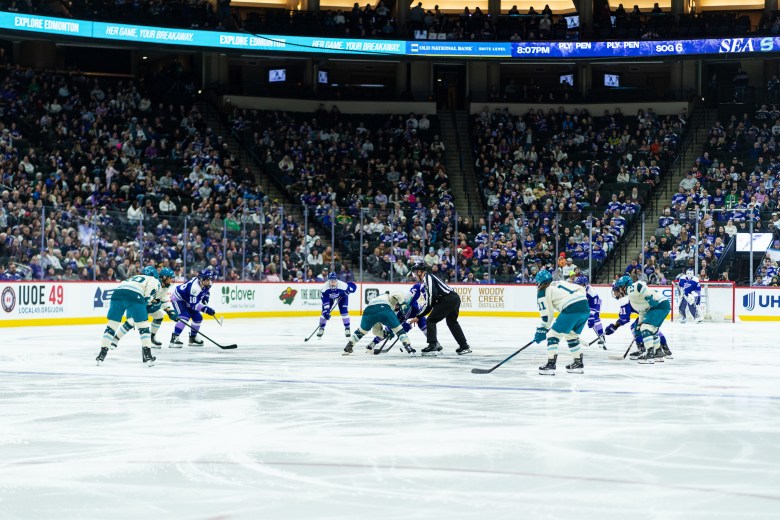
By the time Seattle took the ice against Toronto on Sunday, the consequences of Britta Curl-Salemme’s hit were clear. Mikyla Grant-Mentis was not in the lineup, sidelined with an upper-body injury sustained two days earlier against Minnesota.
When a hit removes a player from a game and then from the next one entirely, it raises an obvious question: how did that play only warrant a minor penalty?
Grant-Mentis was in a vulnerable position near the boards, and Curl-Salemme finished the check, driving her hard into the wall. Boarding calls exist precisely because of that scenario. Players facing the boards have little ability to protect themselves, and the resulting impact can easily lead to head, neck, or shoulder injuries.
Torrent head coach Steve O’Rourke shared similar frustration when asked about the subject during the post-game media availability.
“It’s a call. Not sure how that’s not a five-minute [major] or at least looked at. I mean, we’ve lost a key player, and probably long-term because of it.”
The issue is not simply the outcome of one hit, but the context surrounding who delivered it.
A Clear Pattern
Curl-Salemme already has one of the most extensive disciplinary records in the young history of the Professional Women’s Hockey League. During her rookie season with the Minnesota Frost, she became the first player in league history to receive three suspensions. One came for high-sticking Boston forward Theresa Schafzahl in January 2025. Later that season she was suspended again after an illegal check to the head. The pattern continued into the playoffs, when a hit on Toronto defender Renata Fast during the PWHL semifinals resulted in a five-minute major, a game misconduct, and another suspension.
Those incidents established a reputation that now follows Curl-Salemme whenever she delivers a questionable hit. Physicality is part of hockey and the PWHL has embraced a fast, aggressive style that allows players to finish checks. That said, there is a difference between physical and reckless. Illegal head contact and dangerous hits along the boards are exactly the types of plays the league has created rules against. The PWHL rulebook prohibits hits where the head is the main point of contact and the contact was avoidable. The league has also introduced automatic major penalties and game misconducts for illegal checks to the head.
That is why disciplinary history matters. When a player repeatedly crosses the line, the standard for evaluating the next incident should change. In most professional leagues, repeat offenders face escalating consequences because smaller punishments have already failed to deter the behavior.
Curl-Salemme’s history suggests that threshold has already been reached.
The hit on Grant-Mentis also fits a broader pattern in how Curl-Salemme plays the game. Her style relies heavily on finishing hits and applying pressure on the forecheck, but that intensity has frequently turned into poorly angled checks and contact with vulnerable opponents. The illegal head contact penalties and suspensions from last season were were clear rule violations involving upward extensions of the arm or contact that made the head the primary point of impact.
That context makes the boarding hit on Grant-Mentis more concerning, not less. From Seattle’s perspective, the impact was immediate. Grant-Mentis has served as an important depth forward for the Torrent, bringing speed and forechecking pressure to a lineup that has struggled to generate consistent offense at times this season. Losing her, even temporarily, matters for a team missing both captain Hilary Knight and forward Hannah Bilka, and still trying to stabilize its lineup late in the year.
But the broader issue goes beyond one player missing one game. The PWHL is still defining its competitive identity, and how it handles repeat offenders will shape that culture. If a player with multiple suspensions delivers a dangerous hit that forces an opponent out of the lineup and the only in-game consequence is two minutes, it suggests the threshold for serious discipline remains too high.
Grant-Mentis sitting out in Toronto is the clearest indicator that the hit was more than simply routine contact gone wrong. When a repeat offender delivers a hit that removes an opponent from the lineup, the response should go beyond a minor penalty and a review after the fact. At some point, the league has to treat that pattern for what it is: two minutes was not enough. A fine, a meaningful suspension, or both would send the message the PWHL says it wants to send about player safety. If the PWHL wants to draw a firm line on dangerous play, this was the moment to do it.