

SACRAMENTO – It almost never happened.
Marta Suarez almost never went to TCU. The Horned Frogs almost never made a second consecutive run to the Elite Eight.
Suarez almost didn’t continue playing basketball.
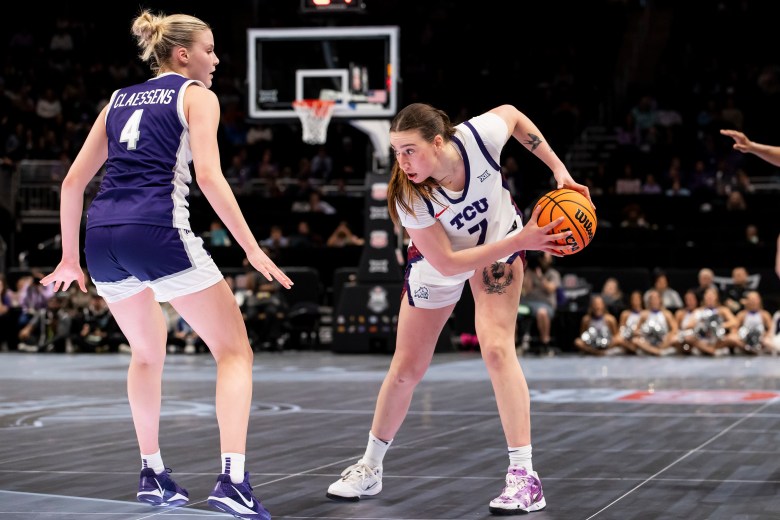
That was hard to believe on Saturday night, when the grad forward posted a career-high 33 points in a 79-69 win for the Horned Frogs over No. 10 seed Virginia to get to the Elite Eight.
How did she get here?
“I was just hoopin’,” she said of Saturday’s game. “It was going in, I kept shooting to be honest.”
Suarez has not had the traditional career arc. A year ago she was the second-leading scorer for Cal, a good player but hardly on the national radar. Her performance with TCU has led her to becoming a WNBA first-round draft prospect.
As a freshman at Tennessee, she started 14 games and scored 4.1 points per game while trying to find her footing as a college player and someone new to the United States. The Vols lost in the second round of the San Antonio bubble NCAA Tournament that year.
Then, she redshirted to deal with a leg injury before stepping away just 14 games into the 2022-23 season to go home to Spain where her mother was sick with terminal cancer.
There, she was almost done with basketball entirely. Her Tennessee tenure wasn’t going as planned on the court, and she was dealing with plenty off of it.
“She’s overcome a lot of life adversity, not just basketball,” said TCU head coach Mark Campbell. “She got dealt a tough hand, and she is a resilient kid. She is a brilliant human being. She has a brilliant mind… She’s our warrior. And she’s been that way this whole year. She’s got one of the greatest work ethics that I’ve ever been around.”
She spent the next two seasons at Cal, helping a Bears program get back on the map after years as a Pac-12 doormat. Last year, she was blossoming as a range-shooter with the ability to drive transition as Cal returned to the NCAA Tournament for the first time since 2019.
Listen now to The IX Sports Podcast and Women’s Sports Daily
We are excited to announce the launch of TWO new podcasts for all the women’s sports fans out there looking for a daily dose of women’s sports news and analysis. Stream on Spotify, Apple Podcasts or anywhere you listen to podcasts, and make sure to subscribe!
With TCU as a graduate student, she’s flourished.
“But I think that’s my ability as a player, I think that’s what I take pride on, my ability to recognize the match-up and know that I can back somebody down,” Suarez said. “But I can also play from a triple threat and space the court with my 3-point shooting. So I just came out and came out in a good rhythm and this team has a lot of great tools. And so just came down to that, so very grateful.”
TCU itself had to find its footing in the women’s basketball space not too long ago. In Mark Campbell’s first year with the program, the team had to hold open tryouts and even forfeit some games while dealing with injuries.
Then he became the guy who recruited through the portal. He did it last year, bringing in stars such as Hailey Van Lith to bring the Horned Frogs back into the national conversation.
Last offseason, he got Notre Dame star Olivia Miles, who joined TCU instead of declaring for the WNBA draft. He got center Clara Silva from Kentucky.
Suarez was another essential add.
“Marta is a unicorn in her own way,” Campbell said. “She’s a rare stretch 4 that’s powerful and strong that can post, and then she has guard skills that can shoot threes.”
A year ago, Suarez was a good, not great, college player looking to break through once she went pro. This season under Campbell and with the super-team he built out of the portal, she finds herself as a part of the “Miles and Suarez” duo that’s taken a team to the Elite Eight.
What a difference time makes.
“The coaching staff believes in me and my teammates believe in me, so I have to believe in myself.”
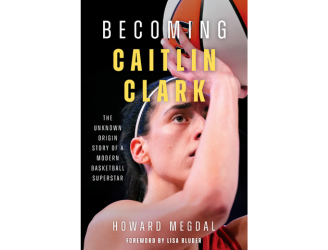
“Becoming Caitlin Clark” is out now!
Howard Megdal’s newest book is here! “Becoming Caitlin Clark: The Unknown Origin Story of a Modern Basketball Superstar” captures both the historic nature of Clark’s rise and the critical context over the previous century that helped make it possible, including interviews with Clark, Lisa Bluder (who also wrote the foreword), C. Vivian Stringer, Jan Jensen, Molly Kazmer and many others.