


The 2026 NCAA Women’s Hockey National Championship featured two Big 10 rivals, Wisconsin and Ohio State, battling for the trophy. For the third time in four seasons, Wisconsin came out on top. The conference is best known for success in other sports like football, women’s basketball, and men’s basketball. It’s also is a women’s hockey powerhouse despite not formally fielding the sport (Wisconsin, Ohio State, and Minnesota are in the WCHA, Penn State competes in the AHA).
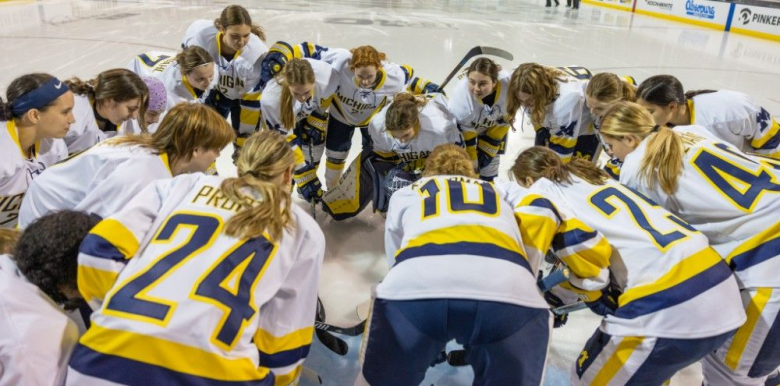
But, women’s hockey at the highest level is absent from the University of Michigan. Not only is it one of the Big 10’s most notable schools, it’s also Ohio State’s most famous rival. There is no D1 women’s hockey team at the University of Michigan, or at any college in that state. A group of leaders at Michigan is looking to change that.
A Brief History of College Hockey in Michigan
College hockey began at the University of Michigan in 1923, when the first university-sanctioned ice hockey match occurred between men from Michigan and the University of Wisconsin. The sport soon spread throughout the state as teams developed at other colleges and began to play each other. In 2026, there are seven D1 men’s hockey teams in Michigan.
Top-level college women’s hockey has existed in Michigan before. Wayne State University in Detroit had the first and only D1 team in the state. They played for 12 years, from 1999 until the program was axed as a casualty of funding cuts in 2011. Meanwhile, Adrian College has fielded a D3 team since 2007, Michigan’s only remaining varsity women’s hockey team.
Outside of NCAA-sanctioned competition, a handful of club teams exist throughout the state. The University of Michigan’s club women’s hockey team has played since 1994. In 1997, Michigan even considered elevating the club team to varsity status. By the end of 1998, though, that plan was dead in the water. The university passed over women’s hockey in favor of water polo and soccer, citing program costs and difficulty securing facilities as their rationale.
Feasibility and Funds
Program costs and facilities challenges are common refrains in the current fight to bring D1 women’s hockey to Ann Arbor. In 2024, the university published a feasibility study presenting several paths and cost estimates for establishing a program. Conducted by the consulting firm Collegiate Sports Associates, the study estimated a women’s hockey program would cost Michigan about $4.5 million per year, without including additional scholarships. Revenue was conservatively estimated at $400,000, but that still means a lot of money is lost each year. The study states that Michigan’s men’s hockey team loses about $900,000 per year.
Three potential facility options were proposed in the feasibility study. Renovating Yost Arena, the over-100-year-old home of Michigan’s men’s team, would cost about $50 million. Building a new arena with one sheet of ice for both teams would cost at least $300 million. The estimate climbs to $330 million for two sheets in a new facility similar to Minnesota’s Ridder and Mariucci Arenas.
In short, any way forward is going to be expensive. To fund the program, the study worked through several option. One, for the athletic department to foot the bill. Another, for the university to subsidize the sport, and lastly, a philanthropic donation to help with start-up costs. The study concluded the third proposal is the best option. It cited the Pegula family’s contributions that funded arena construction and the start of men’s and women’s hockey teams at Penn State.
Continued Challenges
Over a year and a half has passed since the feasibility study was published. Now, a group of leaders at the University of Michigan grapples with solutions to the same problems. Jenna Trubiano is a former player and coach of the Michigan club women’s hockey team. She’s now part of that group as strategic advisor to the university regents. “We want to focus on what we can do today, tomorrow, the day after tomorrow, to bring women’s hockey opportunities to the state of Michigan,” Trubiano told The Ice Garden.
Facilities remain the biggest and most pressing challenge for immediately establishing a program, Trubiano said. After the feasibility study, the committee began looking at what comparable D1 schools with two hockey teams do, from New England schools with one sheet of ice to Big 10 competitors with separate rinks for men’s and women’s teams. Yost Arena is beloved by fans and has support from leadership for hosting a women’s program.
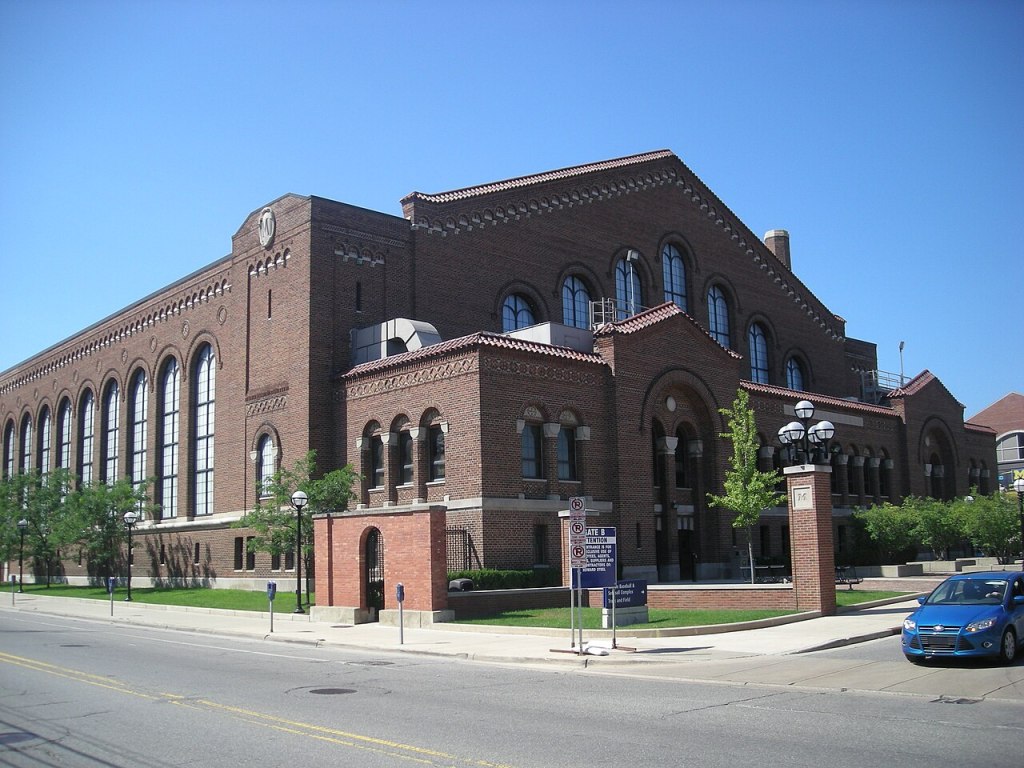
However, the historic rink would need significant renovations to fit a second team, pushing the arena’s footprint into the surrounding parking lot and affecting gameday operations. Constructing a new arena would have similar space issues in Ann Arbor’s crowded south campus. Trubiano stated that options outside the university have been considered, particularly with the idea of getting a team on the ice as soon as possible in mind, but the goal is to ensure top-level facilities and ideally have them on campus.
Athletics at the University of Michigan is also in a state of flux. University president Santa Ono left in May 2025, and a new president, current Syracuse chancellor Kent Syverud, is beginning in July. Ono was a significant supporter of bringing women’s hockey to Michigan. Trubiano hopes to build a similarly positive relationship with the new president, noting that Syracuse has a women’s hockey program but not a men’s team.
The Michigan athletic department is also currently under investigation following significant upheaval within the football program last fall. While this turmoil might present an obstacle to continuing to build a women’s hockey program, Trubiano insisted that “the things that have been happening [in the athletic department] don’t affect us directly.”
What has affected the committee’s planning is the changes in the landscape of college sports. Trubiano suggested the feasibility study could use an update for 2026. The rise of NIL and the settlement in House v. NCAA has dramatically affected the financial viability of college athletics, even for big, successful schools like Michigan.
Future Progress
Despite these challenges, Trubiano remains optimistic about bringing women’s hockey to her alma mater. “There has never been a better time for women’s hockey in the state of Michigan than right now,” she said, highlighting recent successes in the area. The PWHL has played two Takeover Tour games in Detroit at Little Caesar’s Arena, with the second game on March 16, 2025, setting a US women’s professional hockey attendance record at the time. The league will return to the home of the NHL’s Detroit Red Wings again this weekend on March 28. There are also rumors that Michigan’s largest city is in the running for a PWHL expansion franchise, perhaps joining the WNBA team arriving in 2029 to establish Detroit as a women’s sports city.
Trubiano’s work since the publishing of the feasibility study has largely focused on building connections and garnering support for a women’s hockey program at Michigan. She attended the American Hockey Coaches Association conference to network with stakeholders in the sport. She has also been in contact with representatives from the PWHL and NHL on behalf of Michigan.
Although women’s college hockey in Michigan has little to show beyond the feasibility study and some press in the wake of the Olympics, Trubiano is hopeful that good things are on the way for her home state. “The landscape of women’s hockey in the state of Michigan could change so much over the next five years.“
She even has a lofty goal for her school. “Hopefully by the next Olympic cycle, we have a women’s hockey player there that has played for the University of Michigan or is playing for the University of Michigan.”