

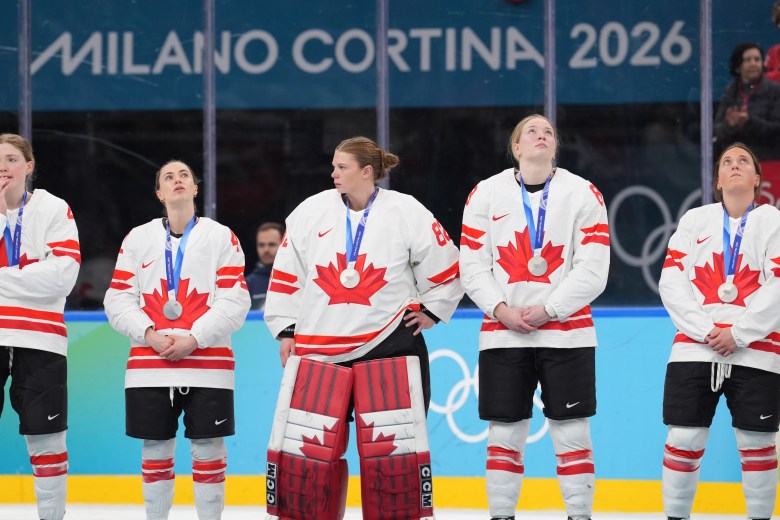
The sad Canadians with silver medals around their necks truly summed up the way many Canadians were feeling after watching Megan Keller’s overtime winning goal in Milan. From the start, it was gold or bust for the Canadians, who just fell short of their goal. But was the entire tournament a wash when just one goal separated them from the top spot? Let’s take a look.
Grade: B
How They Finished
Canada took home the silver medal after a 2-1 overtime loss to the Americans. They finished the preliminary round with a record of 3-0-0-1 after a 5-0 loss to Team USA. They faced Germany in the quarter-finals, Switzerland in the semi-finals, and then finally, Team USA for the gold. The Canadians ranked second in scoring efficiency, first in power play percentage, fourth in penalty kill, and fifth in save percentage.
What Went Wrong
For most teams, a silver medal likely means that they had a strong tournament and just fell short of the target. And while that is still somewhat true for Team Canada, this tournament further revealed the issues that the roster has had since the 2025 World Championships (and possibly even before).
Roster Building: After the US swept the 2025 Rivalry Series with a combination of speed and youth, Canada opted not to make many changes to their roster. Much has been written and spoken about their roster decisions, but much of it can be summed up in the decision to leave 18-year-old NCAA defender Chloe Primerano at home in order to take 37-year-old Jocelyne Larocque. While the Americans showed up to the Olympics with seven NCAA players, Canada showed up with none. Ultimately, it may not have made that much of a difference in the end, as both American goal scorers in the gold medal game were veteran players, and yet, it leaves Canada with very little youth development as they head towards the future.
Coaching: The silver medal cemented what many have been feeling for the last year or so: Canada needs a coaching change. While Troy Ryan is the second-most successful coach in the team’s history, he left many fans and analysts with many questions during this tournament. His lineup choices and ice-time management simply did not reflect the quality of play. Lines and pairings that gave up goals or chances, or weren’t able to produce, were not shifted around. Players who had good games, sometimes the only ones who had good games, were not awarded with more ice time. After being one of the top point earners on the team, Julia Gosling remained on the fourth line. Kristen O’Neill, who scored the only goal for Canada in the gold medal game, was only given five minutes of ice time in the game.
After the 5-0 loss to the Americans in the preliminary round, there were only two changes made: Poulin was inserted back into the lineup, and the second and third defender pairings were slightly different. Doing the same thing over and over again and expecting a change does not work.
Scoring: Despite bringing four full lines of players who can score day in and day out in the PWHL, Canada scored 11 fewer goals than the US in the same number of games. Players who usually get on the scoresheet were non-existent. Although she was coming back from an injury, Sarah Nurse, who set the record for most points in a single Olympic tournament in 2022, only had two points. Maltais had only two points, and Clark only had three. Roster mismanagement led to Gardiner and Spooner each only having one point. This was most on display in the semi-final game against Switzerland, where an injured Poulin was the only player to get on the scoreboard despite the team firing 46 shots at Andrea Brändli. This is also linked to coaching and roster mismanagement, but some ownership must lay on the players as well.
What Went Right:
Despite the silver medal, some things had to have gone well for Canada to get the chance to play for gold.
Veteran Prowess: For a team that chose to prioritize experience and maturity over youth, the veterans did show up. In the gold medal game, they looked like the more confident and settled team until the last two minutes. Poulin rallied the team to get through the semi-finals, and the veteran goaltending duo of Desbiens and Maschmeyer was solid. Hopefully, the players who will bridge the gap between the older and younger generations can build from this experience as they move into the leadership roles in 2030.
Bounce Back: The team did not let the 5-0 loss to the Americans hold them back for the rest of the tournament. They went on to win the next three games, including a 5-0 win over Finland, and were arguably the better team against the Americans in the gold medal game until the third period. It could easily have been a huge blow, especially since the team maintained that the Rivalry Series wasn’t a real test of the American team, but they bounced back well.
Top 3 Players:
Marie-Philip Poulin: Even though she didn’t score the game-winning overtime goal to bring home a gold medal, Poulin still had a fantastic tournament, both as a leader and on the scoresheet. After a rogue hit in Canada’s preliminary game against Czechia, Poulin missed two games due to injury. Even so, she had four points across the tournament in five games. Two of her goals came in the semi-finals against Switzerland, where she was the only goal scorer, clawing her team into the gold medal game.
Canadian player Julia Gosling told Claire Hanna, “She’s our leader, she’s our captain, she’s the best teammate I’ve ever had. After seeing her get hurt, we just wanted to win for her and push even harder and have her be proud of us.” It’s clear how important she is to the Canadian team, even off the ice.
In her fifth Olympics, and with an injury, she was still named the best forward in the tournament, set the record for most points by a woman at the Olympics, and is now the only Canadian to have played 27 games at the Olympics. The list of accomplishments only grows.
Daryl Watts: In just her second season with the national team, she has proved why she deserves a spot on the roster. Her eight points were the most of any Team Canada player, and—until Megan Keller’s gold medal-winning overtime goal—tied for the most points by a PWHL player at the Olympics. Watts earned herself a slot on the first line right from the start of the tournament, averaging between 15 and 20 minutes of ice time per game. Even after Poulin was injured and Watts’ line changed slightly, she was able to produce at a high level, carrying over her strong play from the PWHL to her first-ever Olympic experience.
Julia Gosling/Kristen O’Neill/Jennifer Gardiner: I’m cheating and slotting in an entire line here that I believe didn’t get enough recognition (and ice time) for their work this tournament. All three players were at their first Olympic Games, and each proved they earned their shot at this tournament. Gosling had five points in seven games, including two goals in the preliminary matchup against Czechia. O’Neill also had five points, including the only goal in the gold medal game for Team Canada. Gardiner only had one goal in the seven games, but she made an impact when she was given the chance.
Despite the coaching staff keeping this line the fourth line for the majority of the tournament and refusing to give them more ice time, all three players showed up when they were given the opportunity. Sometimes that’s harder than getting 20 minutes a night.
According to C Benwell from The Hockey News, Troy Ryan spoke to the media on Wednesday and acknowledged that it’s time for a transition, and he expects Hockey Canada to already be taking action in finding new leadership.
It seems like change is already underway for Team Canada.