Welcome to Basketball Insider, presented by The BIG EAST Conference. I’ve spent most of this week, including Saturday night at Barclays Center, trying to understand the yawning chasm between how the 2026 WNBA season has gone for Caitlin Clark and the Indiana Fever by virtually any measurement, and the endless noise and rage directed towards them from across the internet.
Basketball Insider

The phrase I keep coming back to is “reality distortion field”. It doesn’t seem to matter, essentially, what the Indiana Fever do or don’t do. The narrative around the team will take on its own momentum, every unasked question about a circumstance that doesn’t exist driving engagement on a thousand social media posts.
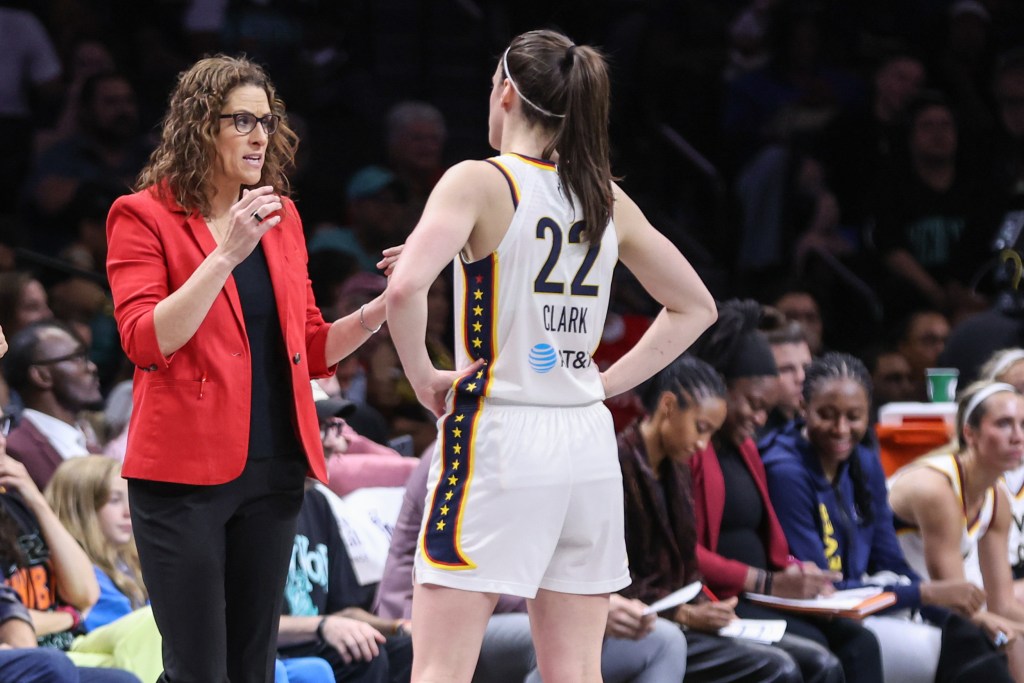
So I put it to Stephanie White on Saturday night in Brooklyn: why, when I dig into the numbers, or talk to folks inside or outside the Fever organization, is there no “there there” when it comes to the most dire declarations about the Fever? She grinned slyly.
“I think you used a good word,” she said. “I mean, you’re talking about it from a rational perspective, so that’s my first thought.”
Can you even imagine being Stephanie White right now? This is a woman who has accomplished virtually everything one can as a player and coach. Few I’ve ever met are more driven not only to win, but also to try and figure out the ever-changing chess match that basketball presents. She’s never missed the playoffs as a head coach across three separate tenures for two franchises (Indiana and Connecticut) and is open with both the media and, more importantly, her players.
But, to a fan wearing a “Fever 22” jersey whom I spoke with on my walk to Barclays Center, there was genuine surprise that White was not engaging in a conspiracy to undermine Clark, her own starting guard and franchise player.
It’s worth noting: this is one of many, many conspiracies alleged in the darkest corners of the internet about the Indiana Fever every single day.
Notably, this fan was open to the possibility, when I raised it, that there might not be a conspiracy engineered by Clark’s own coach against her. (There are loads of normal, reasonable Fever fans!)
It’s a two-step process, really: noise is generated by certain sectors of the online world, in places where the loudest and angriest takes are encouraged, and where normal people come to believe if there’s this much smoke, there must be fire. Then, investigating what the fire is produces its own smoke: every time White and her players are forced to deny the silliest rumors, the denials themselves serve as proof they are all lying.
And for those of us covering it all? If we ask about these things, we fan the flames. If we don’t, players and coaches can’t put them to rest, and we’re complicit in the cover-up to boot. I would be lying if I said I’ve figured out how to combat misinformation on a systemic scale.
Clark herself is masterful at staying even-keeled in a media setting, but even she expressed frustration about it on Saturday night.
“I mean, I don’t really know why we’re still on this,” she said. “We talked about it, and I think, especially for our team, we didn’t like blatantly sit there and talk about like everything you guys were writing and what’s in the media. We’re just talking about how we can be better as a team.”
It is agonizing for me or any media member studiously trying to get at the truth, to be lumped in with those building entire business models around Caitlin Clark headlines. Though it is worth noting that the “media” is not a single-minded entity that comes up with a narrative collectively. Most of the time, even those of us within a single outlet can’t agree on everything we saw in a single game. Even further, those perpetuating misinformation are seldom the people who show up to do the actual work of reporting.
To that point made by Clark: yes, the Indiana Fever can get better. They are 6-5, with a net rating of 3.6. They’ve played like the median team in the league by most metrics, falling short of expectations for a franchise that reached the semifinals in 2025 and employs a healthy Clark in 2026.
But progress takes time. Reintegrating Clark into the group, replacing Natasha Howard at the 4 with Monique Billings and Myisha Hines-Allen, and incorporating rookie point guard Raven Johnson into the rotation, all take a collective toll on early season results.
Even still: Kelsey Mitchell is scoring at an impressive, efficient pace, with a .570 true shooting percentage. Aliyah Boston has successfully incorporated her 3-point shot, hitting 41.7% of them on 2.4 attempts per game, a number which drew a satisfied smile from her when I mentioned it on Saturday night. Against New York, Billings showed herself to be a versatile 4 who complements Boston and should elevate the Fever on both ends. At point guard, perhaps the league’s most difficult position, Johnson is holding her own in spite of the questions and comparisons to Clark, who has moved off the ball in many lineups with Johnson.
Again, the reality distortion field is always in place.
“I think for us, it’s really just looking at how we are each and every game,” Boston said when I asked how she navigates this. “We can’t get too high from the highs or low from the lows. We’re not even where we want to be. I think each game you see improvement in certain areas, but there are certain areas where we have to continue to improve. We want to be top of the top by the end of the season.”
Listen now to The IX Sports Podcast and Women’s Sports Daily
We are excited to announce the launch of TWO new podcasts for all the women’s sports fans out there looking for a daily dose of women’s sports news and analysis. Stream on Spotify, Apple Podcasts or anywhere you listen to podcasts, and make sure to subscribe!
About that: I spoke to a half-dozen WNBA talent evaluators about the Fever. No one views the Fever, when given the chance to speak freely on background, as a team in crisis. Like, at all. Several noted that White’s teams consistently get better as the season progresses, and with a staff that includes Briann January, Karima Christmas-Kelly and Austin Kelly (all three good candidates for future head coaching positions) that isn’t likely to be any different this year.
It’s not even clear what the massive hole other teams will exploit is supposed to be. The idea is that White doesn’t play fast enough, yet the Fever are running 17.7% of their offensive possessions in transition, per Synergy, up from both 2025 and 2024, and second in the WNBA to the Atlanta Dream. The idea is that the Fever aren’t good enough defensively to contend, but they’re fourth in the WNBA in defensive net rating, all while continuing to learn from each other. Supposedly they can’t share the ball, yet they’re somehow third in the league in assist percentage. Or maybe they aren’t rebounding the ball enough, yet they’re third in the league in rebounding percentage and first in defensive rebounding percentage.
As for Clark herself? Through 63 games, she dwarfs any other WNBA player in assist percentage, at 41.8%. No one else even reached 38 in their first three seasons, Ticha Penicheiro second at 37.8%, Sue Bird fifth at 35.1%. Notable, too, about Bird: she had a true shooting percentage in her first three seasons of 55.6%. Clark through 63 games over three seasons? IDENTICAL. Diana Taurasi checks in over her first three seasons at 27.1% assist percentage and a true shooting percentage of .548.
I don’t need to waste time on this, do I? Clark compares favorably so far to the early careers of the two best guards in WNBA history. This is not someone failing to meet expectations or someone a team can’t build a championship roster around.
Everyone who actually needs to face the Indiana Fever knows this. In the final seconds Monday night, Indiana’s Sophie Cunningham inbounded the ball to Clark. Washington’s Cotie McMahon raced to intercept the pass. The implicit decision she made? If the ball made it into Clark’s hands, she’d hit the shot, the game was over. McMahon didn’t make the interception, and her judgement was right.
Never mind that Clark had missed two free throws moments earlier, shots which would have put Indiana ahead. The theory of folks around the league and Clark alike is a simple one: winning will solve everything and quiet the noise.
“Nobody’s going to look back and be like ‘oh well the Fever probably should have lost this game but made a buzzer beater,” Clark told reporters in Washington after Monday night’s game. “No, it’s a W. It’s a win for us.”
From a rational perspective, Clark is right. But that’s just not the world the Indiana Fever live in these days.
“Becoming Caitlin Clark” is out now!
Howard Megdal’s newest book is here! “Becoming Caitlin Clark: The Unknown Origin Story of a Modern Basketball Superstar” captures both the historic nature of Clark’s rise and the critical context over the previous century that helped make it possible, including interviews with Clark, Lisa Bluder (who also wrote the foreword), C. Vivian Stringer, Jan Jensen, Molly Kazmer and many others.
This week in women’s basketball
Love seeing a Dave Sheinin byline on a WNBA story.
Jackie Powell throws an Elphaba comp on Cheryl Reeve. (Complimentary!)
Lindsay Whalen is mentoring Olivia Miles. (It shows!)
Loved this from Jenn Hatfield on Shakira Austin.
And don’t miss Powell on the return of Sandy Brondello to New York.
Five at The IX: Caitlin Clark, Stephanie White and Lexie Hull
Soccer: Annie Peterson, @AnnieMPeterson, AP Women’s Soccer
Tennis: Joey Dillon, @JoeyDillon, Freelance Tennis Writer
Basketball: Howard Megdal, @HowardMegdal, The IX Sports
Softball: Maren Angus-Coombs, @Maren-Angus, The IX Sports
Golf: Marin Dremock, @MDremock, The IX Sports
Hockey: @TheIceGarden, The Ice Garden
Gymnastics: Jessica Taylor Price, @jesstaylorprice, Freelance Writer
Monumental Sports and Entertainment, the group that owns the Washington Mystics, holds a minority stake in The IX Basketball. The IX Basketball’s editorial operations are entirely independent of Monumental and all other business partners.