Howdy y’all and welcome to Tennis Insider!
The clay is gone, the grass is growing, and women’s tennis just handed us one of the more chaotic, compelling starts to a grass-court swing in recent memory. Queen’s Club and ‘s-Hertogenbosch have wrapped up and this week we have Berlin and Nottingham. However, the crown jewel in Wimbledon looms at the end of the month, so instead of a neat recap with scores, let’s talk three questions that are going to define the next few weeks.
1. Is the grass court season long enough?
Here’s the thing that nobody wants to say out loud but that is becoming increasingly hard to ignore: the women’s grass-court season is still not long enough, and the sport is leaving real drama on the table because of it.
Right now, the WTA runs seven events across Germany, the Netherlands and the UK before Wimbledon — Queen’s Club, the Libema Open in ‘s-Hertogenbosch, Nottingham, Berlin, Bad Homburg, Eastbourne and then the finale at SW19. On paper, that sounds like a substantial slate. In reality, the whole thing is crammed into about six weeks, and the actual match-volume players get on grass before Wimbledon is thin. You can win a 500-level event and have played five matches on the surface. That’s it. That’s your grass-court preparation.
Compare that to the clay swing, which starts in late April and runs for nearly two months through Madrid, Rome and Roland Garros, with a deep roster of 250-level events giving lower-ranked players real reps on the surface. The grass equivalent just doesn’t exist. There are no grassroots (pun intended) development events at scale. There’s no equivalent of the clay-court Challenger grind that helps players find their footing. You either adapt to grass fast, or you’re eliminated before your game clicks.
This matters especially for the WTA because grass genuinely rewards a specific style of play — flat groundstrokes, aggressive net approaches, big serving, low-bounce exploitation — that takes time to groove. The players who thrive at Wimbledon every year are overwhelmingly those who have deep grass-court memories in their bodies: Rybakina, the Williams sisters, Sabalenka. The current calendar structure doesn’t do nearly enough to close that gap for everyone else.
The counterargument is tradition: grass courts are expensive and labor-intensive to maintain, the season already runs deep into summer, and there’s only so much calendar real estate before the hard-court swing begins. Fair enough. But Bad Homburg only became a WTA 500 event in 2024 — these things can change. The question isn’t whether the grass season should be longer in some abstract sense, but whether the WTA is being strategic enough about growing it. The answer right now is probably no, unfortunately.
2. Who actually wins on grass when the field is this deep?
The WTA in 2026 has a depth problem. Specifically, it has a ‘depth that is so good it’s become a prediction nightmare’ problem.
Look at the grass season so far. Last year’s swing produced five different champions across five events: Tatjana Maria at Queen’s, Elise Mertens in ‘s-Hertogenbosch, Markéta Vondroušová in Berlin, McCartney Kessler in Nottingham and Jessica Pegula in Bad Homburg. Five events, five different champions. Then Iga Świątek stunned everyone by taking her first Wimbledon crown with a double bagel finish.
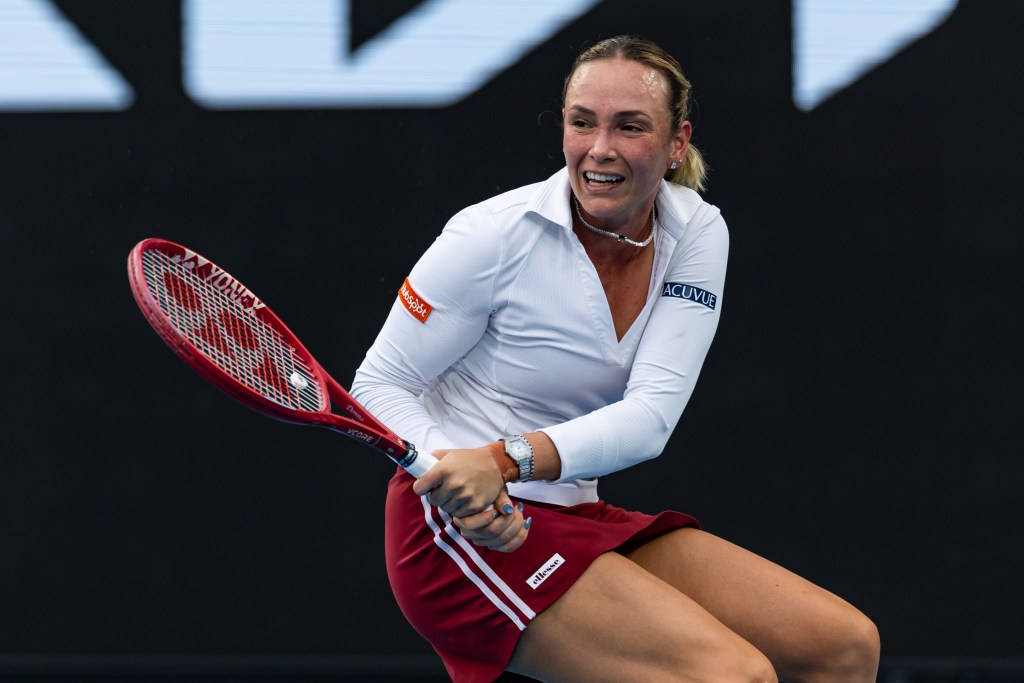
Heading into this year’s Queen’s Club, Elena Rybakina entered as the top seed and clear favorite, with Amanda Anisimova and Belinda Bencic among the other names expected to contend. Rybakina made sense as the grass-court standard-bearer as her powerful groundstrokes and efficient baseline play make her a natural fit for fast surfaces. Her flat shots stay low and punish short balls, and she’s never really lost the “Wimbledon favorite” label she picked up when she won the title in 2022. Still, lucky loser Donna Vekić emerged as the champion, knocking out Emma Raducanu in the final.
But here’s what makes the next few weeks genuinely interesting: For Rybakina, or Sabalenka, being the favorite doesn’t mean much when the draw is this volatile. Mirra Andreeva won Roland Garros at 19 and arrived on grass at 36-9 for the year, the most wins of anyone in the field, though her grass resume is thin (just 17 matches, going 11-6). That’s a compelling unknown.
Then there’s Jessica Pegula, who is quietly one of the most dangerous players in this field. Pegula has produced some of the best tennis of her career at times this season, and with the improvements she has made to her serve, she could see that work pay off on grass — whether that means a title before Wimbledon or a deeper run at the Slam itself is to be determined. I feel she always raises her level, or you could argue peak, just before a Slam, but doing it during it has been elusive.
And don’t overlook the younger Americans. Iva Jovic is someone I have high hopes for and my expectation for her is that she’ll adapt to the surface well. Anisimova, who went to the Wimbledon final last year, is still one of the more naturally gifted grass-court players on tour. The talent is not in question. The consistency is. Someone who’s typically beyond consistent is Coco Gauff. Could her early Roland Garros exit help translate to a career-best showing at SW19?
This is what makes watching the next three weeks so addictive. There’s no player you can pencil into a final with confidence and go do something else. Every draw feels genuinely open. The WTA’s own preview of the grass swing noted that results from events like Queen’s, Berlin and Bad Homburg shouldn’t be over-weighted heading into Wimbledon.
3. What does Serena Williams actually want?
Let’s be honest about what happened at Queen’s Club last week.
Nearly four years after her last professional match and aged 44, Serena Williams returned to competitive tennis at the HSBC Championships at Queen’s Club, pairing with 19-year-old Canadian Victoria Mboko in the doubles draw as a wildcard entry. She hit service winners of up to 120 mph and some ferocious groundstrokes, and they beat the third-seeded team of Nicole Melichar-Martinez and Erin Routliffe 7-6(2), 6-2.
The crowd was sold out and Lindsey Vonn watched from one of the balconies. Serena’s two daughters, Olympia and Adira, were also in attendance. For Adira, born in 2023, it was the first time watching her mother play a match. Serena’s postgame quote on the win was characteristically unbothered: “Adira wanted to go to the toy store, and Olympia wanted to know what was for dinner.”
All of that is wonderful. But the real question underneath all the warmth and the nostalgia and the viral moments is one that nobody is asking directly: What does Serena Williams actually want from this?
After the win, she described her motivation for coming back with characteristic bluntness: “I got tired of sitting at home.” That’s a great line. But it’s not an answer. She hasn’t confirmed any plans beyond this week’s tournament, opting to stay focused on the quarterfinal when asked about the future. She also has doubles entries at the Berlin Open coming up, and the Wimbledon question is hanging over everything.
Here’s the thing. Serena Williams has 23 Grand Slam singles titles. She has nothing left to prove in doubles. She has never officially retired, never definitively said the 2022 US Open was her last match — she just … stopped playing. And now she’s back, serving at 120 mph and beating seeded teams in doubles on one of the sport’s most demanding surfaces.
The question isn’t whether she can still play. She clearly can. The question is whether this is a “getting the itch out” moment or the beginning of something more sustained. Whether she actually wants back in — the training, the travel, the pressure — or whether she wants the crowd and the moment and the feeling without the grind that comes with taking it seriously as a full-time pursuit.
Nobody should begrudge her anything she’s doing. But the narrative around her return has been so uniformly celebratory, so wrapped in “look who’s back” energy, that the harder conversation isn’t happening. If she decides to enter Wimbledon, the scrutiny will come. The media will want to know about singles. Fans will expect more than doubles cameos. The fairy tale has a shelf life, and the longer she stays without articulating what she’s actually here for, the more the expectations will spiral.
Serena Williams has always known exactly what she was doing. That hasn’t changed. Whatever comes next — Wimbledon wildcard, Berlin doubles run, or a quiet exit after this grass swing — she’s thought it through. It would just be nice to know what she’s decided.
Now, onto links!
This week in women’s tennis
Robin Montgomery didn’t play after last year’s Wimbledon and came back at Bogota earlier this Spring. The American entered the Libema Open ranked No. 494 and left with her first WTA singles title after Barbora Krejčíková withdrew ahead of the final due to viral illness.
Simona Halep had a retirement ceremony in Cluj-Napoca with Elina Svitolina helping out with the festivities.
Donna Vekić brought in an old coach just before the grass season began and with her Queen’s title, already is on the verge of a Wimbledon seeding.
Wimbledon announced a 20% increase in prize money, totaling over $86 million.
Really enjoyed this read from Rennae Stubbs on the tour and female coaches.
Martina Navratilova and Chris Evert opened up about their rivalry on-court and the friendship that evolved over the last half-century ahead of their documentary premiering:
The more Serena Williams goes in her comeback, the more the GLP1 in sports debate gets attention.
Destanee Aiava has switched allegiances to New Zealand, becoming their No. 2 singles player as a result:
Karolina Plíšková had to relearn how to walk following ankle surgery, but the Czech is finding some form and has re-entered the Top 100 this week.
Poor Erin Routliffe. She has to face Serena Williams in her first match back and this week? Gets her again.
Aryna Sabalenka was named one of TIME’s 100 most influential people in sports.
Listen now to The IX Sports Podcast and Women’s Sports Daily
We are excited to announce the launch of TWO new podcasts for all the women’s sports fans out there looking for a daily dose of women’s sports news and analysis. Stream on Spotify, Apple Podcasts or anywhere you listen to podcasts, and make sure to subscribe!
Tweet of the Week
Rooting for ya, Jenny!
Five at The IX: Queen’s Club
Q. What does this win tell you about yourself, both in terms of your difficulties at the start of the week but also difficulties in general, difficult results in recent months?
DONNA VEKIC: Yeah, I think it really showed me that I have the level to be playing, to be winning titles, and to be playing against the best players in the world. Something that I was definitely doubting for last year, these couple of first months of the year.
But I really worked hard to get back here, and I’m really proud of myself and my team and the work we have done.
Q. Tough luck today, but still an incredible week. Where does this rank in your career? Obviously there was the US Open, but where does this week rank in your tennis career?
EMMA RADUCANU: Yeah, I think it’s incredibly special. You know, playing at home, there is no feeling like it. I was so just in awe of the atmosphere and in awe of the support I received all week. I couldn’t really believe it. Even though I know I’m playing at home, it just trumps anything that you ever really think of.
For that, I’m really grateful, and I just see how many people are behind me and rooting for me. It means a lot, because the results don’t always go your way the whole season. You see things written about you or spoken about you, but when you play at home, you’re just reminded how much support there is actually for you. It means a lot to have that.
Q. Serena, a lot of the younger players have talked about how wonderful it is to have you around again and how much they have to learn from you. I was wondering whether it felt like that from your point of view and whether you have particular things you’d like to pass along. And has the game changed a lot? And to Victoria, you said a little bit earlier, but what does it feel like to be next to a legend like that?
SERENA WILLIAMS: Yeah, I think it’s so many new faces. You know, a lot of the young players I actually watch. I love watching their games, and I think everyone has just gotten so good and so talented. And they’re so young.
It really feels good to be a part of a sport that you can see so much growth in.
VICTORIA MBOKO: I mean, of course even knowing I could play with Serena with me, that was very — I’m so grateful, first of all. I don’t play that much doubles, but I think sharing the court, I think I can learn a lot, even though we’re still competing. I just, if anything, I just had so much fun today. I feel like we complemented each other on the court very well.
I just really liked our attitude on court. We had the same mentality. That’s what I always look for in a partner. I just was enjoying myself.
Q. In terms of your performance, an incredible run to the semifinals, how much confidence does that give you for the rest of the grass court season? Like you say, with Nottingham coming up, another opportunity for you to go really deep into that tournament.
KATIE BOULTER: Yeah, I mean, look, as I said, I’m really patient with myself. I think that’s something that, I don’t know, I work hard at. I’m not normally a patient person, but for me on the tennis court, I have to be. I don’t have enough choice. I’m not someone who was 15 winning Grand Slams. I have been it for the long run.
So the weeks for me that are really important are the weeks backing up to tournaments like this. I think, you know, trying to get momentum and going into the bigger tournaments is really important. You know, next week in Eastbourne, I think they’re great tournaments for me to get more match wins and very important for me.
However, I already feel prepared. I feel prepared having gotten some great matches this week. No matter what happens in the other weeks, I feel like mentally I’m in a really good place.
I feel like my game is moving in the right direction. I think as long as I play the way that I’m trying to play, that’s what’s going to give me the confidence, not necessarily like the number of wins or the number of tournaments, but for my ranking, I need that. Ultimately, my goal is to get back up to where I was and surpass that, but I need to be doing well consistently for that to happen, and they’re great opportunities to do that, as long as my body is feeling good.
Q. I wanted to ask your impressions of three up-and-coming Czech talents: Bartunkova, Bejlek, and Valentova. They have all emerged onto the scene this year. They’ve all got very different games. I wondered what your opinions were of their games? And also why Czechia has a lot of up-and-coming talents but they’re all very different games.
KAROLINA PLISKOVA: Yeah, well, there is a lot of Czech players. Somehow they always show up somewhere, so each from different city, each from different club. Honestly, I don’t know. There is no secret to that. I mean, just one secret is that of course we have a great history in tennis in Czech Republic, so I think just the motivation is there.
And a lot of players, they just trying to follow these role models like Kvitova, me, Safarova was there, so there is always somebody who is in the top. Now Muchova is doing great. There is a lot of girls. And especially in the girls, I feel like there is so much of them.
I think the mentality of Czech people is quite good, you know, for tennis. We are a bit like negative, but at the same time we are a bit, like, hard on ourselves, so that’s, I think, a good thing in tennis.
Yeah, but there is a lot of girls. I know pretty much all of them, and I think all of them, I think they can be great one day. So let’s see.
Rep The IX Sports at your next game!
Shop the logo collection or special “Women’s Sports are Front Page News” collection now on Shopify.
Soccer: Annie Peterson, @AnnieMPeterson, AP Women’s Soccer
Tennis: Joey Dillon, @JoeyDillon, Freelance Tennis Writer
Basketball: Howard Megdal, @HowardMegdal, The IX Sports
Softball: Maren Angus-Coombs, @Maren-Angus, The IX Sports
Golf: Marin Dremock, @MDremock, The IX Sports
Hockey: @TheIceGarden, The Ice Garden
Gymnastics: Jessica Taylor Price, @jesstaylorprice, Freelance Writer