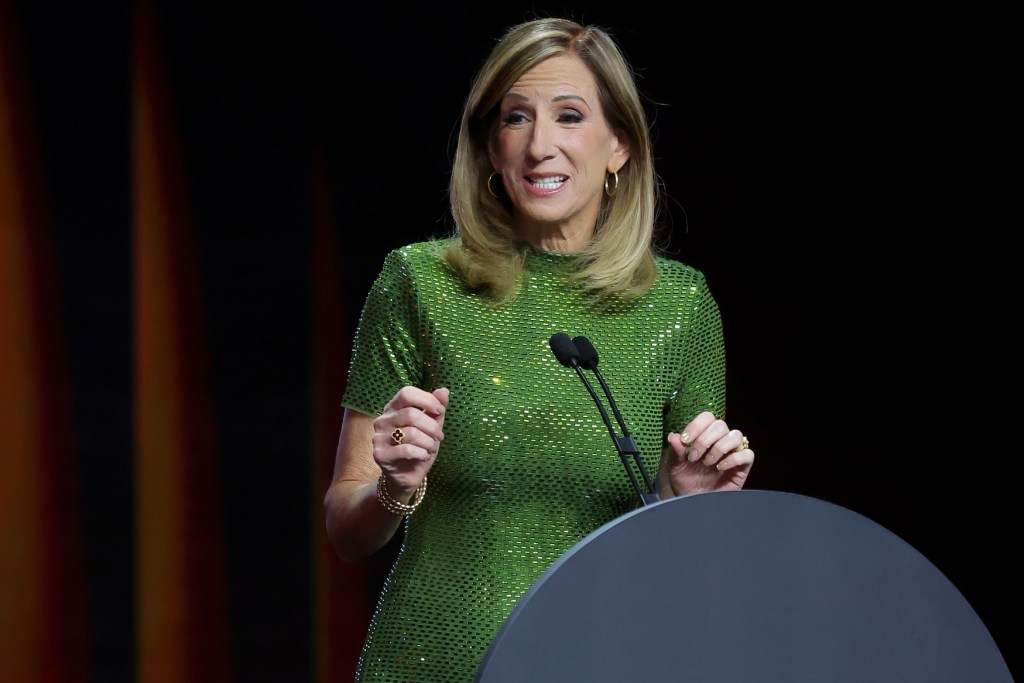
NEW YORK — Welcome to Basketball Insider, presented by The BIG EAST Conference. The most awkward moment of Monday night’s 2026 WNBA Draft came during Cathy Engelbert’s pre-draft availability, though the subsequent conversation around it reinforced the point Engelbert was trying to make. Let’s get into it, because there is a larger corrective I believe we need to apply to the way we evaluate her tenure as commissioner.
Basketball Insider
The New York Post’s Madeline Kenney asked Engelbert about her job status and whether she intends to stay in the position. This did not come out of nowhere — there have been people publicly questioning Engelbert’s work dating back to last summer, when player complaints grew louder amid a collective bargaining process that ended up stretching into March. Adam Silver, asked about Engelbert, sounded less than unequivocal. And internal league sources are leaking their concerns with Engelbert in a way no other commissioner is facing.
“I do crack up how everybody’s focused on me, and you should be focused on the thousands of women who run this league, outside of myself,” Engelbert said. “Our women owners, board of governors, GMs, and head coaches, and my whole team of diverse women and men who are working hard to get our 30th season tipped off by May 8. But I appreciate that you’re focused on me as well, I wonder if you would ask this of a man, by the way. We get asked different questions than men do.”
Let’s get this out of the way: Kenney, who is just the right amount of fearless as a reporter, would have asked this question of any commissioner. The bigger point that Engelbert was addressing, as I heard it, is about the larger conversation around her, what constitutes success, and what is cause for concern. (It’s something she could have addressed in a more effective way with a proactive, post-CBA media blitz, but that’s a strategy question for another time.) And from this viewpoint, that is a dramatically different set of parameters she faces than those set for, say, Silver, Roger Goodell or Rob Manfred.
To understand the scope of Engelbert’s tenure, it is necessary to know the history. Engelbert’s hiring in May 2019 came at a moment the league was about to undergo a pair of shocks to the system. One came from a CBA opt-out by the players, leading to a new agreement in January 2020. The second followed almost immediately, with a league that had just promised significant additional commitments on the salary side forced to reckon with a COVID-altered season.
Fortunately, Engelbert’s expansion of power — a commissioner, not a president — along with her business expertise, which dwarfed that of any leader of the league since Val Ackerman, helped the WNBA navigate these twin storms.
Listen now to The IX Sports Podcast and Women’s Sports Daily
We are excited to announce the launch of TWO new podcasts for all the women’s sports fans out there looking for a daily dose of women’s sports news and analysis. Stream on Spotify, Apple Podcasts or anywhere you listen to podcasts, and make sure to subscribe!
It is easy to pick on specific decisions made in that time. The capital raise, clearly, undervalued the league relative to what it is worth now. The additional context though — that capital was vital to the league’s growth at that time, and the owners who rightly believed in investing themselves rather than giving away equity were not a critical mass — means that the solution was one of necessity. Engelbert’s job is not to overrule a majority of WNBA owners. It’s not something she could even do.
And instead, somehow, the bottom line of it all is obscured. The WNBA is operating in a different stratosphere financially than it was when Engelbert took the reins. Somehow, all of that sucess, all of that level-raising, gets hand-waved, while any criticism at the margins is elevated.
This matters for so many different reasons, from turning teams into places owners are now actively investing, an arms race to elevate the league and the experience for players and fans alike directly because teams are now financial engines, to what it means for players entering the WNBA for the first time.
Joining the league has always been a joyful exercise. Drafts are happy nights. But no longer do players have to separate reaching that apex from knowing they are achieving true financial security as they do it. That happened on Engelbert’s watch. Engelbert took criticism even for privately taking some credit for this, as if that growth and assigning responsibility for it is a zero-sum game, as if the league adding partners at an almost unfathomable rate is the way things always went for the WNBA on the financial side of operations.
The players made this happen in the sense that of course without a product to sell, the league cannot monetize itself. But the current players are not the first group worth investing in. Tamika Catchings and Maya Moore and Deanna Nolan and Rebecca Lobo and Tina Thompson were all deserving of this cash influx, too.
What changed is who is in charge. I get emails every 15 minutes, it feels like, with big companies joining forces with the WNBA. And not deals with the NBA, the WNBA thrown in as a gift-with-purchase, but WNBA-specific deals. We heard about Procter & Gamble last week, Mars this week. I haven’t gotten a WNBA email about Boost Mobile in years, which is helpful, because I still don’t really know what Boost Mobile is. Is it a cell phone company no one uses? Is it a regional soda? No idea, and because I cover the current WNBA, I’ll never need to find out.
So if even taking stock of this publicly is fraught for Engelbert, allow me to do so: the league has a massive increase in media rights negotiated on her watch. The financial windfall of that, along with the new partnerships, have allowed her to bring the owners along on what is a transformational CBA, the phrase she used endlessly and never wavered from, regardless of personal attacks, and sealed it with all-nighters for two weeks straight, sounding ready for more at the end of each marathon.
Expansion used to be the thing league presidents were asked about and deflected. Under Engelbert’s watch, the league has grown from 12 to 18 teams, with a Canadian franchise joining the WNBA in 2026 and there are plans for a game outside of North America next year. And the teams joining are paying massive expansion fees which were already outpaced by what the Houston owners are paying to relocate the Connecticut Sun.
Perhaps most notable to me is that the things Engelbert does best, the league is now even better-positioned to maximize. I asked her how the conversations with potential partners have changed with labor peace, and this was her answer:
“One of the reasons, obviously we wanted to get a successful CBA done, is to build the confidence and balance it with the ability for these companies to continue to invest in a league that’s still in hyper-growth mode and a league that is drawing a ton of confidence, because again, if you think about why you would sponsor the WNBA, I mean, again, our fanbase, they’re avid. They’re rabid. They’re loyal.
“I think I saw a stat today that WNBA fans are 45 percent more apt to buy a product or service when a brand advertises in an arena or on our broadcasts than any other sports league. That’s a huge advantage for the WNBA…
“…But the confidence now, having long-term labor peace and having long-term media rights deals, the confidence in the league and its growth prospects are very high. Every business you’re trying to say to your investors or to your ultimate supporters, invest in us because we’re going to be in growth mode. And I think both those things that we’ve gotten done over the past couple years.”
Just for a point of comparison, here was former WNBA league president Lisa Borders at the 2016 WNBA Draft answering a similar question:
“I’ve been pleasantly surprised at how engaged our owners are and how engaged our players are and how willing they are to do whatever it takes to grow the game. So for example, I talked about — you asked me about social media. I asked the players would they be willing to use their own platforms to invite their friends, families and their followers to tune into a game or come to a game; would they be willing to go back to their undergraduate programs and speak on campus and invite their Trojans or their Titans or whatever they are to tune into the WNBA, and they said yes; they just had never been asked. So they are ambassadors of the game. They are the players. They are the talent on the floor, and they have more credibility at their home school, wherever it might be.”
A long-term CBA with long-term media rights deals and expansion set through the end of the decade means it will be the job of the commissioner, most of all, to do one thing: keep on filling the coffers for all the growth to come. No one has come close to doing this as well as Cathy Engelbert in league history, and it can be argued no sports commissioner has grown a league financially as well as Engelbert in any sport in recent history. The comparison that has always struck me is to David Stern. Remember when he was forced out? Neither do I.
Now, with her success in business and career accomplishments, it remains entirely possible that she may decide it isn’t worth it to continue on in this role. But the continued conversation around forcing her out of the position, well: if you’re a bottom-line thinker like Engelbert, and you look around and see all of the successes in your tenure, wouldn’t you be curious exactly why that conversation (particularly leaks from within the league itself) looks so different from the one about Silver or Goodell or Manfred? If you are Silver, shouldn’t you be taking proactive steps to keep Engelbert?
And if you’re the WNBA team owners or Adam Silver: exactly what would you want, from a bottom-line standpoint, in a commissioner that you aren’t getting from Cathy Engelbert? Careful what you wish for.
This week in women’s basketball
Really enjoyed this from Cassandra Negley on Cori Close.
Same with Maitreyi Anantharaman on the UCLA title.
Sabreena Merchant caught up with Cheryl Miller, a fantastic addition to the NBC broadcasts.
Worry not for Dawn Staley and South Carolina.
Five at The IX: Azzi Fudd
Mondays: Soccer
By: Annie Peterson, @AnnieMPeterson, AP Women’s Soccer
Tuesdays: Tennis
By: Joey Dillon, @JoeyDillon, Freelance Tennis Writer
Wednesdays: Basketball
By: Howard Megdal, @HowardMegdal, The IX Sports
Thursdays: Golf
By: Marin Dremock, @MDremock, The IX Sports
Fridays: Hockey
By: @TheIceGarden, The Ice Garden
Saturdays: Gymnastics
By: Jessica Taylor Price, @jesstaylorprice, Freelance Writer