Happy Hockey Friday! I’m Eli Fastiff from The Ice Garden, where there has never been more hockey news to write about. Not only is the PWHL midway through its combined expansion/free agency process, but the league’s entry draft is just five days away.
I cover college hockey, and while I’ve certainly kept an eye on all the expansion process news (which has been easy to do thanks to our PWHL staff’s great coverage!) I’ve been focused on our pre-draft previews. If you’re interested in learning more about who could get picked next Wednesday, read more here.
While a lot of the focus has been on which players might get drafted and what it would mean for the PWHL team that drafts them, I thought it would be interesting to learn more about what having a player drafted means for college programs. Over half of the 236 draft-eligible players are coming from NCAA programs, with all five Division I conferences represented. This week, I caught up with a pair of coaches from ECAC Hockey, a conference with 40 draft-eligible players including multiple who could hear their names called in the draft’s early rounds.
First, I talked to Colgate’s Stefan Decosse, who just wrapped up his second year as head coach, and 10th overall, in Hamilton, N.Y. In last year’s draft, two Raiders made headlines: Kristýna Kaltounková was selected first overall by the New York Sirens and Hannah Murphy was the first goaltender to be drafted. This year, four recent Colgate graduates have declared for the draft, headlined by Elyssa Biederman.
The next day, I chatted with Cassandra Turner, head coach of the reigning ECAC champions, Quinnipiac. Under Turner, who will begin her 12th season at the helm next fall, Quinnipiac has evolved into a pipeline to the pros, currently boasting 12 alumni in the PWHL, the fourth-highest total of any school according to College Hockey Inc.
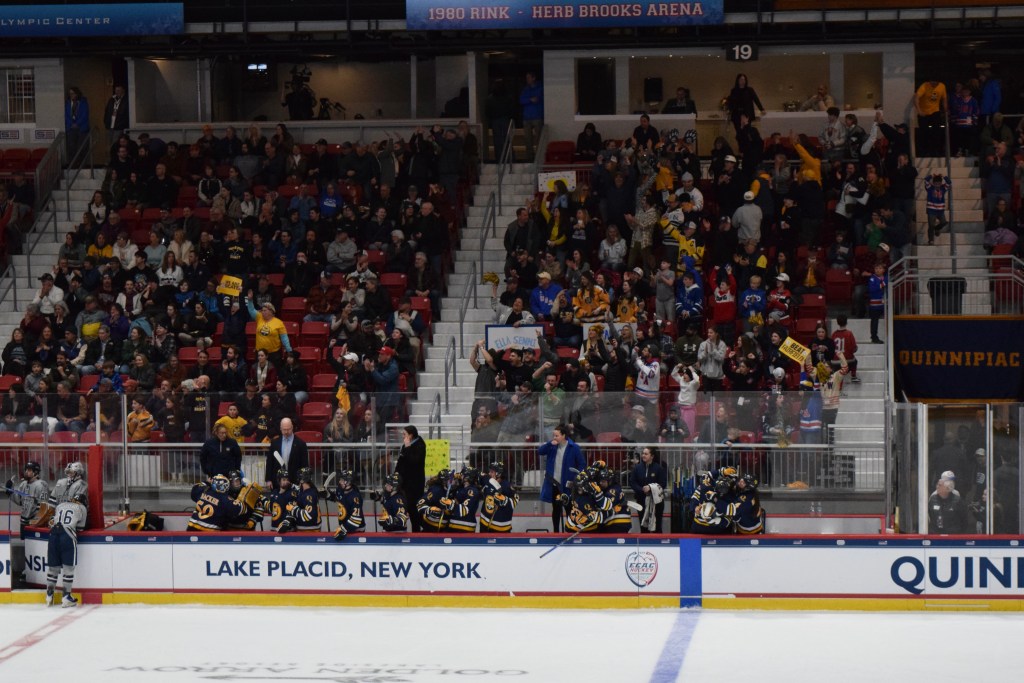
Here’s what Decosse and Turner had to say about their alumni’s successes in the PWHL, what they’ve heard from coaches and GMs about scouting college players. The two also spoke about how the option to play full-time after graduation has affected their teams.
Note: Questions and answers have been lightly edited for length and clarity.
The Ice Garden (TIG): What does it mean for your program to be consistently sending players to the next level?
Turner: It’s awesome, we’re so proud of them. I think for us, we try to create an environment where people love to come to the rink every day and are so passionate about getting better. I think to really be a pro who can sustain, enjoy and love that lifestyle, you have to want to get better and you have to love the game. I can say that about all of our alums that are currently playing in the league; they have just that. I hope we had a small part in being able to create that mentality for them while they were at Quinnipiac.
Decosse: It’s critically important for us as a program. … For us, development is at the forefront of what we do. But that’s just words, until it comes true. It’s easy to talk and say things, but what’s really important is to take a look back at programs and take a look at their outcomes, both as teams and individuals. We’re incredibly proud [of our alumni success] because we’re very intentional with our development process here.
Listen now to The IX Sports Podcast and Women’s Sports Daily
We are excited to announce the launch of TWO new podcasts for all the women’s sports fans out there looking for a daily dose of women’s sports news and analysis. Stream on Spotify, Apple Podcasts or anywhere you listen to podcasts, and make sure to subscribe!
TIG: Have you talked at all with PWHL head coaches and general managers? What have they told you they look for in college players?:
Decosse: Absolutely. It’s especially interesting because talking to [former Colgate and current Sirens head coach Greg Fargo] who has coached now at the Division III level, the Division I level and now the PWHL, the game just gets tighter [at every level]. And at the professional level, it’s just tough to score and that’s proven to be a challenge.
The vast majority of players who are playing in the PWHL, when they were playing collegiate hockey they were on the top power-play unit, they were on the top penalty-kill unit and now they’re in a 12 team league, that changes [their role]. So [figuring out] what role can you play, and how can you adapt your game to fit the needs of the team you currently find yourself on, that’s a new experience for players, one that they haven’t had to endure just yet.
Turner: I’ve had a lot of conversations with scouts and GMs. When they’re talking to me I feel like they get excited about Quinnipiac players because they know they’re going to know how to play on both sides of the puck, and that it’s not just going to be about the offensive side of the game, that they’re going to be able to be those everyday players. And when they bring offense, it’ll be great, but they know they’re not going to be a liability without the puck and they’re going to be great at winning pucks back.
TIG: Has the PWHL’s existence and the knowledge that there is an opportunity to play full-time after college changed how seriously players take their on-ice performance, practice and time in the weight room?
Turner: Yeah [and] it’s only going to accelerate the [college] game and help everyone get better. I think seniors always really care about winning, but I think our seniors, how they care about improvement, is just amazing. They want to go to the league, they want to get great positions, and they want to be ready. So it’s changed a lot of what it looks like I’m sure everywhere in college hockey, having this league to look forward to.
Decosse: It’s an entirely different ecosystem and landscape. I notice it with our current players. I notice it in the conversations we’re having with recruits. I notice it in just the ecosystem of youth hockey and what that landscape looks like and how more and more agents and family advisors and various elements that once were characteristic of the men’s side, were starting to see it on the women’s side. So I think there’s a lot of new, and a lot of things happening all at once, but it has certainly spiked the motivation of our athletes.
Catch up on PWHL expansion
“Five Excellent People” headline Hamilton’s expansion haul by Natalia Rachman
After a brutal Phase 2, who should the Seattle Torrent protect next? by Silvia Leija Rosas
Vancouver Goldeneyes escape Phase 2 with zero losses by Maya Smith
Where the Ottawa Charge stand after Phase 2 by Melissa Burgess
“Becoming Caitlin Clark” is out now!
Howard Megdal’s newest book is here! “Becoming Caitlin Clark: The Unknown Origin Story of a Modern Basketball Superstar” captures both the historic nature of Clark’s rise and the critical context over the previous century that helped make it possible, including interviews with Clark, Lisa Bluder (who also wrote the foreword), C. Vivian Stringer, Jan Jensen, Molly Kazmer and many others.
Soccer: Annie Peterson, @AnnieMPeterson, AP Women’s Soccer
Tennis: Joey Dillon, @JoeyDillon, Freelance Tennis Writer
Basketball: Howard Megdal, @HowardMegdal, The IX Sports
Softball: Maren Angus-Coombs, @Maren-Angus, The IX Sports
Golf: Marin Dremock, @MDremock, The IX Sports
Hockey: @TheIceGarden, The Ice Garden
Gymnastics: Jessica Taylor Price, @jesstaylorprice, Freelance Writer