

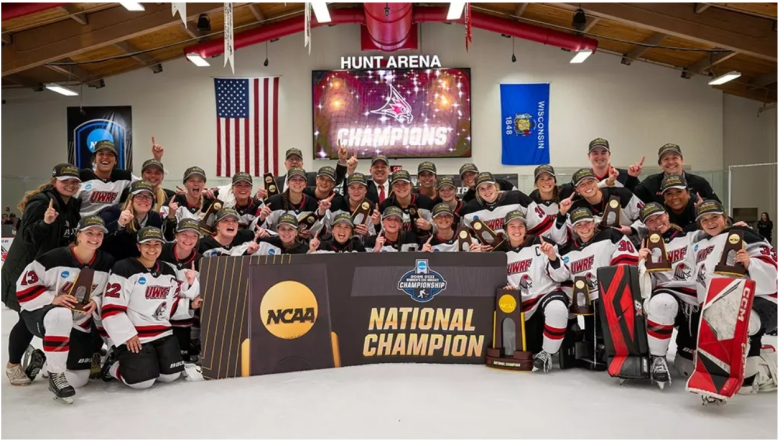
The University of Wisconsin-River Falls Falcons now fly in rarefied air, as only the third team to three-peat in D3 women’s hockey.
Joe Cranston’s squad romped through the postseason, allowing a grand total of three goals in six conference and NCAA tournament games while scoring 24 times. Their semifinal game against Amherst was a repeat of last year’s championship game, right down to ending with an identical 3-1 score. Meanwhile, on the other side of the bracket, championship weekend newcomer Nazareth roared back against perpetual favorite Norwich, rebounding from a 3-0 deficit after the first period to win, 5-4 in overtime. With this, Naz stamped their mark in the record book as the biggest comeback in D3 Frozen Four history.
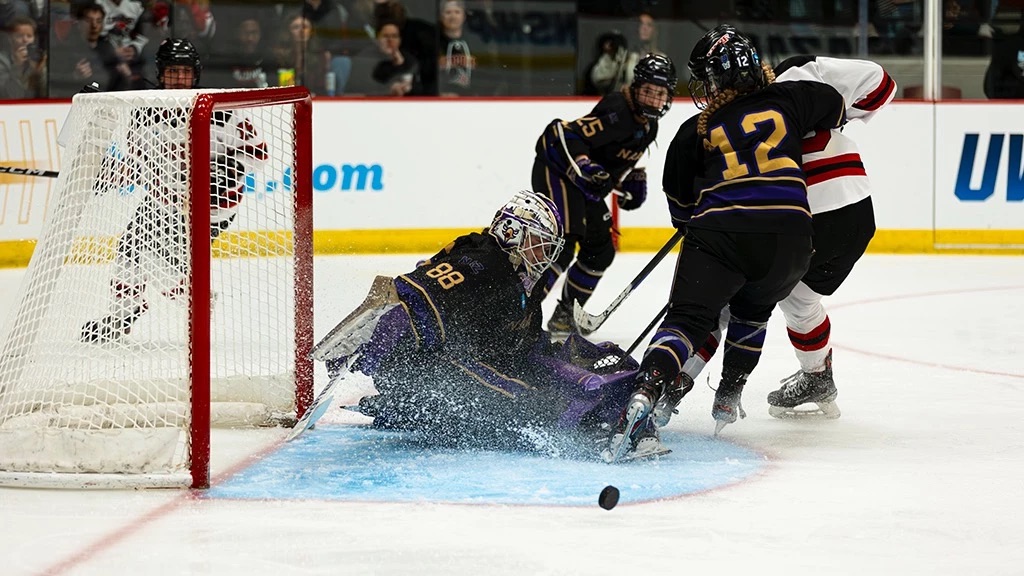
The championship game was less suspenseful: UWRF controlled play throughout, although Naz goalie Mia Gonsalves kept her team in the game by making one spectacular save after another, for a career-high 40 saves by the final horn.
First period
Naz took the first penalty of the game, a trip, just over three minutes in. Taking penalties against UWRF is playing with fire, as UWRF led the nation at over 45% conversion this season. True to form, UWRF kept the pressure on, with Naz unable to easily clear the puck all the way down. Nonetheless, Naz’s penalty kill held up, with the team helping out Gonsalves by blocking shot after shot. UWRF’s best scoring chance of the first period came between the two penalties, when Naz tried to send the puck deep but instead put it into UWRF forward Katherine Bell. Bell skated the puck in, all alone, but Gonsalves swallowed her shot. UWRF continued to carry the play after the breakaway. On one of Naz’s few forays into their offensive zone, Sydney Gurlea was called for body checking. Naz’s PK once again came through. The period ended with the game still scoreless, but a hooking call assessed on Naz forward Logan Marchese at the end of the first period meant that UWRF would start the second period on the PP.
Second period
Naz’s third penalty would prove to be their undoing. About a minute into the second period, UWRF’s star defender MaKenna Aure took a pass at the center point from Megan Goodreau on the right side and sent the puck to Brooklyn Riley in the left circle, who deflected it past Gonsalves. Riley is somewhat of a PPG specialist, as she scored all of her goals this year on the power play. That goal proved to be the game-winner. Nonetheless, UWRF kept pushing, and only a couple of minutes after their first goal, Aure sent the puck across the blue line to Cahlilah Lindquist, who took a shot from the right point. Gonsalves made the initial save, but the rebound found Sophia Hess on the back door with Gonsalves leaning the other way.
With UWRF up 2-0, Naz used their timeout to try and regroup. It paid off in that they got a power play opportunity of their own shortly thereafter, but they were unable to maintain extended possession in the zone, with UWRF repeatedly clearing the puck and even getting a shorthanded shot on Gonsalves. Naz got another crack at a power play when Hess, on the attack, tripped Naz forward Abby Flanagan behind her own net. The player advantage didn’t last: 38 seconds later, Bell headed towards Gonsalves on another breakaway, this one shorthanded, and was hooked down before she could shoot. The period thus ended with 4-on-4 play.
Third period
The third period started with a continuation of the penalty parade. Just before Naz returned to full strength, Hess interfered with a Naz player. But even with the player advantage, Naz’s offense continued to struggle and UWRF continued the attack. About halfway through the period, defender Sami Pool collected a puck at the blue line and walked it into the top of the right circle. She fired it into the slot, where Madison Kadrlik tipped it in for a 3-0 lead. However, there’s a big difference between coming back from being down 3-0 with 40 minutes left to play, and coming back from the same margin with less than ten minutes left.
As the period ticked on, Naz had their most dangerous sequence starting with about 8 minutes left in the game. Naz’s Ella Cedrone collected an errant pass from UWRF at the top of the left circle. She wristed it towards the net where Naz’s Amy Laskowski waited to help, either with a screen or a deflection. UWRF goalie Jordan O’Kane got enough of it for a whistle. On the next faceoff, Naz was finally able to maintain possession in the UWRF zone. Flanagan sent an innocuous-looking spinaround backhand from the slot to the net. O’Kane did not cleanly corral the puck at first, but forward Kylie Jones was there to help freeze it before either of the Naz players nearby was able to do any damage.
For the next few minutes, UWRF carried the play, just as they had for most of the game. They continued to pound shots at Gonsalves, forcing her to make more good saves. Naz managed a few more shots on goal of their own, but they were from distance, unscreened, or blocked.
Endgame
With 3:01 remaining in regulation, UWRF made another rare error and iced the puck. Naz took advantage of the faceoff in the zone and pulled their goalie. Despite the effort, Naz only needed 45 seconds to score an empty net game and cement the win at 4-0.
The whole game, UWRF was clearly in charge. Not only did they outshoot Naz 40-22, their shots were higher quality and more dangerous. Naz also blocked 21 shots in the game, on top of those that were on goal. From the first NPI ranking release of the season, UWRF had been on top by a huge margin. In this game they were the better team by far, and the score reflected it.
The championship game replay is available to stream on the NCAA Championships YouTube channel, the two semifinal replays are also available from the NCAA website (use the pulldown menu to specify D3), and all 12 games from the tournament are available on the NCAA Championship Pass smart TV app.
Broadcast Blues
I wish UWRF’s three-peat was the biggest story of the weekend. Maybe it was, to the 1689 fans inside Hunt Arena for the championship game. But those of us watching the stream at home this weekend, the experience was disappointing, not because the games didn’t deliver but because the broadcast was lacking.
Hello? Anyone there?
Audio issues became apparent almost immediately with the first semifinal between Nazareth and Norwich. I cued up the stream on my computer, and it went live a few minutes before puck drop. Unfortunately, the broadcast began without commentary. Finally, with 13:35 left in the period, we started to hear the commentary. But to have a national semifinal stream go nearly 15 minutes without commentary is unacceptable.
Video too
The scorebug was minimal, lacking penalty clocks and shot counts. We had to rely on the commentators to tell us how much time was left on penalties rather than being able to see for ourselves. I expect more from an NCAA-produced broadcast.
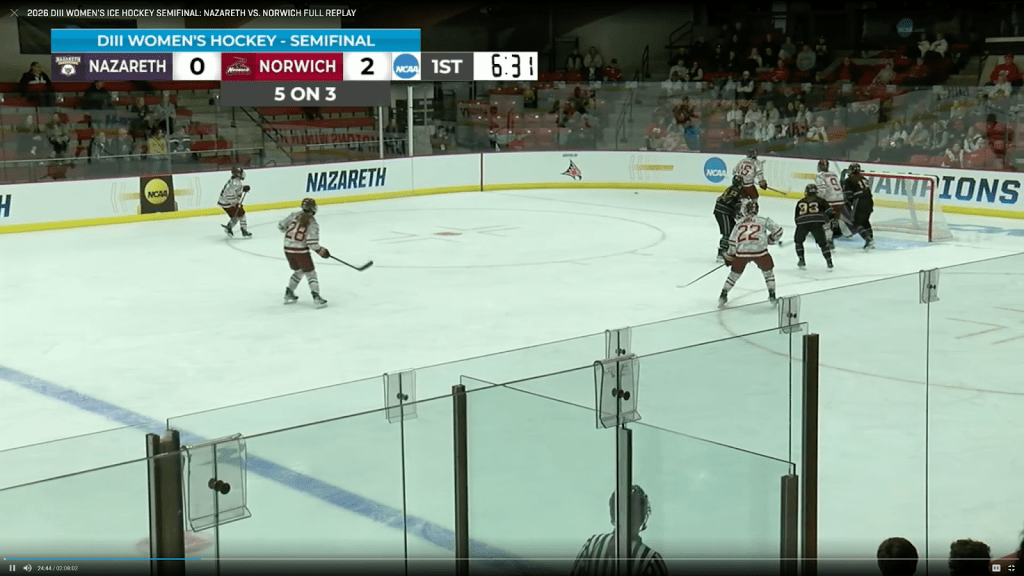
(Caption: The scorebug is minimalist, showing only the game clock, the score, and if play was something other than 5-on-5. No penalty clock, and no shot counts. Screenshot grabbed from NCAA video.)
(Alt text: A screenshot of the stream, showing play in Nazareth’s D-zone. Naz has dark uniforms on, Norwich is in light, and the refs are in stripes. The scorebug in the upper left corner says that Norwich leads 2-0 and is currently 5-on-3 with 6:31 left in the first period.)
Instant replays were problematic throughout the weekend. Sometimes we weren’t shown a good angle: on the reviewed goal in the first semifinal, the views we saw elucidated nothing about whether the puck was kicked in. An overhead view might have helped; presumably those were available since goal cams are required for the D3 championship weekend, but they were never broadcast. Sometimes the wrong play came up: instead of seeing the first period body check in the championship game, we saw UWRF making a line change.
The human aspect
The production quality issues touched on may or may not be easy to upgrade. But, one issue that should be easy to control is the information the commentators work from. Specifically, I felt like the team hadn’t done their homework. We heard a few stats and stories, but more significant items went unmentioned.
Take forward Megan Goodreau’s assist on UWRF’s first goal of the championship game, for example. It was her 77th point of the season, equaling Laura Hurd’s single-season record from 2002. It’s hard to overstate how enormous an achievement this is, given how different D3 women’s hockey was 26 years ago. This was one of the earliest records in the book; it’s likely that Hurd’s other records will never be broken or tied.
Even worse, the broadcasters spread misinformation. They went astray by saying that in two years, UWRF could host again as the top seed. However, as was discussed here earlier this year, the D3 men’s and women’s hockey committees met last summer and decided that, moving forward, all championship sites will be preselected. So no, UWRF cannot earn the right to host, although they can bid to have their arena selected to host, as happened last year.
The weekend featured first-class players playing a first-class game. They deserved a first-class broadcast, and it’s disappointing that it didn’t happen.
Awards
Laura Hurd Award
The Laura Hurd Award, given by the American Hockey Coaches Association, recognizes the top D3 women’s hockey player each year. The 2026 Laura Hurd Award winner is Megan Goodreau from UWRF.
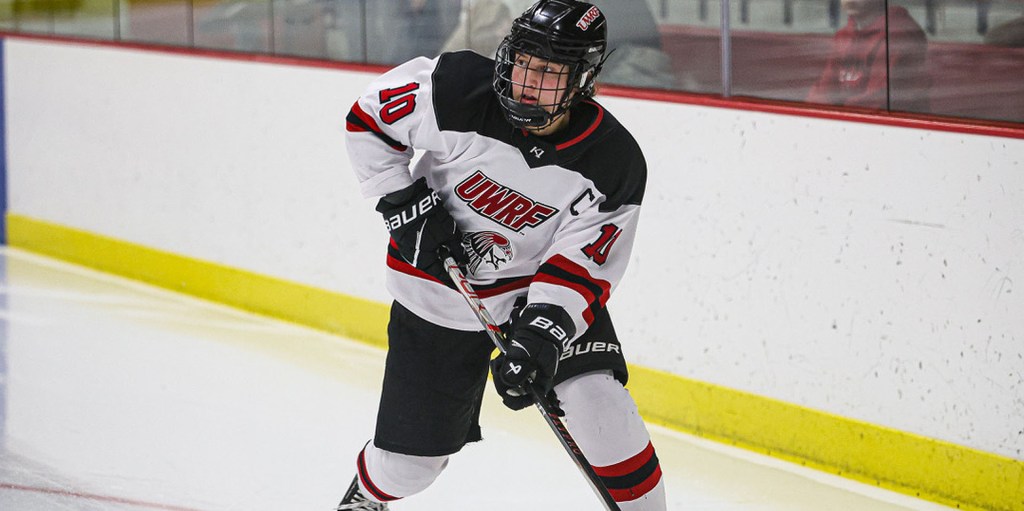
It seems fitting, even though the announcement came before Goodreau tied Hurd’s record for points in a single season. Goodreau is the third straight winner from UWRF, the fifth straight winner from a western school—every winner since the pandemic pause—and the fifth winner from UWRF, all coming in the last 10 years.
This year’s runner-up is Natalie Stott, Amherst’s outstanding goalie. Stott led the nation in GAA, save percentage, and shutouts, while still making a respectable number of saves.
All-Americans
The AHCA also named five teams of All-Americans this year, three teams in the east and two in the west. Of the 29 players named, 11 participated in championship weekend and seven came from teams left out of the tournament. (There is a mistake in the listing, as there is a duplicate player on east and west second teams. My apologies.)
Speaking of Stott, she entered some rarefied air this year. She’s only the third player and first goalie in the NCAA era to be tapped as a first team All-American for all four years of her career. MaKenna Aure, from UWRF, also became a four-time All-American this year, but she was named to the second team in her first season.
Also noteworthy: Molly Martin (D, Albertus Magnus, second team), Katie Mahoney (F, Cortland, second team), Abby Hansberger and Mackaylan McGown (both F, Concordia University Wisconsin, second team), and Michaela Birmingham (D, Western New England University, third team) are the first All-Americans from their schools in program history. It’s great to see new programs with All-Americans, just as it’s great to see programs make their NCAA tournament debuts (hat tip CSB). Growth is exciting. Congratulations to all!
Coach of the Year
And finally, this year’s coach of the year is Joe Cranston of UWRF. He is the only head coach the Falcons have known, and also won this award in 2024. He has coached his alma mater into a dynasty, with 17 appearances in the NCAA tournament and now three straight championships. Will he become only the second coach at the helm of a four-peating team, after Kevin Houle of Plattsburgh? We should know that by this time next year.
