

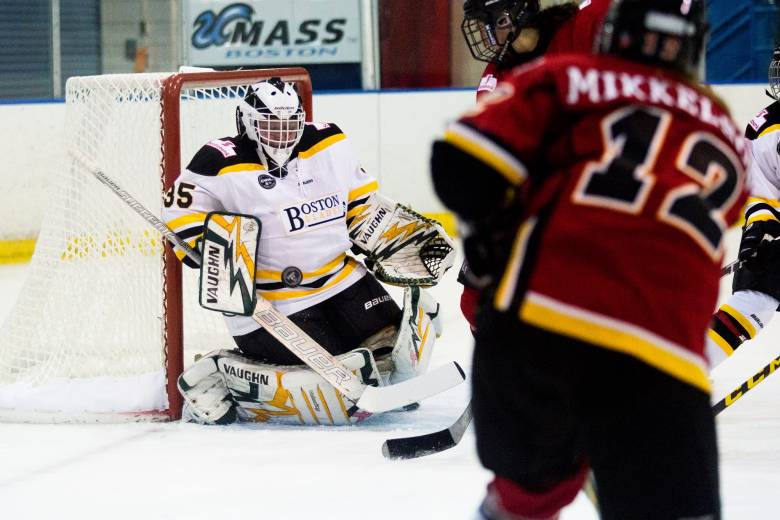
A common meme you’ll find out in the wild is that “Dudes can literally just sit around, name old sports players, and have the best time.” Honestly, this applies to all fans, regardless of gender. Find me a sports fan who doesn’t love reminiscing, and I’ll show you a liar. So, let’s sit around and name old players.
Dudes can literally just sit around and name old sports players and just have the best time.
— E.M. Hudson (@EMHudsonlives) July 15, 2021
This year the PWHL helped bring more eyes to women’s hockey than ever before. I’ve been watching women’s hockey since 2002—well, it would have been 1998, but my parents were all like, “No, you can’t stay up in the middle of the night watching the Nagano Olympics…” These players have been waiting a long time for this moment—and so have I. If you too have been through the trials and tribulations of the OG NWHL, CWHL, and PHF, this is going to spark some memories. If you’re one of the new fans, you’ll meet some cult heroes from back in ye olden times, when we were lucky to get any games streamed.
There are so many stories to tell that the best way to do this is in three editions: goalies, blueliners, and forwards. Goalies are obviously the best, so we’re going to start with them. This is all my opinion, and there will be an obvious skew towards North American goalies here because the CWHL/early PHF didn’t see a lot of European goalies. If you’re wondering where Nana Fujimoto is on this list, for example, my response is that she last played in the 2022 Olympics—not exactly a long time ago compared to the rest of the goalies here.
Sonja van der Bliek
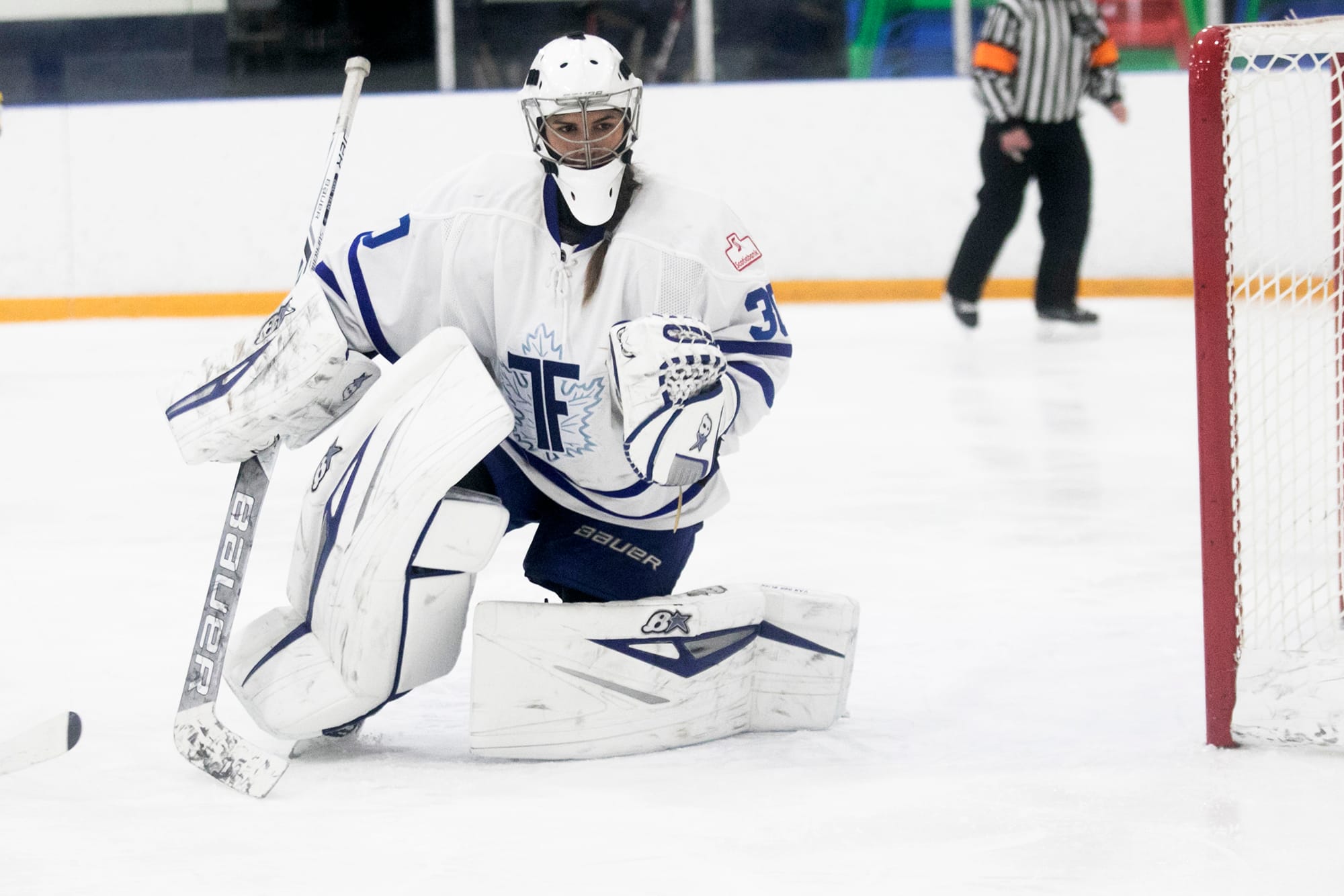
Oh yeah, we’re doing a deep cut right off the bat. Some of you may remember Sonja van der Bliek, though it’d be unsurprising if you didn’t, considering she spent her NCAA years at Rensselaer Polytechnic Institute, whose hockey program hasn’t been the most successful, and only three seasons in the pros as the starting goaltender. The rest of her time was as the backup. Unfortunately for Sonja van der Bliek, she was generally around too early for her teams to be good. With the Brampton Thunder it started out well, with her first season in 2011/12 on a Brampton team that finished with a 18-7-2 record led by Gillian Apps, Jayna Hefford, and Cherie Piper. She was in the backup role behind Liz Knox and won all three games that she was given.
.@TorontoCWHL G Sonja Van der Bliek has been under siege so far looking at the shot chart @saskystewart pic.twitter.com/DIUplfV2nd
— Giants in the Crease (@CreaseGiants) October 30, 2016
It was arguably all downhill from there as van der Bliek wouldn’t see game time in the 2012/13 season. When she came back for the 13/14 season, Brampton was left without its Olympians, leaving Brampton in a rough spot. The leading scorer Danielle Skirrow had 15 points in 24 games and van der Bliek finished with a 4-11-2 record to go with her -0.479 GSAA/30. To put it in perspective, Brampton goalies Jamie Miller finished with a -1.218 GSAA/30 and Erika Vanderveer had a -1.931 GSAA/30.
After one more season in Brampton, van der Bliek was off to the Toronto Furies, where she had a very good run as the backup behind Christina Kessler. When Kessler retired in 2017, van der Bliek was back in the starting role during an Olympic year where the Furies saw themselves without Natalie Spooner and Renata Fast. This went poorly for Toronto, who finished with a 9-17-2 record, but Sonja van der Bliek ended up with a good 0.625 QS%. She would spend one more year in hockey as she moved to Sweden to play with a struggling Brynäs IF team, finishing with a 9-9-1 record and 0.579 QS%.
Christina Kessler
This next goalie isn’t much of deep cut. If you were a CWHL fan anytime before the 2018 Olympics, you probably fell in love with Toronto Furies goaltender Christina Kessler. Nearly every game could be summed up as Kessler/Spooner vs. the opposing team. For newer fans, a good comparison might be Carly Jackson with Buffalo—not necessarily in style, but in how they played their hearts out against wild odds. If the CWHL had longer lasting power and Kessler was on some better teams, she might have been comparable to Amanda Leveille. Neither broke through to the national team, but both had such good domestic league careers that would put them in HHOF conversations.
Christina Kessler faced 150 shots (unofficial) in 3 games against the Inferno. She allowed 8 goals… that’s a .947 sv%. MVP of series #CWHL pic.twitter.com/s7QgL7h6Cs
— Mike Murphy (@DigDeepBSB) February 26, 2017
Kessler was certainly no slouch when she joined the CWHL. She put up a tremendous career in the NCAA with Harvard University helping them to some of the biggest successes that program has seen since the late 90’s. Upon moving to the CWHL, Kessler was saddled with helping the Burlington Barracudas. If you don’t remember who they are, that’s because they disbanded in 2012. It was not good times in Burlington for Kessler, who saw six wins in 29 games, though she didn’t do too poorly herself with a 0.583 QS%.
Upon moving to the Toronto Furies, things were rough the first season (4-11-1, 0.385 QS%), but in the 2013/14 season Kessler was the star of the show as Toronto won its first and only Clarkson Cup in CWHL history. It was a wild upset as the 10-10-3 fourth place Toronto Furies would win over the 19-2-2 Montréal Stars, 13-11 Boston Blades, and 12-11-1 Calgary Inferno. After their Cup win, though, the Furies found themselves routinely close to the bottom of the league, despite Kessler’s play. In her final season she left on the highest note she could with a 0.765 QS% and 6.7 GSAA. After playing for such poor teams, Kessler did have the silver lining of leaving with a Cup championship, noted as a playoff MVP, and having the most saves in CWHL history, with 3005 saves over 115 games played.
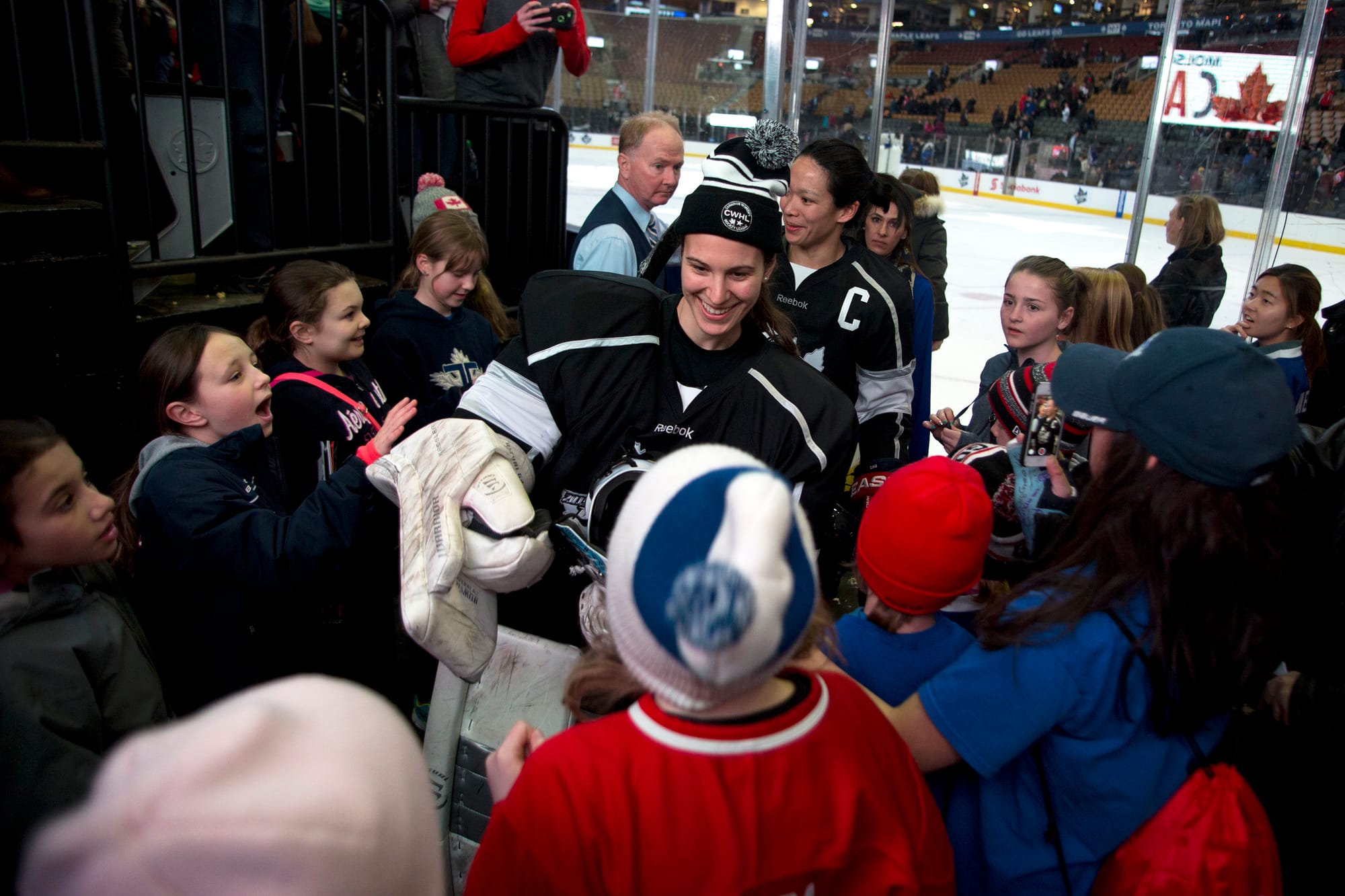
Lauren Dahm
The creation of the new NWHL (later known as the PHF) led to the demise of the CWHL Boston Blades franchise. I’m not going to debate whether the league deserved to lose all of its Team USA players, but that’s what happened, and the Blades never recovered. They went on to win a total of four games in the four seasons post-2015. It was dark times, and in dark times you need a hero. That hero came in the form of one of the most fascinating goalies I’ve had the pleasure to watch: Lauren Dahm.
To say the Boston Blades were left scrambling to find players is an understatement. Lauren Dahm had a long NCAA career with a good program at Clarkson University. The issue is that that career ended in 2011 and Dahm was brought to the pro ranks in 2016. Not exactly ideal.
#SquadGoals 💛🖤 pic.twitter.com/9ze9kJZvlj
— Lauren Dahm (@dahmer35) March 9, 2018
There’s being thrown in the deep end, there’s being thrown to the sharks, and then there’s being thrown into the Boston Blades net after five years not even at the NCAA level. She played for a team who in the previous season won only a single game, and where Olympian Geneviève Lacasse saw 50.5 SA/60 while posting a -0.099 GSAA/30. Considering the team didn’t improve much, if at all, Dahm did all she could seeing 45.2 SA/60 with a -0.692 GSAA/30.
The next season really wasn’t much better for the Blades, even with all the Olympians gone from the CWHL. Dahm still saw 42.1 SA/60 but improved to a -0.056 GSAA/30. Her final season was a disaster, though it’s really hard to blame her considering the CWHL saw a returning influx of Olympians, plus elite players like Brianna Decker and Hilary Knight.
Unfortunately, Dahm isn’t going to be known for turning the Blades franchise around—not even Lacasse could do that. She’ll be known instead for being the smiling bright spot in a dark time for a doomed team. In three seasons, she finished third all-time in CWHL history in saves, which is astonishing as she only played 61 games.
Katie Fitzgerald
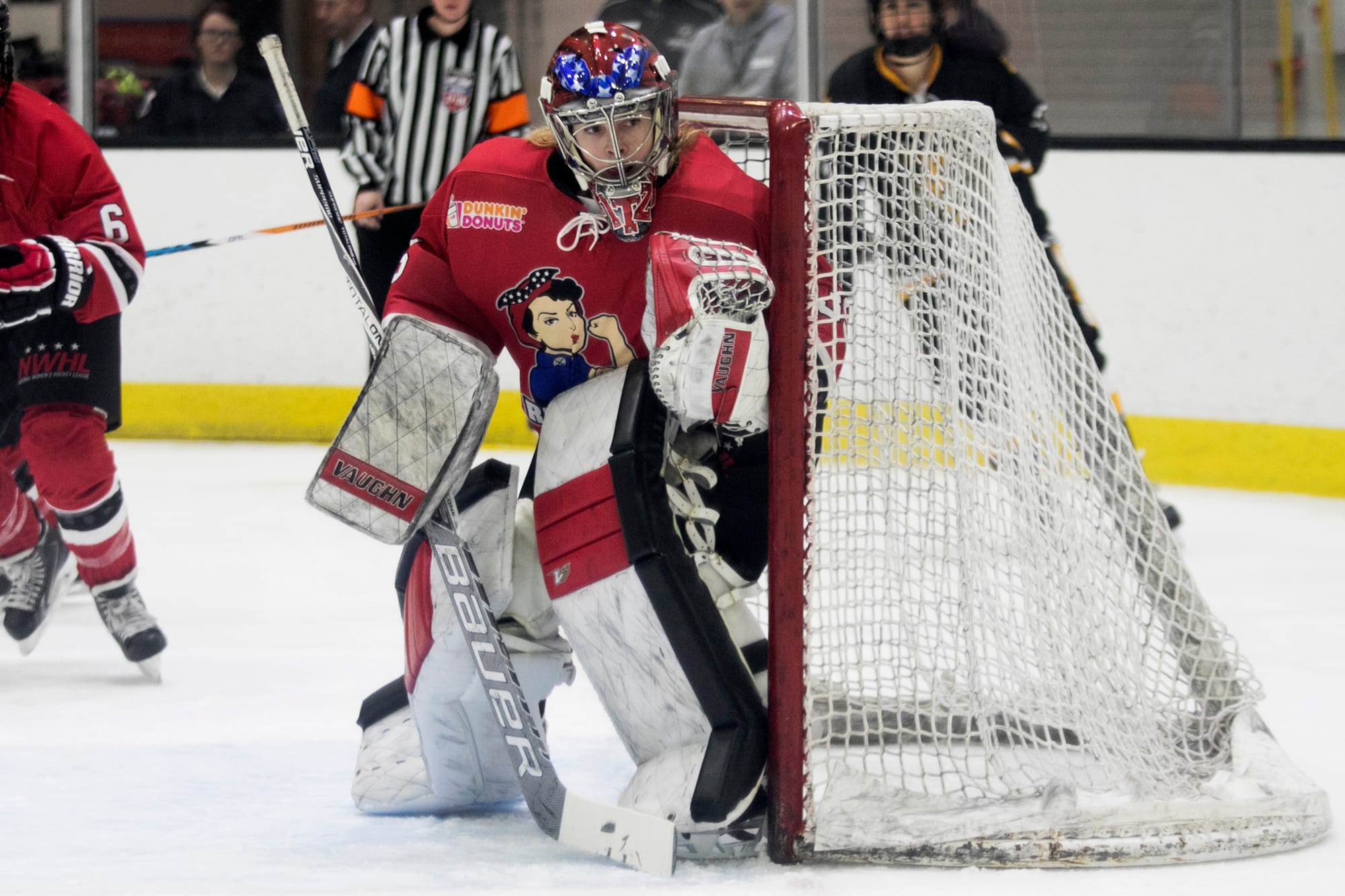
The Metropolitan Riveters were one of the most beloved NWHL/PHF franchises from the beginning, with a banger of a logo featuring WWII icon Rosie the Riveter. Despite all the love given to the franchise from its dedicated fanbase, it’s hard to argue that for the vast majority of its eight season existence the franchise fell short of delivering what the fans so desperately wanted: just a simple Isobel Cup Final game. That is, until 2017/18, when the Metropolitan Riveters had themselves a helluva season ending with an Isobel Cup Championship.
It was the only season the Riveters actually finished with an above 0.500 PT%, and they crushed it going 13-3 in the regular season. None of this would have happened without Riveters legend Katie Fitzgerald. In the inaugural NWHL/PHF season, the Riveters were backstopped by Japanese goaltending legend Nana Fujimoto. She was a huge get for the league but left after the 15/16 season. She left some big skates to fill, and in came St. Cloud graduate Katie Fitzgerald.
katie fitzgerald doing katie fitzgerald things pic.twitter.com/psojeq0VEY
— Michelle Jay (@michelle_jay3) March 8, 2019
If anyone was used to playing on a struggling team it was Fitzgerald, who put up +0.900 SV% seasons on a team in arguably the toughest conference in the NCAA (WCHA) and only hit double digit wins (13) once in Fitzgerald’s last season as starting goaltender. She brought hope immediately to the team by being the best goalie in the league and preventing the Boston Pride from having a perfect regular season.
With the Olympians gone in 2017/18, the PHF season was all about Katie Fitzgerald and Amanda Leveille. Leveille proved to be better in the regular season, taking the PHF Top Goalie crown away from Fitzgerald, but the Riveter goaltender would have the last laugh. Fitzgerald didn’t allow a single goal in the playoffs and made 21-saves to shut out the Buffalo Beauts and win the Isobel Cup.
When the PHF made a big recruiting push for the 18/19 season, the Riveters did not fare well, ending up in the race for last place with the Connecticut Whale and leaving Fitzgerald with some ugly numbers in her final PHF season. Despite the last season of her career, Fitzgerald gave Riveters fans two seasons of hope, fun, and success.
Jessie Vetter
If you look at Team USA today, you’ll notice that it’s rare to see one goalie stay in the crease for too long. Maddie Rooney won Gold in 2018, but in 2024 she’s not even the third goalie on the depth chart. Nicole Hensley is constantly on and off the depth chart. After spending a few years working her way up, Aerin Frankel has taken the starting spot, but for how long? So to have a goalie claim the crease for almost nine years is definitely an impressive feat—but you might never guess who that was.
On this date in 2006: @BadgerWHockey defeats St. Lawrence in the Frozen Four Semifinal game! Badger goalie Jessie Vetter records a shutout, and later would became the first goalie in #WFrozenFour history to record back-to-back shutouts in 2006. 🏒 pic.twitter.com/0pvHUqFfv3
— NCAA Ice Hockey (@NCAAIceHockey) March 24, 2020
The career of Jessie Vetter should undoubtably put her in the Hockey Hall of Fame, but no one is even talking about her… at all. You can find Vetter’s name 12 times in the NCAA record book. To put that into context, you can find Frankel’s name in the record book 14 times and Vetter has seen 15 years pass since her last NCAA game. Looking at both the Olympics and World Championships, Vetter is the USA’s all-time leader in games played (28). She’s made an appearance at those tournaments a combined 10 times, leading all American goalies.
Vetter currently sits sixth all-time in WHC wins and 11th all-time in Olympic wins. While she left both Olympics with a silver medal, her trophy case also contains six WHC gold medals and two silver. No other goalie in WHC history has as many Gold Medals as Vetter does. To boot, she doesn’t have a single WHC loss in regulation. She was the prominent American goalie from 2008 to 2015, but because she never played in a domestic league apart from the NCAA, she’s been forgotten by mostly everyone.