

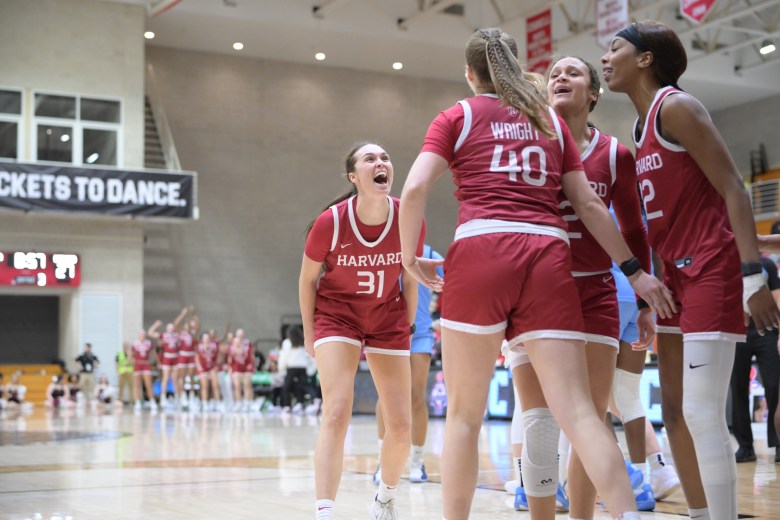
ITHACA, N.Y. — The players huddling in front of both benches were expecting double overtime.
Trailing by 2 points with four seconds left in overtime in Friday’s second Ivy League Tournament semifinal, Columbia had gotten the ball to Ivy League Player of the Year Riley Weiss.
The junior guard danced on the perimeter, then drove to the rim and put up a shot with two Harvard defenders converging on her. As Weiss absorbed some contact and hit the court, a referee’s whistle pierced the crowd noise. One official put a fist in the air to signal a foul, and another waved their arms, signaling that the shot was too late.
The officiating crew immediately went to the monitor to check whether the foul happened before the buzzer. So both teams headed to their benches to wait — and to talk about what could come next.
“I was ready to knock down those free throws and go to double OT,” Weiss told reporters postgame. “So that’s what was going through my mind.”
“I [was] ready to play more basketball,” Columbia senior guard/forward Perri Page chimed in.
The third-seeded Crimson assumed Weiss, an 84% free-throw shooter, would hit both shots, too. But they were smiling in their huddle and “building each other up,” Harvard junior forward Abigail Wright said postgame. They were ready to win the next five minutes and beat the second-seeded Lions.
“If it went into double overtime, good,” Crimson junior guard Karlee White told reporters. “We’re built for that. We practice that every day. We’re built for hard moments.”
What actually came next, though, was nothing. No more basketball.
The officials ruled that the foul came after the buzzer, so Harvard’s 67-65 lead held up. Upon hearing the news, many of the Harvard players bounced into the air, their delight propelling them up and down and up again. Wright wrapped both arms around head coach Carrie Moore’s neck before jumping into the fray.
It was a split-second ending to a game full of twists and turns. There were four ties and 12 lead changes, and neither team led by more than eight points.
Harvard made the first push and led for 32:58 of the 45 minutes. But Columbia kept battling back, including erasing an 8-point deficit in the last 4:48 of regulation. The Lions even had a chance to win on the final possession of regulation, but they couldn’t get a shot off.
“We knew it was going to be a heavyweight match between these two teams,” Moore told reporters afterward. “Every time we play them, it is like this. And this time of the year, I wouldn’t expect anything less.”
Listen now to The IX Sports Podcast and Women’s Sports Daily
We are excited to announce the launch of TWO new podcasts for all the women’s sports fans out there looking for a daily dose of women’s sports news and analysis. Stream on Spotify, Apple Podcasts or anywhere you listen to podcasts, and make sure to subscribe!
Harvard’s win was the fourth upset ever in the modern Ivy League Tournament, which began in 2017. The Crimson are responsible for all of those wins as a No. 3 seed, and they’ve all happened in Moore’s four seasons. Three of the four upsets have come against Columbia: in the semifinals in 2023 and 2026, and in the final in 2025.
The latest loss was an especially tough pill for Columbia to swallow. Head coach Megan Griffith questioned herself after Friday’s game, a departure from her usual unwavering confidence and conviction. She pondered how she’d tried to be more patient this year than ever and second-guessed whether that had been the right strategy after all.
“[We] just underperformed … and you just have to live with that,” she said in her opening statement. “… But I didn’t recognize that team today, and unfortunately, that’s where it starts, at the top, with me, with leadership. So I have to go take a big look at the mirror and figure things out.”
Moore has also questioned herself in the last few weeks, puzzling over why Harvard hadn’t been able to climb higher than the No. 3 seed and become a favorite rather than an underdog. The Crimson have clearly figured out how to thrive in the No. 3 spot, but they’re sick of being there.
“We have always taken third place as disrespect,” senior forward Katie Krupa told reporters postgame. “It’s always been our mentality in this tournament. … I think [it] stinks for Columbia that they’re the ones who have seen us so much in that sort of mindset. … But I think that we would approach that game [the same way] regardless, no matter who our opponent is, because I think we know who we are and what we’re capable of.”
Harvard has been dangerous this postseason, partly because it has figured out how to close games. The Crimson lost to Columbia on Jan. 10 on an and-one by Page in the final seconds, and they would’ve upset Princeton on Jan. 19 if not for guard Ashley Chea hitting a buzzer-beater to force overtime.
But on Feb. 27, Harvard held off Penn, which needed a win to stay in the race for the four-team Ivy League Tournament, and it overcame a 16-point deficit to beat Columbia on March 7. That win denied the Lions a share of the regular-season title and dropped them to the No. 2 seed in the tournament, setting up Friday’s rematch.
Because Harvard had played Columbia so recently, Moore told her team that the game plan had to look different. During the March 7 game, White and Ivy League Rookie of the Year Olivia Jones had carried the team from the guard position, and Harvard had relied on four-guard lineups to close out the game. Moore said on Friday that she thought knowing the strategy had to change helped her frontcourt players assert themselves, and they ended up deciding the game.
Krupa hit a dagger of a 3-pointer with 44 seconds left in overtime, despite shooting 0-for-4 from 3-point range before that shot. After one of those misses, Moore had told her, “Fall to the level of your preparation,” which meant trusting the work she’d put in all season. Krupa thought back to all the threes she’s shot in practice and nodded.
Friday was the second time this season that Krupa has hit a monumental three, as she made one that nearly stood as the game-winner on Jan. 19, just before Chea’s buzzer-beater. But this time, she put Harvard up by four points, not three.
After Columbia scored on its next possession, Krupa also calmly sank two free throws to push the lead right back to four. She had a game-high five points in overtime and nine overall, plus six rebounds.
“Every upset that we’ve had in this tournament, KK has been a part of,” White said. “And she’s a game-changer, she’s a program changer, and we kind of let her know that [pregame today] because we have so much belief in her.”
Wright also stepped up for Harvard with a team-high 18 points on 8-for-14 shooting and three rebounds. She’d been benched late in the March 7 win over Columbia because Moore thought she was giving up too much defensively and not executing offensively. Moore also saw Wright and Krupa crowding each other offensively and wanted more spacing. The move paid off in the 68-64 win.
In the days that followed, Moore and Wright had multiple conversations about that benching. Moore was direct about why it had happened and how Wright could play better in the rematch. At the same time, Moore made sure to remind Wright that she was named second-team All-Ivy on Tuesday for a reason. Namely, it’s because she has thrived in a bigger role for most of the season, increasing her scoring from 5.4 points per game last season off the bench to 13.4 this season as a starter.
On Friday, Wright explained how she’d found success in the semifinal by referencing the same phrase as Krupa did: She fell back to the level of her preparation.
Wright got off to a near-perfect start, scoring Harvard’s first six points.
“[I was] just really excited for her to set the tone the way she did out of the gates,” Moore said. “… Early on, she was a big anchor for us.”
However, Wright picked up her first foul just seven seconds into the game and her second with three minutes left in the first quarter, sending her to the bench. And she wasn’t alone: White and fellow starter Saniyah Glenn-Bello also picked up two fouls in the first half. In the second quarter, Moore had to turn to a five-player lineup that had played zero possessions together in the regular season.
But the reserves kept the game within reach, and the foul-plagued trio stayed engaged on the bench and was raring to go after halftime. Wright had a game-high 12 points and played all but three seconds in the second half.
“Having two fouls early on for the both of us didn’t matter,” White said. “Abigail and I were talking like, ‘This is our half.’ There’s so much power in that. And Abigail came out and just made it her game.”
“She played like the player they needed her to play like today,” Griffith said.
Wright’s performance got Harvard to the Ivy League Tournament championship game for the second straight season. This time, it’ll face Princeton — the school Wright’s mother, Ellen DeVoe, and brother, Ethan Wright, both played for. (Both DeVoe and Ethan Wright also earned All-Ivy honors, so Abigail Wright added to the family’s long list of accolades with the first selection of her career on Tuesday.)
Princeton, the No. 1 seed, won its semifinal in a much different fashion than Harvard did. It raced out to a 29-8 lead on No. 4 seed Brown, forcing Bears head coach Monique LeBlanc to burn two timeouts in the first quarter.
“We came out a little bit like a team, where it was our first time here. We were a little bit tight in some areas,” LeBlanc told reporters after her team’s first Ivy Madness game since 2017. “I thought Princeton came out like a team that’s been here a bunch, and they have.”
Princeton extended the lead to as many as 27 points midway through the third quarter. The Bears cut the lead to 10 late in the fourth quarter, but they couldn’t come all the way back, losing 65-51.
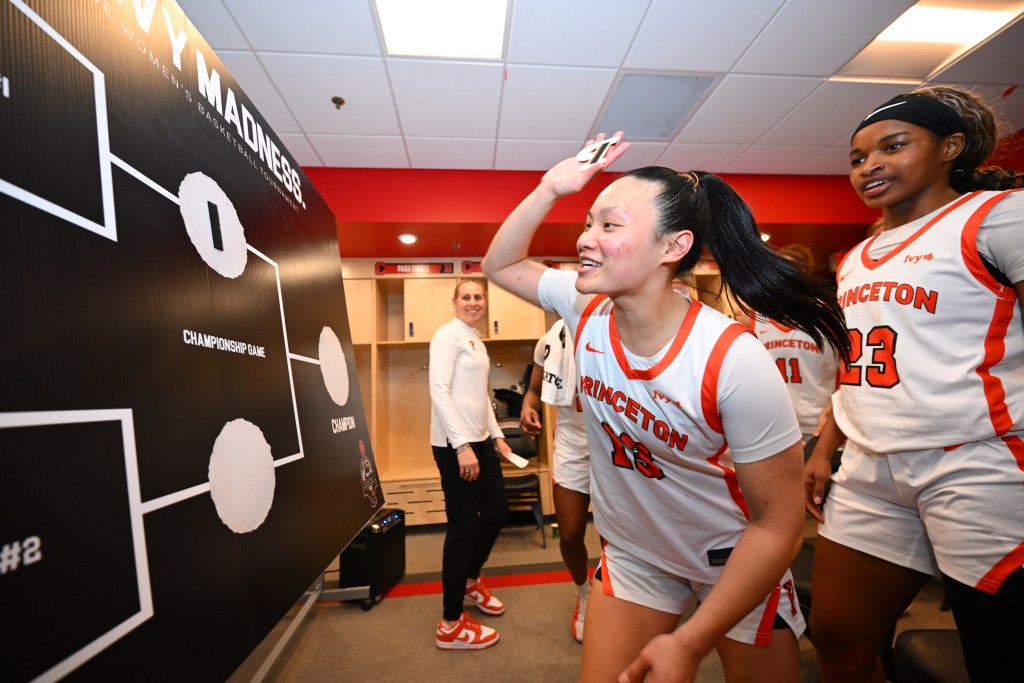
“We talked about the first quarter and how we want to come out strong, and we did that,” Princeton head coach Carla Berube told reporters postgame. “This time of the year, it’s not always pretty … but we weathered the storm. And … it’s about ‘survive and advance’ at this time of year.”
After the Tigers dispatched the Bears, they settled in to watch the Harvard-Columbia semifinal. Berube said she didn’t care who won; she just hoped it would go to quadruple overtime, to help tire out her opponent for Saturday.
She didn’t quite get her wish, but even one overtime shortened Harvard’s already-quick turnaround. At the postgame press conference, the moderator asked Moore if she needed a minute before getting started. “No, no, we’re ready,” she quickly responded. “We must get out of here.”
Moore’s urgency came because she has the blueprint memorized by now to engineer an upset. Her team needed to recover as soon as possible, physically, mentally and emotionally, so it could move on from the Columbia game and prepare for Princeton. Her players needed to take ice baths, use other recovery tools and get some sleep to reduce soreness and refresh their bodies.
Or, as Moore phrased it to her team: “Flush it, literally and figuratively.”
“Becoming Caitlin Clark” is out now!
Howard Megdal’s newest book is here! “Becoming Caitlin Clark: The Unknown Origin Story of a Modern Basketball Superstar” captures both the historic nature of Clark’s rise and the critical context over the previous century that helped make it possible, including interviews with Clark, Lisa Bluder (who also wrote the foreword), C. Vivian Stringer, Jan Jensen, Molly Kazmer and many others.
