

FBref, once the preeminent source of global soccer data, has become a ghost town.
On Jan. 20, Sports Reference, the company that operates FBref, announced that advanced statistics would be removed from the site, effective immediately. According to the company, the data had disappeared due to a disagreement between Sports Reference and its soccer data provider, Opta, which is owned by StatsPerform. In a statement to The Athletic, StatsPerform said that it had terminated FBref’s access to its feeds because FBref had violated the terms of their agreement.
While the violation remains unknown, the impact to soccer data has been immediate, and the women’s game has taken the brunt of it.
Opta became Sports Reference’s soccer data provider in 2022, which improved the site’s coverage and data granularity. More importantly, in switching from StatsBomb to Opta, FBref added data from 10 new women’s competitions, which had not previously been covered on the site. That made FBref the best place for journalists and the public to find data about women’s soccer players, teams, and matches — and that was intentional.
“We are pleased to announce that we are now a partner with Stats Perform Opta,” FBref said in a 2022 statement. “Opta’s data has replaced the previous data from StatsBomb on our site in all cases. This new partnership is the largest data deal we’ve ever signed and represents a huge commitment by FBref to advance access to Women’s football data throughout the world.”
Many of the advanced models and novel metrics that made FBref invaluable are no longer accessible. While users can still find scores for matches and track who leads each league’s golden boot race, the stats end there. Gone are expected goals (xG), progressive passes, shot-creating actions, and the other advanced stats that once made FBRef so uniquely useful. In their place is a white void spanning half the page.
Listen now to The IX Sports Podcast & Women’s Sports Daily
We are excited to announce the launch of TWO new podcasts for all the women’s sports fans out there looking for a daily dose of women’s sports news and analysis.
Stream on Spotify, Apple Podcasts, or anywhere you listen to your podcasts and make sure to subscribe!
The removal of advanced data from FBref, which has shaken the soccer analytics community as a whole, could prove to be detrimental for those covering the women’s game. With no clear successor ready to take its place, the data disparity between men’s and women’s soccer is stark and could continue to grow. FBref, with its charming design reminiscent of the internet of a previous era, was critical for many who cover the sport week in and week out.
“We are especially upset by the massive step back this creates in access for women’s advanced soccer data,” FBref’s statement announcing Opta’s termination of their contract says. “Data Democratization is a core Sports Reference value and the removal of this data is a sad day for all of us.”
The list of FBref’s competitors is short. Some fall into the category of ‘score app’ — mobile-first platforms that serve as fans’ go-to for scores, game times, and more. Others are websites that prioritize granularity at the cost of breadth of coverage or ease of use. One such website, Opta Analyst, is a site hosted by the aforementioned raw data provider. For a selection of competitions, most of which are men’s, Analyst publishes data-driven analyses, displays metrics through interactive tables, and even showcases the granularity of their data through game-specific chalkboards that display every single event in a given match. Overall, like Opta Analyst, many of these sites skew toward the men’s game rather than providing balanced coverage across top leagues for both genders. Some haven’t invested in women’s soccer data at all.
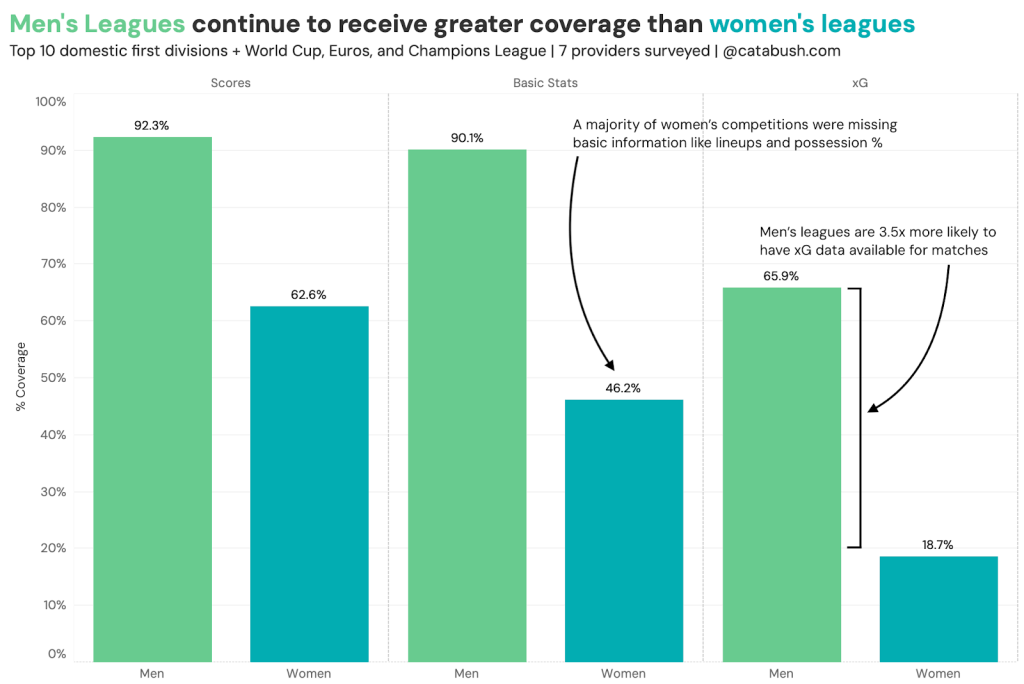
The situation is dire. A survey of seven FBref competitors found that, on average, women’s competitions were covered on these platforms at a rate of just 63%. (The survey’s results are the average of what percent of sites cover each league. In simple terms, if the survey was only looking at three competitions: if Competition A is covered on 30% of sites, Competition B is covered on 20% of sites, and Competition C is covered on 100% of sites, that would result in an aggregated 50% coverage rate.) Further, more than half of these competitions were missing basic information like lineups, shot totals for each team, and possession percentage — knowledge that is easy to access for men’s soccer fans.
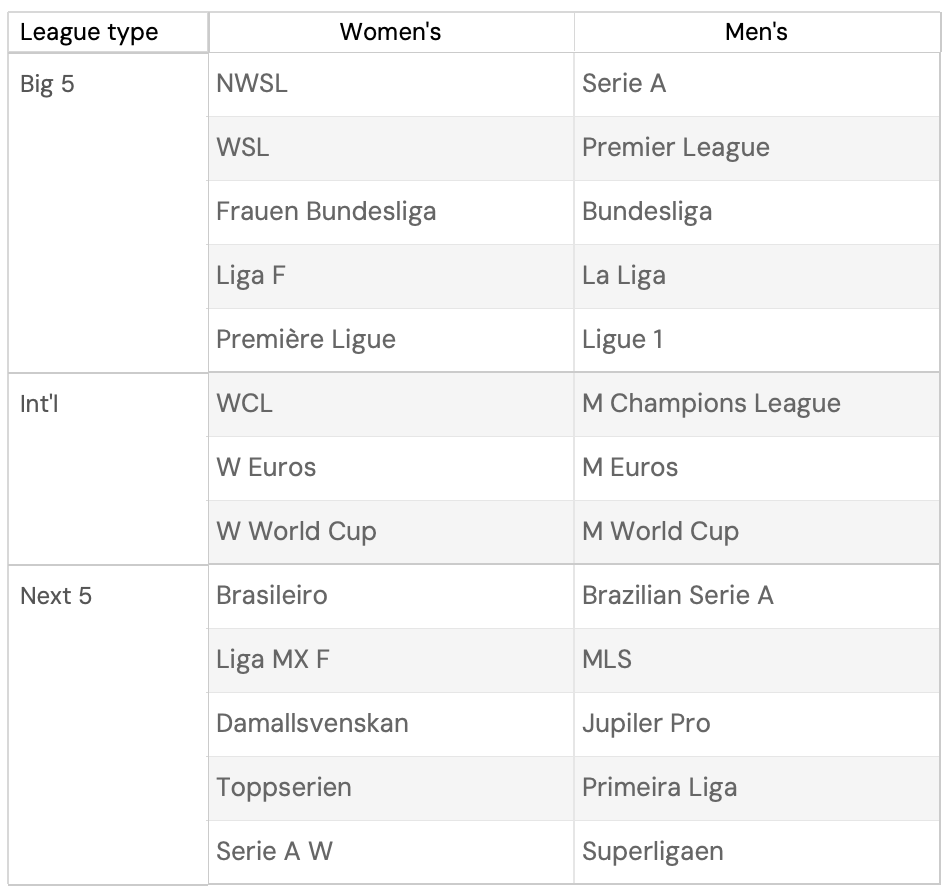
The survey considered the top 10 domestic first divisions (as decided by Opta’s own league power rankings), the World Cup, European Championship, and Champions League for both the men’s and women’s game. The results, as shown above, were anything but equal.
The starkest difference was found in the proportion of sites that boasted expected goals (xG). For men’s competitions, the rate was 3.5 times higher than that of women’s competitions. On average, women’s competitions had xG data available only 19% of the time across the seven sites; the metric, now a mainstay on broadcasts and a staple of analysis, is but a novelty for women’s soccer fans.
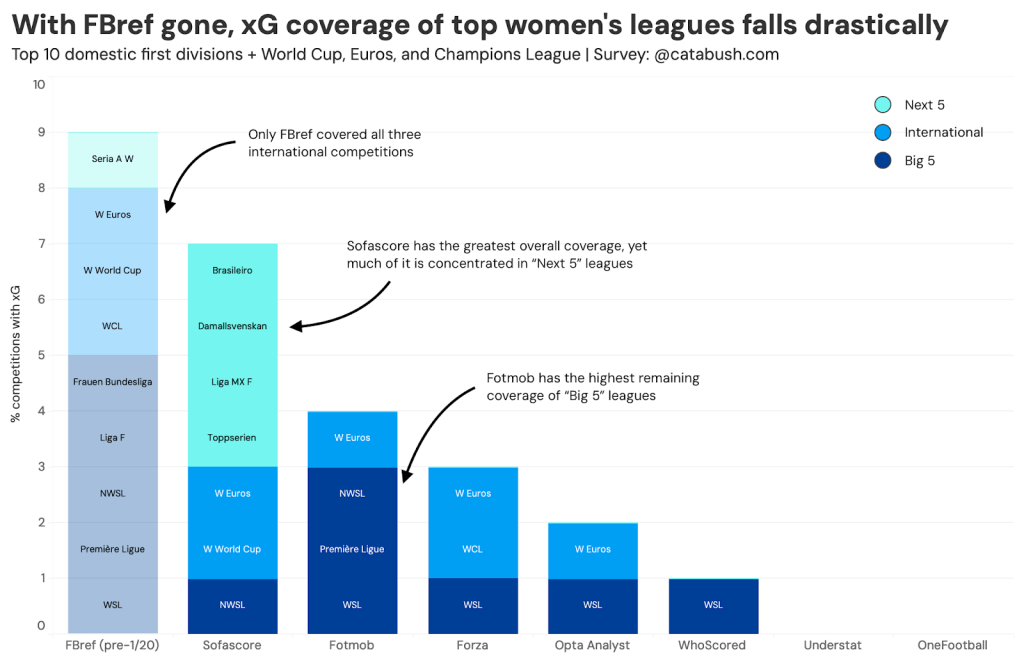
The remaining options available to women’s soccer fans are far less enticing than FBref was in its heyday. Neither Understat nor OneFootball have xG data for any women’s competitions (OneFootball also lacks xG for men’s competitions). WhoScored, a popular site that is well-known for its data granularity, only covers one women’s league — the Women’s Super League in the U.K. Forza, another score app, boasts data for just one women’s domestic league and two international competitions: the Champions League, Euros, and the WSL.
Opta, the provider of raw data that powers many of these very platforms, covers hundreds of leagues spanning youth and professional levels across both genders. The data exists for many, if not all, of the leagues being discussed — FBref’s situation aside, the question is whether companies are willing to pay for it.
Opta itself appears uninterested in displaying the bulk of its women’s soccer data. Despite being the original source for the data, the Opta Analyst website displays just two women’s competitions: the WSL and the Euros.
Fotmob and Sofascore now have Gx data for the most competitions, though each have their own tradeoffs. Sofascore boasts xG data for seven competitions (FBref had nine), yet most of these leagues fall into the “Next 5” category, a group consisting of the domestic first divisions ranked fifth through tenth according to Opta’s list. Only one of the top five women’s leagues — you guessed it: the WSL — has xG data available on Sofascore. Fotmob, meanwhile, is the only app to display xG data for more than one of those top five; in addition to covering the French first division, it’s also the only app to display xG data for the National Women’s Soccer League (NWSL).
Despite unprecedented growth, huge fanbases, and ever-increasing transfer fees in the women’s game, the data critical to the sport’s further growth continues to be devalued compared to data on the men’s side. FBref showed a commitment to some semblance of equality; the deal with Opta prioritized women’s data in an effort to even the playing field, and had a genuine impact on the quality of coverage and analysis for the women’s game. While it is possible that FBref will sign a deal with another data provider, there’s no guarantee that the women’s data will return at the quality and depth this partnership once provided.