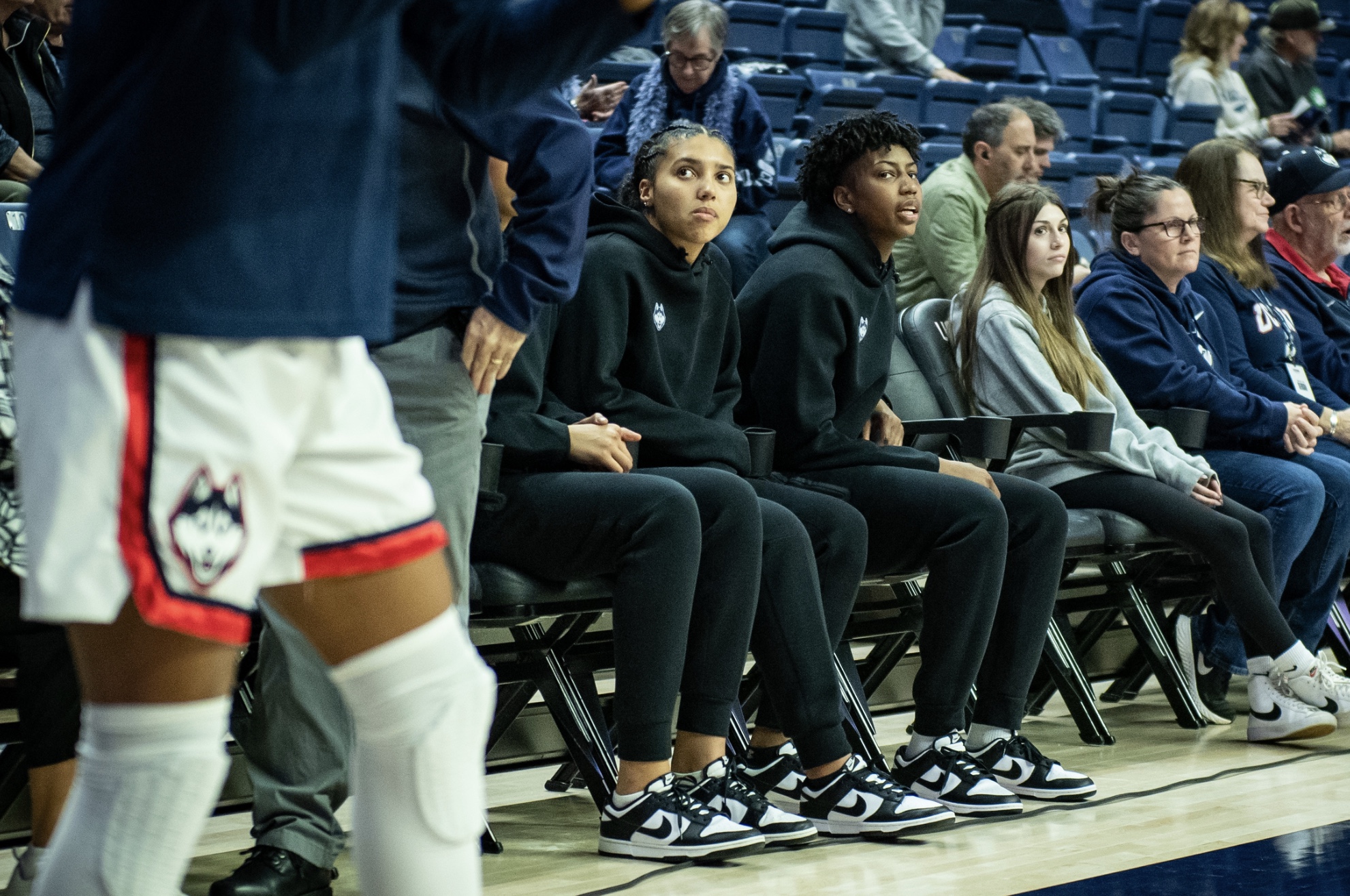
Sometimes, life just isn’t fair and no team is more aware of that fact than the University of Connecticut women’s basketball team.
They’re a national power that annually draws some of the world’s best prospects to campus, a campus replete with world-class facilities and resources. And yet, over the last couple of seasons, the team has failed to live up to expectations due to myriad injuries.
“I feel for the upperclassman because this is all they’ve known since they’ve been in college,” head coach Geno Auriemma said earlier this month after Azzi Fudd went down with was ultimately her second ACL tear. “The only thing they’ve known is [The Bubble] and we’re missing pieces…I think they were anticipating that this year was going to be different.”
Fudd. Paige Bueckers. Dorka Juhasz. Jana El Alfy. Ice Brady. Caroline Ducharme. Lou Lopez Senechal. Ayanna Patterson. Aubrey Griffin.
All have suffered at least one major injury—and in many cases, multiple—over the last four seasons that has resulted in significant missed time. And it’s left many people wondering, what’s going on in Storrs?
The unfortunate reality is that there isn’t any way to definitively know.
Injuries can broadly be categorized into two groups: contact and non-contact. Contact injuries occur during a collision or a fall on the floor. These injuries are, by their nature, freak accidents. Don’t want to break your wrist—like Juhasz—then don’t get tripped while in mid-air and fall on the ground.
Non-contact injuries most often pop up when an athlete is cutting or landing from a jump. Don’t want to rupture your Achilles—like El Alfy—don’t step away from the free throw line.
“What adds to the frustration is that none of these things were things that could be prevented,” Auriemma said. “None of these things are, like, ‘You know, if only you guys did more of this. You could have prevented that. If you’d done less of that, it could have prevented that. If you had done this instead of that, it would have been different.’”
In many respects, what Auriemma said is true. Injuries are multi-factorial. Over-training, under-training, not lifting heavy enough, poor diet, poor sleep, hormonal changes, air travel, changing time zones, chronic workload, acute workload, biomechanics, playing at 100% intensity, playing at less than 100% intensity, the list goes on. All have been associated with an increased risk of injury. Likewise, addressing these aspects is associated with a decreased risk of injury. But, critically, injury risk will never reach zero.
Connecticut’s strength and conditioning staff has taken most of the heat for their team’s injury woes, including from some in the WNBA. As a physical therapist and strength and conditioning coach myself, I would love nothing more than for the Huskies’ fortunes to change by simply changing their exercise routines — and perhaps that is an element that needs to be addressed — but it isn’t that simple.
Altering practice intensity and duration, trying new nutritional plans, allowing athletes to exercise/practice less intensely when on their period, and pushing the athletes to get more sleep are equally likely variables—or perhaps more—to produce positive outcomes.
And then there’s the one law that dictates this all: The best predictor of future injury is past injury.
As Auriemma said, “The things that have happened, it’s almost like when you look back at some of the things that happened to these kids when they were in high school, after the fact, you look back and you go, ‘That was a ticking time bomb.’”
Injury rates are skyrocketing in women’s basketball; this phenomenon isn’t just a Connecticut problem. Athletes are specializing in basketball at younger ages each year and, in many cases, playing games year-round. Doing so places an incredible burden on their developing musculoskeletal system, placing them at increased risk for injury in both the short and long term.
Any injury suffered while the athlete is grinding to earn a scholarship from the Huskies may set the foundation for injuries in the future. But, maddeningly, it also may not. For evidence, see all the NCAA Division I and II women’s basketball athletes who don’t suffer major injuries or those who never suffered an injury at the high school level.
Injuries are not black and white. They are the result of a multitude of interweaving factors that may or may not be altered…or simply being at the wrong time at the wrong place. Sometimes, life just isn’t fair and no team is more aware of that fact than the University of Connecticut women’s basketball team.