When Carrie Moore was hired as Harvard’s head coach in 2022, the Crimson were coming off a season where they ranked second-to-last in the Ivy League in points allowed per 100 possessions. Though the Crimson had made the Ivy League Tournament that season, Moore knew the defense had to improve in order to compete for championships.
“I’ve preached to our team since I got here about the best defensive team in this league wins the championship,” Moore told reporters on Dec. 11, adding that she checks the league’s defensive statistics “pretty much every day.”
It’s not just Moore who sees defense as the ticket to climbing up the standings. Under head coach Monique LeBlanc, Brown has gone from last in the league to sixth to tied for fourth over the last three seasons. But the Bears haven’t made the Ivy League Tournament, missing out last season on a tiebreaker. LeBlanc believes defense is key to getting over the hump.
“The top four defenses, the top four rebounding teams, those have been the four teams in Ivy Madness pretty consistently,” she told reporters at Ivy League media day in October. “… We understand that that has a direct correlation to getting us where we want to be.”
The numbers back up Moore’s and LeBlanc’s stances. The team that has allowed the fewest points per 100 possessions has won at least a share of the Ivy League regular-season title in 13 of the last 14 seasons, according to data from the league and Her Hoop Stats. The exception was Penn in 2016-17 — and those Quakers had the second-best mark in the league.
There has also been consistency in who has the league’s top defense. In 10 of the last 14 seasons, including the past four, Princeton has had the best defense and won the regular-season title.
However, Princeton’s defense has looked shaky this season. Its 94.0 points allowed per 100 possessions — also known as its defensive rating — ranks just seventh in the league and in the bottom half of teams nationally. It’s also nearly 10 points worse than a season ago.
Meanwhile, Harvard has taken over the throne, allowing just 75.9 points per 100 possessions. Penn is second at 84.4.
| Defensive rating | Opponent effective FG% | Nonconference strength of schedule | Possessions in man-to-man | Possessions pressing | |
|---|---|---|---|---|---|
| Harvard | 75.9 | 42.0% | 183 | 97.9% | 33.3% |
| Penn | 84.4 | 41.1% | 301 | 89.8% | 11.8% |
| Brown | 89.3 | 45.4% | 263 | 99.5% | 24.9% |
| Columbia | 90.7 | 48.6% | 86 | 92.4% | 27.5% |
| Dartmouth | 91.8 | 45.6% | 348 | 99.5% | 5.2% |
| Cornell | 92.3 | 46.5% | 314 | 99.7% | 2.6% |
| Princeton | 94.0 | 46.9% | 110 | 97.1% | 1.6% |
| Yale | 97.5 | 48.7% | 208 | 99.5% | 10.3% |
Ivy League teams have defended in varying ways this year. Harvard, Columbia and Brown have pressed often or sometimes, while Cornell and Princeton almost never have. Penn has mixed in the most zone, whereas Cornell has played just two possessions of zone all season, according to Synergy Sports.
Every team will have to adapt during conference play, and their defensive numbers could change a lot by season’s end. But with nonconference play nearly complete, let’s look at the defenses around the league and — if history is any guide — what they might tell us about the race to the regular-season title. (You can also skip to Harvard, Penn, Princeton or other Ivy League teams.)
All statistics are for games through Dec. 27, 2024. Unless otherwise noted, they are from Her Hoop Stats and only include games against Division I opponents.

Harvard: From nearly worst to first
Over the summer, Moore and her staff decided that this year’s team needed a clearer identity than their past teams had had.
“For the last two years, we could go back and forth [with our identity],” Moore said on Dec. 4. “Like, I don’t know: ‘Harmoni Turner is a really good player. Sometimes they score 80. Sometimes they can beat a good team; sometimes they can’t.’
“It’s like, ‘OK, who do we want to be?’”
The coaches believed they had a roster with the depth and skill set to pressure opponents for 40 minutes, and they sought to make this team more defensive-minded than in the past. “I’m so tired of depending on made shots to win games,” Moore said.
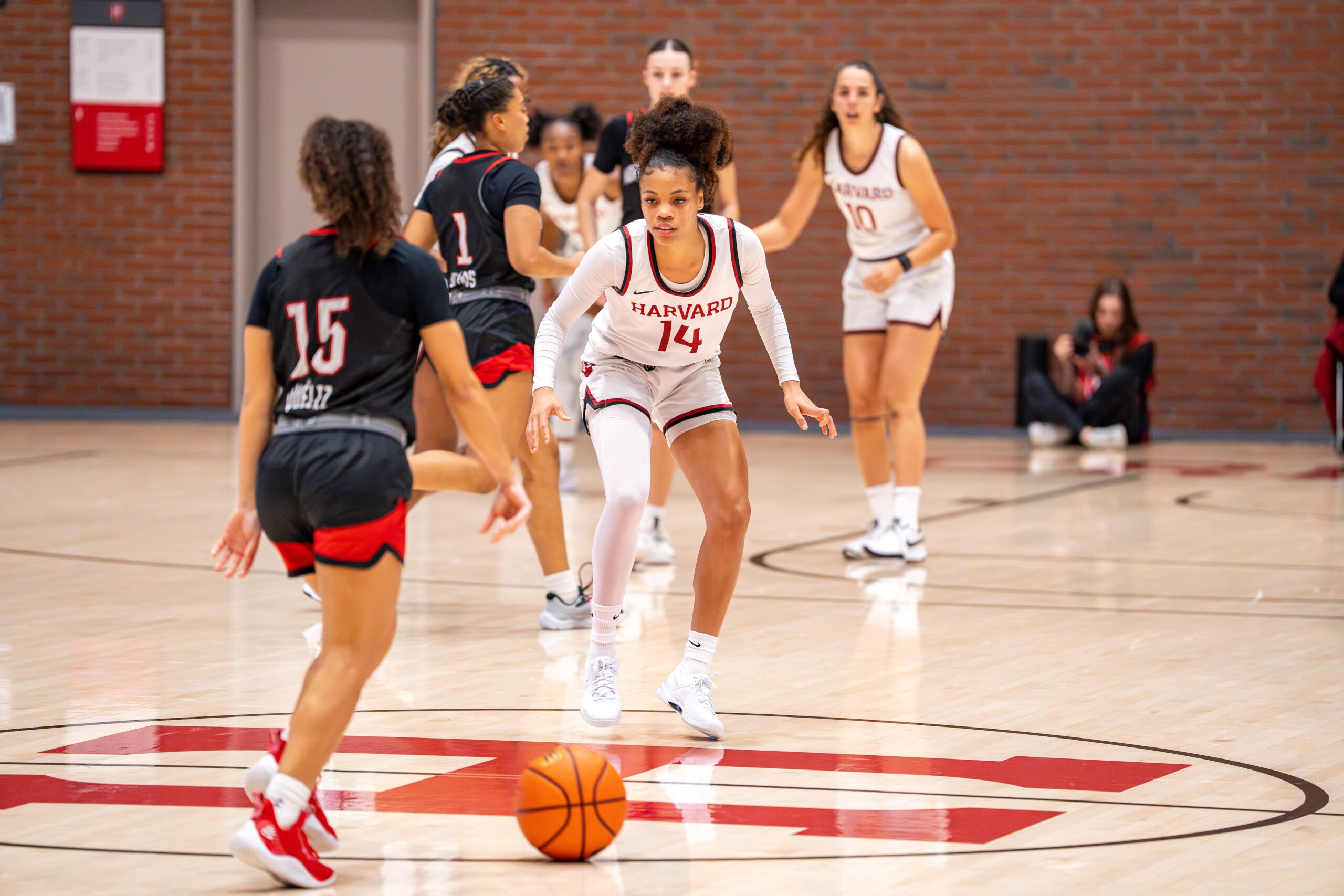
Moore implemented several types of presses, from light full-court pressure to all-out blitzes, and has used them to keep opponents guessing. The players have embraced pressing, too, in part because of its effectiveness.
“They’re loving it,” Moore said on Nov. 20. “… They’re reaping the benefits of it all. It allows them to get their hands on the ball early. It allows them to get some steals and get some easy layups.”
Behind its press, along with effective halfcourt defense, Harvard is 11-1 this season and on a nine-game winning streak. It beat then-No. 25 Indiana on Nov. 7 and has received votes in the last five AP polls. It is also ranked No. 32 in the NCAA NET rankings and first in CollegeInsider’s Mid-Major Top 25.
The defensive statistics are equally eye-popping. The Crimson are holding opponents to 53.3 points per game, which ranks 12th nationally. They’re forcing 23.0 turnovers per game, and 12.6 of those come from steals. That helps them score 25.4 points off turnovers and 11.9 fast-break points per game.
According to Synergy, Harvard’s defense has been “very good” or “excellent” at defending spot-up shots, transition offense, screens, handoffs, and rollers in pick-and-rolls. Its main weakness has been defending in isolation — though blocking the most shots in the league mitigates some of that.
The other concern with Harvard’s defense is its 17.5 fouls per game, which is the fourth-most in the league and above average nationally. According to Moore, most of those fouls are coming in the half court, not while pressing, and she’s eager to cut down on them.
During Harvard’s 14-day break from games for final exams, Moore sought to reinforce her team’s identity. She’d noticed a decrease in turnovers forced per game, and she wanted to reverse that.
“Every game, I feel like we’ve kind of pulled off the press a little bit because we’re scared of So-and-so hitting threes or whatever,” Moore said on Dec. 18. “… It’s like, no, we’re going to stick to who we are and how we play, and they’ve got to adjust.”
The results showed in Harvard’s first game after exams on Dec. 21. It held Boston University to 26 points and forced 38 turnovers in a 60-point win. Since 2009-10, an Ivy League team has forced an opponent into more turnovers than points only one other time.
“It just fits my style,” Moore said on Nov. 6 about her team’s identity this season. “I’m from Detroit. I’m a Midwest girl. I’m gritty at the core … so naturally, I want my team to play that way. All coaches talk about their teams taking on the personality of them, and I think it’s great to see it come to life.”

Penn: Young and good
The Quakers being the second-best defensive team in the Ivy League this year isn’t surprising based on their history under head coach Mike McLaughlin. Penn has ranked either first or second in the league in points allowed per 100 possessions in nine of the past 14 seasons.
More recently, though, Penn has ranked just sixth, third and fifth in the past three seasons, and its youth this season made it hard to foresee the defense being this good this soon.
Penn is starting two first-years, forward Katie Collins and guard Sarah Miller, along with sophomore guard Mataya Gayle. And of the nine players who have played in at least 10 games, five are underclassmen.
“We’ve seen some youth play some big roles on championship teams,” McLaughlin told The Daily Pennsylvanian on Dec. 20. “But I don’t know if we’ve seen so much at once.”
Defense has been a point of emphasis for McLaughlin this season. As Gayle said during a Thanksgiving tournament in Florida, “I think our game plan tomorrow is also still going to be defense, defense, defense and rebounding. That’s what we’ve been harping on the past couple of weeks.”
The Quakers are holding opponents to 36.7% shooting from the field, which is the lowest mark among Ivy League teams. That includes 42.5% from inside the arc and 25.7% outside it. The 6’1 Collins, who leads the team in steals and blocks, has been adept at protecting the rim without fouling, and 6’2 sophomore Tina Njike provides additional size off the bench.
According to Synergy, Penn is at least “very good” at defending nearly all types of plays, including cuts, spot-up shots, screens, putbacks and isolation. The Quakers are also keeping opponents out of transition and off the free-throw line.
Penn has had one of the easier schedules in the Ivy League to date, and its defense will be tested further in conference play. But it’s still an impressive start defensively for such a young team. That could be the Quakers’ ticket back to the Ivy League Tournament this season — and to higher heights going forward.
“[It’s] really exciting for our program, the fact that [young players] are doing this well now,” Njike told The Daily Pennsylvanian on Dec. 20 about the team’s overall success. “I can only imagine how good our program will be in two years. Or even right now, actually.”
Where’s Princeton?
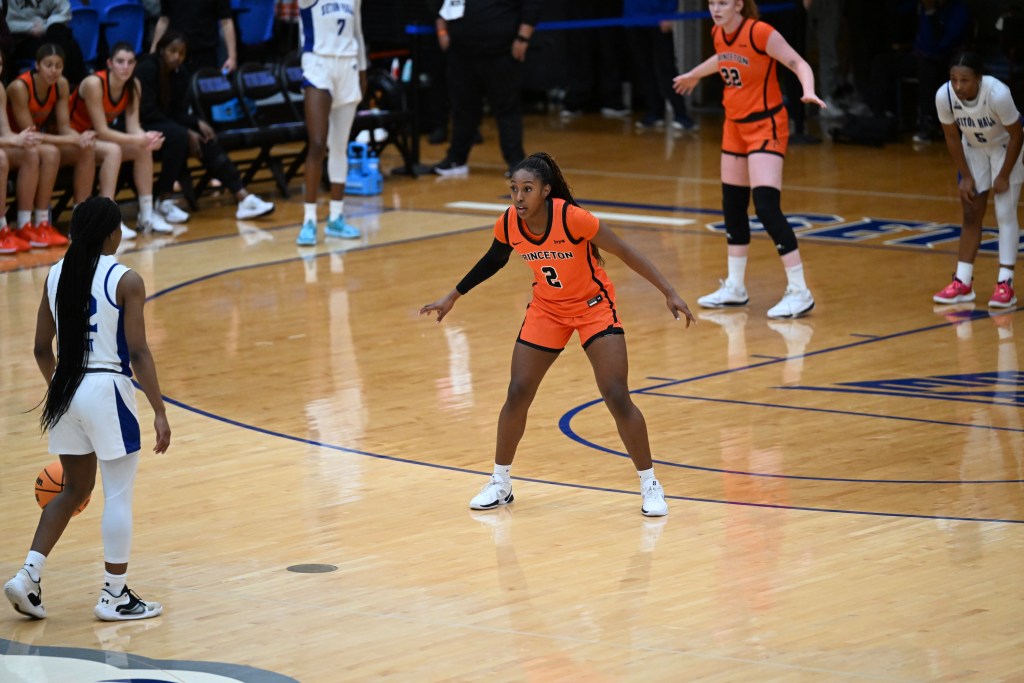
Since 2009-10, Princeton has never finished a season ranked worse than fourth in the Ivy League in defensive rating. It’s only ranked worse than second once. But this season, the Tigers rank just seventh.
The Tigers have had to adjust after graduating Ellie Mitchell, Chet Nweke and Kaitlyn Chen, who comprised their starting frontcourt and their main point-of-attack defender last season. In particular, Mitchell was a three-time Ivy League Defensive Player of the Year and Princeton’s all-time rebounding leader.
Without a singular presence like Mitchell, Princeton now has to defend (and rebound) more by committee.
“We’ve got to be OK that we don’t have an Ellie and a Chet,” head coach Carla Berube told The Next on Dec. 12. “… It’s just got to be really great team defense, really great help defense, and knowing the rotations and knowing the scout. … We’re just gonna keep on working at it, and that’s all I can ask.”
Princeton is also adjusting to a different type of interior presence. Whereas Mitchell and Nweke were tough but undersized post defenders, the Tigers now start 6’4 senior Parker Hill and bring 6’4 junior Tabitha Amanze off the bench. Hill, along with 6’ guard/forward Fadima Tall, has been a bright spot defensively, Berube said.
Berube wants her players to improve at contesting shooters while being able to “pop back and contain” drives. According to Synergy, Princeton has struggled defending spot-up shooters, isolation plays, and ball-handlers in pick-and-rolls. It’s been better at guarding post-ups, screens and putbacks.
Though Princeton has struggled defensively this season, it’s slowly getting better, which isn’t surprising for a team that starts four sophomores. Through Nov. 22, Princeton was allowing 99.4 points per 100 possessions, which ranked in the 26th percentile nationally. That number fell to 96.2 when the Tigers paused for final exams and is now 94.0, which ranks in the 38th percentile.
“It’s not rocket science what we do defensively, but it just takes some time, especially for … those that haven’t played a lot,” Berube said on Nov. 20 on Princeton’s “Get Stops” podcast.
Notes on other Ivy League defenses
Brown ranks third in the Ivy League in defensive rating despite several injuries to its frontcourt. Junior forward Ada Anamekwe is out for the season, and classmate Alyssa Moreland missed the first eight games with a knee injury. Then, in Moreland’s first game back in the starting lineup on Dec. 21, senior center Gianna Aiello exited with an injury. Her status going forward is unknown.
It’s been difficult with the ever-changing lineups for the Bears to find consistency, but that’s what they’re seeking entering conference play. They want to have a lineup they’re confident in to get a stop any time they need one. They’re also working to improve their press, which would add another wrinkle to their defense.
“[Presses and traps] are high risk, high reward,” LeBlanc told The Next on Dec. 9. “… That’s definitely not something that I would say is our identity or our strongest suit yet. But I think that you need to have that as an option, definitely, in Ivy League play.”
Columbia was known more last year for its high-powered offense, but its defense ranked second in the league. This year, head coach Megan Griffith is trying to build on that by having her team approach defense more like offense — that is, playing off instincts and making reads, rather than simply following rules.
“We definitely have a general framework of, ‘This is how we’re defending. This is what we’re not giving up,’” Griffith told The Next on Nov. 16. “… But if [junior co-captain] Perri [Page] feels like she can go trap, go trap. If Perri feels like she can rotate to the rim, you rotate. Let people adjust to you. So we’re just trying to get them to play to each other’s strengths more.”
Columbia’s defense is currently ranked fourth in the league. While playing the league’s toughest nonconference schedule, there have been a few growing pains, such as in a loss at Duke on Dec. 1.
“I thought we pressured in the wrong moments sometimes,” Griffith told The Next afterward. “And I thought when … we were being smart, we really frazzled them.”
Griffith believes she has a smart team that can handle the added complexity, and that could make it harder for opponents to prepare for Columbia’s defense. She’s also optimistic because the Lions have more rim protection this season with junior forward Susie Rafiu starting full-time. That means they can defend one-on-one more often, rather than having to get “creative” with double teams.
Sophomore guard Fliss Henderson, a tough defender who started as a first-year, also hasn’t played this season due to a back injury. So Columbia could be a team whose defense steadily improves in conference play, especially if Henderson can rejoin the fold.

Before a blowout loss at Syracuse on Dec. 21, Dartmouth ranked third in the league in defensive rating. The Big Green subsequently fell to fifth, but it’s still been an impressive start for second-year head coach Linda Cimino on that end, especially without her defensive anchor, 6’4 senior forward Doreen Ariik.
Ariik has not played this season due to injury, but Cimino told The Next that she’s expected to return for conference play. Her return would give Dartmouth even more of an interior presence and shore up its defensive rebounding rate, which ranks last in the league. It would also allow Dartmouth to mix things up more defensively, as it hasn’t played much zone or pressed this season.
“Usually, my programs [switch up defenses] make-miss, and so we do a lot of zone,” Cimino said on Dec. 13. “But I think once we get Doreen back, that helps us because I know I have an anchor down low. So we can get out and run a little bit more … [and] be a little bit more risky.”
One reason for Dartmouth’s defensive success is that it rarely fouls. This has been consistent under Cimino, who previously chaired the NCAA Women’s Basketball Rules Committee. And though it has given up a lot of offensive rebounds, it has defended putbacks well, according to Synergy.
Dartmouth is still building under Cimino. Its schedule has been one of the easier ones nationally so far, and its offense has struggled to score. But the defense is a good sign for the program’s trajectory, and it could produce a few upsets in league play this season.
Under first-year head coach Emily Garner, Cornell ranks sixth in the league in defensive rating. The Big Red are still learning what Garner wants, so she hasn’t yet implemented everything from her eight-year tenure at Trinity, where she led one of the country’s better defensive teams.
“it’s been a big change philosophically for them in terms of what we do compared to what they’ve done in the past,” Garner told The Next on Dec. 9. “… We’re getting better, and I think that’s our continued approach and focus is to continue to work on it.
“I’d say we’re maybe getting about halfway there in terms of our integration of where we’d like to be, just with our kind of base defense. And how much we add to that this year, we’ll see. But I think we’re making progress for sure.”
‘Rare Gems’ is out now!
Howard Megdal, founder and editor of The IX Basketball and The IX Sports, wrote this deeply reported book. “Rare Gems” follows four connected generations of women’s basketball pioneers, from Elvera “Peps” Neuman to Cheryl Reeve and from Lindsay Whalen to Sylvia Fowles and Paige Bueckers.
If you enjoy Megdal’s coverage of women’s basketball every Wednesday at The IX Sports, you will love “Rare Gems: How Four Generations of Women Paved the Way for the WNBA.”
Yale has struggled defensively this season, which has been a big reason for its 1-11 record. The Bulldogs are allowing 97.5 points per 100 possessions, which ranks last in the league and in the bottom quartile nationally.
“First and foremost, I don’t think that we defend one-on-one very well, which is always gonna put a lot of strain on your overall defense,” head coach Dalila Eshe told The Next on Dec. 12.
Yale is defending the 3-point line quite well, allowing opponents to shoot a league-low 21.4%. But inside the arc, it’s allowing opponents to shoot a league-high 53.1%. The Bulldogs also commit the most fouls and are the second-worst defensive rebounding team in the league.
This season continues a tough few years for Yale’s defense. After finishing second in the league in defensive rating in 2021-22 under Allison Guth, the Bulldogs ranked last in Eshe’s first two seasons. This season, they focused heavily on defense during their break for final exams, and they’ll need a big turnaround in conference play to avoid the cellar again.