Note: All statistics are through Thursday, February 12
Watching Paris McBride bob-and-weave her way through third-ranked South Carolina’s vaunted defense last month for 12 points, nobody would have known she had nearly lost her passion for playing basketball. The 5’6 Coppin State senior guard has played free and unbothered this season, knocking down 3-pointers, finding open teammates on the break, pulling one aside to offer encouragement, and enduring the painful ritual of icing both knees before and after games.
It all feels familiar now.
Normal.
It wasn’t. Not long ago, it felt impossibly far away.
This time last year, McBride wasn’t playing at all. She was coaching at Southeast Arkansas College in Pine Bluff. Her fire flickering, her focus drifting toward a future that no longer included the game she’d grown up loving. Basketball had become something she taught, not something she felt.
Then something shifted.
“Coaching rekindled my passion,” McBride told The IX Basketball during a Zoom call. “I loved basketball again. My passion came back. I was excited to play. I’m in open gyms, hooping and everything, and I was like, ‘I’ve still got some love left in the tank.'”
The thought wouldn’t let go.
McBride started texting coaches. One message turned into another, each carrying the same quiet question: Is there still a year left? Every response came back the same way. If that’s what your heart wants, go for it.
So she did.
One of those messages landed on the phone of first-year Coppin State head women’s basketball coach Darrell Mosley. The number was familiar. Mosley had recruited McBride while he was head coach at Lincoln (Pa.) during the 2018–19 season. Now at Coppin State, Mosley was rebuilding from the ground up, replacing nearly an entire roster and searching for a steady hand to organize, lead, and set a tone.
McBride never imagined she’d play for him.
“I only came on the visit to support my teammate, Skylar Barnes,” McBride recalled. “But when I saw Coach Mosley, it felt like an old relationship rekindled. He was looking for a point guard. They welcomed me with open arms. And somehow, that visit became my visit, too. I’m forever thankful for that. I know God led me here.”
She has made the most of the opportunity.
McBride has scored in double figures in 11 games and delivered her best performances against Coppin State’s stiffest competition, scoring 17 points against Oklahoma, 20 against Georgia, and 17 against Morgan State. With McBride leading the way, Coppin State has found a mid-season groove. The Eagles have won four straight games, smashing teams by an average of 28.3 points per game to raise their MEAC mark to 5-4 overall.
She steadies the floor, too. McBride has recorded at least eight assists in 14 games this season, organizing possessions and setting the tempo. And she’s done it all while wearing a bulky black knee brace under her leg sleeve, a constant reminder of the road that brought her here.
“If you see me on the bus, I’ve got my little hammock set up,” McBride said. “I put the stim on my knees. I’ve got my compression boots on. It’s just about doing the extra little things to take care of your body.
“I have had four knee surgeries at this point. Three ACL tears. Three or four meniscus tears,” she continued. “So with that alone, it’s amazing that I’m still able to run up and down the court, get up and move and jump and do the things that I’m able to do.”
Once she committed to Coppin State and realized she’d been granted the precious gift of another season of collegiate hoops, McBride went all in on development. When she arrived on campus this summer, the work was evident. She dropped 15 to 20 pounds, toned up, and quickly separated herself from the rest of the camp. By the end, she had earned the starting point guard role and a captain’s spot.
Mosley has gotten more than he anticipated from McBride, who ranks second on the Eagles in scoring at 9.1 points per game, behind two-time MEAC Player of the Week Khila Morris, who scores at a 13.2 points per game clip, which is fourth in the conference.
“You want some veterans on the team, leaders in the locker room, and leaders on the floor,” Mosley said. “That’s why we recruited her. I wasn’t even expecting her to come in and perform or lead us the way she has from a player standpoint. I was really looking forward to her leadership and guidance. I’m extremely proud of her, especially for pulling herself out of that funk. When you’ve gone through multiple stops or felt like people didn’t believe in you, it can be hard to keep that confidence. But she comes in every day with it and holds her teammates accountable.”
McBride plays like a pit bull: tough, relentless, and loyal. That same instinct shows up off the court, too, in the way she takes care of her pit bull and a German Shepherd-Lab mix. Protection, accountability, and trust aren’t just traits she brings to a huddle. They’re how she lives.
As the oldest player on the roster, she’s learned to meet teammates where they are, adjusting her leadership style and message to those who need to hear them. It’s a balancing act, one she’s embraced. After everything, she’s simply grateful for the chance to play the game again.
Through it all, from playing at North Carolina Central during COVID, to transferring, to earning both her undergraduate and master’s degrees in sociology, to enduring injury after injury, one constant has remained.
“I wouldn’t be anything without God,” McBride said. “The people who inspire me are my family. They’re my why. Through everything, they’ve supported me. They’ll drive anywhere to see me play. They made sure I always held my head high and never let my crown tilt. So those are my whys. They’ve had my back up until this point. Now I’ve got to have theirs and go out and produce for them.”
Listen now to The IX Sports Podcast and Women’s Sports Daily
We are excited to announce the launch of TWO new podcasts for all the women’s sports fans out there looking for a daily dose of women’s sports news and analysis. Stream on Spotify, Apple Podcasts or anywhere you listen to podcasts, and make sure to subscribe!
Inside Aysia Hinton’s record-setting night
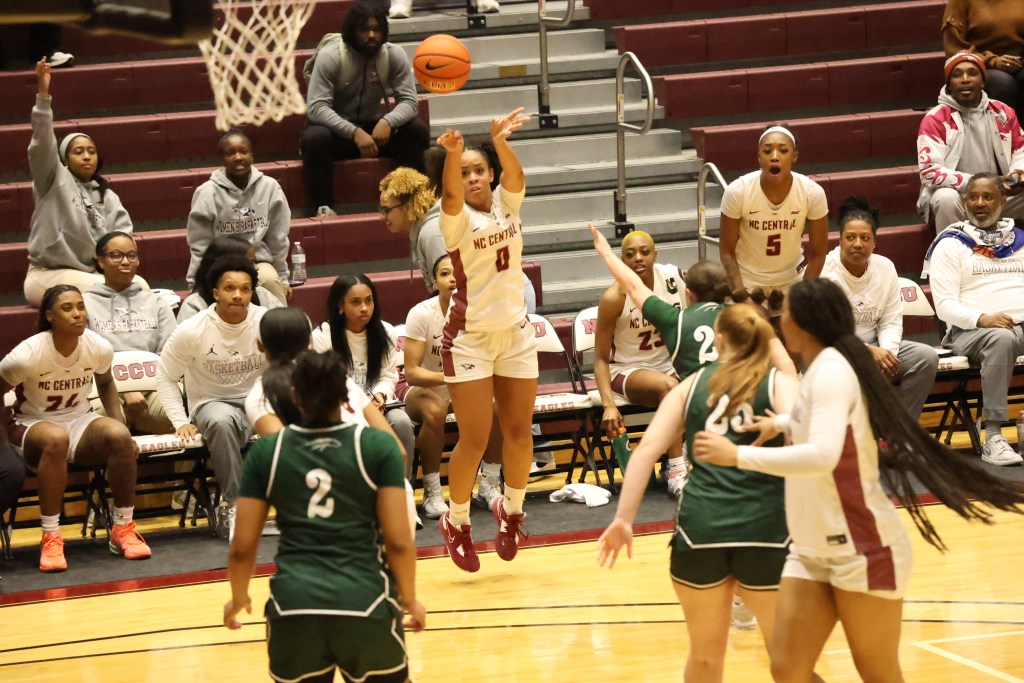
North Carolina Central 5’8 guard Aysia Hinton didn’t need the box score to know her Feb. 3 performance was historic. Not after everything it took to get there. The net was still snapping from her twelfth three-pointer when her phone lit up — texts pinging, missed calls stacking up, notifications flooding her screen.
Teammates were still celebrating. Fans shook their heads in amazement. In the broadcast booth, the shock turned playful.
After Hinton’s 12th three-pointer splashed through the net, the color commentator blurted, “She has lost her mind.” The play-by-play voice followed with a grin you could hear through the speakers: “The hot sign is on, and I’m not talkin’ Krispy Kreme. That’s a dozen.”
Her head coach pulled her aside and pointed to what the stat sheet now confirmed: 36 points and 12 three-pointers. Both single-game school records at North Carolina Central.
After the final buzzer and the postgame handshake line, Hinton hugged her family behind the NCCU bench, smiling through congratulations and cameras. The celebration felt loud, joyful, and shared.
But later, when the gym emptied and the lights dimmed, the ride back to the dorm was quiet.
Almost ordinary.
Then they pulled into the parking lot.
Her father parked and told her to step outside. He turned away, shoulders trembling, trying to compose himself.
“My dad never shows emotion,” Hinton said to The IX Basketball during a Zoom call. “So when he told me to get out because he didn’t want me to see him cry, that’s when I knew I’d really done something.”
That moment made it real.
On Tobacco Road, three-point legends are supposed to wear Carolina blue or Duke blue.
This time, the color was maroon.
In a city steeped in basketball tradition, Hinton authored her own chapter, and her teammates eagerly cosigned. Showcasing their humility, they passed up open layups to find her beyond the arc, hunting history in real time.
“I cried,” Hinton said. “I don’t think it really hit me — honestly, I don’t think it’s fully hit me yet. Everybody’s looking at me like, ‘You just hit 12,’ and I’m sitting there like it was just a regular game.”
No shrug. Just a grin widening as she ran back on defense.
For Hinton, game day didn’t feel much different. Shootaround at 11 a.m., a late tip, a 90-minute nap, Outback for pregame, in which she joked that the rice and salmon were the secret sauce to her night. The only thing out of the ordinary was a phone conversation with her aunt.
“I never talk to my aunt before games,” Hinton said, “But for some reason I did that day. She told me she wanted three threes and to just have fun and play my game.”
It wasn’t reckless volume. It was rhythm. Six in each half.
Five came in the fourth quarter, a jaw-dropping barrage that left the gym exhaling. She scored 15 of the Eagles’ final 17 points. After each make, her teammates leaped off the bench, arms raised and towels twirling. Every splash felt inevitable.
The performance came in a 103–51 victory over William Peace.
Both marks set NCCU Division I-era program records, surpassing the previous scoring record of 35 and the three-point record of 10. Her 36 points are the most by a MEAC player this season, and her 12 threes are the most by any NCAA player across all divisions.
“You know your team really loves you when you get 30 shots up and nobody’s complaining,” NCCU head coach Terrance Baxter said to reporters during the MEAC’s bi-weekly coaches’ teleconference on Feb. 9. “Aniya Finger had just scored 30 the night before, and she had looks she could’ve taken. She didn’t even look at the rim. I don’t care who it’s against; you still have to make 12. I don’t know how many people have done that in a game. I know I haven’t. For my team to feed her the way they did that meant everything.”
As the final seconds melted away, Hinton’s joyful teammates hugged, high-fived her, and gave her the game ball. The outburst came one night after Finger’s 30 points and 12 rebounds in a win against Maryland Eastern Shore, marking the first back-to-back 30-point performances in the Division I era for NCCU.
“It was fun to watch,” Finger said to The IX Basketball during a Zoom call on watching Hinton’s performance. “Personally, when I was in the game, my whole objective was to get her the ball. … I’ve seen her grow and work. I feel like her threes are like lay-ups for her. She deserved it.”
Long before she was chasing records and splashing threes, Hinton was flipping across a gymnastics floor, learning balance, repetition, and the kind of discipline that rewards patience. She competed from age 3 through fifth grade before picking up a basketball in sixth, learning from the two boys next door.
“I was terrible,” she said, laughing.
Her mom wasn’t convinced she was ready for AAU either.
“Very honest,” Hinton recalled. “Truthful.”
Hinton’s road to this moment was paved with adversity, belief, and persistence after transferring from Maryland-Eastern Shore at the start of last year. Baxter couldn’t offer her a scholarship last season. Nothing was guaranteed. That didn’t stop Hinton from making the team as a walk-on, starting 22 games, and averaging 6.7 points. This season, she leads the Eagles with 50 3-pointers. Hinton is tied for first in the MEAC in 3-pointers made per game (2.3).
“I wouldn’t be here without my family,” Hinton said. “Scholarship or not, I knew I’d be good because I had them. I know the type of worker I am. I just kept working and left the rest in God’s hands. If it was my time, it was my time. If not, I was still going to be here.”
Belief was never the issue. Opportunity was.
The numbers felt like something bigger. It was a message from her hometown gym to every court in the city: kids from Durham can be more than the labels placed on them.
“I tied a single-game three-point record in high school,” Hinton said. “But this one means more. It’s the highest level, and I proved to myself who I am. I don’t have to listen to the outside noise. Kids from Durham can do big things.
“I knew I made my family proud. My family in New York was watching that game. Everybody was proud of me. I feel like I’m making a difference not just here, but for my younger cousins and anyone who looks up to me.”
Back in that parking lot, her father already knew.
Everything was earned. And for one night, patience met payoff.

Hunkin-Claytor Leading Alcorn State
Maya Hunkin-Claytor’s journey to Alcorn State began with a leap of faith and a three-flight odyssey.
Born in Germany and raised mostly in Hawai’i, the 5’7 senior guard never set foot on Alcorn’s rural Mississippi campus before signing. COVID erased that chance. Instead, she bet on herself. The road was rocky. The miles piled up. But the decision changed her life.
“From the outside looking in, you probably wouldn’t understand why you’d come in the middle of nowhere to go to school,” she said. “Everybody had that southern hospitality [and] was like, ‘Okay, you got to speak when you come into a room… if you don’t open your mouth, you lose out on opportunities.’ Alcorn shaped me in so many ways. And that’s what makes this place special.”
For the fifth-year senior, the island kid who once described herself as shy, Lorman became something rare. It became home on and off the court. Located about 75 miles south of Jackson in Mississippi’s southwest corner, Alcorn State was a world away from everything Hunkin-Claytor had known.
In a place with few distractions and two-lane roads, she found clarity, community, and the space to become herself.
This season, Hunkin-Claytor is no longer waiting. She spaces the floor, lifts from the corner, and makes defenses pay when they lose track of her for a beat. It’s one reason why Alcorn State’s offense flows like a Jay-Z bar. When the ball finds her hands late in possessions, it leaves with purpose.
She’s become a steady current in Alcorn State’s championship push — third on the team in scoring at 7.8 points per game, trailing only Nikea Cheatham and Kiara Henderson. Her 52 made three-pointers lead the Braves, each one a reminder of how long she stayed ready. Hunkin-Claytor also leads the SWAC in 3-pointers made per game (2.3) and is fourth in 3-point field goal percentage (34.7%).
Trusted enough to start 22 of 23 games, Hunkin-Claytor has turned patience into production and opportunity into ownership. She’s scored in double figures in nine games this season, including a career-high 17 points in a huge 69-53 home win over reigning SWAC tournament champion Southern on Jan. 31.
“Maya doesn’t always have to score to impact the game,” veteran Alcorn State head coach Nate Kilbert said to The IX Basketball. “She draws so much attention that teams won’t leave her. That opens driving lanes for Kiki, for Cheatham — there’s no help coming because they’re glued to Maya. She’s the reason Cheatham can get 17, and Kiki can get 12. Her presence on the floor changes everything for our offense.”
Patience, adversity, and change sit at the heart of Claytor’s story. As a military kid, Hunkin-Claytor was used to being on the move, growing up in Germany and living in Virginia and Georgia before settling in Hawai’i. With that came an understanding of what it means to finish what you start.
She ended up at Alcorn State intentionally, thanks to her high school coach, Latoya Wily, an Alcorn State alum and member of its 2005 SWAC championship team.
“Big shout out to her because she saved me and my basketball career in a time that was really rough for me in high school,” Hunkin-Claytor said. “I needed a coach like her. She is definitely a huge reason why I’m here now, along with my dad. [My dad] sent out hundreds of emails to schools trying to help me get to college and driving me everywhere to get extra training and workouts, especially during COVID.”
In an era defined by quick transfers and instant gratification, she chose to stay and grow at an HBCU that challenged her to get “comfortable with being uncomfortable” — from planning hour‑long drives to Walmart to learning to use her voice in a new cultural space. It meant growth.
It wasn’t easy. As a freshman, Hunkin-Claytor started 17 of the 25 games she played for a program that finished with three wins. In the years that followed, her role shrank. She played just one game during the 2023–24 season, earning a redshirt year. Last season, she averaged 4.1 points in 14.7 minutes.
Still, she remained optimistic and grounded, guided by her inked inspiration and the powerful village she carries with her, even 4,200 miles from Wahiawa. They remind her that she’s playing for something bigger.
Her Polynesian tattoos, etched with symbols of responsibility, womanhood, and family, mirror the way she now carries herself. Fish, nets, flowers, arrowheads — each line tells a story. Each one traces back to the 808.
“When you’re here, there’s a different level of comfort,” said Hunkin-Claytor, who is Black and Samoan. “Especially being an African American student or a person of color. You can breathe. You can be yourself. Alcorn has shaped me to be a stronger‑minded person.”
Her toughness took root long before the SWAC’s blaring bands and roaring crowds. She followed her dad into the gym, waiting on the side courts while he played, the air thick with sweat and squealing sneakers. While grown men swooshed past her without a glance, she kept firing shots at a nearby hoop, the ball echoing against the backboard as if answering her back.
Hunkin-Claytor wasn’t the center of attention then. She was small, quiet, and easy to miss. But even then, she was imagining herself one day stepping onto the hardwood not as a bystander, but as someone the game revolved around.
“My dad used to play,” Hunkin-Claytor said. “He played college ball, and he played all‑army basketball. So I was always just in the gym, and that was our bonding time. After he finished playing, he’d shoot with me, and then we’d all go back home and just kick it. When I’m back home, my favorite thing to do, for real, is just play pickup basketball with my brothers, and when my dad feels like it, occasionally, or he used to back in the day. I love playing pickup basketball. It’s so fun.”
When she’s not torching SWAC defenses, Hunkin-Claytor is just as happy binging The Walking Dead or Snowfall, plucking her ukulele, or eating pizza and sweets; but the self‑proclaimed “sport head” always seems to end up back in a gym somewhere, watching whatever game is on or playing pickup with her brothers for fun.
This season, she’s having fun again — and it shows. Alcorn State has come up short in the last two SWAC championship games, but belief runs deep. Even sitting a game behind red-hot Alabama A&M, the Braves are convinced they’ll be the last team standing on March 14.
Her growth mirrors the team’s.
“Whatever points anybody makes on our team, it goes to Alcorn State University,” she said. “As long as we’re winning, I can only make the person in front of me better, whether that was in practice or off the court,” Hunkin-Claytor said. “When it’s my turn to come into the game, I just do my part. I’ve had that opportunity to really just spread my wings this year. I have that super green light to take the shots I see and like, and to play my game. And Coach trusts me.”
Holmes’ Long Road To Texas Southern
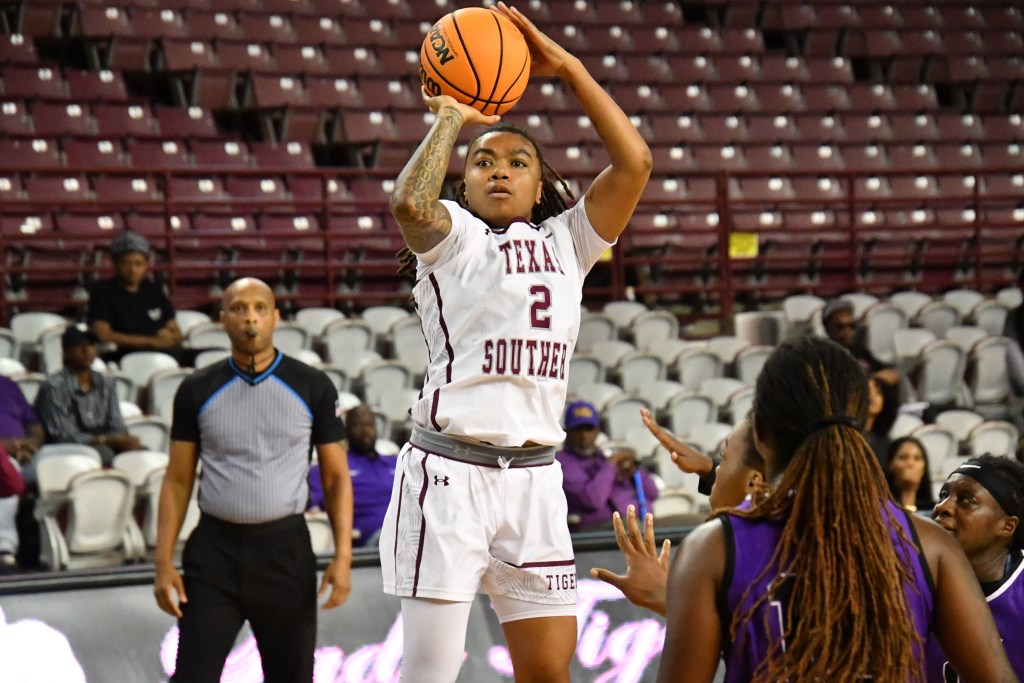
The scenic road to Daeja Holmes’ transcendent 34-point performance on Jan. 31 included a few detours. Low points she eventually turned into mile markers. Holmes nearly lost the opportunity to play basketball altogether, a moment that forced her to change habits, get her life together, and refocus on what mattered.
The Fresno, California, native and Texas Southern senior guard lived the transfer-portal experience before it became a trend. After two disappointing seasons at Georgia Southern, she returned home to Fresno City College, a move that proved both humbling and clarifying.
She wondered if the opportunity she’d dreamed about while watching Maya Moore with her dad as a little girl in the living room was slipping away. The game that once felt like destiny suddenly felt fragile. Holmes’ perseverance became a badge of honor, forged through a refusal to stop fighting, no matter the obstacle.
“When I was at Georgia Southern, I wasn’t really locked in,” Holmes said. “I got distracted easily — no family out there, just around teammates all the time — and I didn’t really know what it took to get to the goals I was trying to reach. Going back home to Fresno was humbling because the opportunity was almost taken from me. That’s when I knew I really wanted basketball. I had to change the way I was acting and reacting to things. I locked in, got my life together, and I ended up here. I’m grateful for it.”
Holmes signed with a Texas Southern program coming off a two-win season, a team still laying its foundation. She didn’t shy away from the rebuild. She chose it.
As a junior, she helped the Tigers grow to seven wins, averaging 9.7 points while learning a new role within a program finding its footing. A year later, Texas Southern won 17 games, finished third in the SWAC, and captured a WNIT victory. Holmes averaged 6.6 points per game, numbers that reflected not a step back, but a conscious sacrifice. An investment in team success over personal shine.
Texas Southern head coach Vernette Skeete saw that shift immediately. She knew she had a gem.
“It was just kind of creating a culture that helped her survive through the highs and lows of her life and putting in perspective a guideline for her to lock into what she was doing and find her passion,” Skeete said. “When she came to us, she was a walking triple-double. I didn’t teach her how to shoot. I didn’t teach her vision or how to pass. Daeja already had that.”
It was the kind of quiet work that goes unnoticed. But it was building toward something. And on the right night, with the groundwork laid and the moment calling, Holmes reminded everybody exactly who she was.
In that win over rival Prairie View A&M, Holmes finished 12-for-17 from the field and 5-for-7 from 3-point distance. Ranked seventh in the SWAC in scoring at 12.3 points per game, Holmes has scored in double figures 17 times this season, forming a potent one-two scoring punch alongside Taliyah Logwood, who averages 12.0 points per game, which is ninth in the conference.
“I have to shout out coach Skeete because she’s preparing us for life, not just basketball,” Holmes said. “She’s helped me grow in so many areas. I’ve struggled with feeling like I belong, and she told me, ‘You belong here. Own that.’ Since then, I’ve understood I’m more than I thought I was, and I’ve kept growing every year.”
For Holmes, basketball has always been about more than stats. It’s about purpose, legacy, and playing like nothing is promised. It was something that hit home with devastating reality when she lost a friend in a car accident. Years later, she carries that spark on her skin with a tattoo in her honor, and another that reads “Dream Chaser” with a nod to Kobe Bryant’s Mamba mentality.
“Life isn’t promised,” Holmes said to The IX Basketball. “So, live every day doing your best. Don’t live with no regrets and just keep going because you never know when your time is, your time. Losing her made me realize that there’s way more to life than basketball.”
With her confidence restored and her faith steady, Holmes is determined to make sure this second chance becomes a beginning, not a finish line.
Already holding her undergraduate degree in transdisciplinary studies, Holmes is now working toward a master’s degree in communications. Her past has given her the resilience to succeed in the present and the preparation to make an impact well beyond it.
“I want to get into coaching,” Holmes said. “I feel like I’m destined for that. I’ve been through a lot of experiences, and I know I’ll keep growing, so I want to use that to help other athletes. I have a lot of faith in God. He doesn’t break promises. I know He won’t let me down, so as long as I don’t let myself down, I don’t have anything to worry about.”
‘Rare Gems’ is out now!
Howard Megdal, founder and editor of The IX Basketball and The IX Sports, wrote this deeply reported book. “Rare Gems” follows four connected generations of women’s basketball pioneers, from Elvera “Peps” Neuman to Cheryl Reeve and from Lindsay Whalen to Sylvia Fowles and Paige Bueckers.
If you enjoy Megdal’s coverage of women’s basketball every Wednesday at The IX Sports, you will love “Rare Gems: How Four Generations of Women Paved the Way for the WNBA.”
Queen of ‘The Hill’
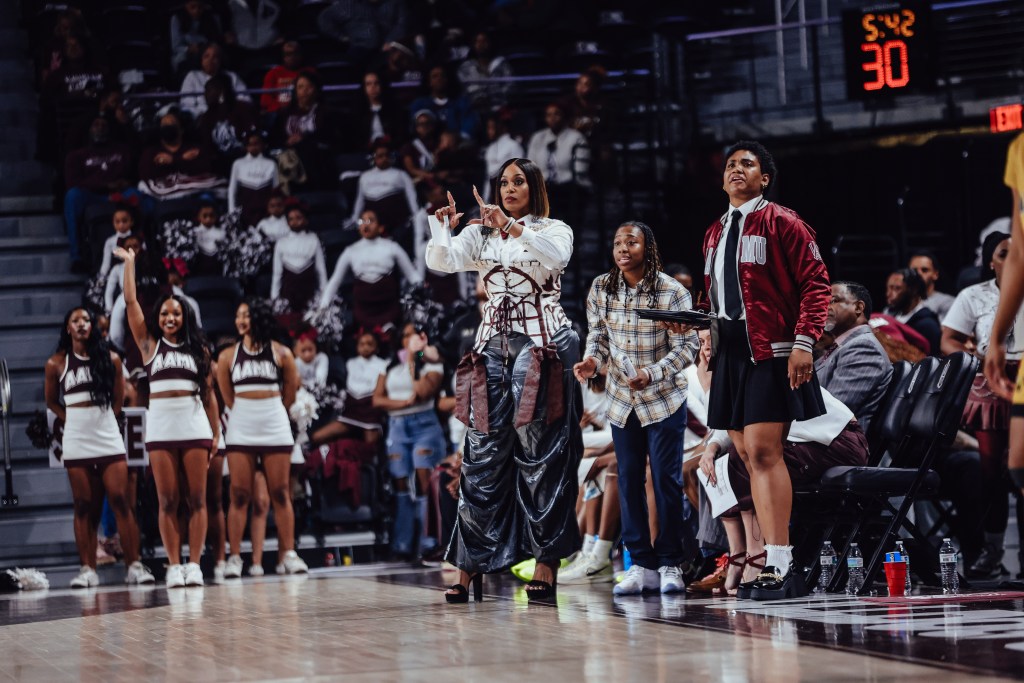
Alabama A&M women’s basketball head coach Dawn Thornton has built a culture rooted in celebration, accountability, and discipline in just two seasons on The Hill. In that short time, she has transformed the Bulldogs from a solid program into a formidable force — currently riding an 11-game winning streak, the longest in 29 years and during AAMU’s Division I era.
Receiving votes in the latest Mid-Major top 25 poll, Alabama A&M has won six of the 11 games during this streak by 20 or more points. After recently celebrating her 125th career coaching victory, Thornton was named the WHoopDirt.com Coach of the Week earlier this week.
In her first season with the Bulldogs last year, Thornton guided them to 20 wins for the first time in their Division I era and a berth in the Women’s National Invitation Tournament. The foundation was set. The standard was raised.
Her fire fits, and locker room celebrations may dominate social media timelines, but don’t mistake the positive vibes for fluff. A fashion mogul, Thornton is also a sharp tactician and a fierce motivator. It’s why the Bulldogs lead the SWAC in scoring defense (57.7 points allowed) and field-goal defense (37.5%). Alabama A&M is 37th in the country in scoring defense.
Yet despite her recent success, Thornton’s name was absent from recent mid-major coaching conversations tied to Power 5 openings. That omission feels curious. In her final season at Arkansas–Pine Bluff, she produced a winning record and secured a marquee road victory over Arkansas, proving that her blueprint travels.
The impact in Huntsville extends beyond the hardwood. The Bulldogs boast a cumulative GPA of 3.2. Attendance has surged 96 percent, from an average of 1,357 fans last season to 2,662 this year. In January alone, the program generated 2.7 million Instagram views, making it one of the most visible brands in the country, according to a graphic shared on X by Thornton’s agent.
Most importantly, Thornton has her team locked in. A challenging road swing through Grambling State and Southern resulted in two gritty wins that strengthened their collective resolve.
The Bulldogs have been led by their talented quartet of Kalia Walker, Jaida Belton, Coriah Beck, and Moses Davenport.
Walker was named the SWAC Preseason Player of the Year. She leads the Bulldogs in scoring at 13.5 points per game, which is fourth in the conference. Davenport is averaging 10.8 points and 6.2 rebounds, which is second on the team. Beck has hit a number of big shots like her dad, Corey, did when he played for Arkansas’ 1994 national championship team. She’s scored in double figures 10 times this season. Belton leads AAMU in rebounding at 6.9 per game, which is fourth in the SWAC.
“I think we’re peaking at the right time,” Thornton told The IX Basketball last month. “The players can visualize what we’re trying to do because it was a struggle in the beginning. When you’re bringing in 10 or 12 new kids every year — even seven or eight — that’s a challenge for a coach. But I’m starting to really see it, and I’m excited about it. I’m enjoying coaching this group. I have a very great group of young women, and it’s really fun every day.”