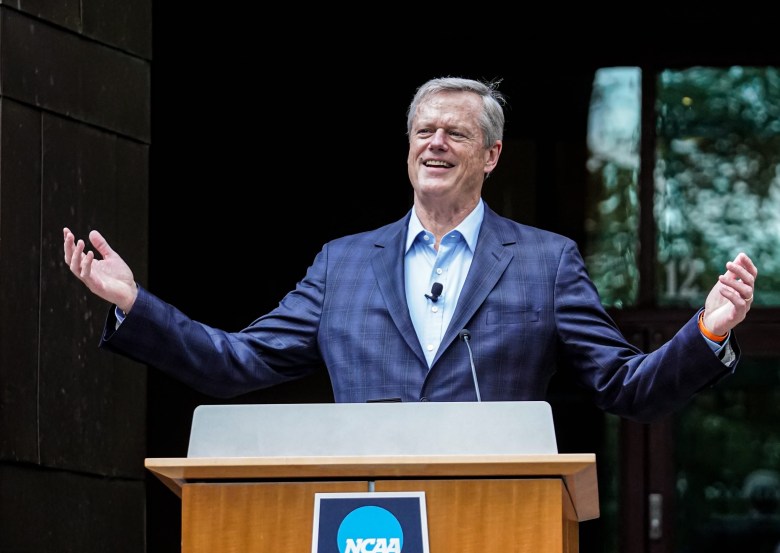
PHOENIX — The NCAA has seen enormous growth and gains in the last three years, but concerns about eligibility rules remain “the biggest and most challenging issue we’ve had,” NCAA president Charlie Baker told reporters Friday ahead of the UConn versus South Carolina NCAA Tournament Final Four game.
Baker’s comments come just hours after Donald Trump signed an executive order that will impose new limitations on how long students can play college sports and how frequently they can transfer to new schools. The order stipulates that athletes can play for “no more than a five-year period” and can only transfer schools once before they graduate without missing a season.
Sections three through six of the order are expected to take effect before Aug. 1 and also institute new policies that will prevent schools from eliminating scholarships and other financial opportunities for women’s and Olympic sports. Those sections also focus on “improper financial activities” (including but not limited to fraudulent NIL deals and using NIL money for coaches or staff) and deals that “discriminate against out-of-state commerce or unduly burden or impede interstate commerce.”
“College sports cannot function without clear, agreed-upon rules concerning pay-for-play and player eligibility that can’t be endlessly challenged in court, as is the case now,” the White House said in a statement. “The resulting chaos is creating financial pressures that threaten to drain resources from all sports except football and basketball, and from many universities altogether.”
The shifts may be positive for college athletes, Baker said, but it’s too early to know for sure.
“Some of the changes that have taken place in the last few years, a lot of people would say they’re the most consequential in college sports, outside maybe the creation of the NCAA and the signing of Title IX,” he explained. “So, I mean, there’s a lot of messiness in that, and I think in particular, a lot of the eligibility stuff is probably the biggest and most challenging issue we’ve had, and that one, again, we win more often than we lose in court.
“But the disruption and the time it takes to get through the court, anytime you try and solve anything through a court process, it’s going to take a really long time, and it’s going to create an enormous amount of uncertainty, and that’s what we’ve been dealing with.”
Some of that uncertainty centers on Title IX and how scholarships and other support for girls and women in collegiate sports is dispersed and sustained. Baker said there’s plenty of reason to assume the best.
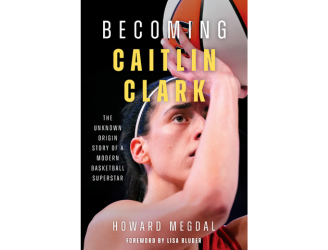
“Becoming Caitlin Clark” is out now!
Howard Megdal’s newest book is here! “Becoming Caitlin Clark: The Unknown Origin Story of a Modern Basketball Superstar” captures both the historic nature of Clark’s rise and the critical context over the previous century that helped make it possible, including interviews with Clark, Lisa Bluder (who also wrote the foreword), C. Vivian Stringer, Jan Jensen, Molly Kazmer and many others.
“I mean, before the House injunction got passed, we had limits all over the place on scholarships, and those limits often translated in women’s sports into a quarter for you, a quarter for you, a quarter for you, and a quarter for you,” he explained as he mimed money being split essentially into separate pots.
“The fact that we now have roster maxes in all sports, but scholarships are uncapped, I can tell you anecdotally… we’ll see what the data says at the end of the year. I think the data at the end of the year is going to show an enormous increase in the number of fully scholarship women athletes, and part of that (is) driven by the fact that a number of the new sports we have are women’s sports.”
Those new sports include women’s wrestling, which experienced rapid growth during the 2024-25 season, and women’s flag football, which is “moving up (as an) emerging sport,” Baker said. The NCAA will also host championships in acrobatics and tumbling and stunt during the 2026-27 season. It may still be too soon to know for sure, but for Baker, “the scholarship numbers are going in the right direction.”
The full impact of the executive order will take time to understand, but Baker said there’s reason to believe it will streamline and clarify eligibility across the board.
All too often, he explained, one school or athletic director will accuse the NCAA of denying an extra year to a student athlete, but then approving one for another. The order will presumably eliminate that experience, something Baker also said “would be really hard for us to do on our own.” The order is not expected to impact the transfer portal, which opens April 6.