INDIANAPOLIS — It was May 20, and the Indiana Fever were hosting the Portland Fire. There were just over three minutes to go in the third quarter. The Fever were up by 19 points and defending against a set play as the Fire tried to get guard Carla Leite open with a screen at the top of the key.
For a moment, Leite saw an opening to cut to the rim, her defender stuck behind the pick. Guard Sarah Ashlee Barker attempted to pass Leite the ball. To that point, Portland had run its action as planned and read the defense well.
There was one problem for the Fire, though. Fever wing Lexie Hull also read the play, and she did it faster. Helping off of her matchup under the rim, Hull stepped up before Barker’s pass was completed. She absorbed contact from the cutting Leite and drew an offensive foul, forcing a turnover.
Mere feet away, the Fever bench loved Hull’s effort. Head coach Stephanie White pumped her fist and let out a roar. Assistant coaches Austin Kelly, Karima Christmas-Kelly and Briann January all stood to cheer. So did Hull’s teammates Justine Pissott and Myisha Hines-Allen. Veteran guard Shatori Walker-Kimbrough was the most animated of all, mimicking the referees’ hand signal that the ball was going the other way.
It was just one play. There are hundreds in any WNBA game. But it showed the defensive value Hull has for the Fever and the contagious nature of her capabilities on the less glamorous end of the floor. Her entire team fed off of that moment.
Meanwhile, Hull popped up off the court after taking the charge and beamed thanks to the reactions from the bench. Teammates Tyasha Harris and Aliyah Boston greeted her and matched her smile.
“It just feels good when we’re in the right spot at the right time,” Hull said postgame about that play, still smiling. “It’s also so exciting because I know those are the things that get us fired up. Those are the little things that turn momentum, keep momentum going. And just to be able to take a charge and then look at the bench and see them so excited, that gets all of us going. So it’s fun. Those are the fun moments.”
It wasn’t even the first offensive foul Hull had drawn in the game — she’d drawn another just before halftime while chasing her player through a maze of screens. Now in her fifth pro season, Hull has never shied away from those moments. In some games, those defensive plays carry more weight, and pain, than in others.
“She’s one of the toughest players I’ve ever been around,” White said of that play and what it says about Hull. “She’s tough. She plays her butt off. She makes the right plays on the defensive end of the floor. She relishes doing those things that energize our team.”
White likened the Stanford product to the Energizer Bunny. That’s something every team needs, but particularly a Fever group whose ceiling will be defined by its defense.
Hull does her part and then some on that end of the floor. According to Help the Helper, the Fever’s defense is 7.7 points per 100 possessions better with Hull on the court than when she’s on the bench. That ranks in the 70th percentile leaguewide. It’s also a major reason why the Fever are 17.5 points per 100 possessions better overall when she’s on the court than when she’s off. That’s the biggest difference for any player on Indiana’s roster.
Listen now to The IX Sports Podcast and Women’s Sports Daily
We are excited to announce the launch of TWO new podcasts for all the women’s sports fans out there looking for a daily dose of women’s sports news and analysis. Stream on Spotify, Apple Podcasts or anywhere you listen to podcasts, and make sure to subscribe!
Her defense is also why Hull moved into the starting lineup after coming off the bench in the team’s first three games. The Fever conceded more than 100 points twice in their opening trio of games, then White put Hull in the opening five. Since then, the Fever have yet to allow more than 90 points in a game and are 3-1.
“I wanted to give a different look defensively,” White said of that lineup change, also noting that guard Sophie Cunningham provided some necessary offensive punch for the second unit.
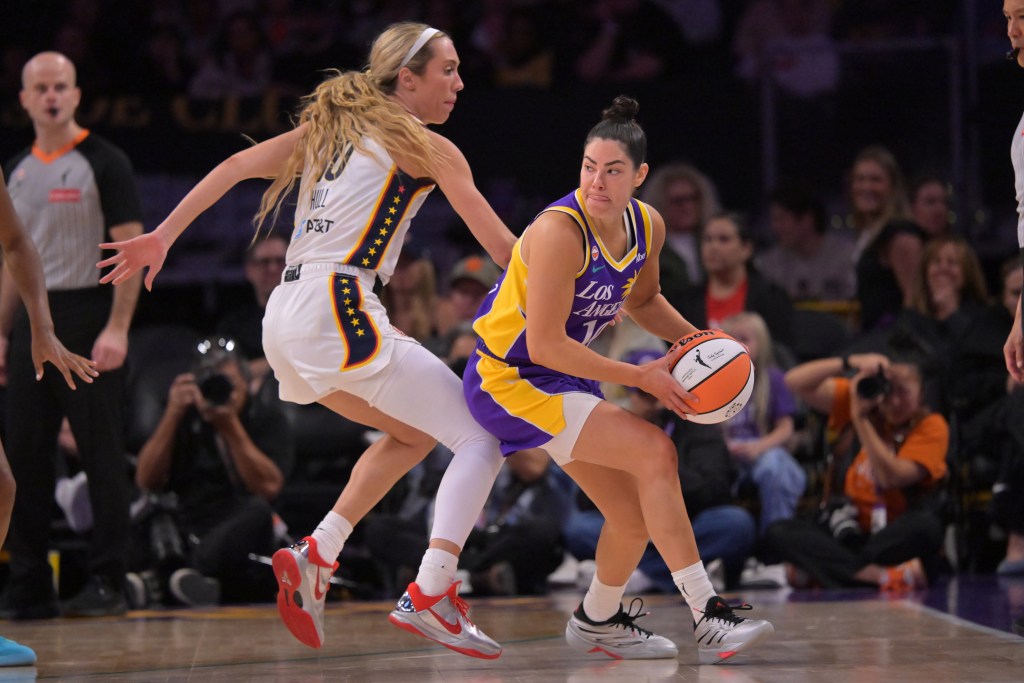
This is nothing new for Hull. Even before Indiana drafted her sixth overall in 2022, her defense has been praised. But right now, it’s perhaps more important than it has ever been given how often the Fever have struggled to get stops this season.
Coaches at every stop have helped her improve, but the defensive willpower largely comes from within.
“It’s just something I’ve taken personally. It’s the foundation,” she said before a Fever practice this week. “From the first moment I stepped on the court, my coaches were always like, ‘We’re starting with defense.'”
Hull’s dad was one of her coaches growing up, and he was one of many people who instilled a defensive focus into her game. In college, she led the Pac-12 in steals in 2021-22. In the pros, she has transferred her skills into being more of an on-ball stopper and taking on tough assignments.
Some of her defensive success comes from endless effort. Other parts of it come from Hull’s preparation and technique, both of which have grown as she’s learned how to study her opponents’ tendencies.
“When you can kind of guess what [your matchup is] going to do, it makes your job a lot easier on that side [of the court]. So there’s a lot of film watching, preparation, studying the game for sure,” she explained.
Hull’s willingness to take a hit often leaves her on the ground. While that can be beneficial for Indiana, it stresses star guard Caitlin Clark out at times.
“I told her she needs to stop falling down so much. She’s just constantly falling down. It stresses me out,” Clark said. “She’s got this cut on her leg, and it doesn’t stop bleeding because she’s always on the ground.”
Then Clark provided more serious analysis.
“She’s just tenacious. No matter who her matchup is, she’s going to go after them. She’s going to pick up full [court]. She’s going to do the little things. And I think that’s something you really appreciate,” Clark said. “She doesn’t care how [many] points she scores. She’s out there to get deflections. She usually leads the team in deflections. …
“She’s going to get steals, she’s going to guard their best player, she’s going to rebound. … She’s going to make an impact. She’s always in our best lineups.”

“Becoming Caitlin Clark” is out now!
Howard Megdal’s newest book is here! “Becoming Caitlin Clark: The Unknown Origin Story of a Modern Basketball Superstar” captures both the historic nature of Clark’s rise and the critical context over the previous century that helped make it possible, including interviews with Clark, Lisa Bluder (who also wrote the foreword), C. Vivian Stringer, Jan Jensen, Molly Kazmer and many others.
The ideal player to plant next to Clark in order to maximize lineups would be a strong defender and shooter. Hull has been both this season, drilling 47.4% of her 3-pointers through seven games.
The opening five of Clark, Kelsey Mitchell, Hull, Monique Billings and Boston have gotten off to some good starts together. In first quarters all season long, the Fever rank fifth in defensive rating (points allowed per 100 possessions) and fourth in net rating (points scored minus points allowed per 100 possessions). In third quarters, the Fever lead the WNBA in each category.
Clearly, that quintet works. And Hull is the one who connects those pieces.
“She covers a lot of gaps,” White said.
White recently spoke with one of Hull’s college assistant coaches, and they asked White if she’s ever had a bad day coaching Hull.
“No,” White replied. “Because she just goes out and busts her butt every single day.”
In Hull’s eyes, there’s more work to do. She wants to improve her defensive discipline. She feels like she lunges too often and sometimes helps when she doesn’t need to. Like every aggressive defender, Hull also wants to reduce her fouls.
“I’m probably my worst critic,” Hull said. “I feel like there’s still so much room to grow on that side of the court.”
The fact that she carries a growth mentality is great news for the Indiana Fever. And if she keeps improving, they will certainly keep smiling.