Howdy y’all and welcome to Tennis Insider!
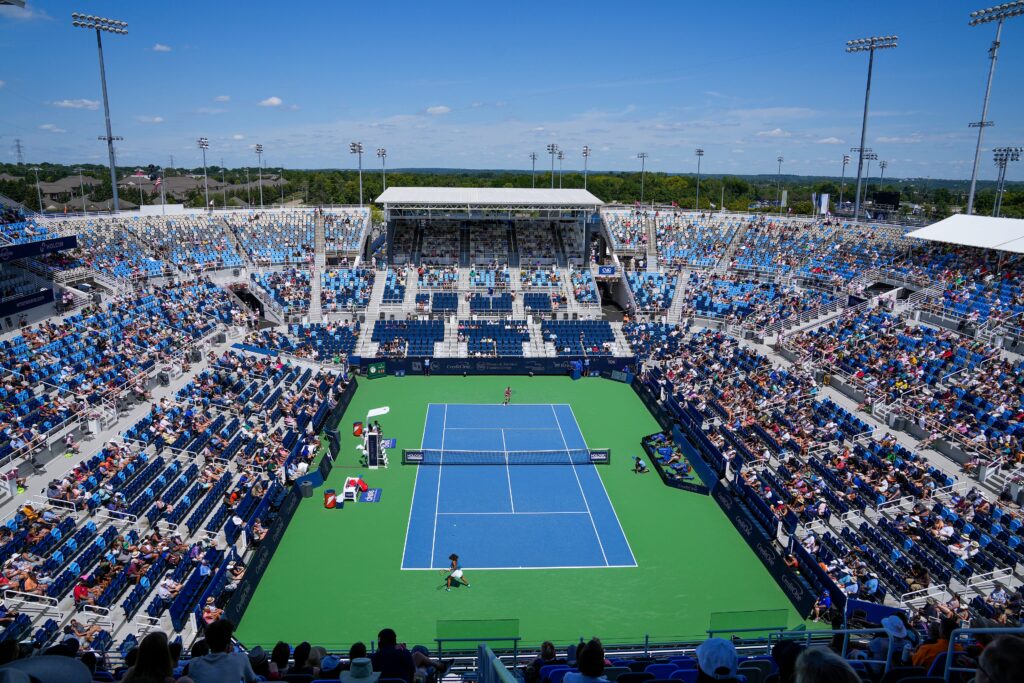
Right now, in Toronto, the Canadian Open is down to its final eight. By the time the trophy is lifted on Sobeys Stadium’s center court, the players left standing will pack up, fly a few hundred miles south, and do it all over again, because the Cincinnati Open opens qualifying the very next day. This isn’t the first year where we’ve had back-to-back two-week WTA 1000s, but is it the right move to have them at this part of the calendar?
Toronto, so far
The top of the draw has already taken some hits. World No. 1 Aryna Sabalenka, still chasing her first Canadian Open title, was knocked out in the round of 16 by No. 16 Ekaterina Alexandrova in three sets, while No. 3 Jessica Pegula fell the same day to Diana Shnaider. Both losses came on the same afternoon, sending two of the tournament’s biggest names home before the second week even started.
Elena Rybakina, by contrast, has been grinding her way through the draw the hard way. Her fourth-round win over Liudmila Samsonova took nearly three hours and 217 points, and by the quarterfinals she’d already logged close to seven hours on court in three matches. Coco Gauff has looked like the opposite story, dropping just a handful of games across her first three matches to reach her 25th WTA 1000 quarterfinal before turning 23, a pace that puts her ahead of even Martina Hingis at the same age.
Toronto’s quarterfinal lineup — Iga Świątek against Shnaider, Alexandrova against Elina Svitolina, Naomi Osaka against Rybakina, and Belinda Bencic against Gauff — is as deep as any non-Slam draw the tour has produced this year. But it’s also missing pieces: defending champion Victoria Mboko is out with a knee injury picked up at Queen’s Club, and Karolína Muchová withdrew after minor surgery. Sabalenka herself arrived in Toronto openly talking about the toll of a long grass season, telling reporters the scheduling into Cincinnati and the U.S. Open is simply “very tricky” for anyone who goes deep on grass.
Cincinnati is next, immediately
There’s barely a cushion built in. The Cincinnati Open‘s main draw begins Aug. 13 — the same day the Canadian Open final is played — and runs through Aug. 23, leaving only about a week before the U.S. Open begins on Aug. 31. It’s a stacked field: nine of the top ten are entered, along with five former Cincinnati champions and ten Grand Slam winners, and Serena and Venus Williams are reuniting for a wildcard doubles run. Notably, the event’s own players voted it the WTA’s Tournament of the Year for 2025, a testament to the expansion they unveiled last year.
Why these tournaments expanded
Until last year, Canada and Cincinnati were among the last WTA 1000s still running the old one-week, 56-player format. Now both are 12-day, 96-player events, matching Indian Wells, Miami, Madrid and Rome. The case for it is straightforward: a bigger draw means more ranked players get direct entry, instead of scrapping through qualifying, which matters for the depth of the sport. For fans and broadcasters, it means twelve days of live tennis instead of seven, more marquee names on-site at once and fewer of the lopsided, walkover-heavy days that used to open these tournaments. For the tournaments themselves, it’s simply more ticketed days and more revenue, which is a big part of why the ATP moved first and the WTA followed.
Listen now to The IX Sports Podcast and Women’s Sports Daily
We are excited to announce the launch of TWO new podcasts for all the women’s sports fans out there looking for a daily dose of women’s sports news and analysis. Stream on Spotify, Apple Podcasts or anywhere you listen to podcasts, and make sure to subscribe!
The cost
The problem is that the calendar didn’t get any longer to accommodate this. Instead, the extra days at Toronto and Cincinnati got squeezed in on top of everything else. Players who go deep in both events are now looking at close to a month of best-of-three, high-pressure tennis with barely a travel day in between, sandwiched between Wimbledon and the U.S. Open. Many players have complained about the on-the-ground experience: long, half-empty days where you play once, then wait around for days before your next match, rather than the tighter rhythm of an old-style week. That dead time isn’t restful, either. Players are still traveling, still practicing, still living out of a hotel, just without the payoff of a match.
It’s also squeezing the rest of the calendar. Every WTA 1000 that expands to two weeks eats into the room available for smaller events, the WTA 250s and 500s that lower-ranked players actually depend on for ranking points and match reps. Some of those tournaments have quietly disappeared from the U.S. hard-court swing in recent years as the bigger events have grown around them (Cleveland, Bronx, etc.). That’s a real cost for the players who aren’t Sabalenka or Gauff and need those weeks to build a season, not just the stars at the top of the draw.
And the fatigue argument isn’t just anecdotal. Sabalenka and Pegula both lost the same day in Toronto to players ranked well outside the top ten, the kind of result that happens more often when top seeds are running on fumes from a long season. Coco Gauff has pushed back publicly on penalizing players who skip events for exactly this reason, arguing the WTA needs something closer to the ATP’s optional-event model rather than docking ranking points from players who need to manage their bodies. That debate is now formal: the WTA set up a Tour Architecture Council, chaired by Pegula, specifically to work through calendar complaints like these, though there’s no indication a fix is close.
The Sunshine Double comparison
It’s worth asking why this particular back-to-back feels rougher than when Indian Wells rolls straight into Miami with barely more turnaround — Indian Wells wrapped on March 15 this year, and Miami’s main draw opened just two days later. The gap itself isn’t actually the difference. Everything around it is.
The Sunshine Double lands early in the season, right after the Australian Open, when players are relatively fresh from the off-season with only one Slam’s wear on their legs. It’s also hard-to-hard-to-hard: Melbourne, Indian Wells and Miami are all the same surface, so there’s no adaptation cost, just travel. And once Miami ends, there’s real room to exhale because the clay swing doesn’t force a mandatory 1000 until several weeks later, giving bodies time to adjust to a gentler surface well before Roland Garros arrives in late May.
None of that holds in August. Toronto opens barely three weeks after Wimbledon closes, which means converting from grass (low bounce, sliding footwork, different loading on the joints) straight onto hard courts, arguably the most jarring surface switch on tour, while already carrying three Slams and a full clay-and-grass swing in the legs. Then it’s Cincinnati immediately after, in the kind of thick, humid August heat that Indian Wells’ dry desert air and Miami’s earlier-season warmth don’t really replicate. And coming out of Cincinnati, there’s only about a week before the U.S. Open begins, nowhere near the runway players get between Miami and Paris. A deep run through both Toronto and Cincinnati means walking into the year’s final Slam already running on empty.
That’s the real gap between the two swings: it’s not just two 1000s back-to-back, it’s two 1000s back-to-back at the single worst point in the calendar to ask for it.
Is it worth it?
Probably both things are true at once. The expanded Toronto and Cincinnati draws have genuinely been good for depth and for fans. This year’s Toronto field is stacked in a way a 56-draw event simply couldn’t be, and Cincinnati’s own players voted with their ballots that they like what it’s become. But asking the same bodies to do that twice in a row, with zero break built into the schedule, is a design choice, not a law of nature. The WTA could stagger these events differently, build in a true off week between them, or rethink which events actually need twelve days. Right now, the tour is getting the audience and depth benefits of the bigger format while leaving the recovery problem for players to sort out on their own.
Now, on to links!
This week in women’s tennis
WTAtennis.com caught up with Alexandra Eala after her Washington D.C. win to discuss finally breaking through and more.
Really enjoyed this piece on Caty McNally, who spoke about traveling without a coach, what she’s looking for in one and her goals moving forward.
It’s been weird seeing Ozempic be among the sponsors for the Canadian Open this week.
Beatriz Haddad Maia shared that she will be taking an extended break from the tour and will come back in 2027 with a protected ranking.
Good on Coco Gauff for lending support for the trans community amid conversations about the WTA’s gene-testing program. In related news, the LTA fully banned trans women from competing in any organized competition.
2019 U.S. Open champion Bianca Andreescu headlines the player field for the qualifying competition later this month.
Congratulations to Caroline Garcia, who gave birth to her first child, Pablo.
Alina Korneeva is a name you’ll likely hear from sooner than later if her Toronto run is any indicator.
Rep The IX Sports at your next game!
Shop the logo collection or special “Women’s Sports are Front Page News” collection now on Shopify.
Tweet of the Week
I found these stats on court time super interesting:
Five at The IX: Canadian Open
Q. I wanted to follow-up on the WTA 500, I guess, the mandatory type of zero-pointer thing. Curious, how do players feel about that rule? Obviously, I feel like it is effective because it prompted you to play DC. But how do players feel about that rule. And then, I guess, is there talks about wanting to maybe change the rule, or do you feel like it’s ultimately for the greater good of promoting the 500s?
JESSICA PEGULA: Yeah, I mean, it’s a loaded question. I sit on the Tour Architecture Council, where we’re kind of talking about how do we possibly maybe lower mandatories.
I think, for the most part, girls play. Like, we want to play and compete. So I think sometimes the tournaments want incentives for players to play, like having to play a mandatory event. But at the same time I think girls will, honestly, always play. Like, we are here to compete and play and stuff like that.
I think what’s also changed is just having these two-week events. Now, all of a sudden, it’s a little bit harder when you do well at a two-week event, not just a slam, but all these other events that become so much longer, to now have to play all these 500s.
I think that when the tour kind of changed, we upgraded a lot of 500s as well. So I think it’s just, I think looking at what we did, and just going back and tweaking it where maybe players don’t feel so much pressure that they have to play.
I think sometimes that’s where players are at. And then that leads to burnout and injury and stuff like that. So we’re looking at it more from like a player kind of health aspect.
Because, obviously I’m not the only one. Actually, I don’t really think I complain, but a lot of players have complained on the men and women’s side about the length of the calendar and how it’s just gotten really, really long.
So I’m on that council and hopefully we can come up with something that alleviates some of the stress that players feel with having to play.
I think that number just maybe was a little too much for players, as far as having to play six. But, yeah, I think it’s a work in progress.
Q. We’re kind of at the midpoint of the season, I’m curious how you would assess your season thus far, maybe compared to those seasons of, that of recent years. I know you haven’t won a title, but you made strides at Wimbledon, and then at other tournaments, too. But, like, do you feel like this is maybe your best pre-Cincinnati season, for lack of a better word?
COCO GAUFF: Yeah, I mean, I guess. I mean, I wish the clay would have went a bit better for me. I felt like I was a little bit disappointed in how that went.
But I think, as far as, like, other surfaces and stuff, I definitely think this is the best I’ve approached so far, like, pre-Cincinnati. I feel like even so far at this tournament, just playing a little bit better than I normally do at the start of this tournament. I think it’s definitely the strides I’m making.
I feel like I’m becoming a better player. I feel like people are seeing that. I obviously have less doubles and things like that.
But, yeah, I wish I could have won a title. I think Rome is the one that stings the most because I just felt like I fell back in some old habits that match.
But other than that, I think I’ve become a better player. I think Wimbledon was a big stride for my career. So, hopefully I can continue that momentum. And especially on a surface I’m more comfortable with.
I think it’s just reassuring myself that I belong where I am, and I’m nowhere near my peak yet, so just trying to do everything possible to reach that.
Q. Going back to the earlier conversation about US Open. Obviously it’s very important to you, how much of it is it like, for lack of a better word, like make or break, like, you doing well at that tournament. Or if, say, maybe things don’t go your way, God forbid, will you still be like the same pretty much?
NAOMI OSAKA: I mean, that’s a tough one. I think, you know, like if I had to call a tournament home, it would be that one. I put a lot of pressure on myself.
I remember the first year I came back from having my daughter, I have the bow dress, and I played Muchova. I remember I lost that match, and I just sat in the parking lot and I was like bawling my eyes out, just because that tournament meant so much to me, and I just wanted to do well.
Obviously last year I did well, and I wanted to get to the final. But Amanda played insane, so I wasn’t even mad about that.
But, yeah, if you’re asking me if I put a lot of pressure on myself for that tournament specifically, I do. And usually it goes my way, but God forbid something happens, it will suck, but at least my outfit was good (laughing).
Q. Aryna Sabalenka is a world No. 1. What’s the hardest part about facing her? What makes her so difficult to play?
EKATERINA ALEXANDROVA: I think, I mean, she has every aspect of the game, I think, in a very high level.
She has an amazing serve, return. She can make amazing shots from both sides, the forehand and the backhand. She can play the dropshot and the volley. So basically she can do anything.
You need to be prepared for that, that, like, that there’s not going to be, like, some easy points or easy shots. So every point you play, you need to be super focused and super prepared for anything. Because even when you make a good shot and you expect something easier for you just to finish the point, maybe it’s not the case with her because she can play it like, you know, like even better shot from your good shot. I think that’s the difficulty to playing against her.
Also, she also is good with the switching, like, timing and the rhythm. Because like today I didn’t feel any particular rhythm. Sometimes it was super fast, sometimes it was slower, sometimes it was with the spin. It’s really hard to readjust for this type of game.
Q. Do you feel like you’re the type of player who kind of plays better later on in the tournament, it might take you a round or two before you find your best form?
ELINA SVITOLINA: No, I wouldn’t say that. I think I’ve been, in so many years being on tour, I have different situations. I wouldn’t say that I start poor. Sometimes, you know, mid tournament you have tough match. Sometimes towards the end, of course towards the end everybody is super confident, and they get there for a reason. And the semifinal, finals can be tough. But I wouldn’t say that, I think it just happened here that way.
‘Rare Gems’ is out now!
Howard Megdal, founder and editor of The IX Basketball and The IX Sports, wrote this deeply reported book. “Rare Gems” follows four connected generations of women’s basketball pioneers, from Elvera “Peps” Neuman to Cheryl Reeve and from Lindsay Whalen to Sylvia Fowles and Paige Bueckers.
If you enjoy Megdal’s coverage of women’s basketball every Wednesday at The IX Sports, you will love “Rare Gems: How Four Generations of Women Paved the Way for the WNBA.”
Soccer: Annie Peterson, @AnnieMPeterson, AP Women’s Soccer
Tennis: Joey Dillon, @JoeyDillon, Freelance Tennis Writer
Basketball: Howard Megdal, @HowardMegdal, The IX Sports
Softball: Maren Angus-Coombs, @Maren-Angus, The IX Sports
Golf: Marin Dremock, @MDremock, The IX Sports
Hockey: @TheIceGarden, The Ice Garden
Gymnastics: Jessica Taylor Price, @jesstaylorprice, Freelance Writer