PWHL players don’t often pop up in Calgary, so when I saw that Malia Schneider was hitting the ice — or, rather, the floor — at Ball Hockey Nationals with the BC Selects team, I jumped on the chance to chat with her.
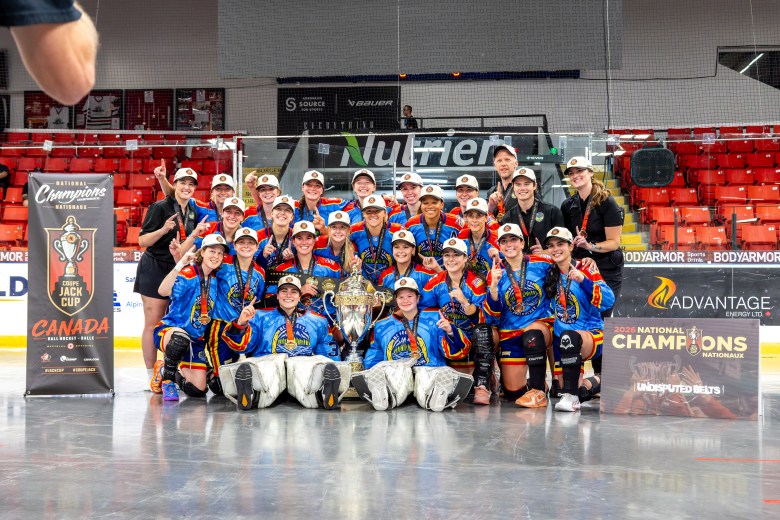
We met before her team’s final round-robin game of the tournament, a game that the Selects would win 3-2 in overtime against NL United. Schneider picked up an assist in that game and finished the tournament with 5 points in six games. The team went undefeated in regulation time to become Senior A Women’s National Champions for the first time in 20 years.
Given that Schneider was playing for a Selects team at Nationals, one might assume, as I did, that she had been playing ball hockey in the off-season for many years.
“No, it’s a brand new adventure,” Schneider told me with a laugh. “I played one game last summer because my friend was like, ‘You need to come out.’ I came out for one game and I was like, ‘This is awesome.’”
The PWHL schedule isn’t forgiving for the ball hockey season, so Schneider made it out to only a few games before Nationals. Aside from some rule differences from ice hockey, like the floating blue line rule, which took some explaining, Schneider caught on pretty quickly. If anything, she told me, it’s been something to have fun and be silly with.
“It was, like, so cool just to try something new,” she said. “I love learning new things and new skills and seeing how they translate to hockey.”
When I asked about how her off-season had been so far, she told me that ball hockey has been a good way to keep her head in the game and to learn.
“I think the biggest thing is going to be my spacial awareness,” Schneider said, reflecting on the biggest takeaways from ball hockey for her on-ice game. “Just being aware of space, open areas, how to support people with and without the puck, those kind[s] of things. That’s definitely going to help me.”
She stressed to me the difference between being on ice, where you’re able to glide and end up where you want to go, and being on the floor, where you have to be consciously moving your feet at all times to get somewhere.
Before the interview, I saw her recent Instagram reel about shooting a puck versus a ball. Even though the shot type is different, Schneider was eager to tell me about the various ways it’s made her own on-ice play better.
“I mean, I can get really nerdy about it,” she said with a smile, “but there [are] different ways to stickhandle. I think really nailing down those little details [is] definitely going to help me on the ice.”
After hearing from Emily Clark earlier in the month about how she spends her off-season, I was curious to know if Schneider broke hers up similarly, emphasizing family and off-ice time before getting back into the swing of things.
“I totally agree with Clarky,” Schneider told me. “I took, like, a month, maybe two months off from the ice. I just did more outside training where I run or [play] pickleball. And now, more in the summer months, … with ball hockey, it’s keeping my mind in it while still being off the ice.”
Schneider said she’ll probably be back to on-ice training as the summer winds down, preparing for the PWHL season. As she’s a free agent heading into next season, I tried to get out of her where she might end up, but she wouldn’t tell.
“Ask [my agent],” she said, laughing.
Whether or not she’ll be back with the Vancouver Goldeneyes, her season with them as a reserve player provided some insight into the biggest Goldeneyes news of the off-season so far: Cara Gardner Morey moving from general manager to head coach.
“I mean, honestly, I wasn’t shocked just because the whole season she’d been saying, ‘This is a new position for me, being GM. I’m used to being a coach,’” Schneider said. “She obviously has a passion for coaching. And I think for her and the team, it’s going to be a great thing just to have her because she is so dedicated to the coaching aspect of it.”
She emphasized that Gardner Morey was by no means a bad GM but that coaching might put her in “more of her zone and element, so I think she’ll do well there.”
I also wanted to hear from someone who had been a reserve player about her thoughts on a potential change to the rules — the PWHL is reportedly looking into adapting the reserve player role or removing it all together, making all rostered players equal.
“I think that would be a great move,” Schneider said of removing the reserve player status and making reserve players part of the full-time roster. “I think, ultimately, we just want to play hockey. Obviously, not everyone can dress [for a game] if they do this, but I just think that it makes it more competitive. [It would be] direct competition within the team, in a healthy way. It’s ultimately going to level up both the team and the whole league.”
With training camp dates and invites not yet announced, fans will have to wait to see where Schneider will end up and whether she can put these new ball hockey skills to good use on the ice.