Whether you have been enjoying the games in full or have just been surfing on the league’s good vibes via social media, highlight clips, and (hopefully) my game recaps, the Women’s Pro Baseball League, which kicked off its inaugural season on Aug. 1, has been a gift from the baseball gods.
The significance of the league, the first professional women’s baseball league in the United States since the All-American Girls Professional Baseball League folded in September 1954, is obvious and almost overwhelming. So much so that it almost feels like a bonus that the WPBL has also been tremendously entertaining, thanks primarily to the enthusiasm, positivity, and, above all else, talent of the 68 players who comprise the league.
Crediting the league to the baseball gods, however, does a disservice to actual human beings behind the scenes whose hard work has made this league a reality. First and foremost among those has been league co-founder and commissioner Justine Siegal, who founded Baseball for All in 2010 and has been fighting for women’s place in baseball for decades.
Of course, as with any new endeavor, the WPBL’s first season has had its share of missteps. The league’s management very much appears to be building the plane while flying it, which has led to some turbulence. Things got even bumpier on Monday, when the news broke that a member of the board of directors has accused some of her fellow board members of financial malfeasance and sued to see the league’s financial records (more on that below).
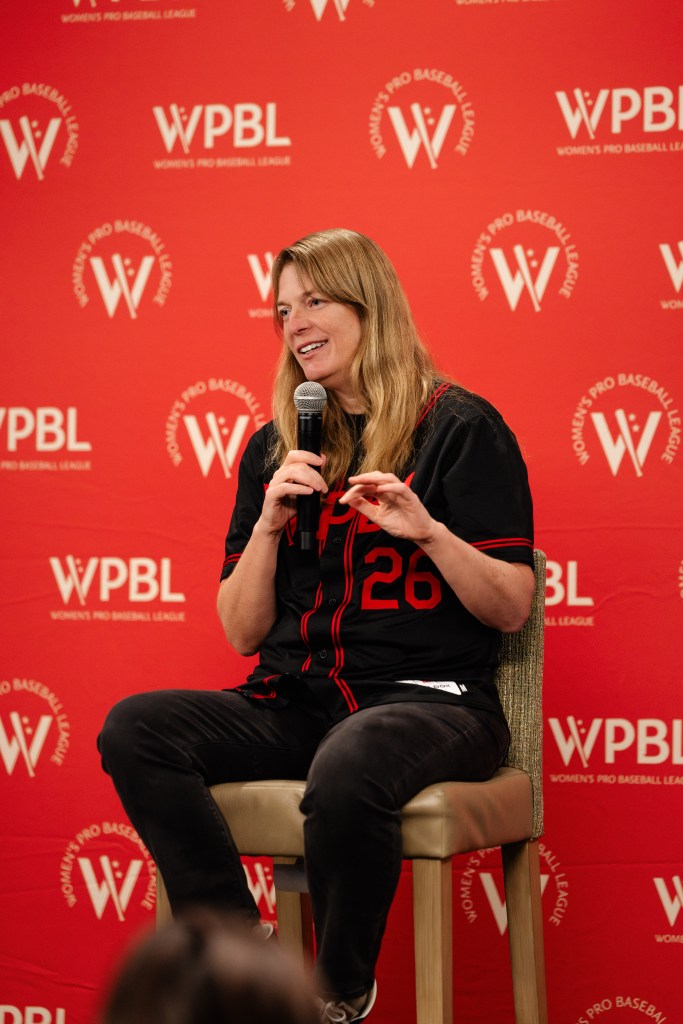
In an attempt to better understand how the league operates on the baseball side of things, how it makes decisions, and where it may be headed beyond this season, I reached out to Siegal, who, despite her heavy workload — “My brain’s pretty full,” she confessed early in our conversation — was kind enough to talk me through a lot of it this past Friday.
I started off by asking Siegal about the WPBL’s playoff structure, as I had just noticed earlier that day that the league had finally added its playoff schedule to its website. Siegal confirmed that the schedule was correct (the accuracy of the information on the young league’s website is not a given), as well as the fact that the seeding and homefield advantage will be determined by the regular-season standings (all four teams will make the playoffs, but the first-place team will host the fourth-place team in the semi-finals, while the second-place team will host the third-place team, etc.).
However, when I asked her about the homefield schedule for each series (are the best-of-three semi-finals 2-1, 1-2, or 1-1-1?) or what the tiebreakers would be if two teams finished with identical records, she told me she’d have to get back to me. On Sunday, she emailed me, “We aren’t ready to release this information.” As you’ll see below, that’s not a dodge. It’s very likely the league hasn’t finalized those decisions yet despite the fact that the playoffs start in two weeks.
Rep The IX Sports at your next game!
Shop the logo collection or special “Women’s Sports are Front Page News” collection now on Shopify.

Cliff Corcoran: Who’s making these decisions, and what is the organizational structure around that kind of thing?
Justine Siegal: Jeffrey [Gardner] and I make a lot of decisions. He’s the director of baseball ops. [Gardner, not to be confused with the Reno Aces manager and former major leaguer, is a pharmaceutical executive and league investor who is also the vice chair of P3 Baseball & Softball, a youth program in New York City.] We make a ton of decisions together, but we also have things cleared, in some cases, by our lawyer or just [CEO] Keith [Stein]. … We did as many policies as we could before the season started, but in the end, we just need to make sure everything is right, even though we’re writing policies.
And we have a competition committee, where certain things go to them. … There’s a lot of committees. There’s the weather committee. They’re not called “the weather committee,” but we have four people we speak to before we cancel a game in the middle, right? And so it’s a truth network. We talk to the grounds crew, and we talk to the broadcast, and then Jeff and I talk, and we make a decision, and so on. That would be a good example.
But the other thing that the competition committee, I know they were just talking about, I think it had to do with ERA. So, our scorekeeping: Sometimes we have a question on whether it makes sense to follow the Women’s World Cup rule or MLB’s rule. And we are overwhelmingly following MLB’s rule. But every once in a while, we just have a discussion to make sure we’re all on the same page, because we want the stats to be as pure as they can to what an MLB fan would expect. But when you only play seven innings, it does change things. And so we have we have a competition committee that that looks at that, and it includes me, Jeff, a scorekeeper…
So, while we’ve tried to, upfront, be prepared to solve as many things [as we can], there seems to always be something that pops up that, you’re a first-year league, that you weren’t quite expecting. So then we look at what’s happening around us. What makes sense for us as a league? We don’t have to follow what everybody else is doing, but we want to be as baseball as possible.
CC: You said you have several committees. I’ve seen a list of people that were on an advisory board. I don’t know if that was a before-the-season-started group or …
JS: Our advisory board is still intact. We are in communication with our advisory board, but they’re not making, as a group, in-game decisions, like what’s happening now within the league.
I’m not saying we have a lot of committees. I’m just saying that Jeff and I are in the center of things, but at the same time, we have to be cognizant that ESPN is filming.
[A] stupid example would be that we traditionally line up on the line when your name is called, and then everybody high fives… But we don’t do that anymore because it doesn’t fit within broadcast. So, what else could we do? Well, we can have the players step out of the dugout and tip their hat. So, those are things that you’re just making adjustments as you realize what it is to be on a major broadcasting channel.
CC: So, then the basic structure, you’ve got yourself and Keith, founders … co-CEOs?
JS: No, no. He’s an acting CEO. I don’t know if he calls himself the CEO, but he’s a very involved founder. And I am a co-founder, knowing that I was coming in on the baseball side and understanding the women’s game and the pro-baseball game, as well. So, I could bring both of [those] to the table. And then Jeff Gardner is our director of baseball ops, and he’s phenomenal. He’s very detail oriented, so he gets a lot of things right, and the players love him.
CC: And then I see that you have Assia Grazioli-Venier. She’s a chairperson.
JS: Yes. She was our chairperson to help us launch. But she’s no longer on the chair, but she’s still an investor.
CC: And is Dave Stewart’s role that he’s still advising, or was that also just for launch?
JS: He’s advising. He was just on the call about playoffs… We’re talking about what logo do we want on the field? Do you want to add bunting, the red, white, and blue stuff? There’s just a lot of things, because you could do the bare minimum, but we want to do as much as we can with the resources we have. And so that’s a phone call to 14 people, including Dave Stewart, which is totally awesome.
CC: I was thinking about this, thinking about all the logistics, in the ballpark, with the broadcast, with the merch, with every aspect of the uniforms … There’s a lot.
JS: There’s a lot, but we’re working hard, and I think we’ve gotten a lot of it right.
CC: Absolutely. I’m very impressed, especially at the speed you’ve put this together and the number of quality players that you have involved. I’m really enjoying it.
To keep going, Alex Hugo is your player of development and recruiting. Does she have an active role during the season, or is that just for getting the players together in the offseason?
JS: …Keith would know what her official title is. I know she came in as a special advisor to help us spread the word amongst the national teams, because she’s so involved with our elite players around the country. And then she did help us. She helps with workouts — we had a workout in Stockton [California] and Brockton [Massachusetts] — and helps with the draft. So, she’s pretty involved… Most of her work was getting us here.
CC: You mentioned the draft, and that’s a big question that a lot of people have had. Rocky Henley said in one of the press conferences the other day that, when she was hired, she was excited to be hired as manager of the Heights, and then she got a look at the roster that she had, and she was excited to have all these players that she knew and these great players. That suggests that she was not part of the drafting process. Is there any front-office aspect to the teams, or is it just the league and then the coaches and players?
JS: So, we did a snake draft, and it was led by our baseball operations team. We had more people with us prior than here, because a lot of people wanted to be a part of the league, but they couldn’t come to Springfield. So they’re available, but they’re not here… Those in charge of player development and helping us run our tryouts, predominantly Alex Hugo and Liz Benn, created a draft, and it was chosen. Players were chosen. I was actually not part of the draft, either.
CC: So, did you have somebody representing each of the four teams and they kind of drafted competitively, or was it a cooperative idea of, like, “Oh, the Hunters need a catcher,” spreading players around …
JS: Yes. It was very much [that] the goal was to create equality within the teams. So, if there’s catcher here and there’s a catcher there, to make sure there’s a couple catchers on every team, the effort to put known stars on different teams and make sure that there’s pitchers coming in and out. I don’t think anybody at the time thought Denae [Benites] would be our home run leader. I mean, we knew she was a star, but we didn’t know she’d be our home run leader at the moment. So, the draft was designed to create competitive balance within the league.
CC: So the teams just exist on the field, then. There’s the league, and there’s the teams, which are just the coaches and players. There’s no front-office structure for the teams right now.
JS: No, no. We save money. Part of being in a single-ownership group is that you can save money and not [have] to split into four different front offices.
CC: Going forward, at some point, you imagine you’d probably build that out, right?
JS: A hundred percent. I mean, our goal is to franchise. But we have to first build a solid league, and then we can franchise, and then my role as commissioner changes into… I just imagine [MLB] Commissioner [Rob] Manfred like 100 times scaled down. … We’ll become a franchise-based league. That is definitely where we’re headed.
CC: So then, when the players signed, because there was a lot of reporting, you know, Denae, Kelsie, whoever signed with the league, they signed with the league, not with a team, right?
JS: Correct.
CC: And the basic terms of that contract, is that just for the course of this one season?
JS: Yes. It’s just for this season, and then they get released. And, in good faith, the idea [is] that they would come back and we would sign them back. … The concept is we continue.
CC: So for the returning players who come back next year, would they be assigned to the same teams they’re on now? Or is [the idea] to redraft the whole league?
JS: It’s a good question. I’m unsure. I think now there would be a second season. Our goal was to get the first season, and we’ve done that successfully. And I see the second season being a run a bit differently, incorporating lessons learned or just the fact that we know which managers we want to bring back. I’m not going to say, it could be all of them, but the point being is that now we have a head start, right? We have them, and it can be done in a more traditional baseball sense, the draft, and with the different teams, and getting a spring training, figuring out if we can find a better way to do spring training, which is always going to be a little bit difficult because of the Women’s World Cup, which is right smack in the middle of July. So, you know, those are things that we have to try to figure out. Do we stay in this type of format? Do we do we have something in the beginning? Do we have an all-star break? All of those things, I just don’t know. But what’s exciting is it’s all possible.
CC: Then the players aren’t necessarily bound to their current teams going forward in any way.
JS: I would think they wouldn’t want to leave, lose their friends, but yes, their contract is to the league not to the team.
CC: And they’re all effectively free agents at the end of this season.
JS: Correct. Free agents with good faith that we would want them to come back.
CC: With the league, but not necessarily their teams. We don’t know about the teams, that’s a whole separate question.
JS: Yes. I mean, we have a plan, but if you’re not adjusting to what you’re learning and as you’re growing, then it’s not a very good plan, right?
CC: Absolutely. You guys have shown that. I mean, we’ve seen various things. For example, the rosters started out I think capped at 15, and now we’ve seen a little flexibility with a couple extra people on there who can be deactivated per game.
JS: Right. So, we have 15 active players and two inactive players, and those two inactive players are here on site, they’re active parts of the roster. So, an example would be that we have one player [Heights two-way infielder Keira Izumi, whom The IX Sports’s Madison Williams profiled last week] is a college student. So school starts, she’s going to have to fly back to USC, and then that inactive person comes in. So there is some flexibility there meant for the realities of being a woman pro baseball player without the salaries of a major leaguer.
CC: I feel like that was something that was an adjustment that was made in-season, is that not accurate?
JS: A little bit. It was a little bit of an adjustment, in part. We did have some visa issues, people coming in [to the country]. So we called up people earlier than we anticipated, and then they earned their spot. But we have a 15-man roster, that’s what we decided on. So this was a great compromise to sort of meet all the needs that our league needed and to give our players the freedom to be successful people.
CC: It’s tricky because you’re asking them to put their lives on hold for five or seven weeks, whatever it is, right?
JS: Yeah, we put them on hold, and we’re paying the players what we can [$300 to $500 per game, per The Defector], but we know that they deserve more, and that’s the direction we’re heading. But for now, there’s a first year. Everyone’s pretty excited. And we’ve got their travel, and we’ve got their lodging, and we give them most of their meals. So they don’t really need a whole lot while they’re here.
CC: What is your confidence level on there being a season two?
JS: Oh, I’m very confident. It’s all we talk about. Like, we’re here. Our feet are here, but we’re all excited about the growth that can happen.
CC: I know a lot of fans have asked, and I’ve seen you answer it on Instagram, but the possibility of playing in multiple locations or closer to the home cities …
JS: I could confidently say that we are going to do more in the home cities that we’re representing, but what next year looks like exactly, we don’t have those answers.
CC: Are you hoping to play a longer season?
JS: We plan to play more. Yes, and to be able to reach more fans in person…. There’s variables as we build, and we need to build strategically. Because other women’s pro leagues, they have different iterations, right? They’ve learned, and then it failed, and then they had another one. But we have the benefit of actually riding the wave of women’s pro sports, and this wave isn’t stopping. But we still need to learn from what they did and strategically grow. Even if you were to give us all the money in the world, we’d still need to strategically grow. So that’s what we want to do. But we certainly want to be able to reach more fans in person, beyond what we’ve done here in Springfield.
CC: Speaking of that, the deal with ESPN came together fairly late, and I’m sure there was probably some conflict in your mind about balancing the revenue that that deal would bring versus the accessibility of having the games free for everybody to watch. Can you speak to that decision making at all?
JS: I really can’t, because it wasn’t my decision. I wasn’t part of the decision making. I do know they were in conversation longer than it seems to the public. It’s not like it happened a week before. I know that Keith had spent a lot of time massaging and figuring out the best way he felt to promote the game… It’s a good question. It’s more of a Keith question.
CC: Do you have just four umpires calling games right now in rotation, or are there more than that?
JS: No, there’s more umpires… For example, they already committed to the Atlantic League. They can’t be here, but they can be here in September, when the Atlantic League’s over. So we have a supervisor of umpires, Kelly Dine, and she’s the one who assigns the umpires.
CC: I know you had the fainting incident a couple weeks ago [with umpire Steve Berardino]. Are you keeping a third umpire on the ready in case you lose somebody?
JS: We have not, but we have been providing more water to the umpires. Not that that’s on us, but sometimes, you’re in a game and you’re so focused, but then if some batboy comes up to you and hands you a cup of water, you’re going to drink it. That was a particularly hot, hot day, and [Aug. 22] was our last doubleheader, and that happened during a doubleheader, a one o’clock game. … It was particularly hot that week. But that umpire was fine. We treated him. He never went to the hospital. We treated him here. I called him, and he was super grateful for everything.
CC: Who’s making the official scoring decisions?
JS: It’s a committee. There is someone here who’s making decisions, but then we are reviewing some of those decisions after the game to do what we think is correct. So we have people on that. I don’t know if it’s an official committee. This is a lot of emails, and a group of people that we email.
So, for example, one person scores for the Red Sox, right? Another guy’s our official scorer. Carly Mitchell did data for the Giants. So, she’s actually running all of our Trackman, stuff like that. So we all collectively, if there’s a question, we look at it, just sometimes to make sure, like, “oh, that loss or that hit was attributed to this pitcher” when we know it’s actually attributed to another, and we just fix those mistakes. Ideally, as the games have gone on, there’s been less mistakes in that area, but, you know, we just want to get it right. … It’s really important to us that we get you the right data, so if there is something wrong then we fix it and then we get it out again.
CC: Somewhere in there, you called somebody your official scorer. So do you have one person who’s the official scorer during the games, and then you have the committee to discuss if necessary?
JS: We have an official scorer. … I think they’re local. And then we have also had a scorer score from home, so that they’re both scoring at the same time, and then that way we can also just get collaboration on it. Because at the very beginning of the season it was … So, if you know women’s baseball, you’re used to Kelsie [Whitmore] pitching on the mound and then going to center field. But if you’ve just been doing straight-up typical men’s baseball, you’re not. So in the beginning, there were more mistakes. So we started checking those games. We’re not having those mistakes now, because everyone’s gotten used to that, the format of what you do when you your pitcher is suddenly your catcher or something like that [that] you never see.
CC: I just wrote about that as part of my game story last night, because we saw that interesting pinch-hitting move by Rocky Henley …
JS: Yes, and that’s part of the women’s game for now. Will it be in five, six years? I don’t know. … There have been times when coaches on Team USA have tried to [create] a pitching staff. But how do you pitch Kelsie and sit her for four days? It’s insane. So, at the moment, we put the best players where we can when we can. But will that one day change? Very possible.
CC: I think it makes for a very entertaining game right now. I mean, you’ve got a bunch of Ohtanis out there, basically.
JS: Exactly. We’re like, “Ohtani? He’s not special.”
CC: You mentioned, maybe next season, possibly an all-star break or game. At some point, there was mention of an all-star showcase this season. My impression is now that’s not going to happen, or is that still something that could happen?
JS: It’s a possibility to do something beyond this season. I know it’s still being talked about. I don’t have anything concrete.
CC: For this season?
JS: Well, this year, right? Because we’re a first-year, we have so much flexibility on what we do between October and next season. So, I wouldn’t say something’s not happening. I would say I don’t know. There’s nothing on the calendar, but we talk about what can we do during this offseason to stay active and help our players continue to grow.
CC: And to grow the game, grow the visibility of the league. Sure.
One thing that a lot of fans are asking about, I’m kind of curious about myself, is the merchandise. I saw you answer a little bit about that on Instagram. Most of the stuff that’s online is sold out. I see some fans in the stands in Springfield wearing some stuff that I didn’t see online. I’m like, “Gee, I’d like one of those.” What is the circumstance going on with the merchandise right now?
JS: We’ve sold almost a million dollars in merch, and we’re just having a hard time keeping it [in stock]. I mean, clearly next year we need someone whose whole job is merch.
We’re a startup league, who, frankly, [we’ve just been] so well-received. It’s so heartwarming to see the media care about us, want to write about us. The fans coming out. We almost have three quarters of a million fans on social media. You can see the ESPN audience is growing. It’s phenomenal. And with that growth, our front office will have to grow. And we know that. So we are, every week, getting a new shipment of merch here in Springfield, which doesn’t help you or the fans [at home]. It is coming here, and then I’m sure we’ll continue to stock up online. And we’re actually now seeing people make their own merch.
CC: Yeah, I hopped on eBay, and I saw a bunch of knockoff team jerseys and things. They’ve got serifs where [you] don’t have serifs, you know, it’s a little off, and I’m like, “I’m not going to spend $40 on that. I want my money to go to the league.”
JS: Yeah, so we can chase them down, but right now we’re busy running a league and [giving] the best product we can.
The one thing I would like to make note is, we know we’re a first-year league. We know we have a lot to learn. We think we put a really good product on the field and that the fans are having a good time. When you come here, you can feel the joy, and you can feel the community. And when we make a mistake, we have a lot of checks and balances, so that, if we do, then let’s fix it. And I think that’s really important, because even though we may have a small staff, comparatively, we have checks and balances so that we get it right, and that’s important. There’s not an ego here saying it’s my way or no way. It’s like, “Yeah, that’s a really good point. Let’s go ahead and make this the MLB designation,” and then we put it out… When we got rained out and we had a weather incident — okay, we thought we were going this way, but it makes the most sense to do it with the MLB keeping score, no revert of inning.
CC: I was gonna say, because I noticed the difference between the broadcast [which reported last Wednesday’s final as 10-8 in five innings] and the box score [which reported it as 11-8 in six innings], and I kind of got caught up in that as a game reporter.
JS: So that’s what happened. We thought, I thought, frankly, we were reverting back to the Women’s World Cup. That’s all we’ve ever known as women playing women’s baseball, is we revert. And then discussion happened. “Hey, we want to keep this as aligned to Major League Baseball as possible. We’re gonna do it the MLB way.” “Yeah. Let’s do it. That makes sense.” So it’s important to us have these checks and balances so that we can make sure that we’re giving our fans the best we can.
Listen now to The IX Sports Podcast and Women’s Sports Daily
We are excited to announce the launch of TWO new podcasts for all the women’s sports fans out there looking for a daily dose of women’s sports news and analysis. Stream on Spotify, Apple Podcasts or anywhere you listen to podcasts, and make sure to subscribe!
Yahoo! Sports’s Ben Horney reported on Monday afternoon that WPBL board member Mina Kim has filed a books and records request in Delaware’s Chancery court after finding the documents previously provided to her by the league insufficient. According to the filing, Kim is one of six members of the league’s Board of Directors along with CEO Keith Stein, Mark Prosterman, Adreas Kloppenborg, Tamara Holmes, and Kara Roll and is accusing Stein of “potential misappropriation of Company assets” (effectively self-dealing); Stein and Kloppenborg of “apparent conflicts of interest” as members of the law firm, Dentons Canada LLP, that represents the league; and Stein and Prosterman of an “undisclosed familial relationship,” alleging that they are “related by marriage.”
In response, the league issued a statement calling Kim’s motivation “a personal grievance rather than a bona fide request for information” and stating that “all of the other board members of the WPBL are opposed to Ms. Kim’s proceedings and stand unified in their repudiation of any allegations or assertions made by Ms. Kim.”
With Stein, Prosterman, and Kloppenborg the targets of Kim’s accusations, Holmes and Roll are the only board members who could potentially side with her. However, Holmes issued her own statement, saying, in part, “now is the time for solidarity and support. Too much is at stake to be distracted by something like this.”
Wanting the league to succeed is no reason to cover up its shortcomings, however. As with every other issue that has arisen thus far for the WPBL, one hopes that sunshine will serve as a disinfectant here and that the league will act quickly to clean up this mess, however dirty it may or may not be, so that similar issues do not derail its continued progress.
Speaking of which, one of the league’s early missteps, as detailed in an investigative piece from Jen Ramos Eisen and Frankie de la Cretaz at The Defector last Wednesday, has been in its communication with its players, particularly the more than four dozen who were drafted but not rostered.
Of the more than 600 players who tried out for the league, 120 were drafted, but just 60 were rostered on Opening Day, as the four-league team began with 15-player rosters. As discussed above, rosters have since been expanded to 17, adding eight spots league-wide, but six of those additional eight players are Japanese nationals who made the initial cut but were held up due to visa issues (Hinano Beppu and Ayaka Yamamoto of the Firebells, Suzu Narasaki and Emi Saiki of the Heights, Suzuka Yamamoto of the Hunters, and Ayuri Shimano of the Queens), leaving 52 players in the awkward limbo discussed by Ramos Eisen and de la Cretaz.
Their piece describes the difficulty many players have had in getting and staying ready to play given life’s other demands and the overall lack of opportunity for women to play baseball outside of the WPBL. It also details some of the league’s other early gaffes and asks some pointed questions about its financial situation. Again, the point here is not to take the league down, but to urge it to do better going forward.
As one anonymous player says in the piece, “I am super understanding of a new league trying to figure out all the kinks. … I’m also critical because this is the time for women’s sports, and they have to know there are going to be so many eyes on this and so many people who can speak critically of their development of this league.”
Although game-level coverage of the league has thus far been limited to, as best I can tell, myself, Becky Brouse Davis of This is Women’s Baseball, and the league’s own website, a few profiles of individual players appeared in the last week.
Michael Clair, whose work at MLB.com often shines a light on non-MLB baseball, spoke to Queens outfielder/pitcher Brittany Apgar in on Aug. 14 and Heights catcher and league home run leader Denae Benites last week, on both occasions combining a video conversation with a feature article. Virginia’s Loudoun Times-Mirror profiled Sterling native and Queens closer Meggie Meidlinger on Friday. And The IX Sports’s own Madison Williams spoke to Heights infielder/pitcher Keira Izumi on Thursday about balancing the WPBL and her junior year at USC, which starts this week.
Meanwhile, the women of the WPBL haven’t been the only female baseball players in the news in the last week. In what feels like a signal from the universe that the future of baseball is female, 12-year-old Kinley Rasmus of Phenix City, Alabama, tied Mo’ne Davis’s record for strikeouts by a female pitcher in a Little League Baseball World Series game last Wednesday with eight and, on Monday night, tied Davis’s cumulative record for strikeouts in a Little League Baseball World Series with 14.
Nicknamed “the Bow” for white bow she wears in her hair, Rasmus is the daughter of former Angels pitcher Cory Rasmus, who is one of the team’s coaches, and the niece of longtime major leaguers on both sides of her family (Colby Rasmus on her dad’s side, and Jeff Mathis on her mother’s). A two-way star, Kinley is also one of just four girls ever to collect three hits in a Little League Baseball World Series.
Monday night, she started at shortstop and hit second, then came on in relief in the third inning, snuffing out a rally by turning a line-drive comebacker into a double play. In the bottom of that inning, she tied the game with an RBI single. In the top of the seventh, she made a big play on a bunt and went on to complete 4 2/3 scoreless innings and earn the win as Phenix City won on a walk-off in extras to remain alive in the tournament.
Twelve years ago, when Mo’ne Davis so dominated the boys in the Little League Baseball World Series that she landed on the cover of Sports Illustrated, her professional sports aspirations were limited to basketball, because there was no professional women’s baseball league. Today, Kinley Rasmus can dream of a future in the WPBL, just as her father and uncles dreamed of MLB as Little Leaguers.
After covering the second full week of WPBL games on my short-lived WordPress site A WPBLog, I found myself experiencing women’s baseball withdrawal during the league’s off-days last Monday and Tuesday. To get my fix, I watched the 2019 documentary Hardball: The Girls of Summer, which is available on the Roku Channel and Tubi. The 74-minute film focuses on the biannual Women’s Baseball World Cup, which was the highest level of women’s baseball prior to the launch of the WPBL and has featured many of the WPBL’s best players in recent years. Firebells two-way star Kelsie Whitmore, then a teenager, is a centerpiece of the film, and her teammate (then and now) Amanda Gianelloni and Queens ace Ayami Sato are among the other familiar faces who make appearances.
If you search for “Girls of Summer,” you’ll discover that the phrase is a default title for films and books about women in baseball. That’s how I stumbled upon a tremendous 1991 panel discussion with six members of the AAGPBL’s Grand Rapids Chicks from Grand Rapids Television (GRTV) hosted by local historian Gordon Olson. If you want to know more about what it was like playing in that league, as well as see examples of the different sized balls used over its 12 seasons, hop over to YouTube and spend an hour with the women who were there.
Finally, this week, I’d like to leave you with a smile. Specifically the smiles Heights third baseman/pitcher Alyssa Zettlemoyer draws on her cheeks for every ballgame. Colorful and elaborate eye black has been a visual characteristic of the WPBL thus far, with players using a variety of colors (black, white, blue, pink, gold, glitter) and designs (streaks, crowns, crosses). The most distinct are Zettlemoyer’s happy faces. The 19-year-old was asked about them in a post-game press conference last week. Here’s what she said:
“So, I wear it now because I’m seeing so many younger girls playing baseball, which is really inspiring for me, and I want them to see that there is positivity and kindness in baseball, even though, yes, we’re here to compete. But we’re also here to have fun. It’s a game. We, of course, want to beat our friends, because we know so many girls here, which, in my opinion makes people better. But, yeah, I just want to bring some happiness into the game of baseball, so you know it’s never just grind, grind, grind 24/7. You’re allowed to have fun.”
“I love telling this story: So, I started wearing them about, I would say, two-ish years ago, maybe a little more. The whole story behind it is, when I was in high school, my high school baseball experience wasn’t that great. I had the typical, ‘they don’t let me play because I’m a woman.’ It was a whole thing. But I stuck it out for four years, and I’m really glad I did, ‘cause I’m here.
“But my sophomore, junior year was probably my lowest baseball point, just because I could feel that my coaches didn’t have that much confidence in me. They were never uplifting or sending any positivity anywhere if it wasn’t their starting nine. So, after that year, I started wearing these smiley faces on my face, because I’m like, ‘Well, if they’re not gonna put me in the game, there’s nothing I can do about it. They’re my coach. I have to listen to them, unfortunately.’ Which, again it was very unfair. But looking back at it now, it was a really good experience that I needed to grow as a person. So I still hold that in my heart.
“But with the smiley faces, I didn’t want to go home every day after a game being so upset because I didn’t play, or upset because I did play and didn’t do good. So, my main things after every game was I would write down three things I did well, three things that made me happy, and three things that I did with my teammates that [were] uplifting or encouraging. And that really got me through my whole senior year, and the smiley faces is kind of like a token of that.
Your business can reach women’s sports fans who share your passion!
Here at The IX Sports, our audience is a collection of the smartest, most passionate women’s sports fans in the world. If your business has a mission to serve these fans, you should reach out to our team at BAlarie@theixsports.com to discuss ways to work together in 2026.
Soccer: Annie Peterson, @AnnieMPeterson, AP Women’s Soccer
Tennis: Joey Dillon, @JoeyDillon, Freelance Tennis Writer
Basketball: Howard Megdal, @HowardMegdal, The IX Sports
Softball: Maren Angus-Coombs, @Maren-Angus, The IX Sports
Golf: Marin Dremock, @MDremock, The IX Sports
Hockey: @TheIceGarden, The Ice Garden
Gymnastics: Jessica Taylor Price, @jesstaylorprice, Freelance Writer