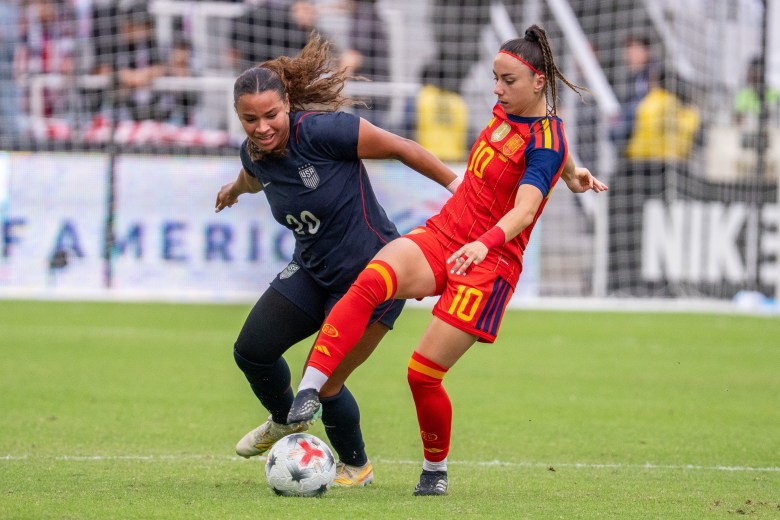
CHESTER, Pa. — For the second time in four days, the U.S. women’s national team found itself trailing Spain by two goals before halftime. But this time, the final result was a lot different — and a lot more encouraging — for the USWNT.
IN Saturday’s game, in Washington D.C., Spain’s early 2-0 lead held up through the final whistle. Spain is the reigning world champion, but the loss still stung the U.S. women and left them intent on a better result in Tuesday’s rematch at Subaru Park. And for the first 20 minutes last night, it appeared the Americans might deliver. Their press was coordinated and the two teams looked well-matched.
And then Spain scored twice in five minutes — a goal in the 27th minute by Alexia Putellas and then one from Salma Parallel five minutes later — and by halftime, the story was the same as Saturday’s.
But unlike on Saturday, the Americans rallied. Ashley Sanchez made it 2-1 shortly after halftime, and Mallory Swanson scored an 86th-minute equalizer to secure a 2-2 draw in front of 18,648 fans. By the final whistle, the Americans had gone from struggling to contain Spain’s attack to nearly stealing a victory. The cheers from the crowd felt like they were responding to a win, not a tie.
So what caused the USWNT’s second-half transformation? Some tactical changes were implemented, but a remarkable eight subs — including five at once, around the hour mark — also played a part, bringing new energy and life into the game for the Americans.
For USWNT head coach Emma Hayes, the decision to sub so many players was an example of exactly why she’s spent much of her tenure expanding the USWNT’s player pool rather than settling on one preferred starting lineup.
“I always wonder why people keep asking, like, why? What’s the settled 11 going to be?” Hayes said after the match. “That’s a story of the past in football.”
Tuesday’s lineup featured four changes from Saturday’s loss, with Sanchez, goalkeeper Phallon Tullis-Joyce, midfielder Claire Hutton and defender Gisele Thompson all getting a chance to start the game.
Those changes initially appeared promising. Sanchez was particularly active on the left side in the attacking third. In contrast, Trinity Rodman was consistently challenged by Spain’s defenders on the right side, drawing two corners but otherwise unable to really generate anything.
Meanwhile, Tullis-Joyce made an important early save, and Thompson broke up several dangerous attacks. But as the first half progressed, Spain increasingly controlled possession and the Americans’ defensive vulnerabilities became apparent.
The backline, featuring Kennedy Wesley and Tierna Davidson at center back, at times looked like a unit still learning to play together. Spain exploited their mistakes, and the second goal in particular exposed the dangers of defensive miscommunication.
Hayes acknowledged the challenge of building chemistry among a constantly changing defensive group, which is currently without its best player, the injured Naomi Girma.
“[Kennedy’s] probably had to play with four different partners every time,” Hayes said after the game. “It’s not easy. Sometimes those things happen when you don’t have the chemistry.”
Lacking that cohesion is a potential downside of Hayes’s wide experimentation. While the coach has emphasized the importance of building depth, a lack of consistency can also create problems against opponents like Spain, who know how to take advantage of another team’s weaknesses.
Hayes switched her players into a 3-5-2 formation at halftime, a tactical adjustment that preceded the substitutions. And just four minutes after the restart, Sanchez cut inside a Spanish defender and finished into the bottom corner, scoring her first international goal since July 2022.
The goal by Sanchez, who returned to the national team this window after nearly two years away, gave the USWNT a foothold in a game that had threatened to slip away. And she seemed to have found her opportunity by way of underestimation — Spain didn’t seem as concerned with her as they were with Trinity Rodman and Sophia Wilson, the other U.S. forwards, which left her open to do what she does best on the club level — which is score.
“To come back from two-zero down and get two back, and the chances we created — I think with some more time we actually probably could have won that,” Sanchez said afterward.”
It was around the hour mark that Hayes then made five substitutions, bringing on Swanson, Michelle Cooper, Lily Yohannes, Jaelin Howell and Alyssa Thompson. The impact was instantaneous. Cooper brought a burst of energy to the attack, combining particularly well with Sanchez. Yohannes added composure and creativity in midfield, while Swanson provided another dangerous option in front of Spain’s goal.
Quickly, the match became scrappier, faster and considerably more exciting. The Americans pressed forward with an urgency that had been missing in the first half, and Spain suddenly found itself defending against wave after wave of attacks.
“I don’t think the group coming in the second half did themselves any harm,” Hayes said. “They were fearless.”
Hayes was particularly complimentary of Cooper, whose explosiveness made her one of the most influential players on the field despite playing only about 30 minutes.
“I think she was [a] massive difference to our team in the second half,” Hayes said.
In the 80th minute, Hayes made three more substitutions, introducing Emma Sears, Kate Del Fava and Pietra Tordin. For Del Fava and Tordin, it marked their first appearances with the senior national team. And six minutes after they came on, the Americans tied.
Del Fava sent a long ball forward to Cooper, who found Swanson in space. Swanson collected the pass and shot the ball into the bottom left corner, scoring her first USWNT goal since the 2024 Olympic gold-medal match. She had taken a long break from the USWNT, during which she had her first child, but now she is clearly back.
“It feels really good,” Swanson told reporters afterward. “A little surreal because it’s been like two years since I scored, which … a lot has happened. But yeah, I think it’s nice just to get that first one out of the way. It’s a big step in the right direction.”
And before the game ended, the USWNT nearly found a winner. In stoppage time, Yohannes unleashed a shot from outside the box that deflected toward goal, forcing a diving save from Spain’s goalkeeper, Misa Rodríguez. A match that had looked destined for another disappointing defeat for the Americans came very close to being a remarkable 3-2 victory.
In the end, the draw was an accomplishment, but hardly the result the team wanted heading into the game. Across two matches against Spain, the USWNT conceded four goals, struggled defensively — a rarity for this team — and spent considerable stretches chasing the game rather than directing it.
But the friendly series also demonstrated the depth Hayes has been working to develop. With Del Fava and Tordin making their debuts and Howell returning to the field, 46 players have now appeared for the USWNT in 2026, a program record.
And that number reflects an intentional philosophy. Hayes is less interested in simply identifying 11 players who might start most World Cup games; rather, she wants to build a deep squad that can give the Americans important flexibility over the course of 90 minutes.