This weekend, on Oct. 23 and 24, the Cornell Big Red take a trip to Chestnut Hill, Massachusetts to play the Boston College Eagles. Cornell and BC have faced off 27 times in their histories, with 18 wins for the Big Red and eight for the Eagles. The earliest game between these two teams was in 1975, 25 years before the NCAA would officially sponsor women’s hockey.
Boston College and Cornell are by no means great rivals, but this particular non-conference matchup holds a unique historical significance: both teams owe their existence to a pair of sisters. Reggie Baker Robbins founded Cornell’s women’s hockey team. Her younger sister, Reenie Baker Sandsted, helped start the program at BC.
Reggie Baker’s Cornell dream
The Baker sisters grew up in a hockey-loving household in Lansing, NY, just a short drive from Cornell’s campus. Their father was a Cornell professor and hockey fan, and he would shovel snow off the pond behind their house so his daughters and local kids could play on it. Reggie was a fixture at their backyard rink in the winter, but practiced all year round with a tennis ball on the driveway. From the beginning, it seemed like hockey was her destiny.
“I just knew from very, very young that I was gonna start the team at Cornell. I just never doubted that,” Robbins told WBUR in 2018.
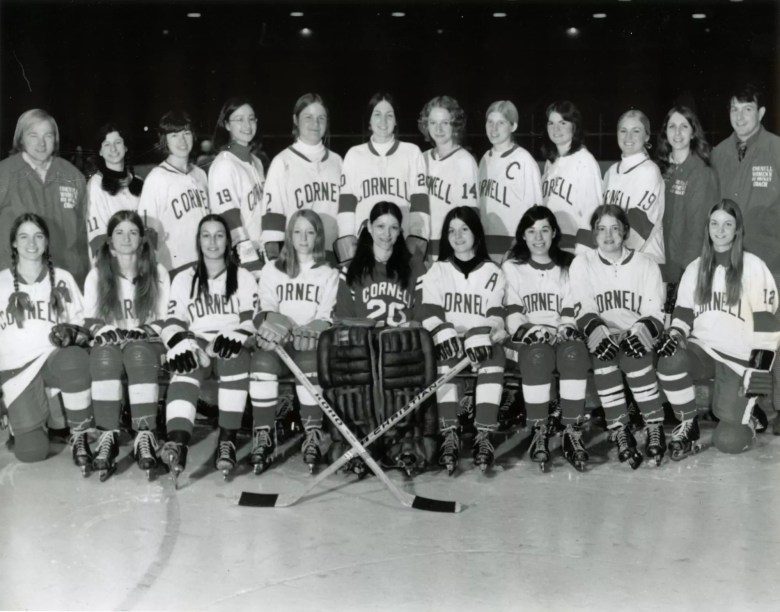
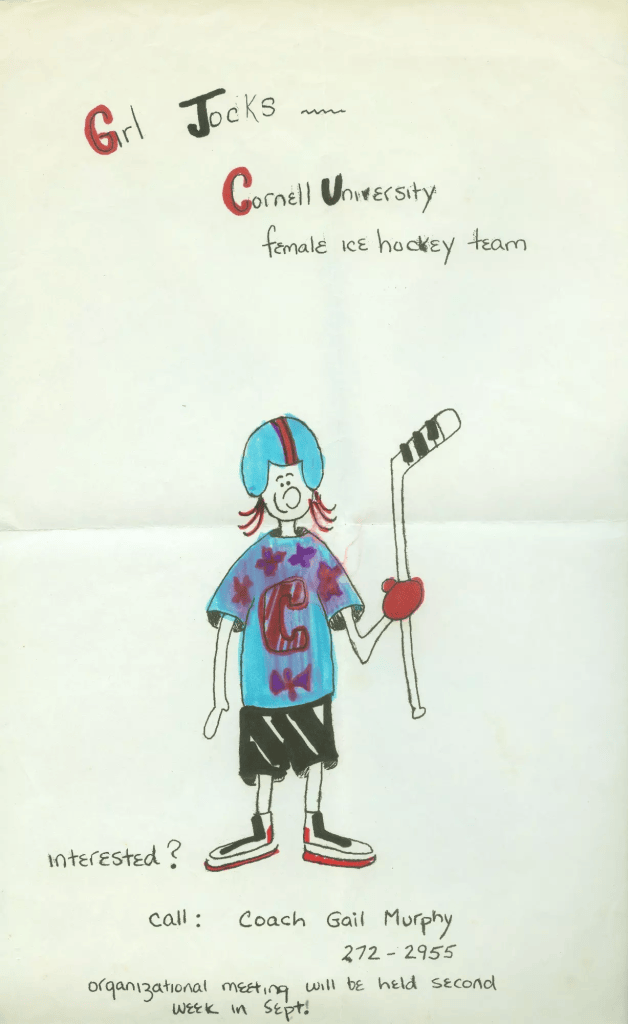
In 1971, while she was still in high school, Reggie decided to make the Cornell women’s team of her dreams a reality. She asked her science teacher, Gail Murphy, to coach the team. Murphy accepted, despite having little experience with the game. To spread the word, the two plastered hand-drawn posters all over the Cornell campus in search of other women hockey fans.
By the time Reggie was a Cornell student herself, she had recruited 23 other women to join the team. The problem was, very few had ever played hockey, and even if they had, getting ice time was near-impossible. When Reggie and Murphy asked the athletics department to use Lynah Rink, the only ice sheet in Ithaca at the time, they were summarily rejected for not being a varsity team. Reggie stayed determined, though, earning enough time for a handful of games as a club team.
In 1972, Reggie convinced the athletics department to accept Cornell women’s hockey as a varsity team. It was only the second varsity women’s hockey program in the country after Brown’s “Pembroke Pandas” were established in 1964.
But even with varsity status, the university did not fund the team. Players had to pay for their own equipment and transportation, leading to borrowed gear, long van rides, and crowded hotel rooms. Cornell’s team wasn’t very good, either. They lost their first game 14-0 and were defeated by the Pandas and other teams from Canada.
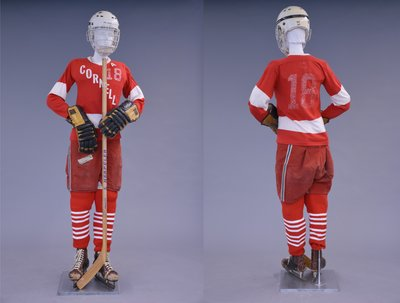
Gradually, Cornell’s women’s hockey team started improving. Murphy turned over coaching responsibilities to two graduate students and former Cornell men’s hockey players, Bill Duthie and Johnny Hughes. The team began winning more games than it lost. And as more colleges started women’s hockey teams, Cornell gained more opponents. In 1974-75, the program’s third season and Reggie’s senior year, Cornell had a 12-2 record, including wins over Princeton, Brown, and future ECAC rival Colgate.
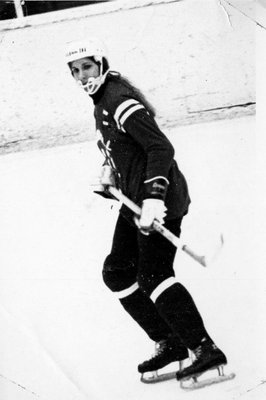
“Those women were pioneers,” Hughes said, as quoted in Forever Faithful by Jim Roberts and Arthur Mintz. “They played for all the right reasons. They dared to do something that wasn’t thought of as what women normally did in those days. They were doing it because they wanted to learn new skills — and they were competitive.”
Reenie Baker’s battle at BC
Meanwhile, Reenie Baker was deciding on her college path, inspired by her trailblazing sister. After watching Cornell and Boston College at the ECAC men’s hockey championship, Reenie committed to attending BC and starting a women’s hockey team there.
Reenie began recruiting as soon as she arrived on campus in 1973, but hit roadblocks just as quickly as her sister had. BC had become a fully co-ed university only three years earlier, and although Title IX was passed one year before Reenie enrolled, the school wasn’t exactly ready to support women’s ice hockey. Reenie had a list of 25 players, mostly figure skaters and field hockey players, who wanted to join a team, but the athletics department rejected her requests for ice time and varsity status.
“I pulled the Title IX card many times with the athletic department — ’You can’t tell me no!’ I think that was irritating to them,” Baker Sandsted told BC News. “I kept trying to get them to give us varsity status. They were saying it was too expensive and we had to start as a club team. I finally accepted that just to get to play, but I never stopped pushing for varsity status.”
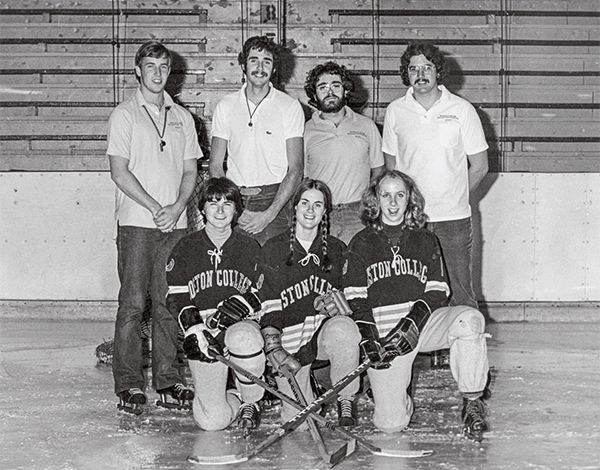
Determined to get on the ice either way, Reenie and the rest of the ragtag club team pushed forward. They fundraised for gear and held a series of chaotic early practices, trying to reconcile a wide mix of skating and stick-handling abilities. When the BC women’s hockey team took the ice for their first few games, they wore sweatpants and figure skates. They lost badly.
One of those early games was at a first women’s hockey invitational in 1973, hosted by Cornell. The Baker sisters got to see each other’s teams for the first time, though they never faced off.
“[We] were in awe at how Cornell came out in these bright red uniforms and, you know, just looked so spiffy. … We looked very bedraggled next to them,” Baker Sandsted said to WBUR of the tournament. “Some of the times when I would make a breakaway and head for the goal, they would start cheering for me because they felt so bad for us.”
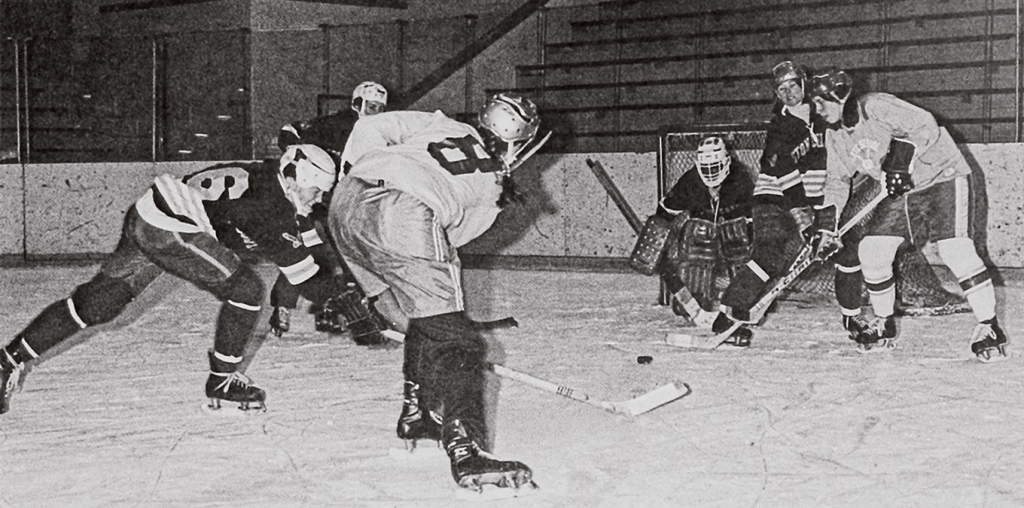
By the next year, the BC women’s hockey team had recruited more players and a new coach, got proper equipment, and started winning games. The university eventually funded their uniforms and equipment, but Reenie wasn’t on the ice by then. After two years with the club team, she stepped away from play, though she kept fighting for varsity status. In 1976, BC women’s hockey awarded the team MVP the ‘Baker Cup,’ named after Reenie in honor of her battle for the team’s existence.
Two sisters, one shared legacy
It wouldn’t be until 1994 that Boston College officially sanctioned women’s hockey as a varsity sport. Since then, the Eagles have not awarded a team MVP, but perhaps the Baker Cup could return in the future.
“Our current players really appreciate being able to know the roots of their program. There’s a lot of pride in what we came from,” BC head coach Katie Crowley told BC News. “We’re grateful for what Reenie and all of these pioneering women hockey players did for all of us.”
Earlier this year (and to be later celebrated on Nov. 14), Reggie Baker Robbins was inducted into the Cornell Athletics Hall of Fame in the special category, in honor of her leadership in women’s hockey and overarching contributions to women’s sports at Cornell. When the team she founded plays the team her sister founded this weekend, it’s a reflection of 55 years of women’s hockey history. Without Reggie and Reenie Baker, Cornell and Boston College would not be the women’s hockey stalwarts they are today.