Welcome to Basketball Insider, powered by The BIG EAST Conference. Some news broke on Tuesday that speaks to WNBA commissioner Cathy Engelbert’s remaining agenda for her final weeks in the role. Simultaneously, it reveals just how much the league’s growth is affecting the decisions of WNBA ownership.
Basketball Insider
Before I get to that, I wanted to take a moment to thank those of you who have already contributed to our first-ever end-of-year fund drive. If you haven’t, please take a moment to watch this video on why we’re pushing for 27 in ’27.
Covering women’s sports isn’t free
Support our 27 in ’27 campaign.
Let’s get into it. In The Athletic on Tuesday, Annie Costabile wrote the following:
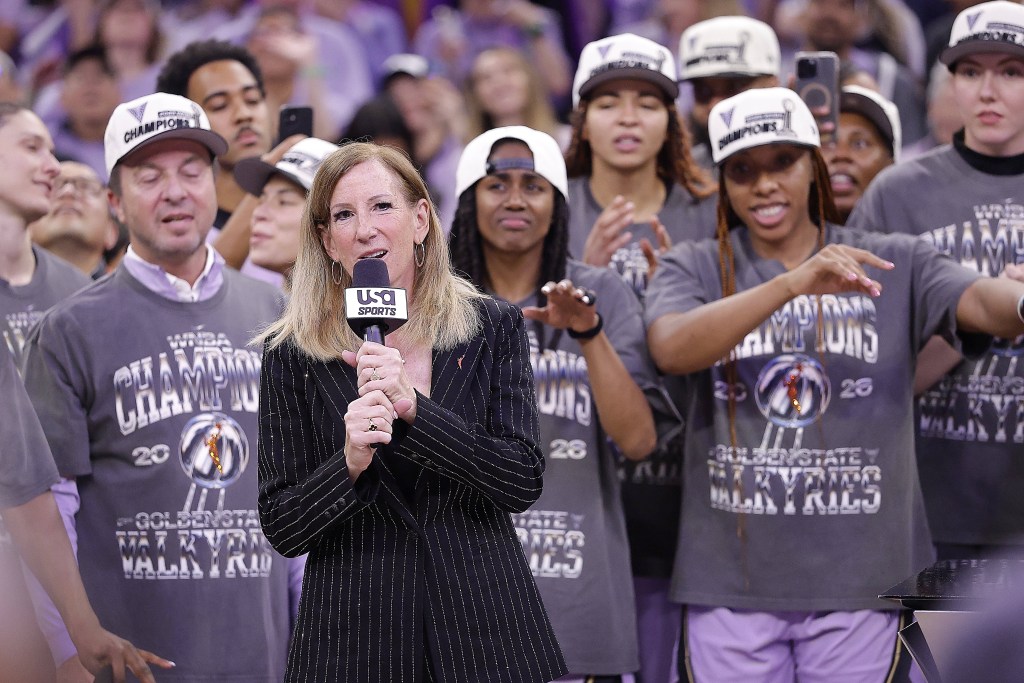
The WNBA is thriving in a way it never has under any previous leader. But as Engelbert makes her exit, retiring by the end of the calendar year after her seven-year tenure, one of her decisions remains a top talking point among the league’s biggest stakeholders: the capital raise she led in 2022 resulting in 16 percent of the league being sold for $75 million.
Engelbert has been looking at ways for the WNBA to regain control of that stake as one of her final moves as commissioner, according to multiple league sources familiar with the matter who spoke on condition of anonymity because they were not permitted to discuss it publicly. The league’s capital structure was discussed at length during Monday’s meeting, but nothing was brought to a vote.
For those of us who have covered the financial journey of the WNBA, along with longtime owners and front office personnel, this is fascinating on multiple levels.
As background: back in 2022, the WNBA sold approximately 16% of the overall equity in the entire league for $75 million. I’d urge you to read my contemporaneous reporting about it for a deeper dive into how and why that happened.
The short version: the WNBA needed money to grow, especially following the Wubble 2020 and truncated 2021 seasons, and this provided the WNBA with the capital to do that. Engelbert has been publicly touting the decision ever since.
Generally, in financial circles, an argument like this produces a single answer about who won or lost. Was the argument from those owners who wished to keep the equity and float the money themselves the right one? Or was Engelbert right to push for the capital raise?
The answer in both cases, depending on how you view it, is yes. By any standard, 16% of the WNBA is worth massively more than $75 million. 16% of some individual teams in the WNBA now are worth more than that! And just using, for instance, the CNBC valuations from May, puts this gap into sharp relief. Here, I’ll show my work. Existing teams were worth an average of $460 million, and there were 15 of them, for a league valuation of $6.9 billion. 16% of that is north of $1.1 billion. That’s a lot more than $75 million!
Of course, it’s not so simple. Engelbert, like any commissioner, simply cannot command her owners to do, well, anything. And there simply wasn’t popular will among the owners to spend their own money, though you will notice a number of them in the piece I wrote back in 2022 who were.
Interestingly, those owners are still in the league. And the league meetings on Monday also included the 15 existing teams along with the three ownership groups from upcoming expansion franchises Cleveland, Detroit and Philadelphia. The balance of power in the WNBA has shifted.
Listen now to The IX Sports Podcast and Women’s Sports Daily
We are excited to announce the launch of TWO new podcasts for all the women’s sports fans out there looking for a daily dose of women’s sports news and analysis. Stream on Spotify, Apple Podcasts or anywhere you listen to podcasts, and make sure to subscribe!
I spoke to front offices around the league to try and determine, should the league decide to internally raise the money to buy out the 16%, whether that motivation comes from a renewed belief in the league’s growth, an infusion of new owners or both. Opinions on this varied through my conversations. Several league sources I spoke with also noted what Engelbert often has — without that $75 million, all of this explosive growth wouldn’t have been possible. (The folks who support raising the money internally would note the growth could have happened with the WNBA’s own money if they’d simply ponied up back in 2022.)
And even this is more complicated than separating into two camps — for instance, a number of current WNBA owners are among the group who purchased the 16% equity stake.
But if the WNBA does take this step, it eliminates the one area where critics can plausibly attack the economic record of Cathy Engelbert’s tenure, specifically in how it set the league up for the future. The WNBA’s long-term financial security is secured through extended media rights deals. Labor peace is at hand. A simplification of the ownership structure itself would allow the WNBA to continue growing with less interference.
No one I spoke with knew whether or not a true ownership separation, not just from the 16% but also from the pre-2022 50-50 split with the NBA, is on the table. But that would be, for many, the masterstroke to end what many perceive as interference without consequences by the NBA in WNBA affairs.
It would sure be expensive, though! This all is! But both the fact that Engelbert is entertaining it at this late date, and that there is enough interest among the owners to suggest this is a live concern, speaks both to the WNBA’s growth and a growing consensus among decision-makers that we aren’t anywhere near the apex of it.
This week in women’s basketball
You know how we had the great Kate Riga on the podcast in September to discuss the bad-faith right wing effort to slime the WNBA? Well here is that effort in easy-to-digest graphic format!
Kim Caldwell, always fascinating.
Lovely from Mitchell Northam on Sylvie Jackson.
Speaking of Mitch, his book about UNC women’s basketball is on sale now, and it’s terrific!
Our Michael Waterloo was on hand for the battle for The Real SC.
Our David Mendez-Yapkowitz has sights and sounds from UCLA’s banner-raising.
And Kenneth Ward takes you live into the Houston Comets’ draft night party.
“Becoming Caitlin Clark“ is out now!
Howard Megdal’s newest book is here! “Becoming Caitlin Clark: The Unknown Origin Story of a Modern Basketball Superstar” captures both the historic nature of Clark’s rise and the critical context over the previous century that helped make it possible, including interviews with Clark, Lisa Bluder (who also wrote the foreword), C. Vivian Stringer, Jan Jensen, Molly Kazmer and many others.
Five at The IX: Fadima Tall, Princeton
Soccer: Annie Peterson, @AnnieMPeterson, AP Women’s Soccer
Tennis: Joey Dillon, @JoeyDillon, Freelance Tennis Writer
Basketball: Howard Megdal, @HowardMegdal, The IX Sports
Softball: Maren Angus-Coombs, @Maren-Angus, The IX Sports
Golf: Marin Dremock, @MDremock, The IX Sports
Hockey: @TheIceGarden, The Ice Garden
Gymnastics: Jessica Taylor Price, @jesstaylorprice, Freelance Writer