Breanna Stewart, A’ja Wilson, Elena Delle Donne and Brittney Griner. These are the only four No. 1 high school recruits to become All-WNBA players since ESPN HoopGurlz was founded in 2008.
Stewart, Wilson, Delle Donne and Griner, considered among the top draft prospects in league history, were poised for future WNBA stardom even at 17 and 18 years old. However, this trajectory is rare for most other highly-ranked high school recruits.
Through an extensive dive into the last decade of recruiting rankings from ESPN and BlueStar1, two of the most reputable outlets in the industry, we hope to uncover this question:
Are recruiting rankings indicators of a player’s eventual draft position and the likelihood of becoming a superstar in the WNBA?
Let’s dive in.
Where did top recruits go in the WNBA draft?
Though the No. 1 high school recruit doesn’t always meet expectations, all 14 players2 ranked as the top high school recruit from 2011 to 2019 became first or second-round WNBA draft picks. In fact, 12 of the 14 players3 were selected in the first round.
How about prospects ranked in the Top 5, not just at No. 1?

As seen in the table above, ESPN HoopGurlz is the more accurate of the two sites, with 56.8% of its Top 5 recruits becoming first-round draft picks — compared to BlueStar at 48.7%. Additionally, 72.7% of ESPN’s Top 5 recruits have been selected in the first or second round – slightly higher than BlueStar at 68.3%. And by average, over 70 percent of the Top 5 recruits are drafted.
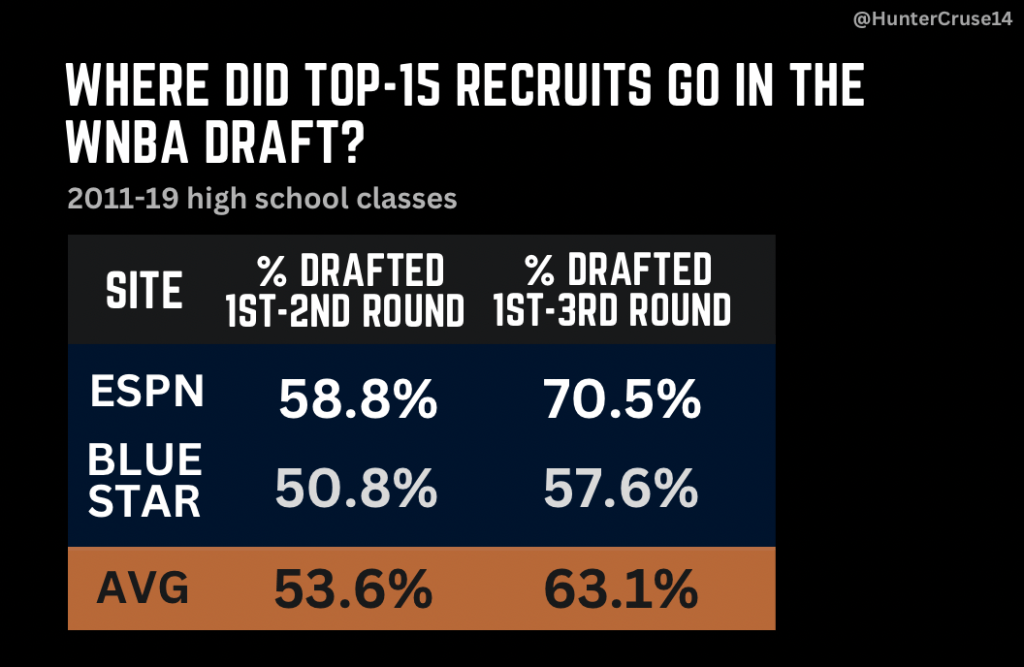
If we widen the range to the Top 15 recruits, on average, there’s a considerable drop-off in both players selected in the first and second rounds (-16.9% decrease) and players drafted in the first through third rounds (-12.1% decrease) from the Top 5 sample.
Over time, BlueStar and ESPN have improved at projecting WNBA draft positions.
From the 2016 to 2019 recruiting classes, 54.2% of BlueStar’s Top 15 recruits went in the first and second rounds — a 5.7% increase from 2011 to 2015.
On the other hand, from 2016 to 2019, 58.8% of ESPN’s Top 15 recruits went in the first and second rounds — a 4.2% increase from 2011 to 2015.
It’s almost a coin flip if a Top 15 recruit becomes a first or second-round draft pick, while the odds a Top 5 recruit lives up to the hype are (unsurprisingly) higher.
How did All-WNBA players rank as prospects?
In the NBA, the likes of Ja Morant, Paul George, Damian Lillard and Isaiah Thomas have emerged from high school recruits ranked outside of the ESPN100 to bonafide All-NBA players; however, this phenomenon is nonexistent on the WNBA side.
Note: This sample doesn’t include players who entered the draft as internationals rather than attending an American college (i.e., Liz Cambage, the No. 2 overall pick in 2011).
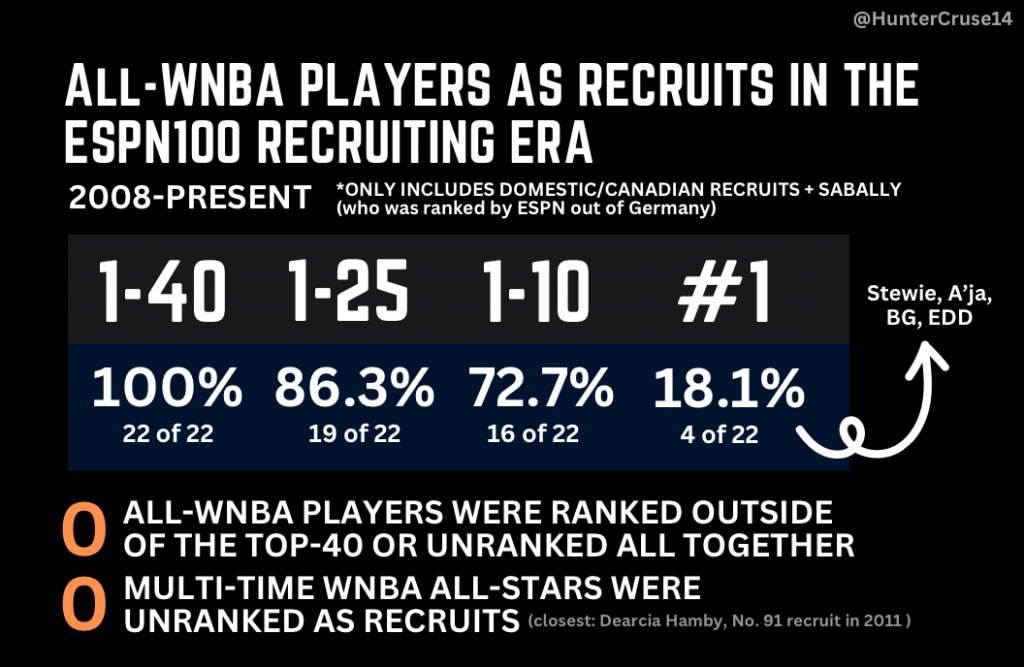
Since ESPN began ranking women’s basketball recruits in 2008, 100 percent (22 of 22) of All-WNBA players were Top 40 recruits and 86.3% (19 of 22) were Top 25.
The exceptions to this trend were Kelsey Plum (No. 26 in 2013), Myisha Hines-Allen (No. 34 recruit in 2014) and Satou Sabally (No. 36 in 2017), who were the sole players outside the Top 25.
Furthermore, there have been zero unranked ESPN recruits to become multi-time WNBA All-Stars4. The lowest-ranked player is Dearcia Hamby, the No. 91 recruit in 2011.
There are plenty of unranked recruits who blossom into quality role players in the league, but as evidenced by this data, outlier star development is uncommon in WNBA draft prospects.
This is heavily due to different growth timelines between NBA and WNBA draft prospects. Typically, growth spurts come earlier for women and later for men.
For example, the aforementioned Stewart experienced a rapid growth spurt early in high school, giving her ample time to fill into her height (6’4) and massive wingspan (7’1).
“By my junior year, I was 6-4 and I was done growing,” Stewart told ESPN’s Julie Foudy and Stacey Pressman in 2018. “That’s when I grew into my body. It was about understanding how to use my length, how to make it all work together on the court.”
How did 2024 WNBA draft prospects fare as recruits?
Since the 2015 WNBA Draft, 0.06% (5 of 83) of first-round draft picks were ranked outside of the ESPN100 as high school recruits. However, three of the five players were selected in the last two drafts alone – Maddy Siegrist (2023), Veronica Burton and Mya Hollingshed (2022). It’s not likely, but it’s also not impossible.

Note: This sample doesn’t include Washington State’s Charlisse Leger-Walker, from New Zealand, and Virginia Tech’s Georgia Amoore, from Australia, who weren’t evaluated as high school recruits by ESPN.
This year, every collegiate prospect expected to land on The Next’s final 2024 draft board was a Top 100 recruit in high school, while 89.5% (15 of 19) were Top 40 recruits and 31.5% (6 of 19) were Top 10 recruits.
The six players ranked in the Top 10 include Paige Bueckers (No. 1 in 2020), Angel Reese (No. 2 in 2020), Cameron Brink (No. 3 in 2020), Caitlin Clark (No. 4 in 2020), Kamilla Cardoso (No. 5 in 2020) and Rickea Jackson (No. 5 in 2019).
While the four players ranked outside of the Top 40 include Utah’s Alissa Pili (No. 41 in 2019), Stanford’s Hannah Jump (No. 50 in 2019), Tennessee’s Jewel Spear (No. 82 in 2020), and Florida’s Leilani Correa (No. 83 in 2019).
What value can recruiting rankings add to WNBA draft scouting?
From a scouting lense, it’s important to not look at recruiting rankings as anything more than a data point.
For every Napheesa Collier and Jonquel Jones, there are two former top recruits playing for a lower-level professional team in Europe or out of basketball altogether.
There are many reasons why a top recruit does or doesn’t live up to the five-star status; in actuality, college coaches don’t really care about ‘stars’ once you step on campus.
If a program signs four Top 40 recruits, it’s more likely than not that one of these players will slip through the cracks and their development will stagger from the lost in-game opportunities — unless your name is Dawn Staley5. That is something that can’t truly be measured with this research.
Nonetheless, recruiting rankings are certainly an indicator of potential star upside, given the track record of every WNBA superstar being regarded as a Top 40 recruit out of high school.
But hey, you never know, maybe there’s a player that comes out of nowhere and breaks this trend in the next decade. That would be fun.
———————
- BlueStar is the longest-running national evaluation site for women’s high school basketball recruiting, originating in the early 1980s. ↩︎
- 14 different high school recruits from 2011 to 2019 were ranked as the No. 1 prospect by ESPN HoopGurlz and BlueStar – Kaleena Mosqueda-Lewis (2011), Stewart (2012), Mercedes Russell (2013, ESPN), Diamond DeShields (2013, BlueStar), Wilson (2014, ESPN), Brianna Turner (2014, BlueStar), Katie Lou Samuelson (2015), Lauren Cox (2016, ESPN), Joyner Holmes (2016, BlueStar), Megan Walker (2017), Christyn Williams (2018, ESPN), Charli Collier (2018, BlueStar), Haley Jones (2019, ESPN), Aliyah Boston (2019, BlueStar). The four players in bold were unanimous No. 1 prospects by the two outlets. ↩︎
- Of the 14 top recruits, Homes and Williams were the only players selected outside of the first round. ↩︎
- Four unranked high school recruits have become one-time All-Stars – Layshia Clarendon, Cheyenne Parker, Courtney Williams and Riquna Williams. ↩︎
- South Carolina signed four Top 15 recruits in 2019, according to ESPN – Boston (No. 3), Zia Cooke (No. 4), Laeticia Amihere (No. 10), and Brea Beal (No. 11). Boston, Cooke, and Amihere all became first-round draft picks in 2023, while Beal was selected by Minnesota in the second round. ↩︎