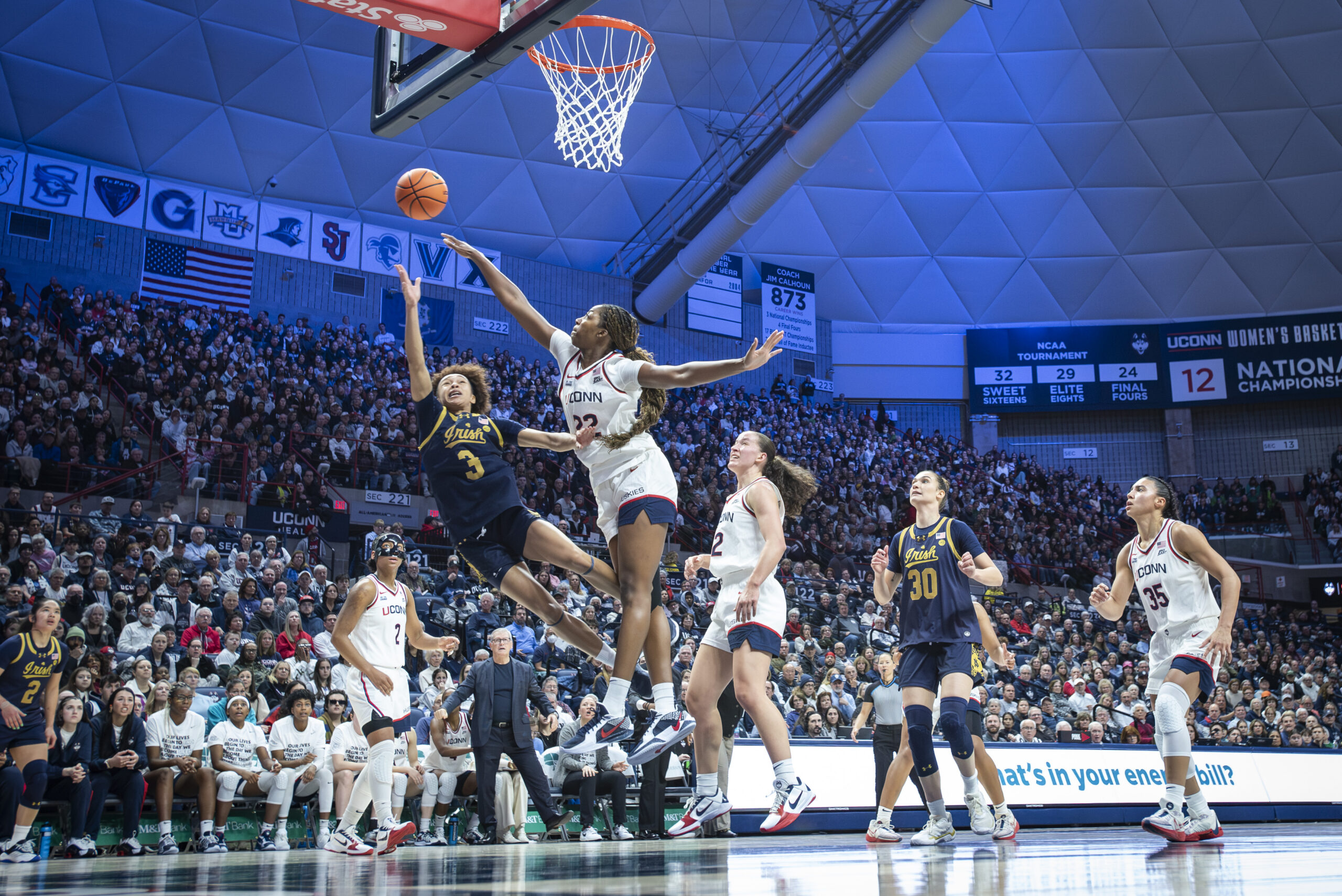
After having had UConn’s number through her first two collegiate seasons, Hannah Hidalgo led Notre Dame into Storrs, Conn., on Jan. 19 and had one of the worst games of her career in an 85-47 loss.
It’s something of a rite of passage for great players on non-elite teams to play the Huskies and find themselves completely overmatched — see Jaloni Cambridge, Audi Crooks or Raegan Beers from the past couple years alone. This is a trend that goes back decades, from Michele Van Gorp and Alana Beard to Jewell Loyd and Courtney Williams. Top prospects have been leading sorely disadvantaged teams to big losses against UConn for long enough that we actually have a sample size large enough to draw conclusions from.1 And it turns out that future stars, even in completely overmatched situations, still bend the game around them.
The problem for Hidalgo in trying to reach that level of play wasn’t necessarily that she shot 5-for-15 so much as which shots she was taking and how she got there. Alyssa Thomas shot 2-for-12 in her first matchup with UConn, but most of those misses were good looks and came after forcing her way into better matchups and not settling for worse options.
By contrast, Hidalgo, for her collegiate career, has shot 32.0% on pull-up 2-pointers and 27.4% on pull-up 3-pointers, both decidedly poor marks. She still took eight pull-up jumpers against the Huskies last month, making only two. UConn was not only content to give her those looks, sagging off to defend driving lanes instead of crowding her, but she did little to force her way into better looks. She took multiple deep pull-up threes with plenty of time left on the clock and was mostly inactive off the ball, even at times when certain cuts could have forced the Huskies into rotation. When she did get by her defender or beat a big’s ball screen coverage, she was late in making the right read to find an open teammate, turning opportunities for assists into other Irish turnovers.
The easiest path to Notre Dame winning might have been Hidalgo taking and making these shots, but given her career to this point, the odds of that working were terribly low compared to passing her teammates open after forcing UConn into rotation. Some of those missed passes were chances that Hidalgo routinely turned into assists her freshman year.
These are issues that still pop against lesser opponents — Hidalgo scored 16 points on 21 shots against Virginia Tech last week — but the fact that the Huskies didn’t need to send much help at Hidalgo or adjust its gameplan much is instructive. This is often the case with good players against these overwhelming lineups UConn has thrown out over the years.2 But it’s not the case for true stars.
Listen now to The IX Sports Podcast and Women’s Sports Daily
We are excited to announce the launch of TWO new podcasts for all the women’s sports fans out there looking for a daily dose of women’s sports news and analysis. Stream on Spotify, Apple Podcasts or anywhere you listen to podcasts, and make sure to subscribe!
On their face, Rebekkah Brunson’s career numbers against UConn weren’t flattering, with 54 total points on 42.4% true-shooting across four games. In the lone matchup we have film for, from January 2003, she shot just 3-for-12, but was a menace on the boards, fought to get to the line, and was the best defensive player in the game. She held UConn centers Jessica Moore and Willnett Crockett to 1-for-6 combined shooting, and was arguably the second-best player on the court.
Alyssa Thomas played the Huskies again in November 2013. She was arguably the best player that day, with 20 points on 59.2% true-shooting and significant impact as both a passer and defender, forcing a Husky lineup of five future WNBA starters to adjust to her game.
Chelsea Gray’s upperclassman Duke teams were arguably among those squads with “rotations full of real prospects” (see footnote No. 1), but they still did not measure up to UConn. A prime example of the importance of development arc, Gray grew continually as a scorer in college, and in that senior-season game against the Huskies, she picked apart their point-of-attack defense, got by Breanna Stewart in the pick-n-roll, and finished over Stefanie Dolson multiple times.
Brittney Sykes and AD Durr similarly terrorized excellent Notre Dame rosters in the late 2010s, although context comes into play with the pro careers of both: Sykes’ jump shot was notoriously inconsistent, and AD already had a possible issue with their difficult shot profile before contracting long COVID early in their W tenure.
This isn’t to say that Hidalgo is not a serious prospect for failing to live up to this standard. Many of the issues she had in this game are either mitigable against merely good competition or are less relevant when playing in a better lineup. Against USC, Mississippi and Duke this season, who rank Nos. 9, 12 and 7 in CBB Analytics’ adjusted defensive rating, respectively, Hidalgo averaged 24 points on 53.7% true-shooting, and previously had resounding success against UConn across 2023-25.
But playing against a team laden with WNBA and Euro prospects, without teammates that measure up to that same level, is another beast entirely. History has shown that these matchups are effective at filtering stars from the rest because they can still force a portion of the game to revolve around them even as the opponent pulls away. That didn’t happen with Hidalgo against UConn last month.
A silver lining: This isn’t the first time Hidalgo has been in this kind of lopsided matchup. Though Notre Dame’s lineup was considerably better at the time, in her collegiate debut, Hidalgo played against a South Carolina team whose main nine-person rotation was entirely made up of players who (barring further injury) would/will all see WNBA minutes. While teammates Sonia Citron and Maddy Westbeld struggled,3 Hidalgo was a clear star. That should make it no surprise if she is able to still develop into a W star someday.
- This applies not just to UConn, but also to other teams who at one point or another had rotations full of real prospects: Tennessee through 2001 and across 2005-08, Purdue for 1998-99, Notre Dame over 2017-19, South Carolina in 2023-24, and UCLA this year. 2005-06 Maryland, 2012-14 Duke and 2019-20 Oregon also have arguments. ↩︎
- Not that UConn’s lineups from 1999-2002 and 2012-16 are comparable to anything else in the sport’s history, but with the exception of 2004-06 and 2019-20, in any given year, UConn’s rotation is appreciably tiers ahead of most other great teams. ↩︎
- In that sense, the matchup was analogous to Notre Dame’s bouts against UConn from 2009-15. ↩︎