“You’re a little too slow and a little too short, but we can work with that.” That’s what then-Harvard head coach Kathy Delaney-Smith told former player Kaitlyn Dinkins (now Dinkins Kincaid) on a campus visit, by way of offering her a roster spot.
It was a prime example of how the longtime head coach was unfailingly honest and real with players and recruits. That authenticity, often paired with her famous humor, made players gravitate to her and completely buy into her vision for the program.
The one topic where Delaney-Smith encountered skepticism over the years was when she would retire. “She’s told me at least 10 times in the last 15 to 20 years that she’s going to bow out,” Loyola (Md.) head coach Danielle O’Banion, who started her career as an assistant to Delaney-Smith in 2001, told The Next. “So that got to a point where I was like, ‘No, you’re not.’ Nobody believed her anymore.”
But on March 11, 2022, after a near-upset of Princeton in the Ivy League Tournament, Delaney-Smith walked off the court for the final time after 40 years at Harvard. She amassed a 630-434 record, 11 Ivy League championships and six NCAA Tournament berths, and between 1986 and 2011, every senior class except one won at least one conference championship.
“She was Ivy League basketball, and she was Harvard basketball,” former Dartmouth player and Ivy League coach and current North Carolina head coach Courtney Banghart told The Next. “And so [she] was almost larger than life.”
Amid all the wins, though, Delaney-Smith’s most important legacy is that she always showed her players how much she cared—from how she spoke to them one-on-one, to how she coached the team, to how she fought for women’s rights more broadly.
“Kathy is someone who has the ability to build a community like no one I’ve ever seen,” former player Shilpa Tummala told The Next. “And I think I’ve learned that from her more than anything, because everywhere I go, I keep seeking out a community that’s similar to the one that I found at Harvard through basketball. But it’s just like, nothing’s the same.”
When Delaney-Smith interviewed for the Harvard job in 1982, she had to borrow a suit from a friend, and she wasn’t at all sure she wanted the job. She had a 204-31 record as the head coach at nearby Westwood High School, including a streak of 96 straight regular-season wins in the mid-1970s, whereas Harvard had an elitist reputation and a decidedly mediocre basketball program. In its eight varsity seasons to that point, Harvard had a 91-92 record overall, 21-25 in conference.
But Delaney-Smith took the job, falling in love with the school during her interview even as a member of the selection committee asked her whether she knew how to shoot a jump shot. (She did, but, according to a 1982 Boston Globe article, she responded by diagramming her vaunted full-court press on the blackboard because that was more relevant.) Having never coached at the college level, she described herself as “very excited, but clueless” on her first day of work.
One person who saw Delaney-Smith’s potential at Harvard was Dartmouth head coach Chris Wielgus, whose teams dominated the league at that point. The two coaches had worked local camps together, and Wielgus says she knew Delaney-Smith would be “a fierce competitor.” Delaney-Smith would prove her right.
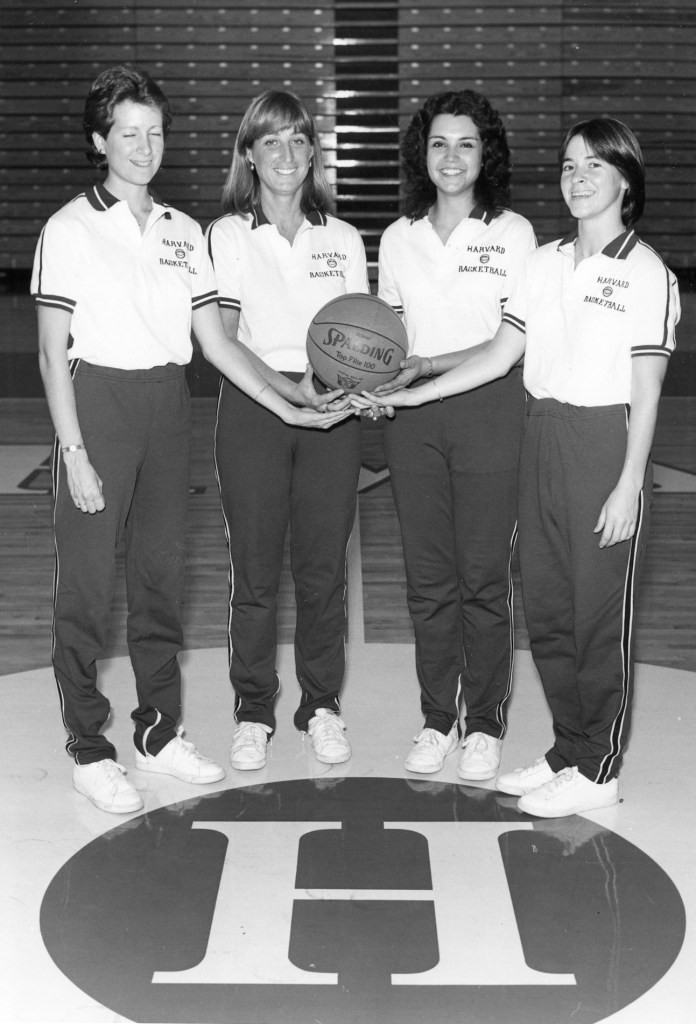
Delaney-Smith didn’t implement her press right away, figuring she needed to recruit more talent for it to be effective. But she got right to work on the recruiting trail—and on changing the program’s culture. She told The Next that she was stricter and more direct than what her players had previously experienced, and she increased the conditioning significantly.
Trisha Brown, now the head coach at Stonehill College, and Erin Sugrue, who had also played for Delaney-Smith at Westwood, were part of a pivotal eight-player freshman class in Delaney-Smith’s second season in 1983. Brown would go on to be a team captain, while Sugrue (now Erin DiVincenzo) helped translate what Delaney-Smith wanted to her teammates—and prepare them for the worst. “This is the day she’s going to say, ‘No basketballs,’ and we’re just going to condition,” Sugrue would predict as they walked to practice.
Delaney-Smith also implemented strength training, which was new to most of the players. She held individual meetings where—sometimes for the first time in their lives—players were told what their weaknesses were. She tried to root out homophobia, which she says had created a “very unhealthy” and divisive team culture before she arrived, and grappled with eating disorders and other body image issues.
“I think I did more program building than brilliance on the court,” Delaney-Smith says of her first few seasons.
There was some culture shock for Delaney-Smith, too, coming from a winning program that drew sellout crowds. DiVincenzo remembers Delaney-Smith trying to prepare the team for a crowd as they drove to Maine the day before a game. “Get right into the locker room,” she said, wanting to avoid distractions and start practice promptly. But when they arrived, not only was there no crowd, but the gym was dark.
“She’s like, ‘Oh, there’s nobody here. I’ll go find somebody to let us in,’” DiVincenzo told The Next. “And we were howling. We were like, ‘Oh, look at the crowds. Ho, ho, hold ’em back!’”
But, back then and to this day, Delaney-Smith has been known for her willingness and ability to learn. She will borrow plays or ideas from any coach she respects, whether they work at the high school or Olympic level, and Brown told The Next that Delaney-Smith even brought other coaches to Harvard to help teach the team. “She’s almost … like a coaching chameleon,” former associate head coach Mike Roux says. “She just finds a way to make it work.”
Delaney-Smith rebuilt Harvard faster than anyone probably expected, winning the school’s first Ivy League title in 1986 and another in 1988. Those titles prompted the student newspaper to write that the program was “revived from the dead, and the doctor who performed the CPR is Coach Kathy Delaney Smith [sic].”
As Delaney-Smith overhauled Harvard basketball, she set a foundation of building relationships that never wavered. She could have lost the team’s trust by imposing so many changes so quickly; instead, she brought everyone together.
“You could tell right away that she was somebody that really cared about her players. It wasn’t just about the Xs and Os,” Brown says.
During one practice early in Brown’s freshman year, an upperclassman had her way with Brown both offensively and defensively, and she was frustrated. Soon after she got back to her dorm, the phone rang. “I know you had a tough day. I’m just checking in,” Delaney-Smith said.
“Just the little things like that definitely separated her as [a coach],” Brown says.
By 1989, the secret was getting out. A Boston Globe headline proclaimed, “Harvard coach looks beyond winning,” with the subtitle, “Delaney-Smith has helped high school, college women with off-court lives, too.”
“I definitely did not think I would be here 40 years. Oh my God, no,” Delaney-Smith says, thinking back to 1982. “… My only goal was to win … and winning at the college level is recruiting.”
So Delaney-Smith and her staff looked far and wide for prospects, building relationships with high school and AAU coaches and asking alumnae across the country to keep an eye out for talent. Delaney-Smith also traveled to Europe to build connections, recognizing the international pull of the Harvard brand.
Over her 40 years, she has kept her messaging simple and consistent. “If you have an opportunity to go to Harvard and you don’t look at it very seriously, then you’re not that smart,” she quips. “This school on every level is phenomenal.” According to O’Banion, by the early 2000s, Delaney-Smith could name an alumna (or three) working in virtually any field a recruit was interested in to bolster her point.
As effective as the message is, former recruits—even those who didn’t choose Harvard—say that the delivery is even more powerful. “She’s like, ‘What, you need a hahd sell? It’s Hahvahd,’” Melissa Johnson told The Next, imitating Delaney-Smith’s thick Boston accent. (Johnson initially chose North Carolina over Harvard but transferred to Harvard after two seasons.) “And so she was very much not a slick saleswoman. She was just like, ‘This is what it is.’ … And my first impression of her [was], I adored her.”
“She just didn’t seem like any other basketball coach I had ever met because she didn’t take herself too seriously,” says O’Banion, who ultimately played for Boston College.
Three-time Ivy League Player of the Year Allison Feaster told The Next that Delaney-Smith surprised her and “put [her] at ease” with her sense of humor and confidence during a home visit. Brown, who became a Harvard assistant coach in the 1990s, says that watching recruits meet Delaney-Smith was one of her favorite experiences for precisely that reason: Delaney-Smith is the opposite of the aloof, intimidating coach many recruits picture for Harvard.
Those recruiting pitches were when Delaney-Smith first got to build relationships with players, and she showed how much she cared about them before they even committed. When Johnson broke the news to Delaney-Smith that she was going to North Carolina, Delaney-Smith told her, “I see you having a great life, even if I’m not a part of it”—a far cry from other coaches who had screamed at her.
The result: “She always seemed to win the recruiting wars,” says Wielgus, who faced off against Delaney-Smith from 1982-84 and 1993-2013.
As Delaney-Smith’s recruiting took off, Harvard emerged as Dartmouth’s main competition in the Ivy League, creating a fierce rivalry. One or both of them won the conference title in 19 of the 25 seasons between 1986 and 2010. They shared it four of those times, including a memorable three-team tie in 2008 that required a playoff to determine which team would go to the NCAA Tournament.
“Harvard and Dartmouth were the schools that you were gunning for,” said Cornell head coach Dayna Smith, whose Big Red won their lone Ivy League title and the playoff in 2008. “… It was Harvard [and] Dartmouth year after year. You look up at the banners, you go to their gyms every year as an opponent. [It] made you sick, you were so angry. You see how they just dominated.”
Adding to the drama, the structure of the Ivy League schedule meant that, most years, conference play started and ended with Harvard facing Dartmouth. “Are you in a good mood, or are you playing Harvard this week?” the Dartmouth athletics staff would ask Wielgus.
“You felt like the championship had to go through each other’s gym, and that just brings it a little bit of … a different vibe,” says Banghart, who won two Ivy championships playing for Wielgus from 1996-2000.
In the past decade, the Ivy League has experienced a changeover at the top, with Princeton and/or Penn winning every title since 2010. But Harvard’s winning culture persisted under Delaney-Smith.
“The expectation was to win always,” says Emma Golen, who graduated in 2013 and is now an assistant coach at Yale.
“It was just this mentality of, this is what we do,” adds 2015 graduate Ali Curtis.
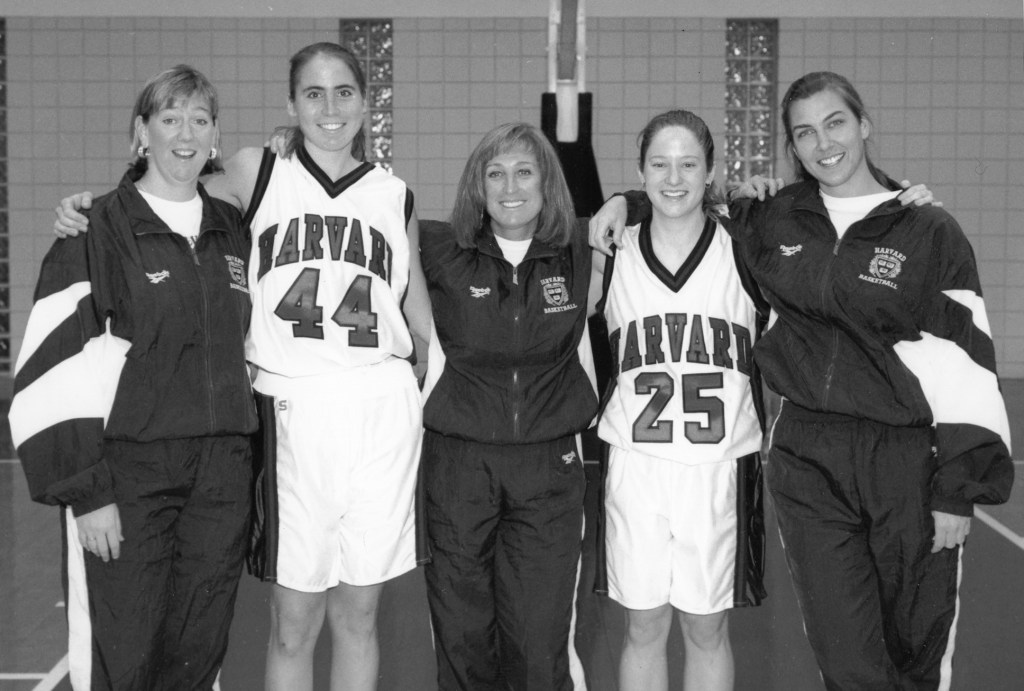
In January 1996, Harvard had just beaten Dartmouth by 22 points to open conference play and was eyeing its first-ever NCAA Tournament berth. (The conference champion, decided based on regular-season results, did not receive an automatic NCAA berth until 1994.) But the dream almost ended the following weekend at Cornell, where Harvard lost by a single point.
Players were sobbing and snow was falling as the team bus departed Ithaca for New York City, where Harvard would play Columbia the next night. Soon, more bad news: The highway was closed due to the snowstorm. The bus driver pulled over to the side of the road to wait it out.
“I was like, ‘Oh my gosh, not only did we lose to Cornell, we’re also going to perish out here,’” Elizabeth Proudfit, a senior on that team, told The Next.
The team needed a distraction, so Brown took the microphone at the front of the bus and sang a Bruce Springsteen song. Soon the entire team, coaches included, was outside having a snowball fight.
“[Kathy] would let us do that type of thing,” says Proudfit’s classmate Amy Reinhard. “… She wanted the student-athlete experience to be good, in terms of not having it be all about basketball.”
When the team got back on the bus, the tears were gone and it was time to refocus. “We have a game tomorrow night,” Delaney-Smith reminded the players. “We’ve got to get back on track.”
“I think that saved the season,” Proudfit says. “… It got us thinking about, ‘This isn’t over.’”
Harvard went on to beat Columbia by 30 points and reel off 12 straight Ivy League wins. The Crimson won the conference title outright.
The 1996 season culminated in the first of three consecutive NCAA Tournament berths for Harvard, all of which produced competitive games. Facing 3-seed Vanderbilt as a 14-seed in 1996, Delaney-Smith put five 3-point shooters on the court to counter the Commodores’ size advantage. It was “way before anyone was playing five-out anything,” Delaney-Smith says, but she had long allowed her centers to shoot threes in transition, even though other coaches and the media often criticized her for it.
The strategy worked, as Harvard sank an NCAA Tournament-record eight threes in the first half, led by one point at halftime, and trailed by only five points with three minutes left before Vanderbilt made a late run.
In 1997, after a 14-0 Ivy League season, Delaney-Smith had to prepare for a nearly opposite challenge in the NCAA Tournament: the speed of North Carolina point guard Marion Jones, who had set a national high school record in the 200-meter dash. Three-seed North Carolina blitzed Harvard early, but the 14-seed Crimson clawed back twice. “I was very proud that we could compete, even though we shouldn’t have been able to win either of those games,” Delaney-Smith says.
By the time 1998 rolled around, Harvard was a force to be reckoned with. Feaster was a senior surrounded by talented role players, and many of the players now had NCAA Tournament experience. “They were the All-Stars and we were The Little Engine That Could, in many respects,” Wielgus says. Her little engine actually beat Harvard in the last game of the 1998 regular season—just the fourth loss all year for the Crimson.
Yet Harvard got a lowly 16-seed in the NCAA Tournament, which “shocked” and “fueled” the team, Delaney-Smith said in 2020 on the “All the Years” podcast. The Crimson prepared meticulously for their matchup with top-seeded Stanford, including by blasting what Delaney-Smith called “metallic, loud, give-me-a-headache music” to simulate the electric crowd and creating signs to call plays amid the noise. As a result, they were confident, even though no observers thought they stood a chance.
“We were so locked in,” says Feaster, who was the nation’s leading scorer with 28.5 points per game that season. “… We approached the game as if it were any other game, and I remember a calm about [Kathy] throughout the game because we were so well prepared.”
Harvard’s game plan was to triple-team Stanford forward Olympia Scott, and it worked: The Crimson took an early 18-7 lead and had a nine-point advantage at halftime. But Stanford made a comeback, leading by three with under four minutes remaining.
“I don’t remember panicking when they took the lead,” Delaney-Smith said on “All the Years.” Instead, her most nerve-wracking moment was in a late timeout, when she decided to switch to a zone defense because she knew Stanford was drawing up a play for a man-to-man defense. “I remember being scared to death to take the risk of running a zone,” she said. “And it worked. It threw them off and the play did not work. … That was a huge possession.”
Although Feaster finished with 35 points and 13 rebounds, it was teammate Suzie Miller who hit the pivotal shot, a 3-pointer with 46 seconds remaining. Harvard hung on to secure the first and only 16-over-1 upset in the history of the NCAA women’s tournament, 71-67.
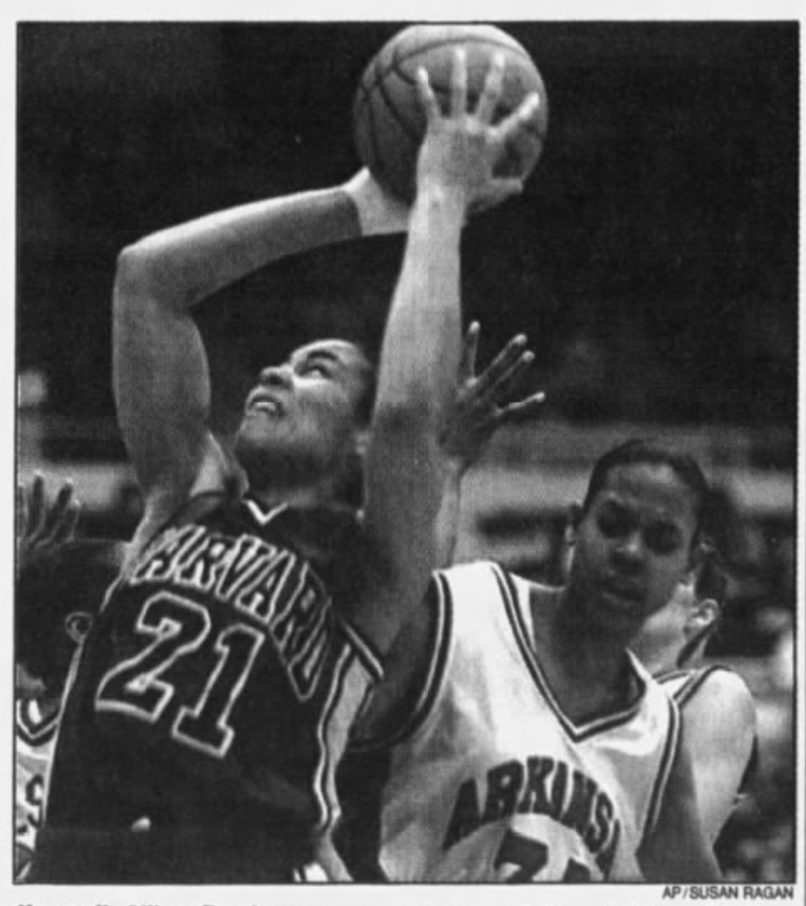
“I … sat on the edge of my couch and was like, ‘Oh my gosh, we’re winning. We’re still winning. We’re still winning,’” says Proudfit, who was watching late at night from Washington, DC. “I did that all the way through the game.” Not being there in person, she says, “may be one of my biggest regrets.”
Reinhard estimates that 15 to 20 Crimson alumnae, including her, made the trip to California on short notice, and when the buzzer sounded, they rushed the court. “You could tell [Kathy] was just overjoyed,” she says.
Around the country, too, a handful of watch parties were euphoric. Harvard women’s ice hockey head coach Katey Stone, who considers Delaney-Smith “a mentor and a friend and a confidant,” hosted other Harvard coaches at her apartment in Belmont, Massachusetts. The Dartmouth women’s basketball team also gathered at Wielgus’s house to cheer on the Ivy League on a national stage.
“When Harvard won, they were screaming and jumping up and down,” Wielgus says. “The next day, my sons get up and they come downstairs. They go, ‘Mom, don’t ever tell us our friends are loud again.’”
Delaney-Smith and her team were immediately “bombarded with press,” she says, but they managed to celebrate at Pizza A-Go-Go, a local pizza shop decorated with autographed surfboards, in the wee hours of the morning. Harvard lost its next game to 9-seed Arkansas, but the magic of the first-round upset was unmistakable.
“It was absolutely fantastic,” Stone told The Next. “… The ripple effect of the enthusiasm around their program and all of women’s athletics at Harvard was huge. … It just is a reminder that we all can do it.”
Delaney-Smith is fiercely competitive, whether it is in a snowball fight on the side of the road or a free-throw shooting contest that she lost to Stanford’s Tara VanDerveer at a banquet in 1992. (“I’m furious about that,” Delaney-Smith says, pointing out that she had no advance notice and wore heels to the banquet.) Yet Delaney-Smith knows how to keep winning and basketball in perspective and build a program that nurtures the entire person, not just the player.
Proudfit came to Harvard in part because Delaney-Smith had told her she would be a true student-athlete, with academics coming before athletics. But she didn’t fully grasp how much Delaney-Smith meant that until she had a math test scheduled that overlapped with her first college game, an exhibition against the Irish national team. “Well, great, go take the test,” Delaney-Smith told her.
Proudfit was shocked—she had expected her coach to advise her to try to reschedule the test. “I mean, she didn’t even hesitate,” Proudfit says. “And I thought back to those [recruiting] calls and I said, wow, that wasn’t just a line she was giving me about being a student-athlete. She really believes that. And sure enough, I showed up probably partway through the first half for my first college game because I had a test …
“This is exactly what I wanted. Because some of the other recruiting trips I took were so in favor of basketball versus school that I actually thought … I want to be a whole person and not just a basketball player.”
Johnson felt the same commitment from Delaney-Smith to her well-being beyond basketball when she tore her ACL nine games into her first season at Harvard. “I never felt like my worth to Kathy was diminished,” she says. Instead, Delaney-Smith met regularly with Johnson during her recovery, and she read the papers Johnson wrote for her philosophy courses and debated with her. That support has continued since Johnson graduated two decades ago and began a career as a writer and artist.
“She always makes me feel like I’m doing the right thing, taking these big swings, taking the risks,” Johnson says, “and is always pushing me on, has always been like, ‘Yes, yes. Go, more. I can’t wait for the next one.’ And I just feel like she completely has my back, no longer [as] a basketball player, but now as an artist, as a writer.”
The 1998 win over Stanford made people notice Harvard and the Ivy League, and it also helped Delaney-Smith’s name resonate nationally. Delaney-Smith remembers then-Team USA head coach Nell Fortner climbing to the top of the bleachers where Delaney-Smith was sitting to congratulate her on the upset. “There are people that would otherwise not know me that took the time to say hello,” Delaney-Smith says.
Delaney-Smith also got her own opportunities with Team USA a few years later, serving as an assistant coach for the U.S. team at the 2003 FIBA World Championship for Young Women, the head coach at the 2005 World University Games and an assistant coach at the 2007 Pan American Games. All three teams won gold, and current South Carolina head coach Dawn Staley, who led the Pan American Games staff, credits Delaney-Smith for mentoring a team of 19- to 21-year-olds who were playing against professionals.
“What I really truly enjoy about Kathy is her ability to coach, to do it in a way in which everybody understands what she’s saying,” Staley told reporters in 2021. “She was a great person to have on the sideline when we had so many young players … When you’re out of the country [and] you’re dealing with some other people’s kids, she made them feel like they were hers and they were ours.”
As Delaney-Smith’s star rose, she got calls from college and professional teams wanting to hire her, but she says she was never tempted to leave Harvard. The Boston native wanted to stay close to family and was happy at Harvard, and she had no WNBA coaching aspirations. She also appreciated how well-rounded her Harvard players were as people and how they consistently embraced off-court learning experiences such as visiting museums on road trips.
Yet coaching with Team USA was still pivotal for Delaney-Smith professionally. She borrowed a few plays from other Team USA staff to use at Harvard—“I steal from everybody I can steal from,” she says—but more importantly, her Team USA debut finally showed her that she knew what she was doing. In her first two decades as a college coach, she felt like she was learning as she went, catching up from not having played or been an assistant coach at the college level.
“I’m like, ‘Oh my god, I can’t coach Seimone Augustus and Sylvia Fowles and Alana Beard and all these who’s who in women’s basketball,’” Delaney-Smith says. “But then when I did … that was probably the first time where I’m like, ‘Wow, I know way more than I think I know.’ I was very validated about my knowledge and how I was coaching and what I was doing.”
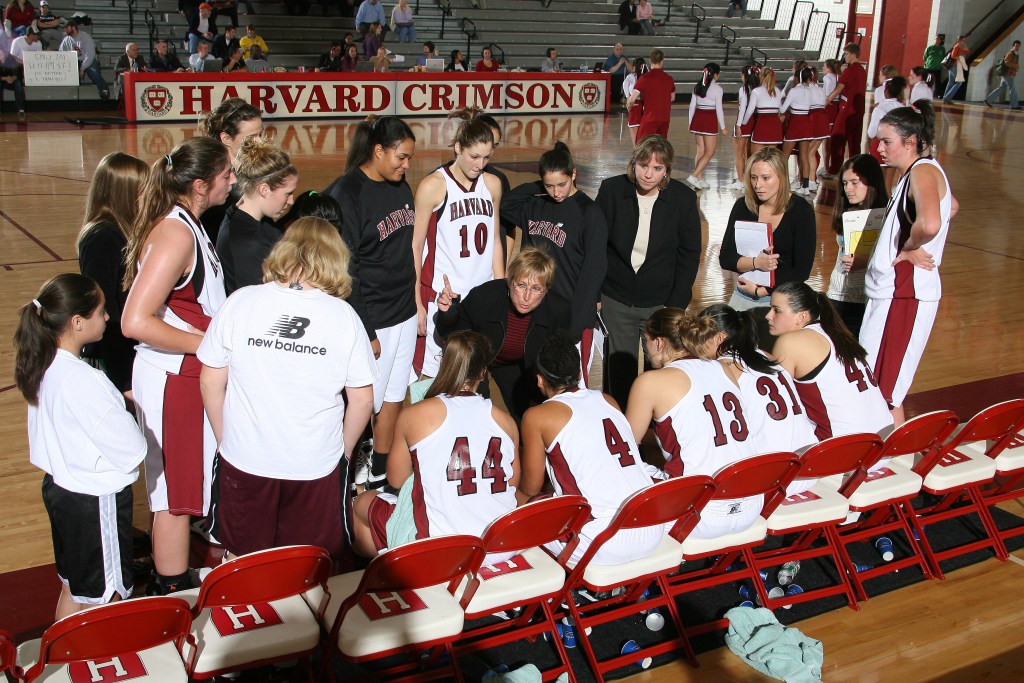
When men’s basketball coach Tommy Amaker arrived in Cambridge in April 2007, his program had zero Ivy League titles to its name and no NCAA Tournament appearances since 1946. Delaney-Smith, meanwhile, had just won her 10th conference title and appeared in her sixth NCAA Tournament in 12 seasons. Amaker’s task was clear.
“Our goal was to try to see if we could somehow be worthy of being in the same gym,” he told The Next. “… We were trying to emulate the success of our women’s program and the tradition that they had built up and the culture … We were very hopeful that we could kind of be a part of that and put our program in a place where people would think of us like that and [we would] hang banners like that and have former players and be proud of that.”
Amaker did elevate the men’s program, which won seven Ivy League titles and advanced to four NCAA Tournaments between 2010 and 2019. But Delaney-Smith continued to raise the bar, breaking former Princeton men’s basketball coach Pete Carril’s record for the most wins by an Ivy League coach in any sport in March 2014. The magic number was 515, and she has since tacked on another 115 wins.
“I think it’s just a testament to her approach, her ability to connect with the young people that she recruits and that she coaches,” Ivy League executive director Robin Harris told The Next.
The day Delaney-Smith set the record should have been joyous, especially because the win came over archrival Yale. But the woman of the hour had much more on her mind: “My little sister died that afternoon, and I found out before the game,” she says. When the buzzer finally sounded, the record in hand, Delaney-Smith’s players swarmed her in a group hug. She broke down crying.
“Everyone thinks I was sobbing because I was so happy to get the win,” she says. “I was sobbing because I was so exhausted and tired and emotionally drained … I was completely, entirely overwhelmed.”
“Kathy was emotional … You see her put so much into us as players, and it was kind of our way of embracing her then, in her moment and in her vulnerable state, just celebrating her,” Curtis says, noting that players usually run toward their teammates, not their coach, to celebrate major wins.
Delaney-Smith didn’t think much about the record as she approached it, telling WBUR, “I don’t count. I’m so not interested in that number.” Now, though, she calls it “one of [her] proudest accomplishments.” She didn’t realize in 2014 that the record encompasses all sports, not just basketball, and she appreciates the symbolism of having her, a pioneer for gender equality, standing atop the Ivy League.
People close to the program believe that Delaney-Smith could hold that record forever. “I’m not sure that it’s one of those records that will ever be caught,” Roux says, adding that Delaney-Smith has outlasted four or five coaches at some peer institutions. “… I don’t think that the longevity that she’s had here is something that occurs in the world of sports anymore.”
“Winning alone is hard, but winning repeatedly is even harder to sustain,” Golen says. “… I’ve done this in coaching for 10 years, and it feels like I’ve done it for 50. I couldn’t imagine 40. And to win the most games in the Ivy League … when you stack it all together, it’s like, oh my god. It’s crazy.”
“Come on, you’re coming to dinner with me,” Delaney-Smith told Golen, who was playing for Delaney-Smith at the time and trying desperately to hide some personal struggles. They went to Regina Pizzeria, a regional chain, just the two of them.
“You need to know my job is to grow you and help you as a human,” Delaney-Smith said.
“I wanted to look at her in that moment and be like, ‘No, Kathy, your job’s to win basketball games. I’m fine,’” Golen says. “But I wasn’t, and she knew that, and I didn’t even know that … She always knew what we needed when we didn’t even know what we needed.”
Curtis has a similar story, talking with Delaney-Smith for “what seemed like hours” at Peet’s Coffee in Harvard Square. “I didn’t ask her to get coffee,” Curtis says. “She just recognized … that, if you’re struggling, you may need someone who you look up to and who you don’t want to disappoint and who got you here to help pull you through … She just really cares. I don’t know anyone else that would do something like that.”
Delaney-Smith cares for her players to the point that some consider her a “second mom,” but she doesn’t stop there: She creates a team culture in which everyone else cares deeply for each other, too. When Feaster was a freshman adjusting to college life from her rural South Carolina hometown, Delaney-Smith didn’t pull her aside to talk about it. Instead, she organized team meals and events that brought all the players closer and helped the older players grow into mentors for the younger ones. In doing so—and in keeping her office door open for Feaster and her teammates—Delaney-Smith made sure players had multiple sources of support.
“It wasn’t just her caring about us as people. She created a culture to where we came in and created all of these amazing relationships with one another to where we had that feeling for each other,” says Christine Clark, a 2014 alumna and former college coach. “And that’s what I think is missing right now from college coaching.”
“Now I can sit here and say, ‘Man, the team helped me get through this. Kathy helped me get through that,’” Golen says.
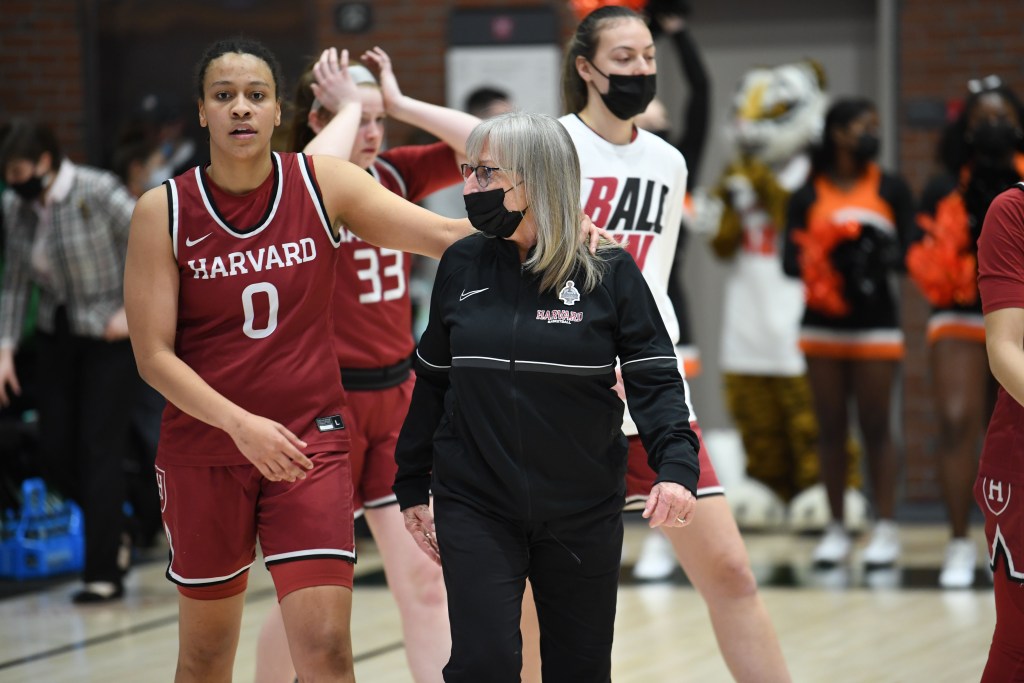
The battles that Delaney-Smith fought for gender equality at both Westwood and Harvard can be viewed as her caring about her players in the big picture and wanting to set them—and all women—up for success in every arena and boardroom.
She filed four Title IX lawsuits at Westwood in the 1970s to force the school district to give girls’ and boys’ teams the same resources, and she turned down multiple college jobs at places that didn’t treat their men’s and women’s teams equally. In 1982, Harvard wasn’t there yet, either, she says, but “I thought Harvard had the intention of being the best of anybody in that regard.”
So she started her fight anew in Cambridge, pushing for equal budgets, meals and practice time just like she had at the high school level. “I fought for everything,” she says. “… It was an ongoing discussion that I have had my entire time here.”
That included quotidian things such as ensuring that the media guides and information on the school website were equally detailed as well as larger battles over facilities and pay. During renovations to the basketball gym in the mid-1990s, Delaney-Smith insisted that Harvard invest the same amount of money into the men’s and women’s locker rooms. About a decade later, she noticed a pay disparity between her and the newly hired Amaker and successfully advocated for a raise.
“I knew she paid attention to that … She just believed in right and wrong, and she was going to right it,” says Stacey Noel (née Connors), who was an assistant coach to Delaney-Smith from 1998 to 2009. “… [But] I don’t remember her making a big deal about it [to her staff]. Just like, ‘I’m going to go fight this. Wish me luck.’”
Just like at Westwood, Delaney-Smith rarely shared what she was fighting for with her players, worried that they would feel like second-class citizens if they realized what was going on. As a result, many former players told The Next that they did not notice any inequities at Harvard and assumed that Delaney-Smith’s battles were largely in the past.
“I was, I’ll say, blissfully ignorant of those things,” says Laura Barnard, a 2002 graduate who is now the program’s coordinator of marketing and program development. “I didn’t—we didn’t—really realize what was going on behind the scenes that she was fighting for. And now I see it, having kind of lived through corporate America and now as a mom of three daughters, you see these little things where gender bias and discrimination creep in.”
“I walked in with a confidence that we were absolutely on equal footing with the men,” Proudfit says. “And I would look up [at] Kathy’s banners, her championship banners, and it was just proof.”
“She’s had such a long journey that I don’t think any of us truly understand because we haven’t been with her for the [40] years,” adds Erin McDonnell, a 2015 graduate. “But you just hear stories, like some of the horror stories, too, [of] what she’s had to fight through … And moments like [KDS Day, a celebration of her career that Harvard held in February] and [breaking Carril’s record] just are a recognition for her for like, ‘Thank you for fighting for us and for being our voice when we continue to sometimes not have one.’”
Delaney-Smith now regrets hiding her battles from her team, but she did emphasize equity more broadly to her players and staff. On the road, if she saw inequities at other schools, she would point them out to her players. And she had frequent discussions with her staff about everyday sexism in the world, such as when youth tournaments would label the gender divisions “basketball” and “girls’ basketball.”
“We talk about [equality] all the time … It’s just a reminder, constantly—to me, to our staff, to our [student-athletes], to our administration, to whoever she’s talking to—that we need to have equity and we need to have equality,” Roux says.
Delaney-Smith’s advocacy has had ripple effects throughout Harvard Athletics and the Ivy League. Amaker and Delaney-Smith have talked often about the battles Delaney-Smith has fought and the importance of gender equity: “She makes sure that that is known, and I love that,” he says. And Stone says that some of the most impactful lessons she’s learned from Delaney-Smith have been “picking the right battles” and “making sure you’re fighting the right fights for the right reasons.”
Delaney-Smith also embraced gender equality by encouraging the women around her to pursue their passions and embrace their identities. She tried to keep women in coaching as they became mothers, both showing and telling them that it was possible to balance work and motherhood as she raised her own son, Jared. She nudged O’Banion to attend the Black Coaches Association National Convention, which O’Banion says “gave me permission to be confident in who I was.” And she empowered the other coaches in the Ivy League—all but one of whom were women and all of whom had barely more Ivy experience combined than she did entering the 2021-22 season—to voice their opinions.
“When you talk about somebody who has fought for Title IX advancements and empowers women, it’s Kathy,” former Yale head coach Allison Guth told The Next. “And you talk about young coaches like myself [being able] to get up every day and do what we love to do and be able to support our families while we do it, it’s because of women like that that are the trailblazers … So she is one of my greatest role models … It’s the end of an amazing era.”
Delaney-Smith’s impact is cumulative over 51 years of coaching—the last 40 at Harvard—in which she never gave an inch. “The Harvard program is where it’s at because she’s never allowed gender inequity and is always willing to be that voice,” Brown says. “It’s so impressive, and … the players that have played for her, they might know—they probably don’t know—all the battles that she has fought, but they understand that she’s always going to fight.”
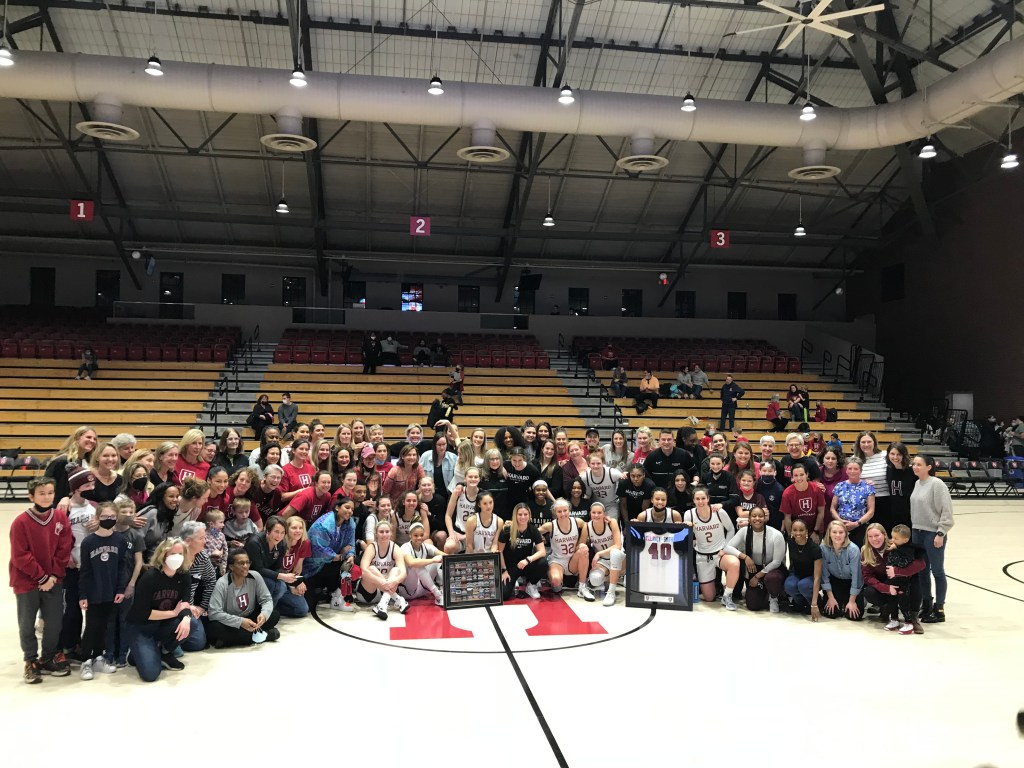
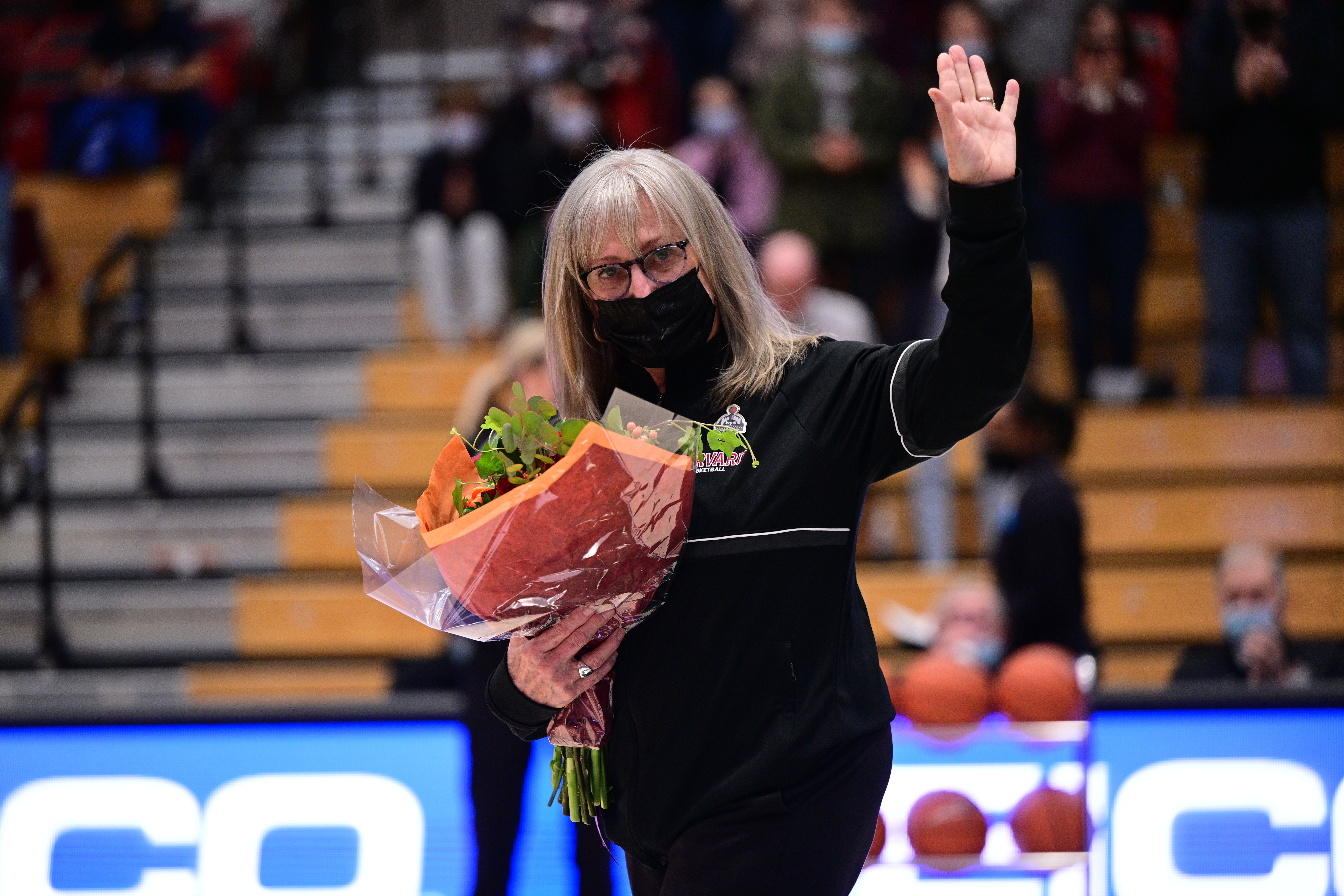
Having announced her retirement before the 2021-22 season, Delaney-Smith received a full farewell tour as opposing coaches and teams honored her final visit to their gyms. There were flowers from then-Arizona State head coach Charli Turner Thorne, a heartfelt speech from Princeton head coach Carla Berube and a tribute video featuring the entire Yale team, all of which left Delaney-Smith on the verge of tears.
The tour culminated at home with “KDS Day,” a celebration of her tenure and legacy on Feb. 12 that drew more than 70 alumnae from as far as California and Canada.
“Thank you to my beloved alumni,” Delaney-Smith said in a short postgame speech, her voice cracking with emotion. “I think Harvard is an incredible place, but the truth be told is it’s incredible because of you guys and all of you that are here. And you really are the reason I have stayed here for 40 years, and I love when you come back. And thank you so much for being here tonight.”
She was just as emotional when she addressed her 2021-22 team: “This is a special group and this is a special year, and I am so glad I’m spending it with you. You know I love coaching you,” she said.
The alumnae turnout wasn’t a coincidence: Delaney-Smith had prioritized creating a strong alumnae base to match the men’s program from the start of her tenure. As she graduated more and more alumnae, Brown says, the reunions “took on a life of their own, and they are legendary.” In 2019, led by Reinhard and Catherine Kelley (née Crisera), Delaney-Smith’s former players represented nearly all of the 34 donors who helped endow the women’s basketball head coaching position, and this season, players from her first Harvard team all the way to recent graduates were on hand for KDS Day.
“The reason why we’re here is because of her and because of this team and how she committed she was to us as people,” Dinkins Kincaid says. “… She’s done a fantastic job winning, but I think what she does other than that is the thing that makes her so special and why we keep coming back.”
After the postgame ceremony, Delaney-Smith spoke with the media before heading to Russell House Tavern in Harvard Square, where she, her alumnae and their families socialized and reminisced late into the night. She said a few words to the group partway through the event but declined to give a fuller speech, opting instead to hold court in a corner of the bar. She seemed to be in her element there, enjoying the company of so many women she has molded and coached and loved.
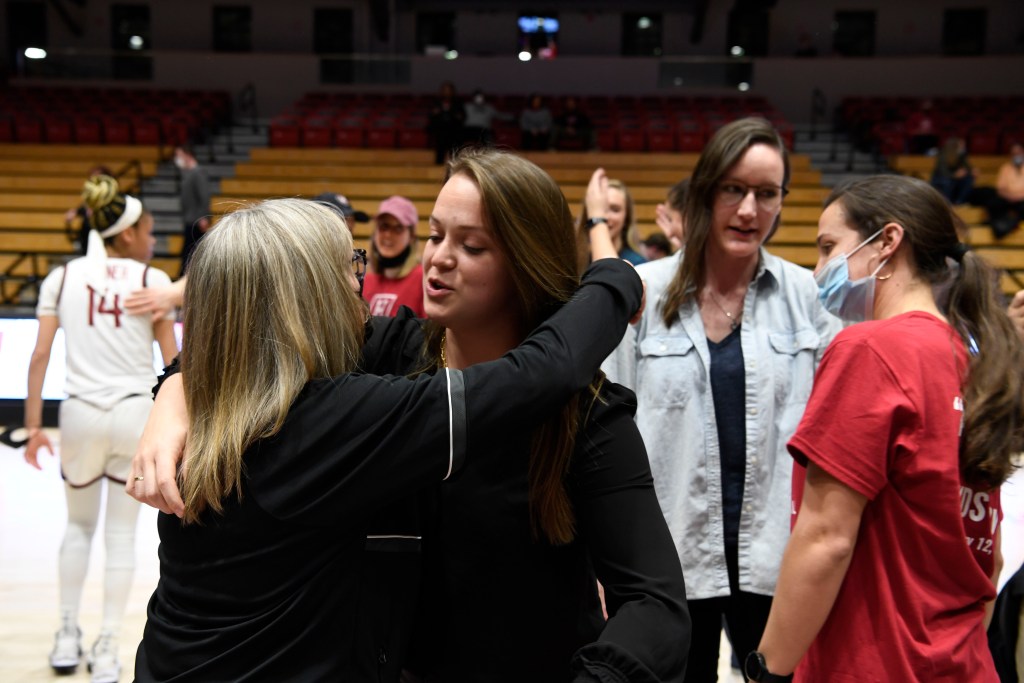
“Once you take a step into the gym that Kathy Delaney-Smith is in, you’re there for life,” senior Tess Sussman told reporters at the Ivy League’s media day in October. That was certainly evident at KDS Day, but seemingly every former player has stories about how Delaney-Smith cares for and impacts them in between reunions.
One common theme is how Delaney-Smith’s famous mantra, “Act as if,” helps alumnae through tough times in their careers or personal lives. Proudfit still visualizes, like Delaney-Smith taught her. Kelley, a 1994 graduate, is “hammering” home the life lessons Delaney-Smith taught her to her own children, and many alumnae brought their children to meet Delaney-Smith on Harvard road trips, eager to introduce them to their mentor.
Golen even followed Delaney-Smith into coaching, in part because she “wasn’t ready to let go” of her experience as a student-athlete at Harvard. “Will I ever even come close to touching how amazing Kathy is at this?” she asks rhetorically. “No! No. But … we all want to be like Kathy, dammit.
“I think there are ways that we actively remember moments and live like Kathy, and then there’s probably so many ways subconsciously [that] we’re living our lives today with things we learned in those four years. So Kathy is literally in us everywhere we go. And I think we all, in our lives, make people better now because of it.”
As she transitions into retirement, Delaney-Smith’s presence remains felt. She did not speak at the press conference announcing her successor, former Princeton assistant Carrie Moore, but Moore and athletic director Erin McDermott both thanked Delaney-Smith for the program and community she built in Cambridge. Delaney-Smith will likely be a fixture at games, too: In February, she told The Next that she planned to “sit 10 rows back and help the new coach coach, just like everyone does to me.”
“I’m wearing a different hat. That’s all,” she added. “… My heart is here at Harvard.”
Away from basketball, Delaney-Smith is writing a book and plans to spend more time biking and playing tennis, the latter of which she dominated in while coaching at Harvard. “None of them can beat me,” she says of the many alumnae and assistant coaches who played against her. “… They go down. They don’t win.”
Delaney-Smith will also extend her most important legacy by continuing to support and care for her alumnae. She plans to visit many of them, joking that, now that she realizes how much she means to them, “they have to host me at their house.” She will likely attend more weddings and other life events; she estimates that she has attended at least 30 former players’ weddings to date and is always disappointed when she can’t be there.
“When I got engaged, she was one of the first people I called, just because she’s … like another mother figure in my life,” McDonnell says. “And she was so happy for me, and then she even texted me after we hung up.”
Clark, who got married during the COVID-19 pandemic, called Delaney-Smith the morning of her wedding in lieu of having her there in person. In Barnard’s case, Delaney-Smith couldn’t make the wedding but sent some Harvard apparel via overnight delivery with a “funny note that broke up our wedding-day jitters.”
Proudfit even invited Delaney-Smith to her bachelorette party in New York, which shows not only how fun Delaney-Smith is off the court, but also how close she and Proudfit are. Proudfit’s older sister, who was so uninterested in basketball that she once read Vogue in the stands during a Harvard game, saw how Proudfit and Delaney-Smith interacted, and something clicked for her.
“Oh my gosh, Kathy’s more than your coach. She is kind of like your lifelong friend,” she said.
“Yeah,” Proudfit replied, “that’s exactly right.”