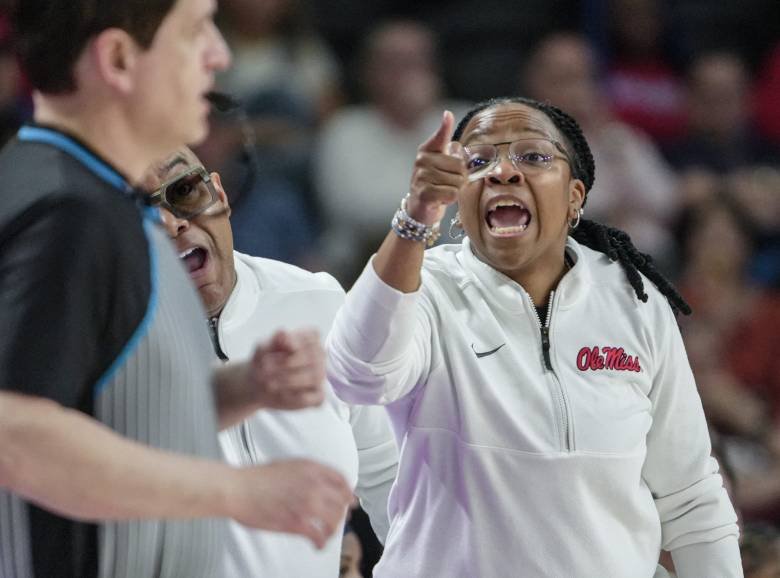
OXFORD, Miss. — Before Mississippi’s seventh summer practice can officially begin, Yolett McPhee-McCuin walks toward the left corner of the court inside the Tuohy Basketball Center and calls her players together.
A dozen of them gather around a computer screen. Ten are newcomers. Nine arrived through the transfer portal. Junior center Desrae Kyles and sophomore guard Lauren Jacobs, each entering only her second season in Oxford, represent the entirety of the returning roster.
For the next 10 minutes, McPhee-McCuin turns a late-June morning into an instructional session on spacing, patience and offensive reads. She stops the action, moves a player several feet and corrects the angle of a screen. She explains how one premature cut or mistimed post-up can clog an entire possession. She wants her guards to drive deeper into the paint, force defenders to commit and recognize help coming from the weak side before choosing whether to finish or pass. She also wants them to breathe.
Rep The IX Sports at your next game!

Shop the logo collection or special “Women’s Sports are Front Page News” collection now on Shopify.
It is June, McPhee-McCuin reminds them. The offense is not supposed to look complete.
Not yet.
For now, Mississippi’s players must learn how to make the right read, execute each movement and trust that one decision will lead to the next. In time, she hopes they will stop operating like a collection of transfers and begin resembling a team.
“I look forward to the challenge,” McPhee-McCuin said. “We have a lot of new pieces, but we’re not necessarily a team yet.”
The distinction defines Mississippi’s offseason and perhaps its entire 2026-27 season.
In the modern transfer portal era, every program must reconstruct some portion of its roster each spring. Mississippi is testing the outer limits of that reality. Transfers account for 75% of the roster, leaving McPhee-McCuin, entering her ninth season in Oxford, to blend players from different programs, systems and backgrounds into a group capable of surviving the Southeastern Conference.
This is not unfamiliar territory.
McPhee-McCuin brought 35 transfers to Mississippi during her first eight seasons. Six arrived before the 2022-23 campaign, when the Rebels reached the Sweet 16 for the first time since 2007. Eight came last season, then the largest transfer class of her tenure. Now comes an even more ambitious experiment.
Four newcomers have played in the SEC. Senior guard Talaysia Cooper and sophomore guard Jaida Civil transferred from Tennessee. Junior point guard Jada Richard came from LSU, and senior guard KN’isha Godfrey arrived from Florida.
The rest came from across the country. Maya Anderson transferred from San Jose State, Emily Howard from Boise State, Doneelah Washington from Illinois State, Jade Tillman from UMBC and Rachael Okokoh from Penn State. Freshman guard Charleen Hudson represents the only newcomer arriving directly from high school.
ESPN ranked Mississippi’s transfer class among the nation’s top four and first in the SEC. Mississippi was one of two teams to sign two players ranked among ESPN’s top 20 transfers, with Cooper at No. 7 and Richard at No. 12.
Along the walls of Mississippi’s practice facility hang canvas photographs commemorating the program’s five Elite Eight appearances. Four came under Van Chancellor in 1985, 1986, 1989 and 1992. The latest came in 2007, when coach Carol Ross and star Armintie Price carried Mississippi within one victory of the Final Four.
Just beneath those reminders of the program’s past sits a quote from Phil Jackson.
“The strength of the team is each individual member. The strength of each member is the team.”
The words read like an assignment for Team 52.
Mississippi finished 24-12 last season and earned its fifth consecutive NCAA Tournament berth. Its season ended with a 65-63 loss to Minnesota in the second round. March, however, remains distant during the final days of June. McPhee-McCuin knows the foundation for that moment begins now, through corrections, repetition and the sometimes uncomfortable process of allowing players to make mistakes.
“It’s been kind of refreshing because they have a million questions,” McPhee-McCuin said. “They’re always in a coach’s office asking about certain things. This group really wants to get it right, offensively and defensively. But my staff and I are trying to teach them that it’s going to be wrong right now. At some point, it’ll click, and everyone will be able to see what we want it to look like.”
Listen now to The IX Sports Podcast and Women’s Sports Daily
We are excited to announce the launch of TWO new podcasts for all the women’s sports fans out there looking for a daily dose of women’s sports news and analysis. Stream on Spotify, Apple Podcasts or anywhere you listen to podcasts, and make sure to subscribe!
McPhee-McCuin originally constructed the roster with former guard Sira Thienou in mind. With standouts Cotie McMahon and Latasha Lattimore getting drafted to the WNBA, Thienou appeared positioned to assume a larger role. Instead, the Bamako, Mali, native entered the transfer portal hours before it closed on April 20 and later committed to SEC rival Auburn. She left after averaging 10.1 points, 5.1 rebounds, 2.1 assists and two steals across 62 career games at Mississippi.
Her departure could have destabilized Mississippi’s plans. McPhee-McCuin said it did not alter their direction. The staff had already changed its recruiting strategy. Rather than repeatedly loading the roster with seniors, Mississippi pursued talented underclassmen who could develop and potentially provide continuity beyond one season. Civil is a sophomore. Anderson and Okokoh also have multiple years of eligibility remaining.
“In the past, we were like, ‘We’re just going to get the best talent,’ and most times that was the oldest kid,” McPhee-McCuin said. “We have a bunch of talented underclassmen that we still will have some time to develop.”
That approach may eventually reduce Mississippi’s annual dependence on massive portal classes. It offers little immediate relief from the challenge McPhee-McCuin faces this summer.
The newcomers arrived from eight programs, each carrying her own habits, terminology and definition of a good possession. Some were stars. Others played complementary roles. Some expect to handle the ball. Others need touches around the basket. All must learn the demands of a program built on defense, physicality and extra possessions.
However, McPhee-McCuin refuses to assign a deadline to the process.
“I’m not going to rush it,” she said. “If I try to put a timeline on when they should gel or what that should look like, I think I’ll be force-feeding it.”
SEC experience should help. Cooper, Civil, Richard and Godfrey already understand the league’s physicality, athleticism and nightly demands. Familiarity, however, cannot manufacture trust. That must grow through work, communication and the willingness to surrender pieces of a previous identity.
Sunday, March 22, 2026.
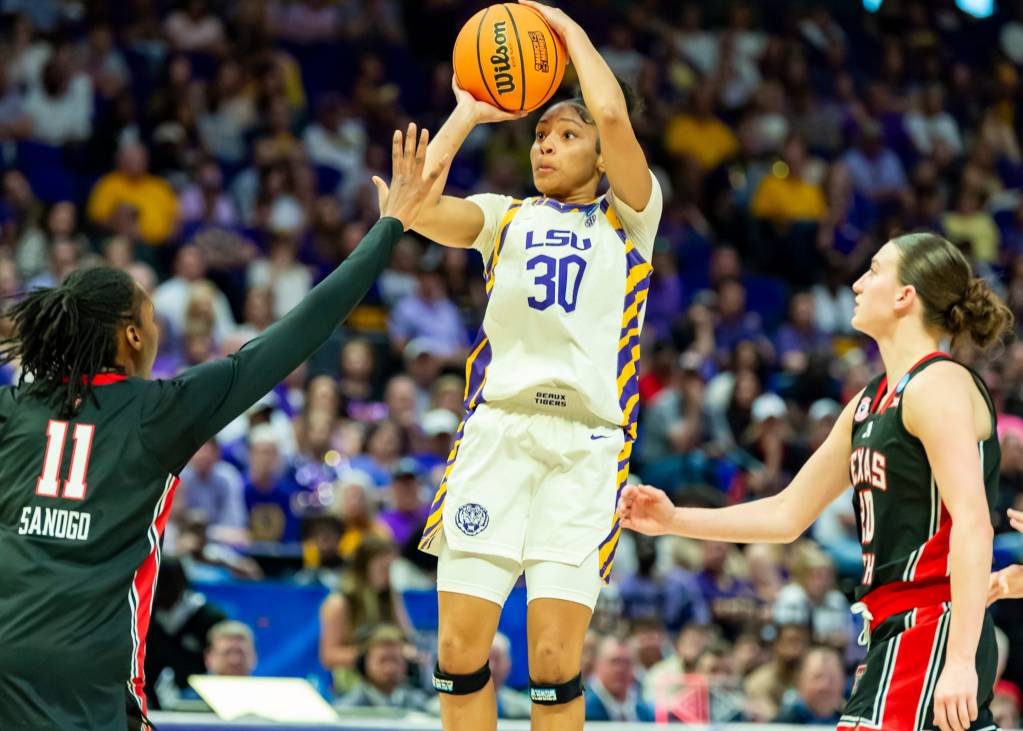
Richard might be best equipped to connect those pieces. At LSU last season, she scored 333 points and finished fourth on a roster featuring Mikaylah Williams, Flau’jae Johnson and MiLaysia Fulwiley. She ranked third with 117 assists and played the second-most minutes on the team.
Richard averaged 9.5 points, 3.3 assists, 2.7 rebounds and 1.3 steals while shooting 44.8% from the field, 40.8% from 3-point range and 88.6% from the free-throw line. She produced without dominating possessions in an offense that averaged an SEC-record 95 points and set an NCAA Division I record with 16 games of at least 100.
The Opelousas, Louisiana, native also won four state championships in high school. She arrived at Mississippi familiar with both crowded lineups and the demands of winning.
“The intensity, the grit, the tenacity, it was everything I expected in a great way,” Richard said. “I’m a worker. I come from work, and that’s all I really know. Being under Coach Yo, what you see is what you get.”
During McPhee-McCuin’s pre-practice lesson, much of the instruction centered on what Richard will be asked to do for Mississippi this season. Coming off a ball screen, the 5-foot-7 guard must diagnose the defense, determine when to deliver the pass and recognize when her quickness can produce a high-percentage finish. On one repetition, Richard keeps the ball and attacks the rim. She misses the layup, steps away from the play and immediately drops for 10 pushups.
The response reflects her accountability and her unfinished transition. Richard is learning a new offense while trying to establish herself as the point guard for teammates who are also learning one another. She wants to lead without pretending their relationships have already reached a place they have not.
“Everybody has a fresh slate,” Richard said. “Coach Yo does a good job of giving me grace. I’m just leading by example. I feel like it’s easy to follow a leader who works hard.”
If Richard can become the connector, Cooper gives Mississippi its most accomplished individual creator.
Cooper led Tennessee with 16 points, 104 assists and 78 steals last season. She spent two years with the Volunteers after beginning her college career at South Carolina under Dawn Staley. Across her two seasons at Tennessee, Cooper averaged 16.3 points, recorded 19 games with at least 20 and produced seven double-doubles.
“Coop is super talented,” McPhee-McCuin said. “She wants to win. This is her last lap. She has, and I say this with respect, an old man’s game. She understands what getting a bucket looks like.”
During practice, Cooper slides with the ball, rotates toward the corner and applies the type of aggressive on-ball pressure that has long defined Mississippi’s defense. She welcomes the coaching, particularly McPhee-McCuin’s refusal to compromise the program’s identity.
“She’s probably one of the best coaches when it comes to producing defense,” Cooper said. “She’s going to live and die by it, and that’s something I like. I love defense that gets my offense going. She’s going to be who she is regardless.”
Cooper’s fit will require more than points and steals. McPhee-McCuin also needs her to become a vocal and more accountable leader. On a roster with few returning voices, Cooper’s response to changing roles, difficult practices and uneven stretches will carry weight. Her teammates will watch how one of the group’s most accomplished players handles sacrifice.
“I feel like I’ve been doing better talking as a leader, and it just comes naturally as you get older and see things,” Cooper said. “Something I feel like I should work on is holding myself a little bit more accountable.”
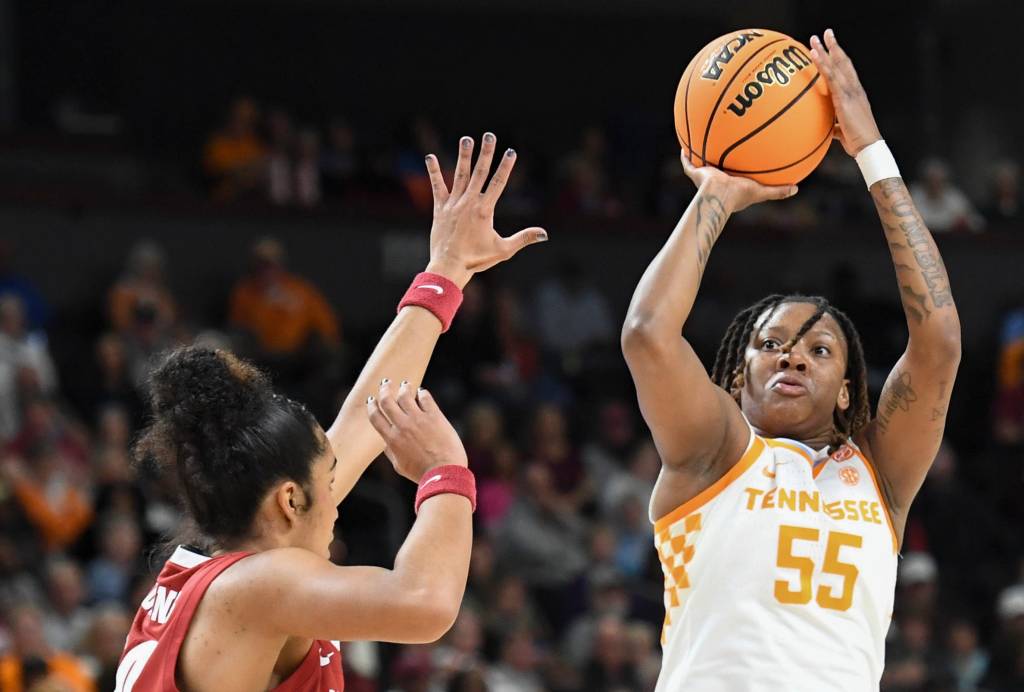
That accountability may prove essential because Mississippi did not merely add talent. It added players accustomed to serving as central figures. Cooper, Tillman, Anderson and Washington each recorded usage rates above 27% last season. Tillman led the group at 32.7%, followed by Cooper at 30.7%, Anderson at 28.7% and Washington at 27.4%.
Four players cannot command nearly 30% of the same offense. Shots will decrease. Touches will fluctuate. A player who carried her former team on one night may spend stretches screening, defending, rebounding or moving the ball without receiving it back.
That becomes the central chemistry question. Mississippi already knows these players can score. Mississippi must discover whether former primary scoring options can remain effective when the offense does not revolve around them.
Cooper appears capable of moving between roles. Her 31% assist rate last season accompanied her heavy scoring workload, showing evidence that she can initiate offense as well as finish it.
Richard offers an important contrast. Her usage rate at LSU was only 16%, yet she remained efficient as a shooter, facilitator and secondary creator. Her ability to contribute without monopolizing the ball could make her the bridge between Mississippi’s high-volume scorers.
Her shooting also addresses a potential weakness.
Mississippi attempted 3-pointers on only 24% of its field-goal attempts last season, ranking 306th nationally. The Rebels did not build their offense around perimeter volume. They created points through transition, physical drives, mismatches, offensive rebounds and opportunities around the basket.
Most of the newcomers produced similarly. Cooper shot 34.3% from deep last season, while Tillman made 32.8%, Washington 29.9%, Civil 28.8% and Anderson 26.8%. Richard’s 40.8% stands as the clear exception.
Mississippi can still succeed without becoming a high-volume 3-point offense, but lineup construction will matter. Driving lanes shrink when defenses do not respect multiple shooters. Washington’s interior presence could crowd those spaces further if she shares the court with several guards opponents are willing to leave open.
Richard’s shooting, Cooper’s creation and the development of another dependable spacer could determine whether the offense flows or compresses. Washington should strengthen areas Mississippi already values. She averaged 16.7 points and shot 50.2% from the field last season.
She can score through post touches, seals, rim runs and putbacks. She also joins a frontcourt that includes the 6-foot-5 Kyles and the 6-foot-4 Howard, giving McPhee-McCuin several options around the basket.
Mississippi ranked 12th nationally with a 40.5% offensive rebound rate last season. Washington can create value without a designed play simply by pursuing missed shots and finishing extra possessions. The team’s larger offensive identity should remain familiar. Mississippi averaged 71.4 possessions last season, used only 16.8 seconds per possession and finished among the nation’s top 30 in offensive and defensive efficiency.
They played fast, defended and attacked the glass. Their 52.7% assisted-shot rate ranked 229th, reflecting an offense comfortable with individual creation and quick decisions rather than constant ball movement.
That style could help a new roster. Transition opportunities, early ball screens and rim runs require less half-court precision than a complex late-clock possession. Mississippi’s depth should also allow McPhee-McCuin to distribute minutes and maintain pressure. The bench accounted for 33.5% of the team’s minutes last season.
Depth, however, creates its own strain. Several newcomers averaged between 26 and 33 minutes at their previous schools. The rotation may remain fluid while the staff determines which combinations can defend, rebound, handle the ball and provide enough spacing. Some games will require Cooper’s scoring. Others may demand Richard’s shooting, Washington’s size or a smaller, faster lineup.

“Becoming Caitlin Clark” is available now!
Howard Megdal’s newest book is here! “Becoming Caitlin Clark: The Unknown Origin Story of a Modern Basketball Superstar” captures both the historic nature of Clark’s rise and the critical context over the previous century that helped make it possible.
Selecting a permanent starting five may matter less than establishing a shared acceptance of whatever each game requires. Mississippi’s theme for the season is “R.I.S.E.,” an acronym for resilience, intensity, sacrifice and execution. The third word may carry the greatest significance.
“We want people that are serious about winning,” McPhee-McCuin said. “Most times, if they choose Mississippi women’s basketball, they kind of know what they’re getting with me. They’ve done their research, they’ve talked to past players, they’ve talked to people on the team, and they’ve paid attention.”
Transfers, she said, often arrive with a direct sense of purpose. They have already experienced college basketball, learned what they value and recognized what they still want from their careers.
“They’re [transfers] here for a particular reason,” McPhee-McCuin said, “and they’re really focused on accomplishing their personal goals and the goals for the team.”
The challenge lies in aligning the two.
For now, the work continues inside the Tuohy Basketball Center, one read, one correction and one possession at a time, as McPhee-McCuin tries to turn this year’s collection of newcomers into a team capable of rising without limits.