

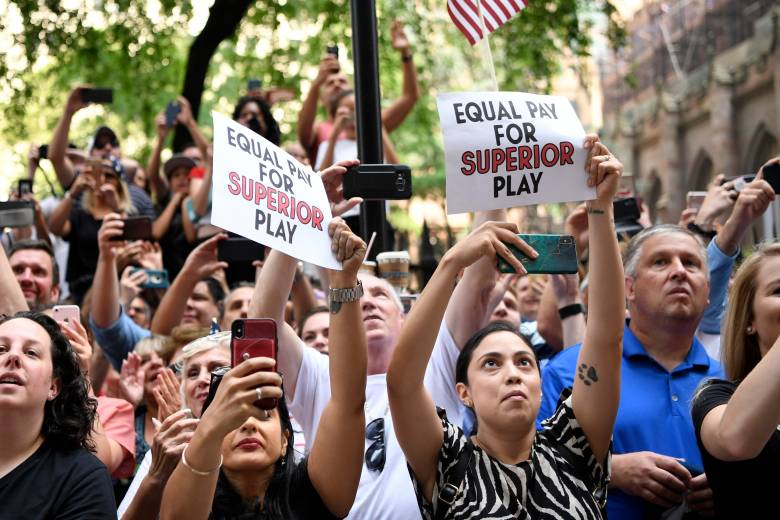
“I think we’ve proven our worth over the years,” said Carli Lloyd to The Guardian in 2016. Lloyd, the 2015 FIFA women’s player of the year and one of five athletes who filed a landmark complaint with the Equal Employment Opportunity Commission in 2016, who was joined by Megan Rapinoe, Hope Solo, Alex Morgan and Becky Sauerbrunn, alleged that the entirety of the National Women’s Soccer League was paid significantly less than their male counterparts, at every level of competition.
It took time — years, in fact — but in 2022 the U.S. Soccer Federation settled the lawsuit for $24 million. “This is going to be one of those incredible moments that we look back on and say the game changed forever, U.S. Soccer changed forever, and the landscape of soccer in this country and in the world changed forever because of this,” Rapinoe said at the time.
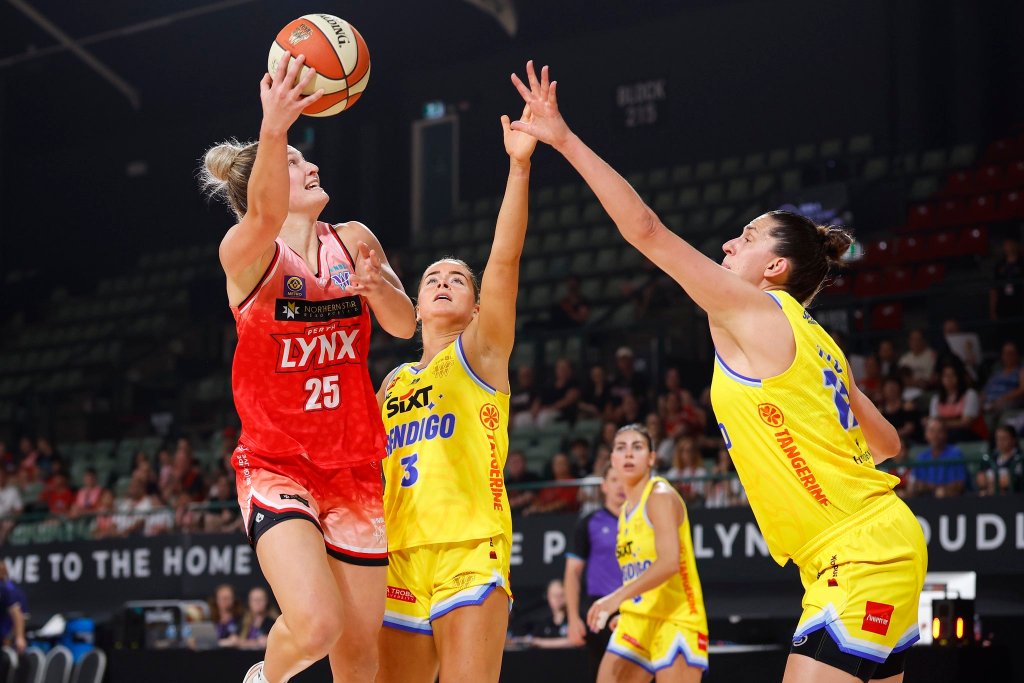
Women’s sports saw another of those incredible moments recently when the members of the Women’s National Basketball Player’s Association (WNBPA) reached a verbal agreement for a new Collective Bargaining Agreement (CBA) that New York Liberty star (and WNBPA vice-president) Breanna Stewart described as “transformational.” That deal was confirmed Friday, March 20.
The new CBA came after nearly 17 months of back and forth between the WNBA’s leadership and the teams’ owners. The players were advocating, among other things, for a new revenue sharing system based on gross revenue (money earned before expenses) versus a net system. Though the finalized and detailed CBA hasn’t been released, reports indicate the new deal includes a 20% gross revenue share, the first comprehensive revenue-sharing model in the history of women’s professional sports.
The CBA also raised the league’s minimum salary to $270,000, and the new supermax salary is $1.4 million — huge jumps from $66,000 and $249,000 last year. Teams will be required to expand their medical staff to include two physical therapists and other experts, to cover the entire salary of a pregnant player and to allow children under 13 to travel with teams. Teams will add two developmental players to each roster, bringing a team’s roster up to 14.
The deal is a landmark agreement for women’s professional basketball, and it’s also meaningful for other women’s leagues. The NWSLPA ratified the union’s first-ever CBA in 2022; the players negotiated an extension of terms that was signed in 2024 and will be in place until 2030. (When asked how the WNBA CBA could impact the USWNT, representatives for the latter declined to comment.)
At the the time of ratification, the NWSLPA’s focus was on empowering athletes “with freedom of choice over their career, elevat[ing] the professional standard of their work environment, and more closely align[ing] incentives so that players participate in the NWSL’s economic growth.” Like the members of the WNBPA, the soccer league’s union has emphasized securing a form of revenue sharing that is equitable and fair.
One women’s league can feed another
The verbal agreement reached between the WNBA and the WNBPA is “transformational,” Liberty star Stewart told reporters early Wednesday, March 18. “It’s going to build and help create a system where everybody is getting exactly what they deserve and more, from on the court and off the court aspects. Just excited that we can tell our fans that we’re going to be back.”
Union president Nneka Ogwumike and vice president Alysha Clark also emphasized the new CBA will impact their careers, as well as the careers of athletes entering the league in coming years. “What we just accomplished is going to change the lives of so many players,” Clark told reporters. “And speaking from experience, players like me are going to be the ones that I think feel it the most, and that’s what I think we’re all super proud of, because that’s what we set out from the beginning, was making sure every player felt the change in the CBA, and that’s exactly what has happened.”
“I really feel like a lot of what we were at the table for was for the next generation,” Ogwumike added. “When we consider the next 10 years, this is really going to continue to catapult us.”
“Becoming Caitlin Clark” is out now!
Howard Megdal’s newest book is here! “Becoming Caitlin Clark: The Unknown Origin Story of a Modern Basketball Superstar” captures both the historic nature of Clark’s rise and the critical context over the previous century that helped make it possible, including interviews with Clark, Lisa Bluder (who also wrote the foreword), C. Vivian Stringer, Jan Jensen, Molly Kazmer and many others.
“Transformational.” “Change the lives.” “For the next generation.” These are words and phrases that speak to a common goal: guaranteeing the future of the sport is sustainable and equitable. In the world of women’s sports, it follows that the NWSL is perhaps the league most well-positioned to undertake a CBA overhaul of its own.
When it was signed in 2024, the NWSL’s CBA was described in similar terms, and was cited as positive proof that the league was positioning itself to compete with standards set around the world.
That CBA introduced a lot of radical changes. For example, it abolished the draft entirely, and replaced it with a system for new players to sign directly with teams instead of being selected at random. The agreement gave free agents the right to sign wherever they want to and ended teams’ abilities to trade a player without their consent. The CBA was, and is, player-oriented and focused; much like the WNBA, it was clear at the time that NWSL players wanted to be taken seriously.
The deal was also ratified two years before its precursor would have expired, an indication of two things: one, that the players weren’t willing to wait long before demanding change, and two, that the league was amenable to introducing that change sooner than later.
The WNBA has changed the NWSL before
Changes in the WNBA have influenced changes in the NWSL before, and in the not-too-distant past. In early 2024 the WNBA announced players and teams would travel exclusiely by charter flight going forward, something that is a standard in the men’s game. The NWSL’s 2024 CBA stops short of mandating charter flights, but does state teams are responsible for six “legs” of charter flights (which could be a combination of round trip and one way flights) and allows teams to fly charter for midweek games.
The move from commercial flights to charter flights matters for a few reasons. Player and team safety and health are chief among them, but one of the biggest reasons is the optics — if a sport wants to grow, its leadership has to show that the capacity to do so is there.
Apart from public discussions and dissections about the WNBA CBA, professional basketball players and soccer players have more direct ways to communicate that fans can’t always see. For example, plenty have friendships that go back years, and they also share agents and managers.
For example, Allison Galer, the founder of Disrupt the Game, represents Chelsea Gray and Monique Billings, as well as Crystal Dunn. She’s not the only agent who works with clients from both leagues — all of the big agencies (THE·TEAM — formerly Wasserman — is a massive agency that works with players form both leagues). Those connections make it easy for players from different leagues to get to know one another, to compare and contrast what they’re receiving, and to offer advice and support.
There’s plenty of time before NWSL will make changes
The current NWSL won’t expire until 2030, which gives the league’s leadership and its players plenty of time before any changes are likely to take place, if they do at all. The current CBA’s minimum salary was set at $37,956 in 2024, and will rise to $82,500 by 2030. Similarly, a team’s overall cap space will increase from $3,300,000 in 2024 to $5,100,000 by 2030, and in 2027 the minimum roster size will increase from 22 to 23 players.
All of these changes will have a positive impact on the lives, and subsequently, the performances of players — and, if the women of the NWSL deem it appropriate, those changes may continue with a new deal after this one expires. For now, the players of both leagues and unions have achieved what was once unthinkable in their sports and have solidified their legacies as leaders and changemakers as a result.
Listen now to The IX Sports Podcast and Women’s Sports Daily
We are excited to announce the launch of TWO new podcasts for all the women’s sports fans out there looking for a daily dose of women’s sports news and analysis. Stream on Spotify, Apple Podcasts or anywhere you listen to podcasts, and make sure to subscribe!