

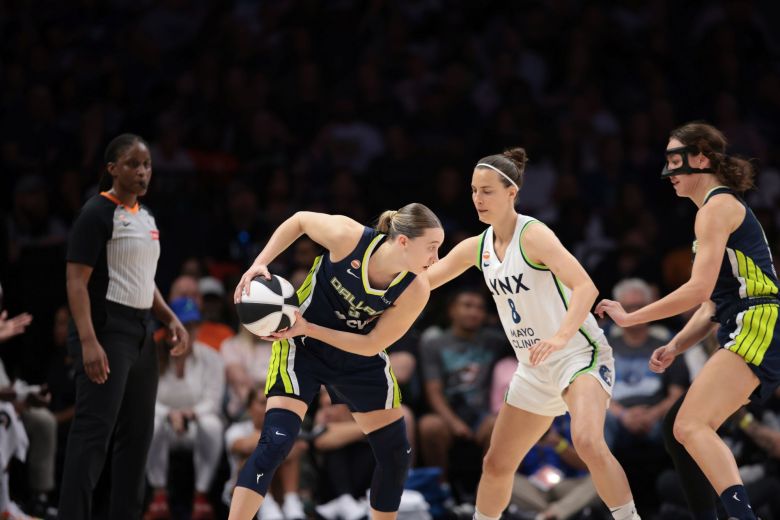
Welcome back to WNBA Notes, your journey into trends and analysis around the WNBA. Today we’re looking at the unique construction of the Wings and its strengths and weaknesses, plus check-ins with Chelsea Gray and Jacy Sheldon. For reference, since this notebook comes out over the weekend, I define “this week” as the prior Sunday through last night.
Tankathon Check-in
To be clear, no one in the WNBA is currently tanking on purpose (at least, the players aren’t). That being said, let’s see where our teams are right now in the lottery standings and where they project to end up (chart vaguely organized by rightmost column). I thought a team led by Alyssa Thomas would probably not end up in the lottery, but things have yet to turn around.
| Team: | Games back in lottery: | Games back of No. 8 seed: | Strength of schedule remaining (out of 15)1: | Likely finish: |
| Connecticut | ——— | 6.5 | 2nd-strongest (14th-easiest) | No. 1 lottery odds |
| Toronto | 5 | ——— | 6 | Top-half lottery odds |
| Portland | 4.5 | 0.5 | 4 | Top-half lottery odds |
| Washington | 11.5 | ——— | 8 | Middling lottery odds |
| Seattle | 13 | 5.5 | 1 | Bottom-half lottery odds |
| Los Angeles | 16 | 0.5 | 7 | Low playoff seed or bottom-half lottery odds |
| Chicago2 | 2 | 3.5 | 9 | Somewhere in the lottery! |
| Phoenix | 19 | 3.5 | 13 | Low playoff seed or worst lottery odds |
2. Washington owns the rights to the better of its own and Chicago’s pick
Chicago
Jacy Sheldon has filled a niche as a solid off-ball shooter who can do a little bit off the dribble sometimes, a starter with a 59.6% true-shooting the past two seasons. Sheldon has also been traded three times in her three years, and owns the sixth-lowest usage rate among backcourt players over that span who’ve played 500 minutes, per Sports Reference.
It’s possible to carve out a niche while rarely doing much on offense, but that almost exclusively pertains to defensive bigs like Kiah Stokes and Brianna Turner, who themselves become liabilities in the playoffs. The dozen other backcourt players in the same low-usage ballpark as Sheldon from that query consists of players out of the league, a backup point guard, two backup shooting specialists, a reverse point of attack defender, and two wings playing next to Caitlin Clark. Sheldon is none of those things, and she’s unexceptional at avoiding turnovers, which makes her value over an average off-ball guard negligible.
The case for Sheldon as a prospect was stellar rim pressure and finishing that was fueled by exceptional lower body athleticism, with shooting and all-around defense that were good compliments to that scoring game. The shooting and defense have held up, but without her generating drives anymore, they’re overleveraged; Sheldon got to the rim 33.5% of the time in the halfcourt as an upperclassman at Ohio State and shot 60.2% there, compared to a 22.8% halfcourt rim rate in the W and a 54.3% FG%. The lineups she’s played in haven’t helped, given the dearth of spacing on the teams she’s played for in the WNBA. But possessions with the ball in her hands too often turn into kick-outs after she’s too hesitant to try to press an advantage. To really grow she needs to make a more concerted effort to actually get downhill and get comfortable operating deeper into defenses; tightening her handle and trading some speed for strength by bulking up could help.
Dallas
The Wings sit tied for fifth in the standings with both the fifth-best offensive and defensive ratings, a surprise for a team generally predicted to be in the mix for the final playoff spots.
The main way Dallas has unlocked its offense has been focusing it through Jessica Shepard. While she’d been heavily featured as a playmaker since her nine-assist game in the season opener, the offense had started by using Paige Bueckers or Odyssey Sims as the primary initiator. Both of them have notable limitations in that role, so alongside Sims being moved out of the rotation, Shepard has now become a focal point early in the shot clock.
Sims’ benching saw Azzi Fudd join Bueckers and Arike Ogunbowale as talented scoring guards in the starting lineup, suddenly leaving the Wings with even more mouths to feed. And one of the easiest ways to let a bunch of guards cook is, somewhat paradoxically, to lift the bigs and take the ball out of their hands. The more space they have to operate, the more they’re able to leverage their off-ball work into easier scores off the catch, and the easier their passing reads once they get downhill. Using Shepard as a playmaking big above the break and moving Li Yueru out of the rotation did exactly that, while also opening more advantageous touches for Shepard on the drive and for Awak Kuier and Maddy Siegrist attacking off the catch.
Thinking Basketball’s Cody Houdek discussed that strategy week in regards to how Karl-Anthony Towns helped open the Knicks offense against the Spurs:
We’ve talked about this for years, especially for Nikola Jokić: If you have a center that’s able to space the floor, to use space to make passes, to make shots, that you have to drag out defensive players out there to contest them and make sure that they’re not splashing threes or driving into the paint, that’s a boom for your offense. That’s the sort of schematic shift that most every defense doesn’t have to worry about.
Like, you go to these playoffs, these big men just are not classic spacers in the same way they are in the regular season. Karl-Anthony Towns, with his driving game, with his passing game … that adds so much value offensively that — let’s pretend, even, that he is a negative defensively — he still has a lot that he’s bringing to the table on offense.
If you think schematically about what the Knicks needed to do — if Victor Wembanyama went to the bench, they attacked the paint. You know the other way that you get Victor Wembanyama out of the paint? You have to have Karl-Anthony Towns on the court, and make sure Wemby ends up on him.
Giving Shepard more playmaking primacy works especially well with the specific guards Dallas features: Ogunbowale’s shot selection has drastically improved, with her taking more spot-ups and fewer pull-up jumpers, more than half her threes being uncontested for the first time in her career, and her halfcourt rim rate jumping from her previous career mark by close to 10 percentage points, per Synergy; Fudd has more space both for the room she needs to be comfortable shooting and to get clean pull-up twos when she’s run off the line; Aziaha James gets better looks to flash her handle and get clean pull-up shots; and Bueckers has been able to play more as a wing than a pure point guard, as it’s become increasingly clear she’s far better attacking tilted defenses.
Bueckers’ problem isn’t her passing — rather, it’s the ceiling on how much any player can be a playmaker when they aren’t forcing the defense into rotation. That’s why Georgia Amoore isn’t creating good looks for the Mystics, or how Kelsey Plum can be a top playmaker despite lacking top-tier passing vision. Bueckers’ passing ability is stellar, but against set defenses she routinely passes out of drives before getting far enough downhill to create an advantage, a habit that a full-time point guard simply cannot have. As Mavs Moneyball’s Jack Bonin noted this week, Bueckers entered Saturday sixth among perimeter players leaguewide in total touches but ranked in the 38th percentile in that group for how often those touches reached the paint. Sometimes this is because she simply doesn’t seem to feel she has an advantage, as her reps against Atlanta and Golden State’s wings showed, but sometimes she makes the right read and just makes the pass a step too soon. And to say that drawing more free-throws is “not up to” her belies that the most important feature of elite foul-drawers is playing into contact near the rim.
That’s not to say that Bueckers is going to have this issue for the rest of her career; comfortability getting downhill is one skill we know can take top players a few years to grow into, and with how she continues to improve as a shooter, she could be an unstoppable offensive force if she improves here as well. But as things stand right now, Bueckers is an elite wing who is overtasked as a primary playmaker, and the All-WNBA-level play of Shepard has opened the opportunity to maximize her there at the moment.
The defensive chemistry is a bit more slapdash than that of the new offense. With JJ Quinerly cut, there are zero point of attack defenders on the roster, and between the issues with Bueckers’ positioning and physicality, Ogunbowale’s screen navigation and Fudd’s mirroring and foot speed, teams with quality lead ball-handlers can pretty easily get the Wings into rotation just through the primary action. The rim protection is spotty behind them, too: Kuier is good at backline help, but Shepard is one of the worst defensive 5s in the league, Siegrist one of the worst defensive 4s, and the now-reinjured Alanna Smith has struggled with some combination of playing with a mask and the increased help responsibilities compared to her time in Minnesota and Chicago. The help defense has mostly been a strength, though, with the gaps from the issues above papered over by Kuier’s length and timing, Ogunbowale’s active hands in the gaps, and Bueckers and Fudd’s rotations.
But that’s not enough against teams that can pressure both the point of attack and the paint, as games against the Lynx, Dream, Sparks and Valkyries have shown. When the offense is clicking, that can be enough that the defensive limitations aren’t a death knell. But if Bueckers isn’t forcing defenses into rotation and shots aren’t falling, then Dallas has issues.
Listen now to The IX Sports Podcast and Women’s Sports Daily
We are excited to announce the launch of TWO new podcasts for all the women’s sports fans out there looking for a daily dose of women’s sports news and analysis. Stream on Spotify, Apple Podcasts or anywhere you listen to podcasts, and make sure to subscribe!
Las Vegas
When a hitter in baseball passes their physical peak, they usually begin to lose quick-twitch athleticism and bat speed, making hard contact more difficult. The best hitters will often compensate for this by swinging earlier and sacrifice some bat control to swing harder, thereby trading more weak contact for less hard contact.
What Chelsea Gray is doing isn’t exactly analogous, but it sure feels like it.
| 3-point attempt rate | Pull-up threes per game | ← FG% | Spot-up threes per game | ← FG% | |
| 2021-25 | 32.6% | 0.9 | 35.0% | 2.2 | 39.2% |
| 2026 | 52.7% | 1.6 | 33.3% | 3.7 | 45.5% |
Gray had already been increasing her 3PAr every year since 2020, but now most of her shots are coming from deep, but she’s kicked that into overdrive this year after losing a noticeable amount of speed over the past year. She set a career-high in both takes and makes against Portland a couple weeks ago, because if you can’t be the best midrange shot-creator in the world anymore, why not hit a ton of threes instead?
Minnesota
Teams to post a net rating above 15.0 through their first 16 games, per Sports Reference:
- 2000 Comets, +19.8
- 2023 Aces, +19.4
- 1998 Comets, +18.6
- 2016 Sparks, +16.9
- 2026 Lynx, +16.2
- 2020 Storm, +15.5
The other five all won a championship, with Los Angeles being the only one to even lose multiple playoff games. (Cheryl Reeve probably remembers that.)

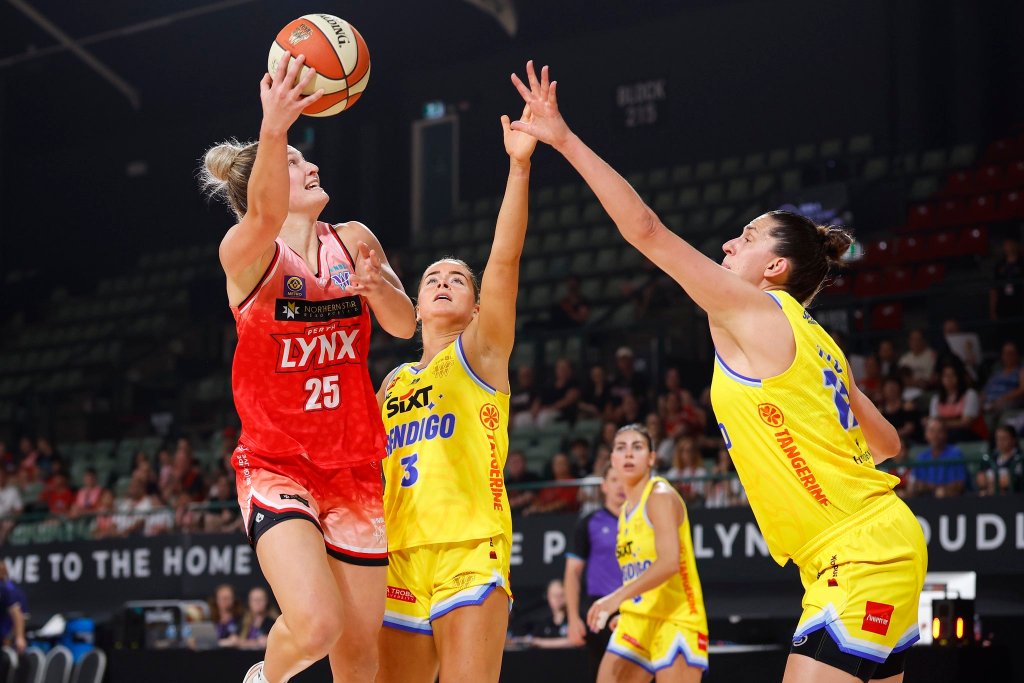
She was producing just fine the first 4 games of the season for Chicago averaging 10.8 ppg (7 FGA/per game) and 3.3 apg as a starter, but Rickea Jackson’s injury had Tyler Marsh pressing the Natasha Cloud button and is usually the case with coaches who need to win now, player development goes out the window.
Sheldon is basically penalized in the WNBA because she’s unselfish and being on a team where you have low percentage shooting guards (Diggins/Cloud/Taylor) routinely taking more shots than Cardoso and attempting more 3’s than Jacy, this is the result you get, especially when the coach doesn’t have the gravitas to make sure his guards stop being ballhogs and look to get their teammates going.