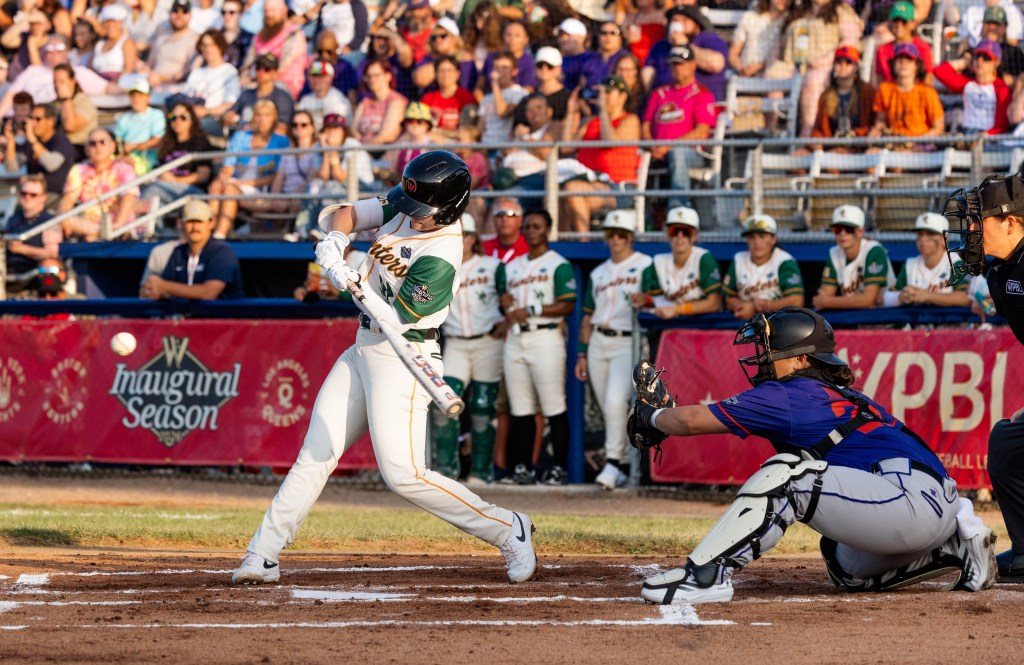
When I tell baseball fans that I’m covering the Women’s Pro Baseball League, one question they inevitably ask is about the level of play. I’d like to answer that question today by crunching some numbers. And to put those numbers in context, I’m going to do something I typically avoid in my coverage of the WPBL: draw comparisons to men’s baseball.
Specifically, I’m going to use Major League Baseball, the top four levels of the minor leagues — both collectively (A-ball, High-A, Double-A, and Triple-A) and individually (Pacific Coast League, Florida State League, etc.) — Nippon Professional Baseball, the Korea Baseball Organization, Taiwan’s Chinese Professional Baseball League, and the Mexican League as comparison points for how often certain events occur in WPBL games.
Many of those leagues, the WPBL included, are outliers in their own ways, but collectively they represent the different styles of play at the highest levels of baseball around the world. My hope is that, taken as a group, they will provide a more meaningful context for the baseball of the WPBL than a one-on-one comparison with the elite, extremely specialized play in MLB.
One thing to note before we begin: how the WPBL plays today and how it will play in future seasons are two very different things. One of the open secrets about this inaugural WPBL season is that the league is effectively having its regular season and spring training simultaneously. The league’s training camp took place in March, more than four months before Opening Day on Aug. 1, and lasted for just two days.
Some players did get to play between six and ten games in the Women’s Baseball World Cup qualifiers in late July as members of the American, Australian, Canadian, South Korean and Mexican national teams, and a handful of its stars (Denae Benites, Kelsie Whitmore, Ashton Lansdell, Mo’ne Davis and Val Perez) get to play more games at the Banana Ball. However, most of the players in the league have not played baseball with any regularity for some time, if ever, because of the biases that have pushed girls and women into softball. Boston Hunters outfielder Lexi Hastings, for example, said while guesting in the ESPN booth last Thursday that she had “only played three baseball games prior to this.”
Hastings, who starred in softball at the University of Connecticut and has since gone on to play that sport professionally, is an extreme example, but the point stands. These women have the skills and athleticism, and they know the game, but they don’t have anywhere near as much experience or targeted baseball training as the male professionals who have played the game consistently, in some cases year-round, since they were in elementary school. Similarly, nearly all of these women either have day jobs or are still full-time students, while the day job of a professional men’s baseball player is baseball.
With a proper spring training — which commissioner Justine Siegal, in our recent conversation, said was something the league is hoping to have going forward — not to mention the experience of this and/or multiple seasons, or targeted training like that provided by Driveline and the like, the characteristics of play in the WPBL are likely to change dramatically.
For right now, the defining characteristic of the league is that it is extremely high-scoring. Through Sunday’s action, the WPBL has seen its teams average 7.7 runs per game. That’s a radical difference from MLB, which is the second-lowest-scoring league among the many in my survey (above only Nippon Professional Baseball) at 4.5 runs per game this season (all statistics are through Sunday’s games). The Single-A California League, a notoriously offense-friendly league, is the highest-scoring men’s league in my survey with 6.1 runs scored per game. That’s still not close to the WPBL’s scoring rate, and that’s before you remember that a WPBL game is seven innings, not nine. Projected over nine innings, the WPBL’s rate of run scoring works out to 10.2 runs per team per game, compared to the California Leagues’ 6.2 per nine innings. That makes the WPBL 65% higher scoring than the highest-scoring professional men’s league in my survey.
That speaks to how far ahead of the pitchers the WPBL’s hitters have been this season. That makes sense. Again, most of the WPBL’s players have had the bulk of their playing experience in softball, and the biggest (though far from only) difference between baseball and softball is the pitching. The windmill windup and underhand pitching of softball is a radically different athletic movement than baseball’s overhand pitching, and while there are some pitchers in the league, such as veteran Queens ace Ayami Sato, who have ample baseball pitching experience, their ranks thin quickly, resulting in a sort of all-hands-on-deck situation on the league’s small, 17-player rosters.
Rep The IX Sports at your next game!
Shop the logo collection or special “Women’s Sports are Front Page News” collection now on Shopify.

That leads to one of the most exciting aspects of the WPBL’s style of play: two-way players abound. For example, all but one of the pitchers who has taken the mound for the New York Heights this season has also started a game at another position. In a league of 68 players, just eight have been used exclusively pitchers (what they call a pitcher-only or “P.O.”), and some of those P.O.s have still made plate appearances as managers regularly surrender the designated hitter when calling a player in from the field to take the mound (in that scenario, the player who replaces the new pitcher in the field replaces the DH).
In this first season, the WPBL is very much a league in which an infielder might say to their manager three weeks in, “I can pitch if you need me,” and their manager will take them up on it. That happened with Queens second baseman Amira Hondras last Thursday, and we saw Hunters third baseman Denver Bryant take the mound for the first time in a long time a week before that. When Heights outfielder Claire Eccles made her first start on the mound on Aug. 13, the ESPN broadcast reported that it was her first pitching appearance in more than a year. Eccles, a slight lefty who mixes in a knuckleball, has since emerged as one of New York’s most effective pitchers, leading the team with a 3.86 ERA in two starts and one relief appearance.
One side effect of pitchers being less specialized and rosters being smaller is that pitching changes tend to be only minimally strategic. Most often, a manager knows what three-or-so pitchers they intend to use in a given game, and the only aspect of their pitching strategy they decide in-game is when to bring in the next one.
As pitching becomes more specialized and the league’s better pitchers build up their arm strength and hone their command and control, we should start to see the run scoring come back down to earth. As it stands, with fastballs speeds hovering in the low 70s (Lee, the league’s hardest thrower, has thus far topped out at 81 miles per hour), the pitching is very hittable, and the hitters, whose adjustments from softball are real but less dramatic, know how to hit it.
As a league, the WPBL is hitting .332/.439/.482 (.921 OPS). The highest OPS in any of the pro men’s league I surveyed is .800 in the Triple-A Pacific Coast League, where the hitters are hitting .272/.363/.437. Not coincidentally, the PCL also has the lowest strikeout rate among top five levels of affiliated baseball in the United States. In the PCL, 20.5% of plate appearances end in a strikeout. In the WPBL, it’s just 12.9%.
There are other ways in which the WPBL isn’t less out of line with the men’s leagues. The WPBL’s 12.7% walk rate is high (MLB’s is 8.9%), but the Single-A Carolina League’s is higher (13.1%), and High-A as a whole isn’t far off at 12.1%.
One trend that’s clear in my survey is that pitching control — walk rate, the rate of hit batters, and especially the rate of wild pitches (which also reflects the quality of the catching) — improves as you move up the ladder from Single-A to the majors. As things stand, the WPBL’s walk rate is comparable to Single-A. The hit-by-pitch and wild pitch rates, however, are also off the charts.
A quick note on the former: I’ve noticed that, while WPBL hitters will turn away from a pitch right at them or duck one headed toward their head, they often lean into inside pitches below the shoulder. I don’t know if that’s customary in softball, but I’m sure the league’s slower velocities make it more of a viable strategy. I have yet to see a WPBL umpire call a hitter back for failing to attempt to avoid a pitch that hit them, which they should, but I do feel that the hit-by-pitch numbers are inflated by the batters’ willingness to be hit.
All of that said, 3.6% of WPBL plate appearances have resulted in a hit-by-pitch thus far this season. The highest rate I can find in any of the men’s leagues I surveyed was 2.0% in the Single-A Florida State League. In MLB that rate is 1.1%, less than a third as often as in the WPBL.
As for wild pitches, the best metric to use would be wild pitches per pitch, but the total of pitches thrown is not readily available for all of the leagues in my survey (the WPBL included), so we’ll have to settle for wild pitches per plate appearance. There, the rate of errant pitches is similar at 3.5%. The highest rate in the men’s leagues is 2.4% in the California League. The MLB rate is 0.8%, less than a quarter of the rate in the WPBL.
Here, we’re also getting a partial measure of catcher defense. That’s in part because I’ve seen more than one passed ball ruled a wild pitch thus far this season, but also because a wild pitch is only scored a wild pitch if the catcher fails to block it sufficiently to keep a runner from advancing. Just from observation, I’d say the pitch blocking in the WPBL needs to improve, but there are two factors to consider here: first, many of these catchers are used to receiving underhand pitches with an uprise, not overhand pitches that dive into the dirt (which is not to say that softball catchers don’t have to block pitches in the dirt); second, blocking pitches is a skill that requires a catcher to use their body as a shield, and the catchers in this league simply have smaller bodies than the Salvador Perezes or even the Alejandro Kirks of the world.
Regardless of why they happen, those hit batters are extra baserunners, and those wild pitches are extra bases, all of which add up to more runs. The same is true for fielding errors, which are also relatively plentiful in the WPBL. Again, I can’t use my preferred metric here, which would be defensive efficiency, because reached-on-error numbers are not available for every league, so I’ll fall back on that old standby Fielding Percentage. In the WPBL it’s .949, meaning 95% of fielding chances are handled cleanly. In MLB it’s .985. The lowest mark among the men’s leagues in my survey is the Florida State League’s .967.
This is where another aspect of the WPBL being a first-year league kicks in. This is a start-up league. Not only are the players relatively inexperienced, but they aren’t playing on the pristinely manicured fields of MLB (no offense to the Robin Roberts Stadium grounds crew). In fact, they’re playing on one of the few turtleback fields remaining in the country, meaning it humps in the middle to allow the rain to drain off the sides. That’s an unfamiliar topography for these players and has surely contributed to a few misplays. It also causes balls mishandled on the margins (the aforementioned wild pitches and passed balls, balls that get by the first baseman or outfielders) to roll farther away from the fielders than they might on a flat field.
Every league has to start somewhere, and that somewhere usually lacks the advantages, financial and otherwise, that a more established league has. So what was the fielding percentage in Major League Baseball the last time one of its two leagues was in an inaugural season? In 1901, when the American League started play, it was .943 for both leagues and .938 in the AL. The major-league mark didn’t surpass .949 until 1904, but it has gradually but steadily increased ever since (this year’s .985 is higher than any year prior to 2021). Yes, some of the reason for that century-long improvement stemmed from improvements in the equipment that the WPBL already enjoys (modern gloves, clean baseballs), but there is some major-league context for the quality of the fielding in this year’s WPBL.
Indeed, the best place to look for comparisons to the style of play in this year’s WPBL may not be in contemporary men’s leagues but in past major-league seasons. For example, thus far this season there have a roughly equal number of walks and strikeouts in the WPBL. That’s radically different than 2026 MLB, where the current 2.48 K/BB is the lowest mark in 14 years, but it was very much in character for the major leagues of the first half of the twentieth century. As late as 1951, the major-league strikeout-to-walk ratio was essentially even, and it was below 1.50 as recently as 1981. The WPBL’s 12.9% strikeout rate? Similar story: MLB’s strikeout rate didn’t surpass it until 1958 and was as low as 12.5% as recently as 1981.
As for the extreme run-scoring environment, well that was also the case with major league baseball in its first few decades in the late 1800s. In the first year of the National Association, in 1871, there were 10.47 runs scored per team per game. As late as 1894, there were 7.39 runs scored per team per game.
Women’s baseball isn’t as far afield as all that, however. While we’ve only seen one pitcher crack the 80s with her fastball, the hitters are registering major-league exit velocities and home run distances. Though the data has not been made available to the press, we have anecdotal evidence from the broadcasts of exit velocities in excess of 100 miles per hour, and Denae Benites and Kelsie Whitmore have each hit multiple home runs over not only the short WPBL fence (which, at 299 at the corners is no more than 11 feet shorter than the closest MLB foul-pole distances) but the permanent fence at Robin Roberts Stadium, which, for most of its history, hosted minor-league baseball.
Sunday’s broadcast shared some Trackman data on Whitmore’s league-leading nine home runs (which she has hit in just 12 games). The average Whitmore homer has left her bat at 93.7 miles per hour and traveled 323 feet. Her longest went 346 feet, which is far enough to leave 27 of the 30 major-league ballparks. Those numbers may be below what we’re used to from MLB, but remember that, against this league’s slower velocity, WPBL hitters needs to generate more of that speed and distance themselves.
In terms of power hitting, the league’s 2.5% home run rate is within the range of the men’s leagues, exceeding that of Single-A and the three Asian leagues; and the WPBL’s rate of 17.3% of hits going for doubles is also greater than those of all three Asian leagues (NPB, KBO, and CPBL). There hasn’t been a triple in the WPBL thus far, but that has more to do with those short fences than the players’ power at the plate or footspeed.
With regard to speed, the stolen base rate (per times on base) in the men’s leagues is highest in the low minors and declines as you climb the ladder (in part because defense improves and the players age). The WPBL’s stolen-base rate falls in between those of Double-A and Triple-A, while its success rate exceeds all of the men’s leagues, but not by a dramatic amount. As for smallball, in the current run-scoring environment it’s no more a part of the game than it is in any other domestic league, with just 0.4 percent of batters sacrificing, identical to MLB.
It’s worth noting here that players in the WPBL are young. Their average age, weighted by playing time, is about 24 years old. The average MLBer is 28.5. The youngest foreign league in my survey is NPB at 27.7. In terms of age alone, the WPBL is most similar to Double-A, where the average player is 24.2 years old. Baseball-Reference.com currently lists the WPBL and its players as minor leaguers, and that’s not entirely unfair given the combination of their relative lack of experience and youth. What’s exciting is that, in their case, it’s not the players who will ascend to a higher league but the league as a whole that should ascend to a higher level of play in the coming seasons.
Add it all up and you have a league that clearly has some refining and maturing to do, in terms of the quality of play, but that is tremendously entertaining in its current state. Plate appearances produce a ball in play 68.4% of the time, identical to NPB (68.4%) and higher than any other league in my survey other than the CPBL. Runs come aplenty. Power hitting is a prominent feature of the game. No lead is safe, and every pitch and every play holds the potential for something unexpected. It’s simultaneously a glimpse into baseball’s past and its future.
Listen now to The IX Sports Podcast and Women’s Sports Daily
We are excited to announce the launch of TWO new podcasts for all the women’s sports fans out there looking for a daily dose of women’s sports news and analysis. Stream on Spotify, Apple Podcasts or anywhere you listen to podcasts, and make sure to subscribe!
Part of what makes the WPBL so much fun to watch is the individual players who play it. One of the league’s strengths is that it has come loaded with budding stars who should be household names in any baseball-loving domicile. Since the WPBL didn’t have an All-Star break, and we’re just one week from the start of its first postseason, here are my picks for a 15-player WPBL All-Star team (all stats are through Sunday, Aug. 30; league-leading numbers are in bold; OPS+ and ERA+ figures courtesy SportyDolphin; everything else from Baseball-Reference):
Catcher:
Denae Benites, Heights
.542/.589/1.125 (266 OPS+), 9 HR, 30 RBI, 20 R, 54 TB, 12 SB, 56 PA
Heights captain Denae Benites got off to a blazing start this season, hitting five home runs in the Heights’ first four games. She has cooled off a bit of late, but she did hit a grand slam on Sunday night to re-tie Kelsie Whitmore for the league lead in home runs. Benites leads the league alone in runs, RBI, total bases, batting average, and stolen bases (she’s a perfect 12 for 12), as well as runners caught stealing from behind the plate (6). Benites is also the only catcher in the league to have caught every inning of every one of her team’s games.
Honorable mention: Alexia Jorge, Firebells (.484/.600/.710, 183 OPS+, 2 HR 40 PA). The Firebell’s catching tandem of Jorge and Sam Gutierrez have combined to hit .468/.590/.702 with three home runs, 18 RBI, and 22 runs scored in 61 PA (some of which Jorge has made as a designated hitter).
First Base:
Andréanne Leblanc, Firebells
.395/.490/.535 (122 OPS+), 1 HR, 1K, 51 PA
Leblanc was quietly consistent in the Firebells’ lineup until she hit a walk-off grand slam in Sunday’s game against the Heights.
Second Base:
Amanda Gianelloni, Firebells
.333/.440/.436 (90 OPS+), 1 HR, 51 PA
At 29, Gianelloni qualifies as a veteran in this first-year league and has shown that reliability at the plate and in the field all season.
Honorable mention: Samaria Benítez, Queens (.421/.476/.421, 95 OPS+, 41 PA); Elodie Ciamarro, Heights (.458/.458/.542, 116 OPS+, 24 PA)
Shortstop:
Joely Leguizamon, Firebells
.349/.429/.442 (88 OPS+), 50 PA
Leguizamon, Gianelloni, and Leblanc have started every game for the Firebells this season at their respective positions, and the double-play combination of Leguizamon and Gianelloni have impressed with their gloves as well as their bats at the two least productive positions in the league.
Honorable mention: Ayuri Shimano, Queens (.357/.500/.429, 102 OPS+, 20 PA; 3.52 ERA, 7 2/3 IP)
Third Base:
Ashton Lansdell, Queens
.474/.615/.868 (219 OPS+), 4 HR, 6 SB, 11 BB, 52 PA
Queens captain Lansdell has been overshadowed by Benites and Kelsie Whitmore due to that pair’s home run race and the late arrival of Lansdell’s power stroke, but she’s been incredible thus far this season. In addition to leading the league in on-base percentage (minimum 20 PA), she’s third in slugging, OPS, and OPS+ (Benites and Whitmore are the only other players with an OPS+ above 200), fifth in batting average, and second in steals (and, like Benites, she hasn’t been caught). Lansdell has also volunteered to play right field on occasion to help get Caitlin Eynon (a worthy honorable mention here with a 120 OPS+) in the lineup more often and has been impressive in the field at both positions.
Outfield:
Kelsie Whitmore, CF, Firebells
.500/.580/1.225 (284 OPS+), 9 HR, 50 PA
In addition to being in the argument over the league’s best hitter, Whitmore has made a league-leading five starts on the mound for San Francisco and is third in the league in innings pitched and fourth in strikeouts. Her 7.20 ERA is unsightly, but league average is 7.46, and Whitmore’s six strikeouts in her last start tied the league record for Ks in a single game by a pitcher. The debate over the league’s most valuable player is likely between her and Benites, and Whitmore’s pitching should put her over the top unless things change radically in the regular season’s final week.
Skylar Kaplan, RF, Firebells
.462/.533/.641 (153 OPS+), 1 HR, 0 K, 45 PA
In addition to her excellent plate production, Kaplan has arguably the best outfield arm in the league, certainly among players who don’t also pitch (the Hunters’ Molly Paddison is her primary rival there). She is also one of just two hitters in the league who has not struck out this season (along with Heights shortstop Val Perez, who has 16 fewer plate appearances).
Natsuki Yonetani, RF, Heights
.408/.500/.592 (136 OPS+), 1 HR, 6 2B, 4 SB, 58 PA
Like Benites, Yonetani started off red hot and has cooled a bit, but she’s still a source of reliable production in the leadoff spot for the Heights, has started every game for them in right field, and is an excellent defensive outfielder.
Honorable mention: Ticara Geldenhuis, Hunters (.265/.432/.588, 119 OPS+, 2 HR, 44 PA) and Lexi Hastings, Hunters (.333/.500/.619, 141 OPS+, 1 HR, 5 SB, 28 PA)
Designated Hitter:
Jamie Mackay, Queens
.375/.457/.800 (169 OPS+), 5 HR, 46 PA
It’s unfair to list Mackay as a designated hitter without context. She has started six of the Queens’ last eight games at DH, but she has also started four at catcher, started one each at first base and in left field, and made four relief-pitching appearances. She’s also third in the league in home runs and RBI (17), fourth in slugging, and sixth in OPS and OPS+.
Starting Pitchers:
Jill Albayati, Firebells
1.80 ERA, 415 ERA+, 10 IP, 3 BB, 10 K, 3.33 K/BB, 3 G, 2 GS, 2-0
.406/.513/.688, 158 OPS+, 1 HR, 39 PA
I had to find room for Albayati on this team somewhere, and her mound performance demanded it be here. Albayati’s primary position is third base, but she has also made multiple starts in left field and spotted at first base. The 22-year-old missed last week’s games due to the start of her senior year of college and has a hamstring strain that could limit her further, but her all-around contributions, on a per-game basis, rank with anyone else in the league.
Claire O’Sullivan, Heights
4.20 ERA, 178 ERA+, 15 IP, 9 BB, 9 K, 1.00 K/BB, 5 G, 1 GS, 3-1
.450/.500/.600, 137 OPS+, 1 HR, 4 SB, 26 PA
Despite her catastrophic blown save on Sunday night (in which just two of the seven runs were earned), O’Sullivan still ranks fourth in the league in ERA and ERA+ among pitchers with at least 10 innings pitched. Like Albayati, her contributions on both side of the ball demand her inclusion on this team. O’Sullivan has made four starts at first base, one at third, and one at DH, and has not been caught in her four steal attempts.
Gigi Schiano, Hunters
4.63 ERA, 161 ERA+, 23 1/3 IP, 16 BB, 9 K, 0.56 K/BB, 7 G, 2 GS, 1-0
The league leader in innings pitched, Schiano has been a workhorse for the Hunters, taking the ball in seven of their 12 games and going at least three innings in all but the first of those appearances.
Liz Gilder, Firebells
4.60, 162 ERA+, 15 2/3 IP, 8 BB, 8 K, 1.00 K/BB, 5 G, 3 GS, 3-1
Gilder has been the top lefty in the league (with a hat tip to the Heights’ Claire Eccles, who has thrown less than half as many innings) and a key part of the first-place Firebells’ rotation alongside Whitmore and Albayati
Relief Pitchers:
Meggie Meidlinger, Queens
2.70 ERA, 276 ERA+, 13 1/3 IP, 4 BB, 12 K, 3.00 K/BB, 8 G, GF 8, 3-0, 3 SV
The oldest player in the league at 38, Meidlinger quickly established herself as the league’s dominant shutdown reliever, and was its only shutdown reliever until the emergence of . . .
Jaida Lee, Heights
5.71 ERA, 131 ERA+, 17 1/3 IFP, 6 BB, 23 K, 3.83 K/BB, 8 G, 2 GS, 5 GF, 1 SV
It’s wild to remember that Jaida Lee was the Heights’ center fielder on Opening Day and their leadoff hitter in their third game. Lee, who is 1-for-13 at the plate with seven strikeouts, has slowly become more of a pitcher-only, and after starting two of the Heights’ first six games, found a home as New York’s multi-inning closer. Lee’s 81 mile per hour fastball is the fastest in the league, and, complementing that with a sharp curveball and the occasional changeup, she leads the league in strikeouts and strikeout rate (27.4%). When she’s on, there’s no pitcher in the league more impressive.
Links
The IX Sports’s Madison Williams profiled Queens captain Ashton Lansdell on Monday.
Joelle Milholm of SB Nation’s Purple Row spoke to Queens manager Eric Young about his WPBL experience on Friday.
I made an appearance on WGBH Boston Public Radio’s The Curiosity Desk on Monday to talk about the WPBL and was followed on the program by Hunters captain Ally Reynolds, who spoke about both the league and her career fighting wildfires in her native Canada.
“Becoming Caitlin Clark” is out now!
Howard Megdal’s newest book is here! “Becoming Caitlin Clark: The Unknown Origin Story of a Modern Basketball Superstar” captures both the historic nature of Clark’s rise and the critical context over the previous century that helped make it possible, including interviews with Clark, Lisa Bluder (who also wrote the foreword), C. Vivian Stringer, Jan Jensen, Molly Kazmer and many others.
Soccer: Annie Peterson, @AnnieMPeterson, AP Women’s Soccer
Tennis: Joey Dillon, @JoeyDillon, Freelance Tennis Writer
Basketball: Howard Megdal, @HowardMegdal, The IX Sports
Softball: Maren Angus-Coombs, @Maren-Angus, The IX Sports
Golf: Marin Dremock, @MDremock, The IX Sports
Hockey: @TheIceGarden, The Ice Garden
Gymnastics: Jessica Taylor Price, @jesstaylorprice, Freelance Writer