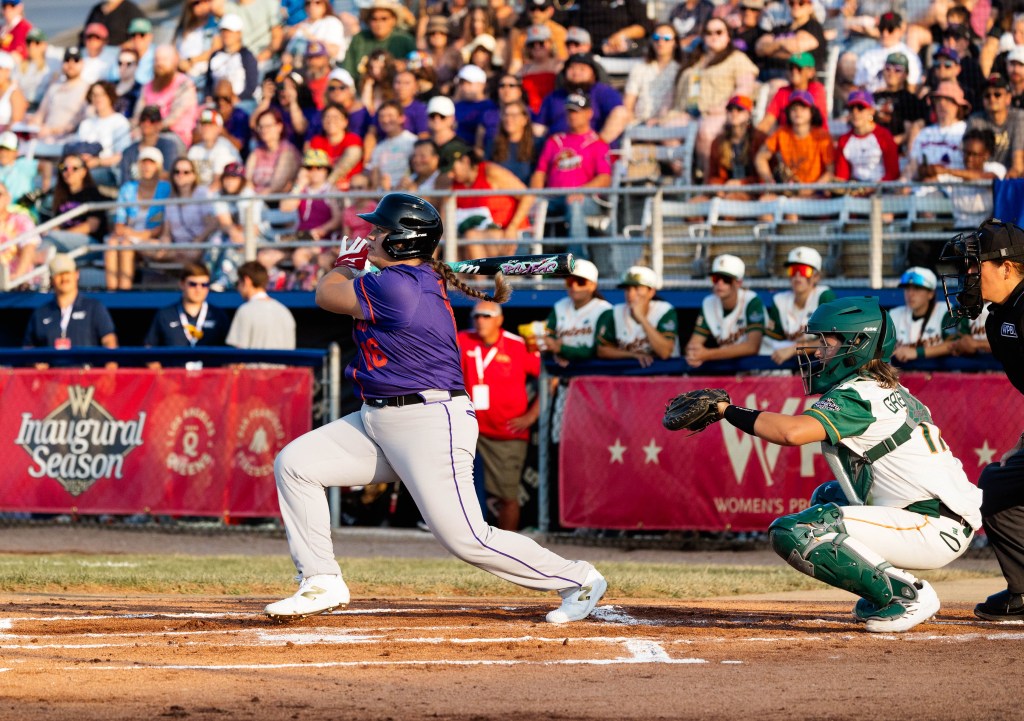
The first regular season in Women’s Pro Baseball League history is in the books. The WPBL’s first postseason begins on Sept. 9. The San Francisco Firebells were the regular-season champions, with a 10-5 record, but with just four teams in the league, everyone makes the playoffs, so things are very nearly starting from scratch for the two-week tournament.
I say nearly, because the regular season did determine the seeding and, thus, the matchups and homefield advantage for the postseason. Admittedly, homefield advantage is slight in a league where every game is played in the same stadium, but last licks do provide some strategic advantage in baseball, and the higher seeds will have them in Games 1 and 3 of this week’s best-of-three semifinals and, presumably, in three of the games in next week’s best-of-five championship series (as has been par for the course for the WPBL in this inaugural season, the league has yet to make clear how homefield advantage will work in that series).
As fun and exciting as the WPBL regular season was, there is every expectation that the league will find another gear in the postseason. There was no proper spring training prior to this season, just two exhibition games in March and a few days of practice prior to Opening Day on Aug. 1. With the exception of New York Heights manager Rocky Henley, a veteran of women’s baseball, the managers are former major leaguers who were largely unfamiliar with their players prior to this season, and they all, Henley included, spent a large part of the regular season figuring out what their players could do and how they could fit together.
Rep The IX Sports at your next game!
Shop the logo collection or special “Women’s Sports are Front Page News” collection now on Shopify.

The players themselves opened the season with varying degrees of experience playing baseball (as opposed to softball). The degree to which a large portion of the league was playing itself into shape and discovering, in-season, what they could do on the diamond added to the sense that the league was effectively having spring training and the regular season simultaneously, as did the lowered stakes of every team making the playoffs.
That’s all behind them now. The players are in mid-season form. The managers know what they have. And the stakes are real: to participate in the final week of this dream season of professional women’s baseball next week, the teams have to win this week.
Here, then, is a preview of the two semifinal matchups: the fourth-place Boston Hunters against the first-place San Francisco Firebells, which starts on Wednesday; and the three-seed Los Angeles Queens against the two-seed New York Hunters, which starts on Thursday. The two series will alternate games through Monday (if necessary), with the home team alternating within each series (the lower seeds will host Game 2). The championship series will start on Sept. 16. Here’s the full schedule for the semifinals (all times Eastern, all games are on ESPN Select in the U.S. and on YouTube internationally):
Sept. 9: Hunters @ Firebells, Game 1, 7:00 p.m.
Sept. 10: Queens @ Heights, Game 1, 7:00 p.m.
Sept. 11: Firebells @ Hunters, Game 2, 6:00 p.m.
Sept. 12, Heights @ Queens, Game 2, 7:00 p.m.
Sept. 13, Hunters @ Firebells, Game 3, 3:00 p.m. (if necessary)
Sept. 14, Queens @ Heights, Game 3, 7:00 p.m. (if necessary)
Some quick notes on what follows: The number in parentheses after each team name is their seed. Pythagorean winning percentage is based on run differential and is explained in further detail here. Positions listed for each player are in order of their number of games played at each this season. Designated hitter is listed only for players who started two or more games at DH. Pitcher is not listed among the positions for hitters; rather, two-way players (of which there are many) are listed twice, with an asterisk (*) in the pitching portion of the roster indicating that they are two-way players. Bench players and relief pitchers are listed in order of their playing time as hitters or pitchers (but not both) during the regular season except where noted. Lineups and pitching roles are all projected based on what we’ve seen the teams do during the regular season. Rosters are 17 players, but each team designates two players as inactive for each game. Statistics are from Baseball-Reference and SportyDolphin.
Here’s some quick background on the league as a whole for those who are just joining us for the postseason.
The Ballpark: Robin Roberts Stadium, Springfield, Ill.
Every WPBL game this season is played at Robin Roberts Stadium in Springfield, Ill, a 98-year-old minor-league ballpark with a grass playing surface, a single-decked grandstand, and a turtleback field (meaning the field slopes sharply away from the infield to allow rain to run off.)
According to Heights infielder Keira Izumi, the outfield drops to as much as 18 inches below the infield, which means that outfielders are running uphill when coming in on a ball. Similarly, that slope begins just behind the infield dirt, which means infielders are suddenly dealing with a downward grade when they hit the grass. That turtleback shape also causes balls that get by fielders at the margins (past the outfielders, corner infielders and catcher) to roll away faster and farther than they might on a flat field.
Visibility is also a challenge for the players during night games, as the sun sets behind left field, causing problems for the fielders on the right side, and the light towers are low enough that fly balls and pop-ups regularly pass in front of them and, in some cases, travel above the lights and temporarily disappear into the darkness. As a result of these conditions, the fielding percentage in the WPBL this year was .940, comparable to Major League Baseball (MLB) from the earliest part of the twentieth century.
The WPBL plays with a short outfield fence that is 290 feet down the lines and 330 feet to center, which is similar to the dimensions used in the Women’s Baseball World Cup. However, we have seen baseballs hit over Robin Roberts Stadium’s permanent fence. Home run leaders Denae Benites and Kelsie Whitmore have home runs of 375 and 378 feet, respectively, per the league’s Trackman data. Benites has averaged 345 feet on her 11 round-trippers. Whitmore has averaged 330 feet.
What’s Different: The WPBL plays seven-inning games and uses metal or composite bats. When setting their lineups, managers have the option to forgo the designated hitter and let their starting pitcher hit, which is not uncommon in a league full of two-way players. The league also uses just two umpires, one behind home, and one in the field. The league does not use replay review of any kind. Otherwise, the WPBL largely plays by MLB’s rules, including the most modern rules, such as the pitch clock, the automatic runner in extra innings and the limits on mound visits and disengagements by the pitcher.
With that, let’s get to the matchups.

Boston Hunters (4) @ San Francisco Firebells (1)
Head-to-Head Series: 5-0 Firebells
Head-to-Head Run Differential: +32 Firebells
Anything can happen over the course of three baseball games, but, on paper, this series is a mismatch. That’s the point of the seeding, I suppose, but not only did the Hunters fail to defeat the Firebells in five tries during the regular season, losing those games by an average of more than six runs, they arrive in the postseason having lost five in a row (three of those to San Francisco) and seven of their last eight (four of those to San Francisco).
The Firebells have won five of their last six, and that one loss came after they clinched first place. That suggests they may have taken their foot of the gas, a mistake they did not repeat in the season finale against the Hunters on Sunday.
To make matters worse, the Hunters enter this series with less rest than any of the other teams heading into the playoffs. They played back-to-back games over the weekend, unlike San Francisco, who only played Sunday.
Boston Hunters
W-L: 4-11 (.267)
R/G: 5.73
RA/G: 8.93
Pythagorean WPct: .308 (–48 run differential)
Projected Lineup:
L – Lexi Hastings (CF/LF)
R – Denver Bryant (3B/DH)
R – Alli Schroder (1B/3B)
L – Molly Paddison (RF)
R – Ticara Geldenhuis (LF/CF)
L – Edith De Leija (2B/DH/3B/SS)
L – Suzuka Yamamoto (2B/SS)
R – Raine Padgham (SS)
R – Beth Greenwood (C)
Bench:
R – Gabrielle Haas (CF/2B/3B/SS)
R – Kate Blunt (2B/3B/SS)
L – Maïka Dumais (1B)
R – Hyeonah Kim (C/RF/1B)
S – Sabrina Robinson (1B)
Likely SPs:
Alli Schroder* (R)
Kate Blunt* (R)
Paloma Benach (L)
Bullpen:
Gigi Schiano (R)
Maïka Dumas* (R)
Olivia Bricker (L)
Raine Padgham* (R)
Denver Bryant* (R)
Manager: Jemile Weeks
Note: Contrary to her wishes, Schroder does not hit when she pitches. Dumais will start at first base when Schroder is on the mound. The Hunters, characteristic of a team still trying to find its way, have the least-set lineup in the league, with Haas, Blunt and Dumais all starting with regularity. Similarly, both Schiano and Bricker are just as likely to start the third game of the series as Benach, though that will surely be an all-hands-on-deck quasi-bullpen game should the Hunters even make it that far.
San Francisco Firebells
W-L: 10-5 (.667)
R/G: 9.47
RA/G: 7.13
Pythagorean WPct: .630 (+35 run differential)
Projected Lineup:
R – Amanda Gianelloni (2B)
R – Kelsie Whitmore (CF/DH)
L – Skylar Kaplan (RF/1B)
S – Andréanne Leblanc (1B)
R – Alexia Jorge (C/DH)
R – Joely Leguizamon (SS)
R – Jua Park (3B/LF/2B/CF)
R – Ela Day-Bédard (LF/CF/RF)
R – Ayaka Yamamoto (3B)
Bench:
L – Jordan Eyster (LF/CF/RF)
R – Samantha Gutierrez (C/3B)
R – Hinano Beppu (2B/LF)
R – Rosi del Castillo (CF)
R – Jill Albayati (3B/LF/1B)
Likely SPs:
Kelsie Whitmore* (R)
Liz Gilder (L)
Niki Eckert (L)
Bullpen:
Peyton Coria (R)
Jill Albayati* (R)
Ela Day-Bédard* (R)
Rosi del Castillo* (R)
Andréanne Leblanc* (R)
Jua Park* (R)
Manager: Matt Williams
Note: The Firebells are dealing with several injuries. Jill Albayati hasn’t played since Aug. 21 due to a hamstring strain and is likely to be restricted to pitching in this series (she’d otherwise be hitting third and splitting third base and left field with Park). Rosi del Castillo has been working her way back from a knee injury and, similarly, has only appeared on the mound since her return. I’ve dropped both to the bottom of the bench list as a result.
Sam Gutierrez was hit in the eye by a groundball prior to Friday’s game, and while the team is optimistic about her ability to participate in this series, her availability is not a given. Manager Matt Williams said that closer Peyton Coria is his emergency catcher if Gutierrez is unavailable. If Albayati, del Castillo and Gutierrez are unavailable as hitters, Williams’ bench is limited to Eyster and Beppu, the latter of whom has barely played and is 0-for-3 with two strikeouts on the season.
Whitmore always hits when she pitches, remaining in the second spot in the lineup.
Listen now to The IX Sports Podcast and Women’s Sports Daily
We are excited to announce the launch of TWO new podcasts for all the women’s sports fans out there looking for a daily dose of women’s sports news and analysis. Stream on Spotify, Apple Podcasts or anywhere you listen to podcasts, and make sure to subscribe!
The Matchup
Offense
This matchup is worst versus first in almost every way. The Firebells, the league’s top offense, have outscored the Hunters, the league’s worst, by an average of 3.74 runs per game overall. The Hunters are the only team in the league that has not achieved a double-digit run total in a game this season (they scored nine in two of their four wins, but otherwise topped out at seven, which is below the league average of 7.92 runs per game). The Firebells have reached double digits a league-leading eight times; that’s more than half of their games.
Against a league average of .339/.443/.492 (.936 OPS), the Firebells have hit .378/.480/.567 (1.047). The Hunters have hit .264/.393/.368 (.760). The only positive offensive category the Hunters led the league in was walks (they had two more than the Firebells). Boston also led the league in strikeouts, giving them the lowest contact rate in a league where putting the ball in play and forcing the fielders to contend with Robin Roberts Stadium’s quirks is a winning strategy. The only positive offensive category the Firebells trailed the league in was stolen bases (just 10, four of them by Jua Park), but who needs to steal bases when you’re slugging .567 as a team?
The Hunters have seen two hitters come on particularly strong in the latter part of the season. Center fielder Lexi Hastings, likely the league’s fastest player, came into the season with a slap-and-go approach as a left-handed hitter who had played softball almost exclusively. Hastings worked in-season to rebuild her swing for baseball, and has emerged as a power threat and her team’s best hitter, batting .400/.550/.833 (193 OPS+) with a team-best three home runs to go with four doubles and six steals in seven attempts.
Similarly, captain Alli Hunter worked in-season to improve her swing, emerged in the last two weeks to claim the first-base job on days she’s not pitching and finished with a .412/.524/.706 (162 OPS+) line. At the same time, left fielder Ticara Geldenhuis, who was the Hunters’ best hitter early and their first (and still only other) hitter with multiple homers, has cooled off since hitting that second home run on Aug. 23 and leads the team in strikeouts with 11.
Edge: Firebells
Fielding
The Hunters have been the worst defensive team in a league characterized by frequent misplays. Boston’s fielding percentage this season was a mere .929, and they also led the league in passed balls with nine. Hastings has great range in center, but she’s prone to frequent mistakes, both physical and mental. Third baseman Denver Bryant plays with great enthusiasm and determination, but there’s a reason she has seen extensive time at designated hitter. On top of everything else, the Hunters are the youngest team in the league, with an average age of just over 22, and they play like it. Boston’s best fielder is 19-year-old right fielder Molly Paddison, who has good range and a fantastic throwing arm, but even she is the second-best right fielder in this series.
To emphasize the point: Do not run on San Francisco right fielder Skylar Kaplan, who has the best outfield arm in the WPBL. The Firebells aren’t the best-fielding team in the league, but they’re above average. Their corner infielders can be a bit shaky, but San Francisco is solid up the middle. Every team in this league makes errors, in part due to the field, but for the most part, the Firebells won’t hurt themselves in a significant way.
Edge: Firebells
Starting Pitching
Two-way infielder Kate Blunt has quietly been one of the best pitchers in the WPBL this season, posting a 244 ERA+ in 14 innings across three starts and three relief appearances, though she has walked more batters than she has struck out. Low strikeout rate is an issue for the Hunters overall, as they’re the only team in the league that has fewer strikeouts than walks on the mound. Captain Alli Schroder has the look of a classic power pitcher, but she has struggled on the mound this season with a 72 ERA+ and 15 walks to 11 strikeouts.
Meanwhile, Kelsie Whitmore has emerged as a stalwart for the Firebells. She’s not nearly as dominant on the bump as she is in the batter’s box, but she’s reliable, able to bear down when needed, and finished the season with a 116 ERA+ in 24 innings pitched, trailing only Boston’s workhorse Gigi Schiano in the latter category. Liz Gilder has been something of a left-handed Blunt, getting good results (148 ERA+) despite poor peripherals (11 walks to just eight strikeouts in 18 2/3 innings). Weekend warrior Niki Eckert gives the Firebells a second lefty in the rotation, which could be an advantage given that Boston’s best hitter, Hastings, is also left-handed.
Edge: Firebells
Bullpen
The bullpen is San Francisco’s one weakness, but if Albayati is able to return, and del Castillo is able to pitch multiple innings, they will have enviable depth. Williams has primarily used Peyton Coria to finish games, but she’s not the lock-down reliever she appeared to be earlier in the season.
For Boston, Schiano is a weapon who seemingly never tires. She led the league in both appearances (tied with Queens closer Meggie Meidlinger with nine) and innings (26 2/3), can seemingly pitch every day, and has turned in relief appearances as long as four innings. She’d be the best choice to start Game 3, but most likely Weeks won’t want to lose her as an option out of the bullpen and will use her in relief in one of the first two games, and possibly both.
Things thin out fast after that for the Hunters. Denver Bryant has made just one pitching appearance this season. Raine Padgham hasn’t pitched since Aug. 15. Olivia Bricker and Paloma Benach are potential Game 3 starters, and one of them or Schiano will have to be held back for that possibility. Bricker and Benach are both low-strikeout lefties. Benach has struck out just three in 14 innings. Bricker, who as appeared in six games, is still looking for her first strikeout on the mound this season. That has prompted Weeks to lean heavily on 18-year-old righty Maïka Dumas, who seems to be tiring and gave up seven runs against the Firebells on Sunday without completing a single inning.
Edge: Firebells
Outlook
This is the kind of series in which an upset would be genuinely shocking, so much so that the thrill would be tempered by the sense that the result was somehow incorrect. The Hunters avoiding a sweep would be an upset in and of itself. Boston winning the series, when the Firebells are not only obviously the better team but pretty clearly the best team in the league overall, would be such an upset it would literally be upsetting.
Los Angeles Queens (3) @ New York Heights (2)
Head-to-Head Series: 3-2 Heights
Head-to-Head Run Differential: +14 Heights
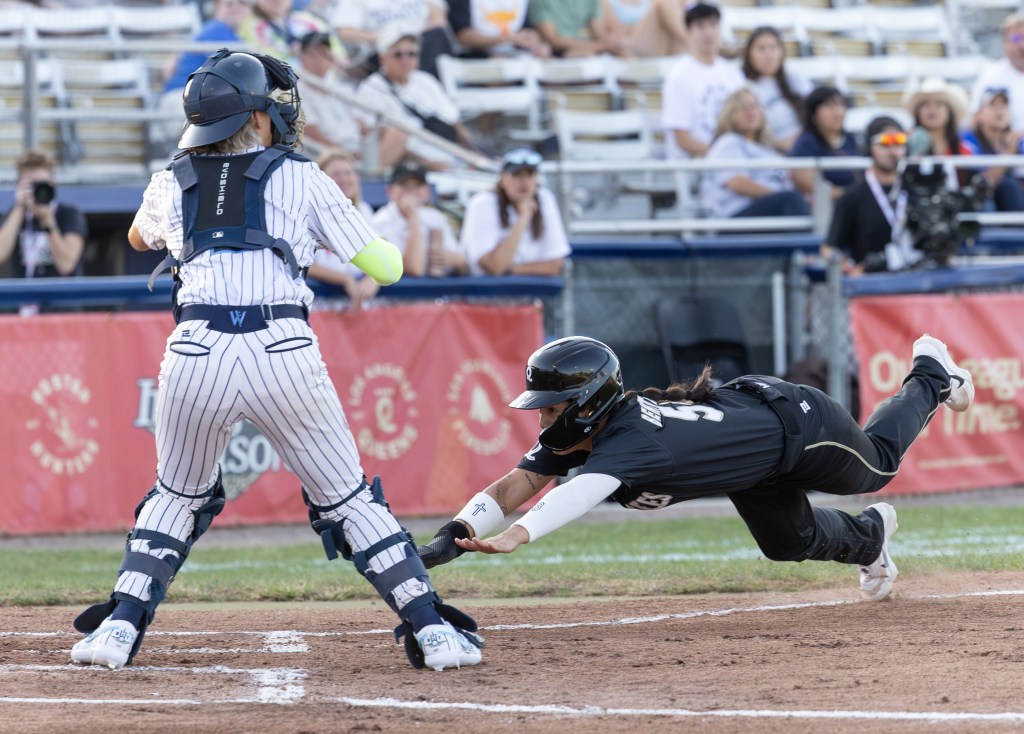
The WPBL season opened with the New York Heights taking on the Los Angeles Queens, and for one of these two teams, it will end the same way. Three of the games in their head-to-head season series were won in the victor’s final at-bat, including the Queens’ Opening Day comeback. The other two games were blowouts the Heights put away early, including last Thursday’s record-setting 18-7 finale, which gave New York the advantage in the series. These two teams know one another well and have exchanged blows in both directions, which is part of why this should be the more compelling semifinal.
Los Angeles Queens
W-L: 8-7 (.533)
R/G: 7.47
RA/G: 8.13
Pythagorean WPct: .461 (–10 run differential)
Projected Lineup:
R – Samaria Benítez (2B/SS/RF)
L – Ayuri Shimano (SS/1B)
R – Ashton Lansdell (3B/RF)
R – Jamie Mackay (DH/C/LF/1B)
R – Caitlin Eynon (3B/SS)
S – Sarah Edwards (1B/LF/RF)
R – Isabella Villarreal (LF/2B)
R – Maggie Foxx (C/LF/RF)
R – Mo’ne Davis (CF)
Bench:
L – Amira Hondras (2B/CF/RF)
R – Michelle Roche (RF/LF)
L – Adelaide Frank (1B/DH)
R – Britney Apgar (CF/RF/LF)
R – Diana Ibarra (CF/LF)
R – Addisyn Baird (LF)
Likely SPs:
Ayami Sato (R)
Michelle Roche* (R)
Ayuri Shimano* (R)
Bullpen:
Meggie Meidlinger (R)
Jamie Mackay* (R)
Amira Hondras* (R)
Isabella Villarreal* (R)
Maggie Foxx* (R)
Adalaide Frank* (R)
Brittany Apgar* (L)
Manager: Eric Young Sr.
Note: Manager Eric Young had to leave the team on Saturday to attend to a family emergency. As of this writing, it was unclear if or when he would return this postseason. Assistant coach Emma Charlesworth-Seiler serves as interim manager in Young’s absence, but that leaves the Queens with just two coaches, one of whom, Springfield native Pete Romero, didn’t join the team until Aug. 21.
When Romero joined the team, belatedly replacing Jemile Weeks, who was reassigned as the manager of the Hunters, Young told reporters, “I realized that me and Emma couldn’t do it by ourselves … and I didn’t want to cheat the players. I thought it was a disservice for them that we couldn’t have practices where we were able to function in a proper manner.” Unfortunately, the Queens are now back in that position until Young is able to return.
New York Heights
W-L: 8-7 (.533)
R/G: 9.00
RA/G: 7.47
Pythagorean WPct: .585 (+23 run differential)
Projected Lineup:
R – Natsuki Yonetani (RF)
R – Denae Benites (C)
R – Claire O’Sullivan (1B/3B)
L – London Studer (LF/1B/CF)
R – Kylee Lahners (DH/1B/3B)
R – Val Perez (SS/3B)
L – Emi Saiki (SS/3B)
R – Madison Willan (2B/SS/3B)
L – Claire Eccles (CF/LF)
Bench:
R – Alyssa Zettlemoyer (3B/2B)
R – Keira Izumi (2B/3B/SS)
R – Elodie Ciamarro (2B/3B)
R – Suzu Narasaki (CF/LF)
R – Katherine Murphy (LF)
R – Rakyung Kim (1B/LF)
R – Jaida Lee (CF/3B)
Likely SPs:
Rakyung Kim* (R)
Emi Saiki* (R)
Jacqui Reynolds (R)
Bullpen:
Jaida Lee* (R)
Claire O’Sullivan* (R)
Claire Eccles* (L)
London Studer* (L)
Alyssa Zettlemoyer* (R)
Keira Izumi* (R)
Manager: Rocky Henley
Note: Jaida Lee started one game each in center field, at third base and at designated hitter earlier this season, but has not played the field since Aug. 13 and is 1-for-13 at the plate with seven strikeouts. Given her increased importance to the New York bullpen and the fact that she dealing with an ankle injury, I expect she will serve as a pitcher-only this postseason, thus I listed her last on the bench. Similarly, Suzu Narasaki started a game on the mound for the Queens but has not pitched since joining the Heights, who I believe see her as a hitter only.
“Becoming Caitlin Clark” is out now!
Howard Megdal’s newest book is here! “Becoming Caitlin Clark: The Unknown Origin Story of a Modern Basketball Superstar” captures both the historic nature of Clark’s rise and the critical context over the previous century that helped make it possible, including interviews with Clark, Lisa Bluder (who also wrote the foreword), C. Vivian Stringer, Jan Jensen, Molly Kazmer and many others.
The Matchup
Offense
Against a league average of .339/.443/.492 (.936), the Heights have hit .362/.451/.525 (.976) to the Queens’ .344/.444/.498 (.942) and have outscored L.A. on the season by 23 runs overall and by 10 runs in their head-to-head series.
The Heights make more contact (with a 10.4% strikeout rate to L.A.’s 13.4%), but the Queens are slightly more patient (12.8% walk rate to New York’s 11.3%). The Heights hit for more over-the-fence power. That’s slightly skewed by Denae Benites’s league-leading 11 home runs, but New York has had seven players go deep this season, three of them more than once. The Queens have had six players hit home runs, two of them more than once, and one of the players who has homered for L.A. this season, two-way outfielder Thaima Maximiliana, has left the team due to a prior commitment to her national team. When it comes to inside-the-park power, which is to say doubles, the Queens have the edge.
The biggest difference between the two teams on offense is on the bases. The Queens are 15-for-20 (67%) in stolen bases, with captain Ashton Lansdell accounting for more than half of the team’s stolen-base total with eight in eight attempts. The Heights are 45-for-49 (91.8%), dramatically outpacing the league in both the quantity and quality of their base stealing (the Hunters are a distant second with 26 steals at 87%, and the three non-Heights teams combined have stolen just 51 bags).
Benites again weighs heavily here, with a league-leading 15 steals in 15 attempts, but seven other Heights have multiple stolen bases, and none of them have been caught. Claire O’Sullivan, a big-bodied corner infielder and pitcher, has stolen six. Corner outfielders Natsuki Yonetani and London Studer have four each. Infielder Keira Izumi, true to her name, provides speed off the bench and has stolen three. In a league that has seen so many games turn on extra bases taken on errors, wild pitches, and the like, no one takes more extra bases than the Heights.
One other item to note: The Queens haven’t laid down a sacrifice bunt all season. There have been just 10 in the entire league this year, so it’s not a terribly relevant strategy to begin with, but zero is a notable number, not only because it speaks to managerial tendencies, but because it speaks to a lack of in-game experience in executing the strategy.
Edge: Heights
Fielding
The Heights had the fewest errors and best fielding percentage in the WPBL this season and finished the year appearing to favor defense-first outfielder Suzu Narasaki as their third outfielder over London Studer, whose primary position is first base. Even if they do that, they’ll likely be playing their third baseman out of position, as Val Perez and Emi Saiki are both shortstops who are likely to be in the starting lineup.
Along those same lines, the Queens have experimented with playing captain Ashton Lansdell in right field to get shortstop Caitlin Eynon’s bat in the lineup at third base. Lansdell, easily the third-best player in the league this season behind headline-grabbers Denae Benites and Kelsie Whitmore, excels wherever you put her, but that alignment has been a clear downgrade defensively at the hot corner. The Queens are also somewhat limited in left field, where Isabella Villarreal is nursing a sore left hamstring and their other options are either playing out of position there, struggling at the plate, or simply haven’t had much playing time in general. That last includes Addisyn Baird, who replaced Maximiliana on the roster for the final two games of the season but only appeared in one of them.
The Heights are the hardest team in the majors to steal against, as Denae Benites, who has played every inning of every game at catcher, has thrown out one third of attempting basestealers (6 of 18), while the other three teams have each allowed 27 or more steals and caught just 8%. The Queens are dead last in this category, dragging down the league’s caught-stealing percentage by catching just one of 26 attempted thieves (4%), which does not bode well for a matchup against the New York, the top stolen-base team in the league.
The one crack in both the Heights’ and Benites’s armor is the trouble she has had blocking pitches this season. The Heights lead the WPBL with 26 wild pitches and are second with five passed balls. Here, Queens catchers Maggie Foxx and Jamie Mackay excel, having allowed just 12 wild pitches and no passed balls, both the fewest in the league.
Edge: Heights
Starting Pitching
If there’s one advantage the Queens might have in this series, it’s this. In a league in which no starting pitcher has been able to excel for more than one game at a time, Ayami Sato and Michelle Roche have been reliable sources of quality innings, ranking third and fourth, respectively, in the league in innings pitched with roughly league-average results (98 ERA+ for Sato, 102 for Roche). Sato, a sort of living legend in women’s baseball at the age of 36, is also the league’s top strike-thrower, leading the WPBL by a considerable distance with a 5.67 strikeout-to-walk ratio and walking just three batters in 23 innings.
The Queens signaled that shortstop Ayuri Shimano will be their third starter by including her in their “tune-up” game (in the words of coach Emma Charlesworth-Seiler) on Saturday. That outing went very poorly, as Shimano struggled with her control, messing up her season stats in the process, but she was sharp in her two outings prior to that and still emerged with a league-average mark of her own (105 ERA+). If this series does get to a third game, the Queens would be facing elimination and surely wouldn’t hesitate to go to their bullpen if Shimano struggles again.
The Heights semifinals rotation requires a bit more guesswork. Rakyung Kim has been New York’s stalwart since Opening Day, leading the team in innings and the only pitcher to make more than two starts for New York during the regular season (she made five). Kim is likely to start Game 1, though her 85 ERA+ doesn’t really correspond to a Game 1 assignment. Emi Saiki is a recent addition to the rotation, but her dominant outing against the Firebells last Friday, arguably the best start by any pitcher in the WPBL this season, secured her spot in the playoff rotation.
The last spot will likely go to either Jacqui Reynolds or Claire O’Sullivan, but manager Rocky Henley has used O’Sullivan as more of an end-game reliever of late, while Reynolds, who was sidelined by shoulder trouble mid-season, has been building back up and threw three scoreless innings in her last appearance on Aug. 30. So, my best guess is Reynolds. Lefty Claire Eccles may also be in play for that start, but Henley seemed to prefer her in relief down the stretch.
Both rotations have the potential to surprise in a good way.
Edge: Queens
Bullpen
I don’t know if the WPBL will give away a Cy Young equivalent award this season, but if they do, it should go to Queens closer Meggie Meidlinger, whose numbers would be award worthy even if she wasn’t pitching in a league with a collective ERA of 7.85. Meidlinger appeared in nine of the Queens’ 15 games during the regular season and dominated in all but one of them (that one coming against the Heights). In the regular season, she posted a 2.35 ERA (326 ERA+), 0.98 WHIP, and 3.25 K/BB in 15 1/3 innings and led the league in games pitched and finished (also 9) and saves (3). Leading up to Meidlinger, however, is a sort of all-hands-on-deck approach comprised entirely of two-way players who are more valuable on the other side of the ball.
The Heights, meanwhile, might have three shut-down relievers in closer Jaida Lee, lefty knuckleballer Claire Eccles, and whichever one of O’Sullivan or Reynolds isn’t being held back for the Game 3 start (again, I assume O’Sullivan, as her relative health should make it easier for the Heights to use her as needed rather than on a schedule). After making a move to the bullpen mid-season, Lee, the league’s hardest thrower and top strikeout pitcher, locked in and emerged as a closer possibly even more dominant than Meidlinger. However, Lee is coming off an ankle injury that puts her availability and effectiveness into question.
In Lee’s absence last week, Eccles emerged in her final regular-season outing as similarly dominant, matching Lee’s single-game record of six strikeouts with arguably the most dominant relief appearance by anyone this season. Eccles was among the more effective pitchers in the league before that outing, and now sports a 284 ERA+, but the strikeout stuff was new, and it remains to be seen if she can recapture that form. O’Sullivan has also been among the league’s most effective pitchers (170 ERA+), though she suffered a notable loss in her penultimate relief outing of the regular season, blowing a five-run lead against the Firebells, the only walk-off loss by any team in the regular season.
Nothing is guaranteed when it comes to pitching in the WPBL this season, with the possible exception of Meidlinger, but the Heights have the advantage here due to their relative depth.
Edge: Heights
The Trade
There’s an interesting subplot to this series that is unique to this matchup. The only trade in WPBL history occurred between these two teams on Aug. 21, and it sent Saiki, who has since emerged as a two-way star, to New York along with Narasaki, who may be one of their starting outfielders in this series. In exchange, the Queens received center fielder Diana Ibarra, who has mostly remained on the bench in LA and is still looking for her first hit as a Queen.
However, the Queens replaced Narasaki on their roster with Shimano, who has since emerged as a remarkably similar player to Saiki. Neither Shimano nor Saiki had appeared in a WPBL game before the trade (both are Japanese and were delayed by visa issues). Since the trade, they have both become their team’s primary shortstops as well as part of their starting rotations. Both hit left and throw right, and both have been productive on both sides of the ball. Shimano has hit .300/.464/.350 (.814 OPS) in 28 plate appearances with a 105 ERA+ in 8 2/3 innings. Saiki has hit .667/.765/.667 (1.431 OPS) in 17 plate appearances with a has a 135 ERA+ in 11 innings. It will be fascinating to see if either proves to be a key player in this series, or if Narasaki or Ibarra has a key moment.
Outlook
The Heights should be the favorite here for a multitude of reasons, but, again, anything can happen in a best-of-three series in baseball, particularly in a league in which so much happens in general, and these two teams are far more closely matched than the Hunters and Firebells. The Heights seemed to find a new gear in the final two games of the regular season, telling anyone who will listen that they were tired of scoring early and letting games get away late and thus took the field with a new determination to keep the pedal down for all seven innings. That resulted in 32 runs in their final two games, the most in any two-game stretch for any team this season. On the other side, the Queens may find themselves playing with a different kind of emotion and determination if beloved manager Eric Young isn’t able to return for this series. With firebrand captains Denae Benites and Ashton Lansdell leading the way for their respective teams, this should be an intense, compelling series.
Your business can reach women’s sports fans who share your passion!
Here at The IX Sports, our audience is a collection of the smartest, most passionate women’s sports fans in the world. If your business has a mission to serve these fans, you should reach out to our team at BAlarie@theixsports.com to discuss ways to work together in 2026.
Soccer: Annie Peterson, @AnnieMPeterson, AP Women’s Soccer
Tennis: Joey Dillon, @JoeyDillon, Freelance Tennis Writer
Basketball: Howard Megdal, @HowardMegdal, The IX Sports
Softball: Maren Angus-Coombs, @Maren-Angus, The IX Sports
Golf: Marin Dremock, @MDremock, The IX Sports
Hockey: @TheIceGarden, The Ice Garden
Gymnastics: Jessica Taylor Price, @jesstaylorprice, Freelance Writer