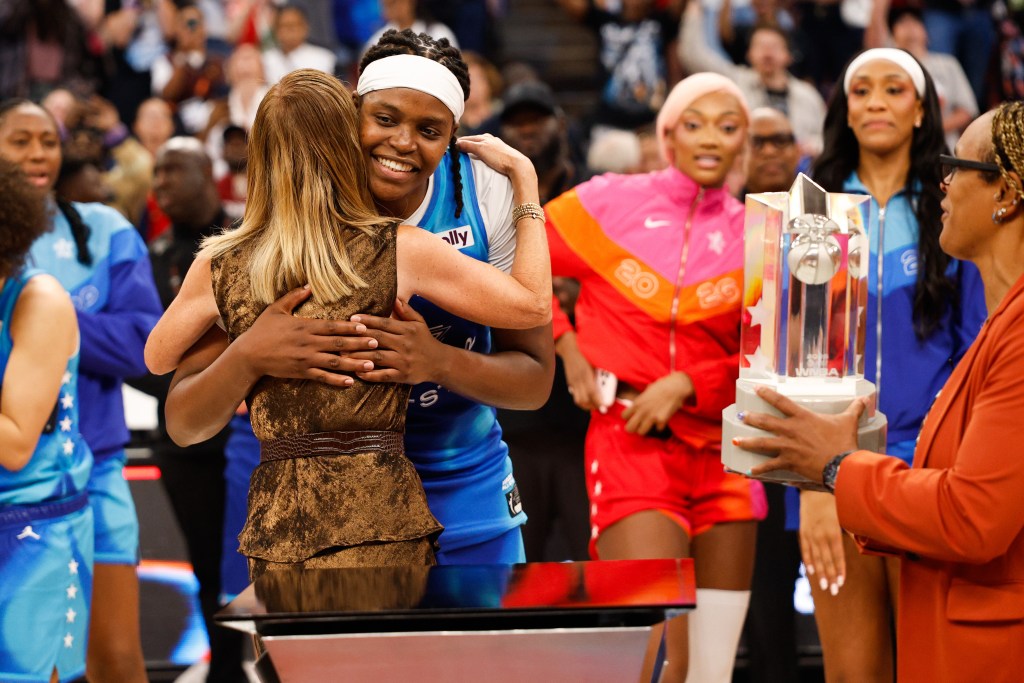
Welcome to Basketball Insider, presented by The BIG EAST Conference. I come bearing a thousand conversations and observations from Chicago, a truly spectacular if spread out city, where the 2026 WNBA All-Star festivities concluded in a fashion that forced virtually everyone to reckon with a league that is actually … doing quite well.
Basketball Insider
The gap between the conversation and reality on topics ranging from player security to officiating to relationships within the league itself were smaller than they’ve been in a long time.
“There’s a lot of narrative about officiating right now that’s not to the positive, and I think that’s unfortunate,” Minnesota Lynx head coach and president of basketball operations Cheryl Reeve said Friday when I asked her about progress on that front. “There are separate issues from the league’s actions have been. They’ve been extremely collaborative.”
She went on to further praise the officiating task force and how it operates. For those of us who have covered the league for a long time, hearing Cheryl Reeve praise both improvements in officiating and the league’s approach felt like receiving positive feedback from my children about bedtime.
But the underlying reasons for this don’t come from Reeve being in a good mood or determined to put the best face on something. In this case, the league responded to a problem with a proactive solution, one that everyone involved recognizes is complicated and takes good-faith effort over time to improve. When stakeholders are heard, movement follows, as it did when the league announced Saturday night that it will be implementing an off-site replay review beginning in the 2027 season.
Similarly, the league held a meeting with the WNBPA’s Executive Committee on Tuesday night to provide additional feedback on ways the league operates with security and listen to the concerns of the players.
As we shared on last week’s podcast, there is an app that the WNBA has made available to its players that helps filter out abuse and threats online. The league, though, cannot force players to download and use the app, and Jonquel Jones told me that she learned about it, this week, from Breanna Stewart.
As Nneka Ogwumike put it when I asked her about ways to further protect her fellow WNBPA members: “If we’re referring to online experiences, as people have online presences, you can’t stop everything,” she said Friday during the media availability at Wintrust Arena. “I think the league’s done a good job of implementing a program that can help filter those things out … I do know players feel as if they have a sense of accountability for encounters that have been taken too far.”
Listen now to The IX Sports Podcast and Women’s Sports Daily
We are excited to announce the launch of TWO new podcasts for all the women’s sports fans out there looking for a daily dose of women’s sports news and analysis. Stream on Spotify, Apple Podcasts or anywhere you listen to podcasts, and make sure to subscribe!
So what does that accountability look like? What role does the WNBPA have in this?
“I’m sorry that she heard about it this week,” Ogwumike said. “Maybe we need to do better to disseminate that information so that players know about it.”
To be clear: this isn’t some WNBPA gotcha. It’s no more exclusively the WNBPA’s responsibility alone than it is Engelbert’s. But it does reflect that even among the fiercest combatants over the last CBA, there’s a dawning realization that the league isn’t in permanent crisis mode and key stakeholders are being given an opportunity to be part of the solutions to complicated, ongoing issues. It’s been a talking point to the level of parody in this space for the past year, the idea that everything that has gone wrong and even much that hasn’t is the fault of the commissioner, and specifically the commissioner’s ability to connect emotionally with others. (You know, like cuddly teddy bears Rob Manfred and Roger Goodell.)
Acknowledging that isn’t a logical way to evaluate Engelbert’s work is a first step toward realizing that actually, things are going quite well! Ratings? Up. Attendance? Up. Walk through WNBA Live and around every corner was another “partner activation”, which is business-speak for another sack filled with money dropped off at the front door of the WNBA offices in New York.
The only unresolved question at the moment is about the length of her tenure, and that’s another one that is out of Engelbert’s hands to a significant degree. Sometimes I wish she’d say: ‘I serve at the pleasure of the owners and Adam Silver. If they change their mind about keeping me on, I’ll let you know.’
(This is where I’ll point out that if, in fact, Engelbert wants to stay on past 2027, Silver could make this question go away tomorrow with a contract extension for her and a public announcement of it. Engelbert can’t make it go away herself.)
Suddenly, as the entire league is getting used to a new CBA, new financial opportunities and expanded, well, everything, having Cathy Engelbert in charge doesn’t seem as bad as many of her fiercest critics make it out to be. And if you believe that Engelbert is a problem personally, well: those deals were not struck with companies because she sat in a room by herself and punched some buttons on an ATM. She closed those deals with actual people, not pieces of paper or supercomputers.
It’s a new reality on the ground that I thought Candace Buckner began to capture with her column this week. In Candace’s view, it doesn’t really matter whether or not Cathy Engelbert is doing the work to include more people in her processes; ultimately, she’s overseeing a WNBA that is vastly more economically successful.
But take a look at Engelbert’s answers to my questions on officiating and security, at the many people who have met with Engelbert and her staff and decided they wanted to work with the WNBA. Listen to what people like Reeve and Ogwumike are saying about her, and ask yourself: what more, from a relationship-building perspective, do you want her to do?
“Becoming Caitlin Clark“ is out now!
Howard Megdal’s newest book is here! “Becoming Caitlin Clark: The Unknown Origin Story of a Modern Basketball Superstar” captures both the historic nature of Clark’s rise and the critical context over the previous century that helped make it possible, including interviews with Clark, Lisa Bluder (who also wrote the foreword), C. Vivian Stringer, Jan Jensen, Molly Kazmer and many others.
This week in women’s basketball
Our team at The IX Sports absolutely killed it. Some highlights:
Sights and sounds from Saturday night from Stephanie Kaloi.
And Friday night from Tony East.
Hear directly from players and coaches on our podcast with Jackie Powell.
Maggie Hendricks on how the new CBA led to some players making the leap to All-Stars.
In many ways, this was the coming-out party for Olivia Miles, Terry Horstman writes.
And not All-Star but: keep an eye on this, Ruby Whitehorn is at Arizona State now.
Five at The IX: Cathy Engelbert
Q. On officiating, to drill down a little bit into it, Cheryl Reeve told us she felt there was clearly progress being made. I would imagine Replay Center was what was recommended from the task force. I know you’re meeting again on Monday. How much has it been helpful to see what you’ve been able to find out from folks who are obviously stakeholders in this?
CATHY ENGELBERT: Yeah, an important part of, again, I talked about it at draft, I knew there would be an adjustment period, but it was the offseason work we did. It was a lot of work, a lot of hours. So you’re absolutely right. I saw what Cheryl said.
Cheryl was one of the ones. We had two separate committees: a state of the game committee, which included players and officials and college coaches and GMs, some team presidents, obviously the league office, ref ops and basketball ops. We also had an officiating task force. They had the hard work of reviewing tens to hundreds of combined hours of film. I think it’s paying off. Fouls are up. Freedom of movement. I named some of those offensive efficiency statistics, the pace of the game, points per game. I have them somewhere here.
Scoring is at an all-time high, field goals made at an all-time high, field goal percentage at an all-time high, two-point and three-point field goals, offensive pace, offensive rating. That would say the freedom-of-movement aspects, which is what we did. That’s important. That’s what we heard from players: We want more freedom of movement. We got it.
There’s always a calibration and adjustment period. More fouls are being called. Players are getting up there on foul calls and things like that. I think it’s adjusting even since the past couple weeks.
Officiating, we always need to be better. Our officials review tens of hundreds of hours of film. Every play in every game, every call and non-call, significant non-calls, reviewed by our referee operations. We’ve added resources, development advisers and things like that. We’re throwing a lot at this to make sure we do have the best officials in the women’s game.
Q. On security, in conversations that we’ve had with folks around the league, there seems to be a general satisfaction with individual security experiences. A player faces a threat, and what follows. Where the gap comes is in communication with understanding the fuller picture. I wonder if you think that is what needs to be most addressed as you think through what’s ahead in security in those next steps you talked about?
ENGELBERT: Yeah, we talked a lot about that in our conversation Tuesday with the players. We talked a lot about, again, we have a technology they could deploy that’s very helpful, but not all the players deploy that technology. We also are learning things from language models that could probably be helpful. Obviously the physical security is number one as well. Again, cyber/digital security.
Again, we’re going to throw as many resources at it. I’m communicating everything that does happen behind the scenes by our security teams and how security can help prepare our players to make sure not only their physical safety, their home, on the way to the office, the office in quotes here, but certainly kind of in the digital world, too.
It’s complicated. The internet is a very complicated place. Someone gave me this term, keyboard warriors – they are very adamant to get their messages through to our players, whether it’s through DMs or other means.
Again, we’re going to try to attack it and communicate a lot more with the players around that.
Your business can reach women’s sports fans who share your passion!
Here at The IX Sports, our audience is a collection of the smartest, most passionate women’s sports fans in the world. If your business has a mission to serve these fans, you should reach out to our team at BAlarie@theixsports.com to discuss ways to work together in 2026.
Soccer: Annie Peterson, @AnnieMPeterson, AP Women’s Soccer
Tennis: Joey Dillon, @JoeyDillon, Freelance Tennis Writer
Basketball: Howard Megdal, @HowardMegdal, The IX Sports
Softball: Maren Angus-Coombs, @Maren-Angus, The IX Sports
Golf: Marin Dremock, @MDremock, The IX Sports
Hockey: @TheIceGarden, The Ice Garden
Gymnastics: Jessica Taylor Price, @jesstaylorprice, Freelance Writer