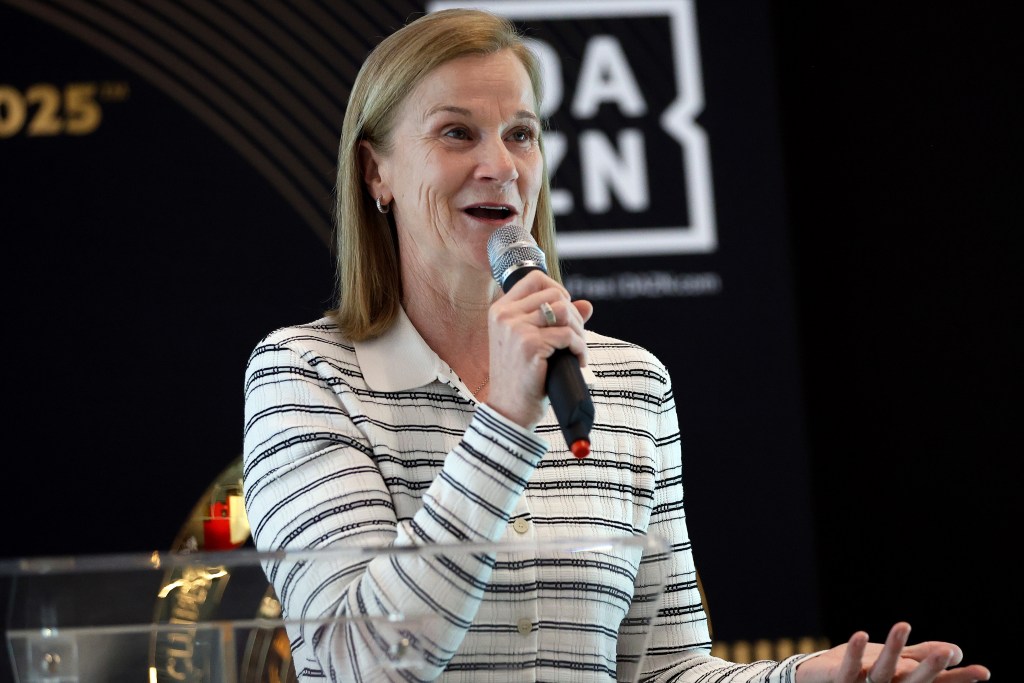
Last week, I spoke to FIFA Chief Soccer Officer Jill Ellis about the Women’s Champions Cup. On Sunday, it was announced that the final round would be played at Miami’s Nu Stadium in late January. Here’s my AP story with more details about the tournament itself.
FIFA has expanded its women’s club competitions, bringing in the Women’s Champions Cup and the Women’s Club World Cup. The Champions Cup will be held every year, except for years when there is a Club World Cup, which launches in 2028.
Help shape what’s next for The IX Sports! Take our short reader survey:
Of course, FIFA wants to capitalize on the growing popularity of women’s soccer. It’s FIFA. But the new events have already spurred new competitions for club teams among the confederations.
“You’re just seeing a lot more attention and growth to the sport, and I think that’s really what we’re trying to do, is not just focus on national teams, but now help and grow and develop and stimulate the players’ week-in and week-out environment, and that’s again through minimum standards. It’s through financial investment. It’s through creating competitions,” Ellis said.
Lifting all clubs
It is hoped that the new tournaments will bring trickle-down benefits to women’s clubs globally.
“Part of building out a club competition is also with that will come club minimum standards, Ellis said. “We’re working with the confederations now to make sure that there are minimum standards for you to be able to compete. So when you try and create a competition, it’s not just creating a competition that brings global recognition to clubs and helps you know promote players, etc. There’s also the incentive of stimulating growth in leagues, and in confederations that obviously host the leagues. So that’s why we’re doing this every year. So now there’s a regular touch point.”
Balancing player welfare
While UEFA has led the way when it comes to club opportunities, other confederations have had to ramp up, which is a good thing. CONCACAF announced its first club competition, the W Champions Cup, in 2024.
But there’s also a line that FIFA, the confederations, the federations and even the leagues themselves have to straddle: How much is too much and how little is too little?
On one hand, there’s the big leagues in UEFA, including the English Women’s Super League and Spain’s Liga F. The teams in those leagues have so many competitions that player overload is a concern.
On the opposite end of the spectrum, there are countries that have fledgling leagues or no women’s league at all. Those players are underloaded when it comes to competitions, which in turn makes them less prepared for big tournaments. It also can mean players are more prone to injury because of less training and preparation.
Last December I wrote for AP about how FIFPRO, the global players union, is calling for a more balanced competition calendar and greater player protections on both ends of the workload spectrum, including mandated rest periods.
FIFPRO has been tracking player workload since 2020. Last year, it looked at Aitana Bonmati, who had the most matches, playing in 60 games for Barcelona and Spain, with less than five days of recovery between 57% of her matches.
Listen now to The IX Sports Podcast and Women’s Sports Daily
We are excited to announce the launch of TWO new podcasts for all the women’s sports fans out there looking for a daily dose of women’s sports news and analysis. Stream on Spotify, Apple Podcasts or anywhere you listen to podcasts, and make sure to subscribe!
I asked Ellis about concerns over workload with new international tournaments coming on.
“I have a very personal take on this. I mean, I worked with players, and I think there is a responsibility, when you have a player that’s perhaps traveling extensively and playing a lot of competitions, that also is is a coach’s responsibility,” Ellis explained. “I was for always managing minutes, talking with clubs and sort of saying, ‘Hey, can we manage this?’ The health and care of the player has to be has to be central. But I also believe that we can navigate that landscape.”
FIFA is working with FIFPRO to formulate the next competition calendar. The two organizations announced in June a Global Social Dialogue Platform for professional football, chaired and administered by FIFA, which aims to bring together clubs and leagues with players, looking at such issues as the transfer market and the competition calendar.
“I think we’ve still got to look at growth, and I think we also have to look at making sure that players are playing what I would say are you know meaningful and competitive games — because we want the viewership to increase, we want the fan attendance to increase,” Ellis said. “You know, in some leagues, I think we’re seeing teams win the trophy 10 years in a row, 15 years in a row, and I think now those teams want to go and test themselves beyond their borders, and so having a global competition is also something that I think affords that.”

Soccer: Annie Peterson, @AnnieMPeterson, AP Women’s Soccer
Tennis: Joey Dillon, @JoeyDillon, Freelance Tennis Writer
Basketball: Howard Megdal, @HowardMegdal, The IX Sports
Softball: Maren Angus-Coombs, @Maren-Angus, The IX Sports
Golf: Marin Dremock, @MDremock, The IX Sports
Hockey: @TheIceGarden, The Ice Garden
Gymnastics: Jessica Taylor Price, @jesstaylorprice, Freelance Writer