Howdy y’all and welcome to Tennis Insider!
The WTA Finals field is finally set and a large reason why Karolína Muchová claimed the eighth slot was because of player exhaustion. Iga Świątek, a six-time major champion, ended her season after a left thigh injury forced her out of Ningbo, which also took her out of Finals contention for the first time since 2020. Coco Gauff pulled out of Wuhan as the defending champion, citing fatigue.
Elena Rybakina withdrew from the same event weeks after reaching world number one, dealing with a lower leg and foot problem. Emma Navarro, Karolína Plíšková, Clara Tauson and Eva Lys have all closed the book on 2026 as well. Wuhan alone lost 11 players before the first ball was struck and this week Tokyo and Guangzhou are both limping into their draws with a string of late withdrawals, including defending Tokyo champion Belinda Bencic.
It is tempting to read all of this as a trend piece about a generation that is soft, or a tour that is broken, or both. The reality is less dramatic and more interesting. Players are responding rationally to a set of incentives that the tour itself built, and the rational response, for a lot of them, is to stop playing. Let’s walk through why, and what could actually change it.
Help shape what’s next for The IX Sports! Take our short reader survey:
Not all early endings are the same
Lumping everyone together hides what is going on. There are at least three distinct groups.
The first is the genuinely injured. Hailey Baptiste is out with a torn ACL and meniscus suffered at the French Open. Victoria Mboko hurt her knee at Queen’s Club in June and has not been back. Świątek’s thigh issue belongs here too. Nobody is questioning these and a tour with a healthy calendar would still have them. Injuries are part of the sport.
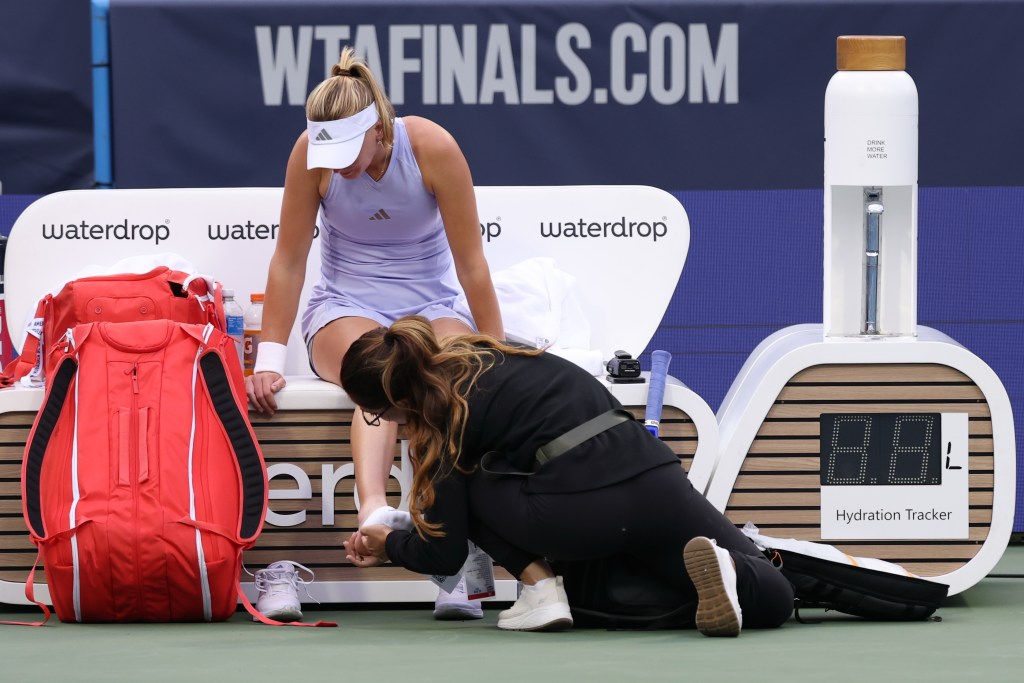
The second group is the exhausted and the managing. Gauff, Madison Keys, Sara Bejlek and Anhelina Kalinina have all pointed to fatigue or workload at some stage of the Asian swing. These are players who are not necessarily hurt today, but who can see the line between sore and injured and would rather not find out where it is.
The third group is the quiet one and the most worrying: players for whom the year simply stopped working. Lys said she was stopping to focus on her physical and mental health and has been open about an ongoing battle with arthritis, finishing a season with an 8-19 record. Navarro talked publicly about silent struggles throughout and since her rise up the rankings. For these players, shutting down is not a strategic rest, but it’s closer to triage.
The common thread across all three is that the calendar gives them very little room to do anything else.
The calendar is long, and the back end is brutal
The tour runs roughly 60 tournaments across six continents, from early January into mid-November. In 2026 there are 10 WTA 1000 events, several stretched to 12 days. Those bigger formats have a real purpose, since they are part of how the tour justifies prize money parity with the men, but they also mean that a player who goes deep is not just playing more matches. She is staying in one place, on one schedule, for nearly two weeks, and then traveling straight to the next one.
The back end of the year is where it compounds. The Asian swing is a run of Beijing, Wuhan, Ningbo, Tokyo and others in quick succession, played in heat and humidity and across time zones, after a tough North American hard court summer and the U.S. Open. By the time the tour reaches Wuhan, a top player may be in her 30th+ tournament week of the year with a body that has been absorbing hard court impact since January. The withdrawals cluster in October because it’s where the accumulated cost of the previous nine months comes due.
Another factor not many think about is the protected ranking, which lets players enter tournaments with their “frozen” ranking when they come back after six months. Ending a season in September or October allows a player to only miss just the beginning of the season and come back during the meatiest part of the calendar.
It is also worth noting what is happening at the top. Top players reach the late rounds of nearly everything they enter. A player who is winning is playing more matches, more tiebreaks and more three-setters than the tour average. Świątek said her 2026 was among the most demanding of her career. The reward for being excellent is a heavier workload, and there is no relief valve.
Rep The IX Sports at your next game!
Shop the logo collection or special “Women’s Sports are Front Page News” collection now on Shopify.

The mandatory system and the points problem
This is the part players keep coming back to. Top players are required to play the Slams and the 1000s, plus a set number of 500s and skipping them can bring fines and ranking penalties. Aryna Sabalenka said at the U.S. Open that she would like to see the mandatory structure removed so players can decide what is best for their own health. Świątek has said openly that she would pick and choose tournaments even when they are mandatory. Top-10 players are also capped in how many 250 events they can enter, which means the lighter, lower-pressure weeks that might make for useful rest-or-rhythm stops are largely unavailable to them.
Then there is the ranking system. Points are earned over a rolling 52 weeks, which makes every result a defensive obligation as much as an opportunity. A player who skips an event she won last year watches those points expire. So the incentive is to play through pain, because stepping back has a cost that shows up in a ranking number right away.
Which leads to the part that gets less attention: the incentives work in opposite directions depending on where you are ranked. A player like Świątek or Gauff can shut down in October because she has already banked enough points and enough income that two more weeks barely move the needle. A player ranked in the hundreds cannot afford that. She needs every tournament for points and prize money, travels without the support team the top ten have, and is far more likely to play through an injury. Last year, there were a dozen players with 34 or more tournaments in a year, but only four of them were inside the Top 100. The early shutdowns we see are the visible, high-profile end of a problem that is worse further down the rankings, where it simply gets less coverage.
There is a cost to the tour, too
If you run a WTA 500 in Tokyo, you have sold tickets and sponsorships on the back of a field. When six players withdraw, including the reigning champion and the best player of her generation, the product you sold is not the product you deliver. Wuhan lost 11 players. Guangzhou lost five. Świątek’s absence also reshuffled the Finals race, with Muchová taking the last qualifying spot while allegedly dealing with injury of her own.
This is the real tension in the tour’s design. The more it asks of its best players, the more often they will say no and the more the events that depend on them suffer. Mandatory rules exist to protect tournaments from exactly this, but they do not actually guarantee participation, because a player who is determined to stop will take the fine. The system punishes the players who comply and does very little to the ones who do not.
What can be done?
The tour has not been ignoring this. In February, it created a Tour Architecture Council, chaired by Jessica Pegula and made up of players, tournament leaders and tour staff, with a goal of delivering workable changes for 2027. The 2027 calendar, as reported, has 55 tournaments and drops the requirement to play six 500s. Players can also swap one eligible 1000 result for a stronger 500 or 250 result. Those are real concessions and they are worth acknowledging but honestly, they’re the easy ones. Here is what would need to happen to change the picture more substantially:
A genuine off-season. The 2027 calendar still starts in the same stretch where the 2026 offseason barely existed. A defined, protected window, with no sanctioned events and no exhibitions the tour can influence, would do more than any single tournament rule. The men’s tour faces the same problem, so it is a candidate for joint action, which makes it harder but not impossible.
Rethink the points expiry. If ranking points lapse after a year, every skipped event carries a penalty. A system that lets a player’s best results count over a longer window, or that allows a certain number of excused absences per year without losing points, would take the defensive pressure off. This is the single change that would let players listen to their bodies without gambling with their ranking.
Loosen the 250 cap for top players. It sounds minor, but allowing top players to drop into a smaller event for match play, after an injury or a lull, is a better outcome than forcing them to choose between a 1000 and nothing at all.
Be honest about the 12-day format. Longer 1000s support equal prize money and that goal is worth protecting. But if the cost is a calendar that runs players into the ground, the tour should be measuring the damage. Publish injury and withdrawal data by event type and season month, and use it to decide whether those formats are working. Transparency is key, too!
Protect the bottom. Any reform that reduces the number of tournaments has to come with a plan for the players ranked outside the Top 50, who need those events to earn a living. Shrinking the calendar without raising the earnings floor for lower-ranked players just moves the burden. Revenue sharing, guaranteed minimums at smaller events and travel support are all more useful than another round of cosmetic changes.
Tournament-side fixes. Events with a history of late withdrawals could be offered incentives to build deeper alternate lists, schedule matches more humanely and improve recovery facilities. That will not stop players withdrawing, but it will make the product more resilient when they do.
Now, onto links!
Listen now to The IX Sports Podcast and Women’s Sports Daily
We are excited to announce the launch of TWO new podcasts for all the women’s sports fans out there looking for a daily dose of women’s sports news and analysis. Stream on Spotify, Apple Podcasts or anywhere you listen to podcasts, and make sure to subscribe!
This week in women’s tennis
Congratulations to friend of The IX Sports Megan Rose, who is leaving the USTA (and tennis) to become the new managing director for the 2031 Men’s Rugby World Cup.
Elena Rybakina secured her WTA Finals berth last year at the Ningbo Open and this year, she took the title with a win over Leylah Fernandez in the final. The doubles title was won by Desirae Krawczyk and Fanny Stollár, who outlasted top seeds Nicole Melichar-Martinez and Cristina Bucșa.
Kateřina Siniaková won her sixth WTA singles title at the Kinoshita Group Japan Open, defeating 2023 champion Ashlyn Krueger in a rout. The doubles crown was captured by top seeds Storm Hunter and Janice Tjen, who downed Jesika Malečková and Miriam Škoch.
It’s a bit of a slow week with the WTA Finals secured in singles, but this week is major for the final doubles berth:
Elena Rybakina is this close to securing the year-end World No. 1 ranking this week in Tokyo.
There are some changes coming to the future NCAA Individual championships starting next year, including a formal wheelchair championship.
Congratulations to Destanee Aiava, who eloped over the weekend going against the norm with a stunning black dress:
An interesting read here about the continuing disappearance of grass court tennis.
Tweet of the week
Former U.S. Open champions Bianca Andreescu and Sloane Stephens earned their first titles in quite some time at the WTA 125 and ITF W100 levels, respectively:
Your business can reach women’s sports fans who share your passion!
Here at The IX Sports, our audience is a collection of the smartest, most passionate women’s sports fans in the world. If your business has a mission to serve these fans, you should reach out to our team at BAlarie@theixsports.com to discuss ways to work together in 2026.
Soccer: Annie Peterson, @AnnieMPeterson, AP Women’s Soccer
Tennis: Joey Dillon, @JoeyDillon, Freelance Tennis Writer
Basketball: Howard Megdal, @HowardMegdal, The IX Sports
Softball: Maren Angus-Coombs, @Maren-Angus, The IX Sports
Golf: Marin Dremock, @MDremock, The IX Sports
Hockey: @TheIceGarden, The Ice Garden
Gymnastics: Jessica Taylor Price, @jesstaylorprice, Freelance Writer