Heading into their 12th game of the season, the Toronto Spectres looked dead in the water. In the 11 previous games the Sceptres had won all of three games. With no Spooner return in sight and scoring looking scarce the Sceptres were predicted to be the first team looking at the Gold Plan. Then, they host the New York Sirens at Scotiabank Arena and win 4-2. A power play goal by Sarah Nurse in the third period breaks the 2-2 tie and breaks a three-game no power play goal streak. This win then sparks the Sceptres to go on a nine-game point streak where they’ve won five games in regulation, two games in overtime, and lost two games in the shootout.
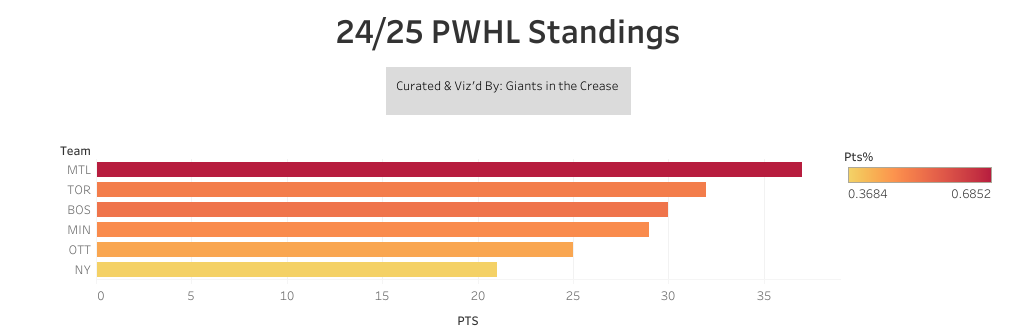
The game at Scotiabank Arena also sparked the Sceptres being on an incredible power play run. They’ve scored a power play in every game in their nine-game point run with three games where the Sceptres have scored two power play goals and two games where they have scored three power play goals. This nine-game run has seen the Sceptres shoot up from last in the league to currently be sitting in second place in the PWHL by points (32) and third in points % (0.508). While the nine-game point run was ended versus the Montréal Victoire a loss was bound to happen but Toronto is sitting pretty otherwise. No reason for concern right?
Toronto absolutely does deserve credit for turning their season around. Wins are wins and as long as you’re winning that’s what matters. The PWHL season though for nearly every team is one of ebbs and flows, ups and downs, highs and lows, etc. you get the idea. Toronto has nine games left in their season and they’re going to lose every so often. You don’t need all the stats in the world and multiple degrees in math related studies to predict that a team is not going to finish the season on a nine-game win streak. If they do, go buy a lottery ticket.

The Sceptres were due for their winning streak to end and that happens. The Victoire went through a small dip but rebounded back to their winning ways unfortunately for Toronto. If Toronto takes a loss or two then goes back to winning, the losses will be quickly forgotten as winning fixes everything. What Toronto, and every other team, will be trying to avoid is seeing more losses ending up on the board than wins in this last third of the season.
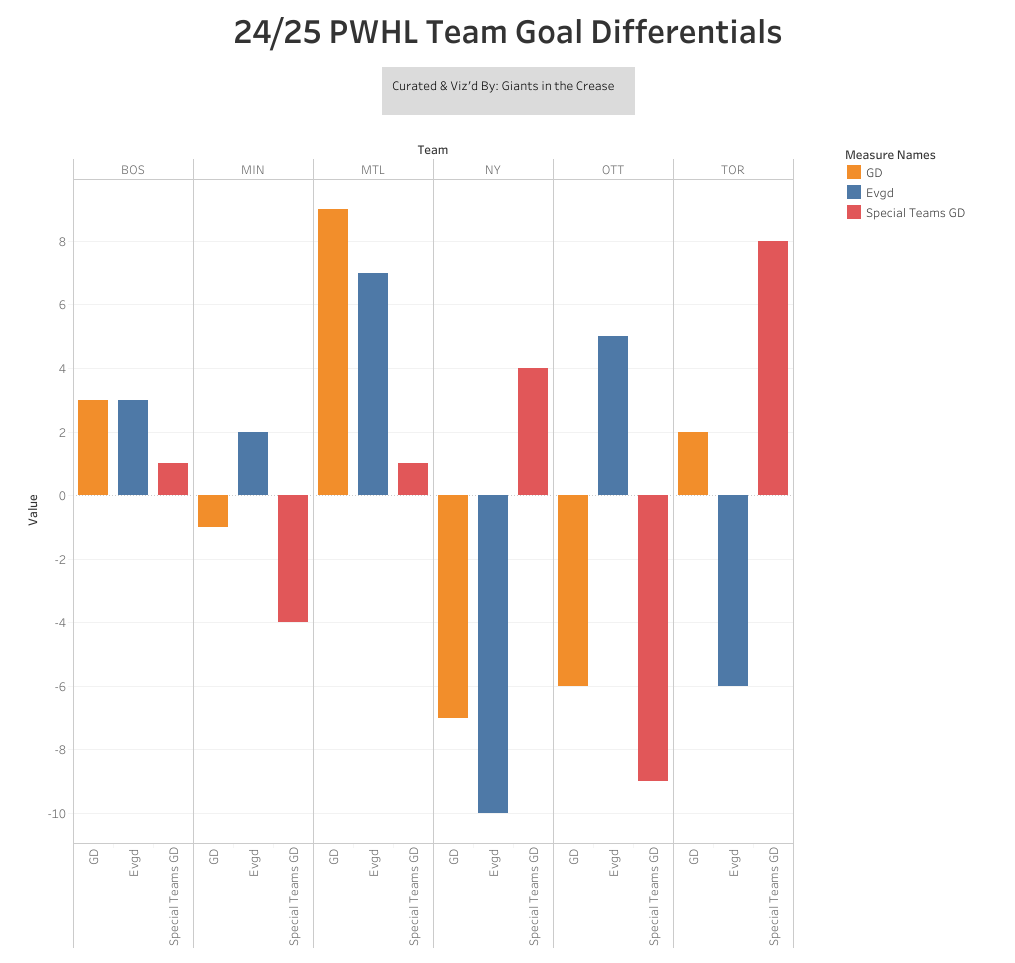
They fixed their scoring problems though so shouldn’t that mean the Sceptres are set to end the season strong enough to make the playoffs? If you’re a Toronto fan, player, or a part of the front office that’s the hope. Unfortunately, there are some yellow flags waving about though that say those scoring problems are going to rear their ugly head again. I mentioned up top that Toronto has been feasting on the power play. In that nine-game point streak they scored 16 PP goals on 34 PP’s for a 47.1 PP%. No other team this season has seen such success on the PP for this length of time. Over the course of the season they’re the only team with a PP% above 30%. The other five teams range between a 15.56 and 18.18 PP%.

The PP numbers don’t stop being otherworldly good there. On this nine-game run the Sceptres are shooting 31.4% on the PP. That’s essentially every third PP shot finding it’s way to the back of the net. To put that into context that means the goalies facing the Toronto PP are posting a 0.686 SV%. How bad or good is that though? Typically goals are easier to come across on the PP than at even-strength because you literally have at least one extra player on the ice so you’re shooting % should be better and a goalies SV% on the PK should be low. It shouldn’t be at 0.686 though as the PWHL PK average SV% is at a ~0.867 SV%. That’s just a hair over a 20% difference. Once again looking at the league and season as a whole up to this point Toronto is sitting at a 19.8 PP SH%. The rest of the league is in a range of 10.3% to 14.5% and you know what? It’s not a crime to have a power play that can’t stop scoring.
It is concerning though when your point streak is being fueled so strongly by a power play that can’t miss but will eventually come back down to earth and with nine games left for Toronto that could put them in an awkward position if the power play suddenly goes cold or becomes league average. For all the scoring Toronto has suddenly found possible on the PP, at even-strength not much has changed. In the first 11 games of the season Toronto scored 15 goals to put them at 1.45 EV goals per game while shooting 6% at even-strength. The nine-game point streak have seen Toronto score 12 goals at even-strength for 1.33 EV goals per game while shooting 6% at even-strength.

Their EV SH% staying literally the same but their EV goals per game has dropped. That is probably explained by the fact that Toronto in their first 11 games went from seeing ~2.7 PP’s per game to ~3.7 PP’s per game in this latest nine-game run. Less time at even-strength to get shots on goal means fewer goals if your SH% remains the same. The problem for Toronto though remains that even if they get back up to their previous 1.45 EV goals per game that’d only put them ahead of a New York team that is experiencing major finishing issues. The other problem is Toronto’s EV SH% of 6% is the lowest in the PWHL.
I know that’s bleak but let me offer some hope that should the PP start to sputter out that Toronto isn’t doomed to drop right out of the playoff race. One aspect of the Sceptres even-strength play that has changed for the better is they’re not being crushed at even-strength goal wise then hoping to make it up on special teams. In the first 11 games of the season Toronto was allowing 2 EV goals against per game. In the nine-game point streak it was down to 1.33 EV goals against per game. Is it the fact that their games have turned into special team battles have allowed less even-strength time to happen thereby resulting in fewer goals?
As mentioned above the Sceptres are currently seeing ~3.7 PP’s per game during their nine-game point streak. They’re also seeing an increase from ~2.6 PK’s per game in the first 11 games of the season to ~3.3 PK’s per game happening during the streak. Interestingly enough, that hasn’t changed the EV SA/GP almost at all. In the first 11 games Toronto was allowing 21.1 EV SA/GP while during the streak it’s at 21.3 SA/GP. So, while we can assume that special teams is taking up more time in game due to the increase in PP’s and PK’s, it’s not obviously effecting the defensive workload in a way that we can see through public numbers.
Working with the public numbers we do have access to and using the eye test, Toronto fans should be happy that the goalies and defensive zone play from the players are finally working together. It was messy and inconsistent in the first 11 games. They had a team EV SV% of 0.905. Can’t lay the blame of that on either goalie as Campbell had an EV SV% of 0.906 and Kirk had an EV SV% of 0.903. The defensive zone play was not gelling with Campbell and Kirk. To further show just how much of a struggle it’s been for Toronto as a whole at even-strength in the defensive zone the league EV average SV% is at 0.923 which is obviously a clear difference over the Toronto 0.905 EV SV%.

Without needing to go into another massive piece talking about the even-strength defensive play differences and how that’s meshing better with the goalies, it’s safe to say that Toronto is better defensively than previously. In this nine-game point streak the Sceptres are seeing an incredible team EV SV% of a 0.943 SV%. Campbell and Kirk were cooking with gas Campbell posted a 0.939 EV SV% while Kirk posted a 0.945 EV SV%. It becomes a lot easier to win games when pucks aren’t going in your net.
The hope that Toronto can hold onto while waiting to play their next game is this loss to Montréal came while missing Hannah Miller and Sarah Nurse while Natalie Spooner clearly isn’t back to her 2024 regular season self. Montréal is also the best team in the league, it’s no shame to lose to them. The problem is no one on Toronto is standing out as being the solution at even-strength. Last season Nurse and Spooner finished top three in EV PTS.
Right now Hannah Miller leads the PWHL in points with 21 but is tied for 16th in the PWHL for EV PTS with only seven. The good news is Miller is tied for third in PWHL EV goals so she’s capable of finishing it’s just that it’s a lot of individual efforts leading to goals which is why we see so few even-strength goals for Toronto. There’s no one distributing and creating offence to ensure the scoring doesn’t rely on Miller or Compher. Izzy Daniel and Renata Fast lead the team in EV primary assists with three apiece. Toronto’s defensive play and goaltending is going to be important in finishing the season strong, however without scoring the door to Toronto’s playoff spot will remain wide open.