

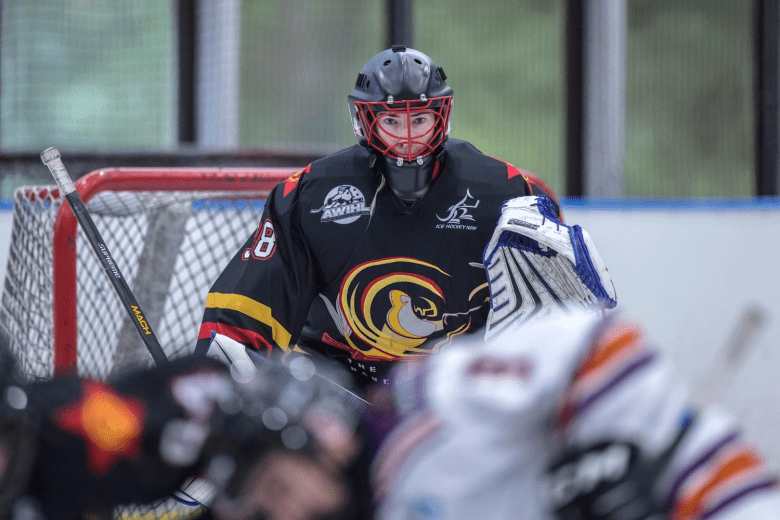
How does a trailblazer come to be? In the case of Sydney Sirens goaltender Ella Licari, the answer is as simple as it is poignant: by being her authentic self. In 2016 Licari became the first transgender woman to play in the Australian Women’s Ice Hockey League, and she went on to win the AWIHL championship with the Sirens that same season. Currently she sits fourth in the league with a .866 save percentage.
Licari spoke with The Ice Garden for a wide-ranging conversation that spans music, her individual experiences with transition, and redefining her place in the game she loves.
What made you fall in love with hockey?
Some of my earliest memories are of spending time at ice rinks. My dad played hockey before I was born, and while he’d stopped playing by the time I came along, he stayed deeply involved in the hockey community as a referee. Sunday games became our routine—I’d tag along to watch him officiate, and for me, it was just as normal as any other weekend activity for an Aussie kid.
What really captured my attention were the goalies—always the goalies. I idolised them. Strangely enough, though, these days I’m not much of a hockey watcher. I enjoy highlights and game recaps, but sitting through a full game? Rarely.
When it came to playing hockey myself, it wasn’t a matter of “if” but “when.” It felt so natural, like it was always meant to happen—though I didn’t get to be a goalie straight away (much to my disappointment!). I didn’t understand it at the time, but he wanted me to learn to skate properly and learn some of the perspectives of players. It has definitely helped me as a goalie.
What do you think keeps you in love with hockey?
What fascinates me most about hockey is how it’s constantly evolving. From a goalie’s perspective, the changes have been dramatic over the years. I grew up watching legends like Dominik Hašek and Martin Brodeur. Back then, goalies were transitioning away from the traditional “stand-up” style towards a more freestyle approach. Not long after that, the butterfly style emerged, revolutionising the position entirely.
For me, one of the biggest challenges—and joys—has been reinventing the way I play, over and over again, to keep up with the game’s evolution. It’s never boring, and it certainly never gets old.
How would you describe your game and your style of play?
At 6’1”, I’ve got pretty good reach and coverage, but my goalie style was largely shaped by watching a single videotape of Dominik Hašek’s highlights over and over again. As a result, some of those old habits still surface—especially during scrimmages or casual league games. People often tell me I remind them of Hašek, and I take that as a huge compliment!
Even in the AWIHL, I sometimes accidentally throw in a pad stack or end up flopping around. Otherwise, though, I’d describe my style as aggressive. I like to play outside my crease, challenge shooters, and stay physical, and I absolutely love shootouts.
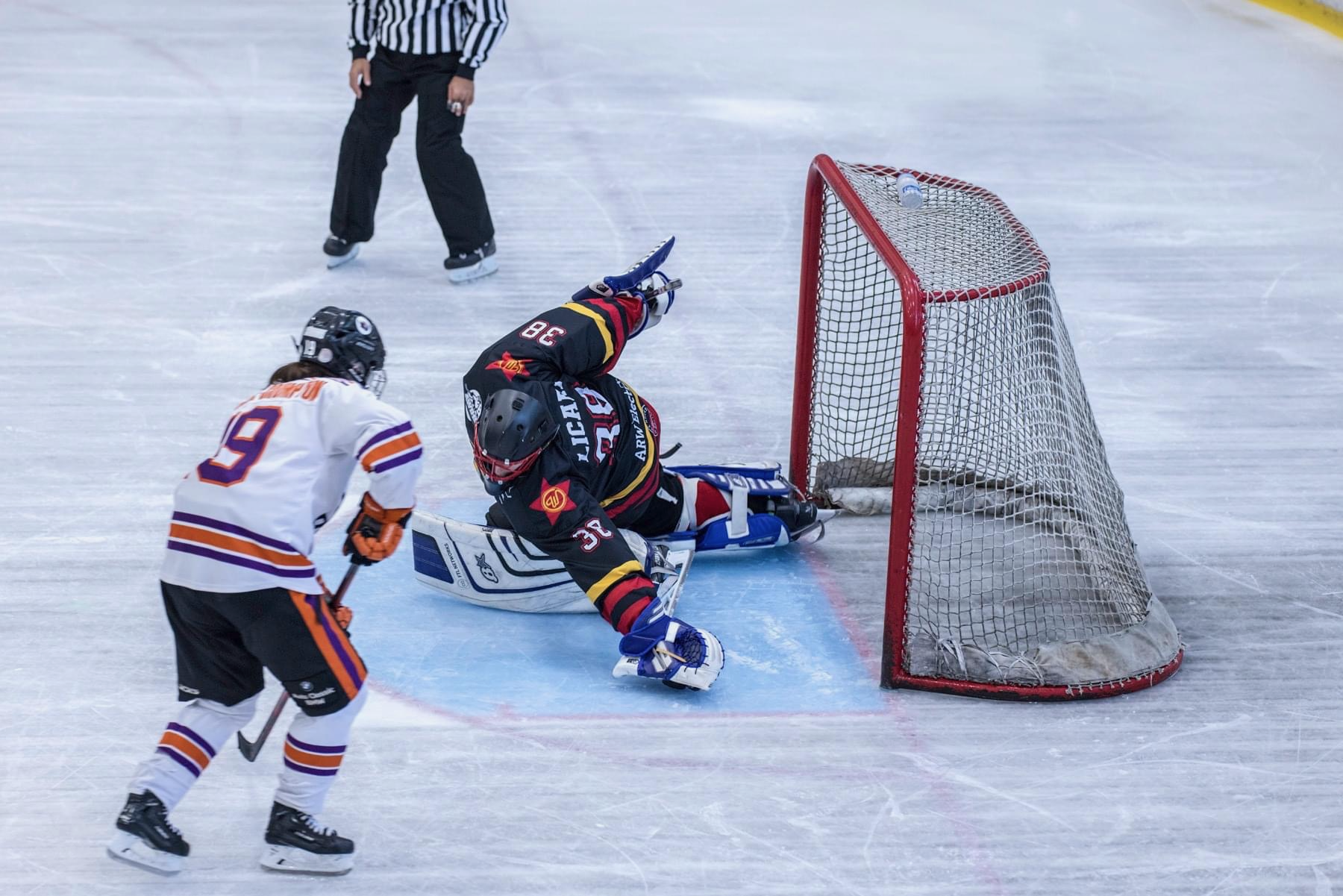
For me, being a goalie is more than just stopping pucks; it’s about being a dependable presence for the team. I take that responsibility seriously, and there’s no better feeling than knowing I’m someone my teammates can rely on.
Who are some goalies you look up to?
Obviously, I’ve always looked up to Dominik Hašek and Martin Brodeur, but Marc-André Fleury is one of the more modern goalies I admire. I love Fleury’s sense of humour—he brings such personality to the game—and what a career he’s had! I’m in absolute awe of everything he’s accomplished and the way he’s gone about it.
Another big influence for me was Mike Richter. His work ethic was second to none, and I’ve definitely taken a few cues from him when it comes to putting in the hard yards. Legends like these have shaped not just my game, but how I approach hockey as a whole.
I saw your Instagram post about Eddie Van Halen after he passed, and you mentioned how “Panama” and “Jump” are on your pre-game playlist. What else is on there?
Okay it’s a long list. On a Saturday where I play at 4:30pm—my playlist starts in the morning when I wake up. It ramps up in tempo and intensity the closer it gets to game time. It contains the likes of Justin Timberlake, blink-182, Green Day, Metallica, Foo Fighters, Killing Heidi, Drowning Pool, Matchbox Twenty, Sugarcult, AC/DC, P!NK, Dido, Sarah Bareilles, Norah Jones, Linkin Park, Disturbed and many more. As you can see, it’s quite a diverse list, it really helps me with that mental preparation to ramp up the whole day, peaking when the coach comes into the change room before we hit the ice!
On a day where I’m playing an early game, I just go for the heavy stuff in that same list to switch my intensity on.
Being a child of the 70’s and 80’s, and my adolescent years in the 90’s it has really influenced my music selections/choices.
In a country with so few ice surfaces, do you and others seek alternate training methods?
For a while, I played a lot of roller/inline hockey, but playing in a hot environment definitely came with its own challenges. Heat stress and hydration can get intense for goalies. We do off-ice training, but it’s not anything specific to hockey. In my hometown of Perth, my very first hockey coach opened a training facility dedicated to off-ice hockey training—NRG Ice Hockey Academy. I really wish we had something like that here in Sydney!
You had a really interesting quote on the Pride & Puck podcast, talking about how when you’re coaching you can see who’s a natural goalie and who isn’t. How can you tell? What does that look like to you?
There’s no hard and fast rule, but there are a few key things I look for in a goalie. For starters, it’s incredibly difficult to train someone to move their face towards a puck flying at them. Equally, it’s hard to break the instinct to flinch, close their eyes or shy away from a puck headed straight for their head. The ability to keep your eyes glued to the puck all the time is important.
Another key factor is their attitude towards discomfort and learning. Skating and moving in goalie gear doesn’t come naturally, and beginner goalies often lack the specific muscle development needed for those movements. That’s where attitude becomes crucial—it’s one of the most important traits I look for.
Almost anyone can learn to play goalie and have fun with it. Plenty of people can even become good goalies. But it’s the right combination of attitude and instincts that can turn a good goalie into a great one.