This past week (specifically Nov. 8-11) was the start of the annual Canada–USA Rivalry Series, with games taking place in Tempe, AZ, and Los Angeles. It marks the start of the march towards the Women’s World Championship in Utica, NY, for these two North American teams. Last season, the Rivalry Series saw the USA take a 3–0 series lead before Canada won four straight games to take the series 4–3. Canada seems to be looking to replicate last year’s success as they dropped Game 1 (3–1) and Game 2 (5–2) to the U.S. Just like last season, Canada will once again be hoping to take lessons from these games to build on and eventually see great success. So what are the lessons Team Canada will be taking from these games?
Built Like Red Bull, Drives Like Haas
For the most part there’s little to complain about regarding the Canadian roster. Personally, I think there’s some min-maxing that could be done, but we’re talking about a roster that, up until what I’d call a phantom penalty in the 2023 Worlds in the third period of the gold medal game, looked like they were the undeniable No. 1 team in women’s hockey. These two Rivalry Series games, though, make Canada look like a team ripe for a repeat 2019 Worlds experience (minus losing their league). In Game 1, the game plan of hard forechecking and the forwards using their speed to cause issues looked good. The defence looked hesitant and slow though, making it look like two different styles were being played on the same team. Game 2 saw more defenders activating, such as Ella Shelton and Renata Fast. Unfortunately, apart from Laura Stacey and Jessie Eldridge, the Canadian forwards didn’t have that same speed from prior game, making it too easy for the Americans to skate all over the ice. This disjointed, slow affair allowed the USA to attack on the rush with near impunity. Whatever it takes, Canada needs to get back to their style of skating down the throats of their opponents and driving to the net.
Shelton Is That Girl
PWHL New York management and fans should be thrilled Shelton is a part of their team. When given the green light in Game 2, she was all over the ice — creating chances and driving the play — not to mention playing well in the defensive zone as well. She was impressive in all three zones, and if Canada doesn’t want to give her a bigger role once the PWHL season starts they might not have a choice but give her one. It wasn’t just her moving her feet that made Shelton look good, it also was her vision and passing. She does well in seeing where the holes are to get passes through and landing them on the tape. If you’re her teammate or opponent, you can’t be slacking off when she’s on the ice because she’s ramping up the pace of play.
Killer Instinct Didn’t Make the Trip
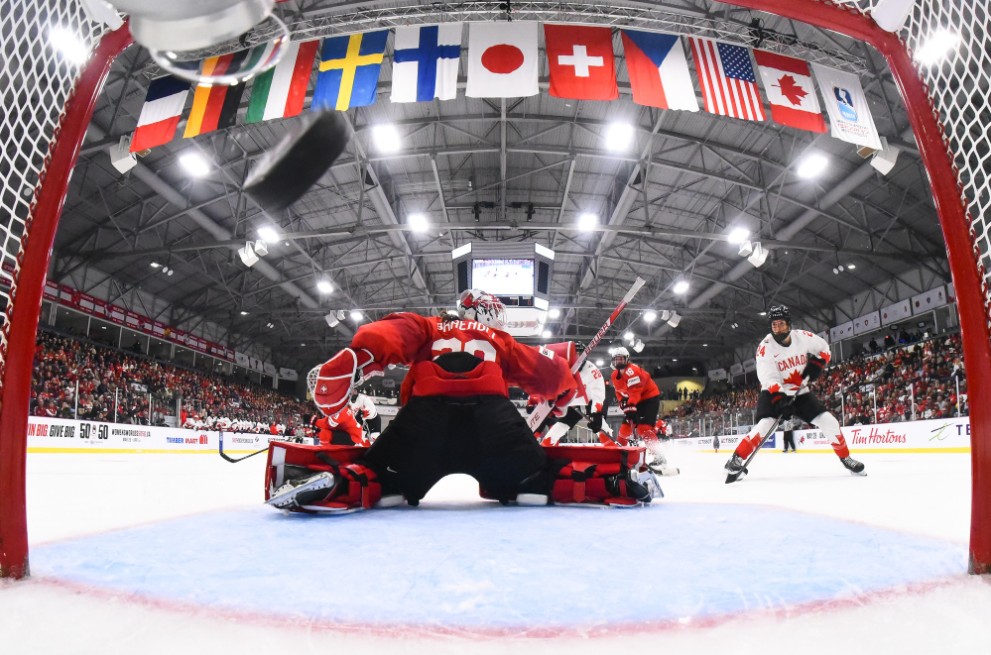
In Game 1, Canada was driving the net and shooting a fair amount. The quality of those chances wasn’t great — but they were good and, with a bit more luck or better shooting, Game 1 would look quite different. Game 2 they couldn’t even get any good chances, and the shots were severely lacking. If you look at the history of all these players, you’d see they’re definitely not lacking in offensive production — whether it comes in the NCAA or PWHPA or CWHL. Scoring in these games is more difficult, though, which is why the players with the most goals at this level either have a great shot or a killer instinct and, in rare cases, both. Just look at Hilary Knight’s Game 1 goal, where she wires the puck into the net making no mistake. Or Hayley Wickenheiser’s goal off the bench in the 2002 Olympics gold medal game. Canada needs to find a way to score goals in these games. Apart from Marie-Philip Poulin and Sarah Fillier, if you’re Team USA, who are you really worried about if they have the puck at a moderate distance? There’s no question Canada has good goal scorers on the team, from Stacey to Sarah Nurse to Brianne Jenner to Jamie Lee Rattray. They won’t score, though, if Canada isn’t creating offensive opportunities, and these players are lacking killer instinct. Canada should be giving a longer look at Loren Gabel and Brittany Howard, at least, to see if they can get their goal scoring to translate to the biggest stage.

Poulin, the Best Player in the World, Still Needs Linemates
The Rivalry Series games are the perfect time for these teams to try anything new that they want without the pressure of the Worlds on their shoulders. Canadian head coach Troy Ryan and staff definitely did that in regards to Poulin’s linemates. In Game 1, Poulin was supplemented by a rotating cast of Emily Clark, Blayre Turnbull, and Emma Maltais. If you’re familiar with women’s hockey then you immediately see the issue. If you aren’t familiar with these players I’ll stop being coy and just lay it out for you. All three of Poulin’s linemates are nearly the exact same player. You can see the logic that Canada was going for in that — with Team Harvey’s in the PWHPA for the 2022–23 season, Poulin led the league with 27 points (12 G; 15 A). Her linemates primarily were Emily Clark and Eldridge. Canada tried to recreate that line in the first two Rivalry Series games, only Turnbull is a lot more like Clark than she is like Eldridge. The coaches swapped Nurse for Clark in Game 2 and, while that line looked better, neither Turnbull nor Nurse are the type of playmakers who have generated Poulin’s best offensive production. For the next round of games, Canada needs to add Danielle Serdachny to Poulin’s line, bring back Clark, or try out Kristin O’Neill. Serdachny, though, would take the playmaking pressure off of Poulin and allow Poulin to focus on getting into scoring areas.

Inject Youth; Trust the Youth
Sometimes it’s OK to take ideas from men’s hockey, and this is one of those times. The best NHL teams, with the longest success and continual “Cup contender” status, are the teams that can inject youth into the lineup, especially into big roles. The USA figured this out, as their 2023 Worlds team had an average age of 24.96, whereas Canada in comparison had an average age of 28.13. What youth brings to the lineup is an injection of energy, which can help a team not get complacent or comfortable, and the addition of new skill. As hockey changes the ones often driving change are the younger players. This isn’t to say the team should get rid of the veteran players, just that they should start finding ways to get youth into the lineup — and in bigger roles, too. Julia Gosling and Serdachny should be given opportunities in the top six. Sophie Jaques should be paired with Larocque or Fast, not made to be the seventh defender. In Game 2, Jaques was struggling on the breakout as she was passing to spots where players weren’t. Jaques knows how to break out, so what happened? Looks to me like a lack of game time and practice reps. If there’s nerves involved, too, the best way to get rid of them is through more reps. The other added benefit of these younger players from the NCAA is they’ve had consistent playing and practice time, even during Covid, while non-NCAA North American players (in the PWHPA/PHF specifically) really struggled to find that ice time. The players who have been in the NCAA for a few years now, or who have just graduated, haven’t seen much of a hitch in their development compared to those who graduated pre-Covid.
Stop Breaking the Law, Asshole!
Canada, you just took 22 minutes in penalties in Games 1 and 2 combined, what are you doing? In comparison, the USA only took 12 penalty minutes. Canada, you’re not going to win games playing like that, and some would rightfully point out it’s a symptom of a larger problem. As I mentioned above, the team is looking disjointed and flat-footed, which may account for quite a few of the obstruction-related calls (hooking, tripping, interference). When you’re spending one-sixth of the game killing penalties it hurts the rhythm of the team and forces players such as Poulin to spend more energy playing defence rather than going on the offence and scoring.
Stop Trying to Make Larocque–Fast a Thing
Jocelyne Larocque and Fast absolutely deserve their spots on Team Canada. They’re among the best two-way defenders in the game. This is part of the problem, though, as they’re both two-way defenders who have a better defensive game than offensive game. Both are capable of participating in the offence and starting breakouts, sure. Fast can even go on a rush and cause some chaos. They’re not really generating a whole lot by themselves, though, and don’t have the offensive abilities necessary to succeed in the way that a Team Canada top pair needs to push the play. Game 1 they were on for all three goals against and just flat out struggled in all aspects, often getting caught flat-footed. In Game 2 they found their feet, especially Fast, but it was obvious how limited their offensive driving abilities were. Both, though, are perfect fits for more offensively inclined and talented defenders such as Jacques or Shelton. As both Larocque and Fast have good breakout abilities and can activate in the offensive zone, they could provide an outlet for the more offensive D partner so they aren’t easily contained.

The Goalies Are All Right
On paper, the save percentages are just awful for Emerance Maschmeyer (in Game 1) and Kristen Campbell (in Game 2). Without having watched the games one could easily be inclined to believe both losses fall on the goalies. Were Maschmeyer and Campbell perfect? Certainly not, and if you asked them they’d probably be disappointed in their play. The save percentages are mostly an indication of how the team played defence in front of them … plus they show two crazy bounces on Campbell. Honestly the Americans were picking apart the Canadian defence, especially on the rush. In Game 1 that was mostly fine, as that’s the type of play Maschmeyer is the most comfortable with, even though the lateral passing was almost too easy for the USA to accomplish. For Game 2 it continued and, arguably, got worse, which is a problem — while Campbell has decent mobility she’s not a quick reflex/agile goalie like Maschmeyer, so you’d prefer not to have her move that much. She handled it mostly well, but goals were scored in situations that are counterintuitive to Campbell’s style. Fix up the defensive play and Canada will see the goalie numbers improve as well.
The Rivalry Series will continue when PWHL training camps start to wind down, with Canada playing host to the USA in Kitchener, Ont. on Thurs., Dec. 14, at 7 p.m. ET and then in Sarnia, Ont., on Sat., Dec. 16, at 7 p.m. ET. Once the PWHL season is in, presumably, full swing, the last three games of the Rivalry Series will be played — in Saskatoon, Sask., Wed., Feb. 7, at 8 p.m. ET; then two days later in Regina, Sask., Fri., Feb. 9, at 8 p.m. ET; and finally the series will wrap up in St. Paul, MN, Sun., Feb. 11, at 2 p.m. ET. With so much time between games, and the games being scheduled in blocks, literally anything can happen — from Canada going full youth movement to Canada going all-in on the veterans. Just like last season, this is far from over — and hopefully more exciting hockey is in store for us all.