As primarily a goalie person I will never admit any position is more fun to put together than goaltending. However, I will admit the idea of getting to create your forward corps from scratch is a very fun idea. It’s the hockey nerd version of being given a large bin full of Legos. For Meghan Turner and Cara Gardner Morey, due to the PWHL expansion rules, they were given a high-quality bin of Lego. They would essentially be able to create their dream Lego creation or dream forward corps anyways.
Now this was a shared bin of Lego so they could try to make the exact same vision in their minds but would have to be a watered-down version of that vision as there just wouldn’t be enough pieces for either. Thankfully, for the sake of this article especially, they both had different visions in mind and were able to create with minimal interference from the other. This leads to us clearly being able to tell what each general manager believes to be the ideal forward corps.
By now, it should be clear that Turner believes in putting surefire elite talent up top and filling in the gaps with decent players. There’s minimal gambling about the elite talent on the team. Just like how Seattle added Corinne Schroeder and Cayla Barnes, there’s little to no questions about what Hilary Knight, Alex Carpenter, and Jessie Eldridge will bring to the team.
Unless you’re brand new to women’s hockey, you know who Hilary Knight is. She’s going to be a first ballot Hockey Hall of Famer and considered one of the best to ever play women’s hockey. Knight is the second-oldest player in the PWHL and while her play in the defensive and neutral zones has seen decline, her offence remains elite. She didn’t have a good 2024 season but immediately turned it around for 2024-25, tying for the league lead in points and being tied for second in goals. It’s simple: get the puck to Knight in the offensive zone and you’ll see good production at the very least.
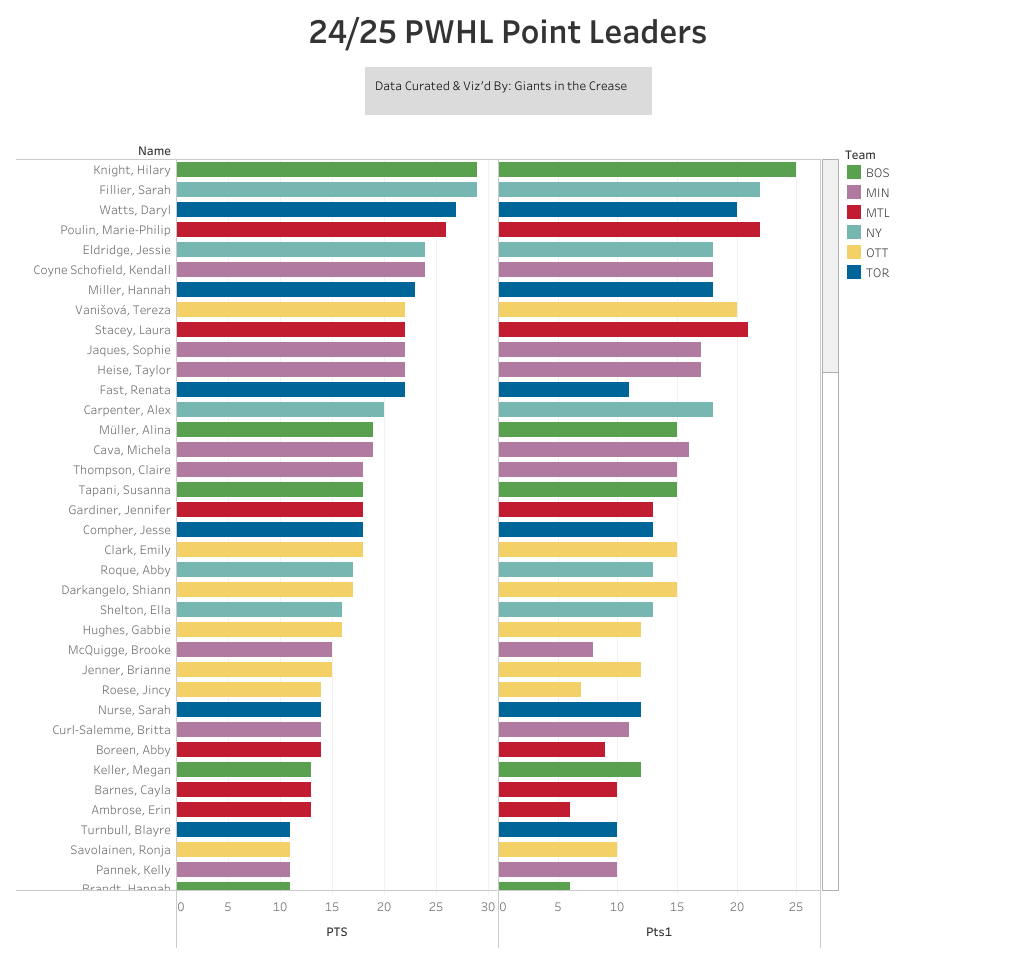
Then there’s Carpenter, who is also getting a bit up there in age but has remained an elite center in her two years in the PWHL. She factored in on 44% of New York’s goals in the 2024 season. And this past season, she saw fantastic chemistry with Sarah Fillier, resulting in Carpenter finishing eighth in primary points per 60 minutes. Yes, Carpenter did have an 18.6 shooting percentage (SH%) this past season, which is very high, but she was only at 9% the previous year when she accounted for nearly half of New York’s offensive production. With Carpenter, you get a number one center who can play the goal scorer role or playmaking role, depending on who is on her line.
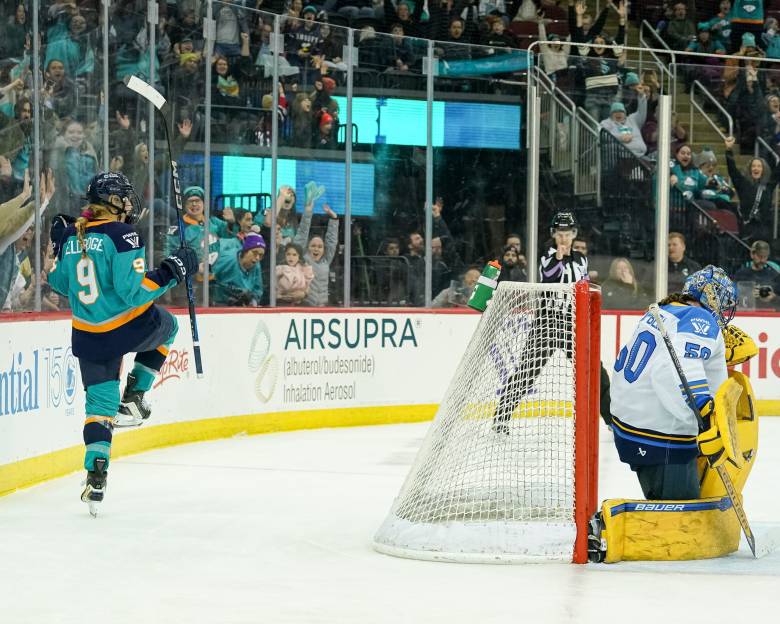
To round out the surefire elite producers on Seattle, Turner made sure to grab Jessie Eldridge from the New York Sirens. Despite the impression that her being left off of Team Canada rosters might give you, it’s clear that, at the very least, she’s a consistently great PWHL point producer. Both PWHL seasons she’s put up the same 0.94 goals per 60 minutes, with minor fluctuations in her SH% from 8.5% in 2024 to 11.7% in 24/25. She’s also finished 15th in the PWHL both seasons in primary points/60. No matter where she is in the top six, she’s going to put up a lot of points and be a factor.
To bolster the proven elite talent on the roster already, Turner also brought into the fold all the first round forwards from the 2024 PWHL Draft not named Sarah Fillier: Hannah Bilka, Danielle Serdachny, and Julia Gosling. In their own ways, they are risks. Serdachny and Gosling ended up in the bottom six of their respective teams, arguably underplaying their draft positions. Serdachny was taken a pick after Fillier and ended the season with a 0.39 PTS1/60 for 91st among PWHL skaters. She showed her potential in the playoffs, but right now Serdachny is still potential.
The same goes for Julia Gosling, who had a better season than Serdachny statistically but still was mostly in a fourth line role with power play time. Gosling ended up with 1.09 primary points/60, for 40th in the PWHL. 70% of her points, though, came on the power play, and her only even-strength points were three secondary assists. The gamble here is that with more ice time, Gosling will find more of a rhythm and be an even-strength producer.
The other 2024 first round pick is fourth-overall pick Hannah Bilka. She nearly missed half of the season with an injury, but in the games Bilka played, she made it clear that she’s not far off that elite potential. She posted 1.28 primary points/60 (29th among skaters), putting her in the same realm as Susanna Tapani and Brianne Jenner. What’s more promising is that Bilka played on average 20:29 a night and finished 18th in primary even-strength points per game.
Here’s where the Seattle philosophy of being top heavy with role players filling the other positions applies to the forward part of the roster. Turner has built the team with a more traditional top six/bottom six in terms of roles. Seattle doesn’t have a bruising bottom six filled with players that will take advantage of the PWHL’s ambiguously applied checking rules. The only player that could play that role is Lexie Adzija.
Turner believes in an identity for the bottom six and it’s easy to tell that because of the bottom six type players they brought in. Apart from Adzija, the three last-signed Seattle forwards fit the mold of being speedy, proficiently two-way, and able to do spot duty in the top six if absolutely needed. After being let go by Ottawa in 2024, Mikyla Grant-Mentis found success in the Montreal organization. She was able to provide some offence while also using her proficient two-way game to shutdown opposing players, leading to a 57.9% 5-v-5 goals for percentage.
2025 first round, eighth-overall pick Jenna Buglioni comes from an Ohio State University program that was all about being relentless in puck pursuit. She may be a Buckeye but she has the heart of a wolverine (that’s right, I went there). Currently the only other signed forward is Natalie Snodgrass, who will bring that same relentless energy to the bottom six, as Turner and everyone else witnessed in the playoffs. You expect the same type of play from Seattle’s unsigned draft picks (Lily Delianedis, Jada Habisch, and Olivia Wallin) and camp invites (Brooke Bryant, Sydney Langseth, and Marah Wagner).
As previously stated, Seattle has specific roles for each player. Let the elite players be elite and the role players play the role of being shutdown players through their speed as well as their two-way play. This goes all throughout their line-up. It’s similar to the philosophy that was applied in Turner’s time in Boston. Get all the elite talent you can, especially on forward to score goals, and do some moneypuck-type thinking to fill in the other spots in the line-up. Put the round peg in the round hole. If injuries happen, hope for the best; it’s hard to replace elite talents no matter the situation anyways.
This is in sharp contrast to Vancouver’s forward corps’ philosophy of focus on just having depth. Cara Gardner Morey does not care if Vancouver is called Minnesota West. If you’re going to copy a team, the two-time Cup winner isn’t a bad team to copy. Sports are inherently a copycat game. Gardner Morey is doing the arguably smart thing in not just straight up copying the Cup winner but doubling down on their ideas. We see that with the goaltending and the blueline. With the forwards. it’s scoring depth galore. From lines one to three. there’s some difference in scoring quality, but ideally those drops are small compared to Seattle, where the scoring efficiency from lines one and two to line three is noticeable.
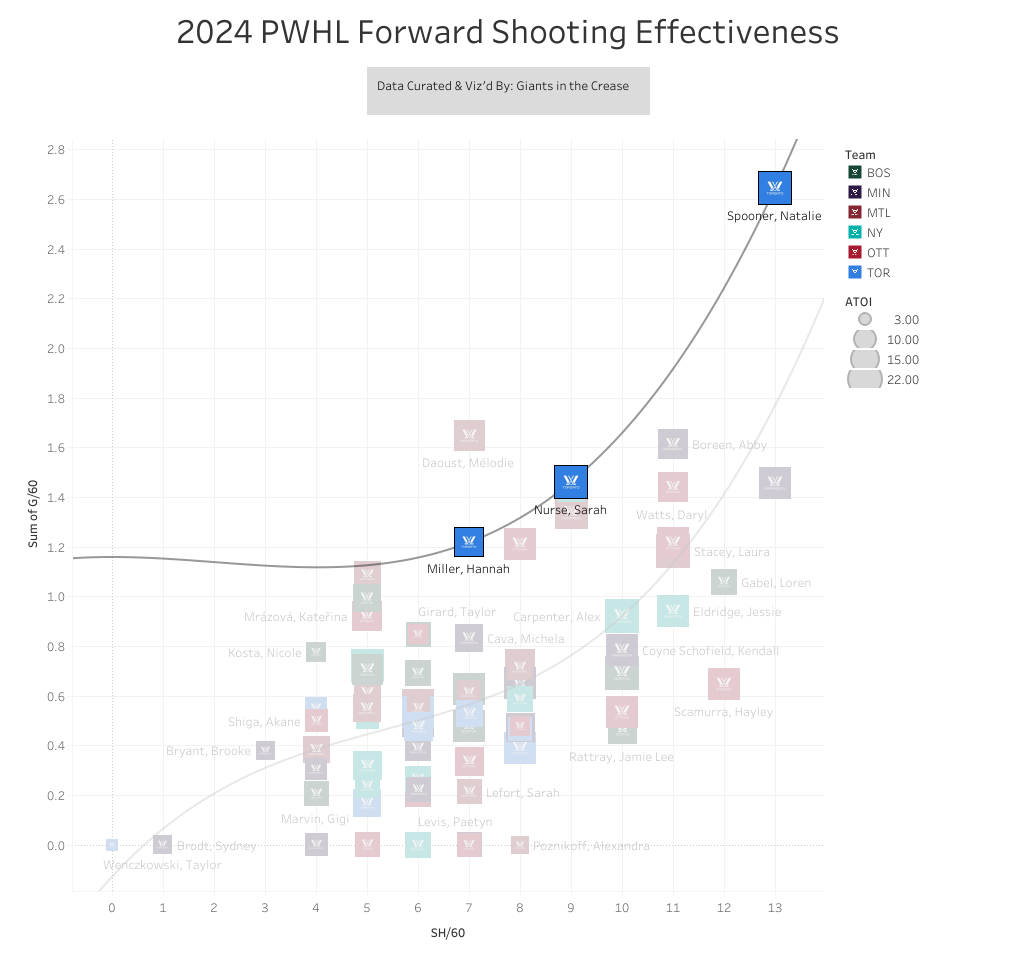
The Vancouver forwards are so close in scoring quality together that it’s tough to figure out the starting point. I believe there will be two players relied on to be the elite players Vancouver needs to put itself into playoffs: Sarah Nurse and Hannah Miller. Nurse was stellar in 2024, finishing the season tied second for points (23) and held second place alone in primary points (20). This past season Nurse saw a dip in her numbers ending up 16th among skaters in PTS1/60 (1.83) so even her dips still have her as a first line forward in the PWHL.
Hannah Miller is an interesting case. Troy Ryan used her all throughout the line-up as a fixer. Whichever line needed to be fixed or stabilized, that’s where Miller ended up for both seasons. Despite all that moving around, Miller remained amazingly consistent in her offensive production, finishing ninth in PTS1/60 for both the 2024 season and the 2024-25 season. What’s really incredible is Miller’s ability to see minimal drops in her SH%. From 2024 to the 24-25 season, her SH% only dropped from 17.9% to 16.9%. That’s usually not how regression works. Add in the fact that in the 2024-25 season, Miller finished first (minimum 10 average time on ice) in 5-v-5 goals for percentage, with a 73.1% goal share at 5-v-5 when she’s on the ice. It’s no surprise Team Canada wants her on the team.
The most interesting wild card on Vancouver to put up elite production is the recently signed Finnish hockey legend Michelle Karvinen. For those who recognize her name, it’s most likely due to her extensive career internationally. She’s won one silver medal and seven bronze medals in the IIHF World Championship to go with her three Olympic Bronze Medals. Karvinen has racked up 62 points in 74 games at the World Championship and 23 points in 24 Olympic games. Recently in the SDHL with Frölunda HC, Karvinen played a large role in getting Frölunda itss first ever SDHL championship, while putting up 74 points in 68 games in the last two seasons. It might be a large ask to hope she puts up elite numbers while being 35 years old and this being her first North American league since her time in the NCAA, but if anyone can do it, it’s Karvinen.
Brian Idalski is feeling the same thing you are when looking at the rest of the forwards on the roster: the scoring depth just keeps going on. By not getting a Knight or Carpenter with proven track records, you can continue to solidify your scoring depth, and that’s what Vancouver did. What they also did is get three of the top seven PWHL players of the 2024-25 season with the highest SH% numbers: Brooke McQuigge with 20%, Tereza Vanišová with 17.2%, and Michela Cava with 17%.
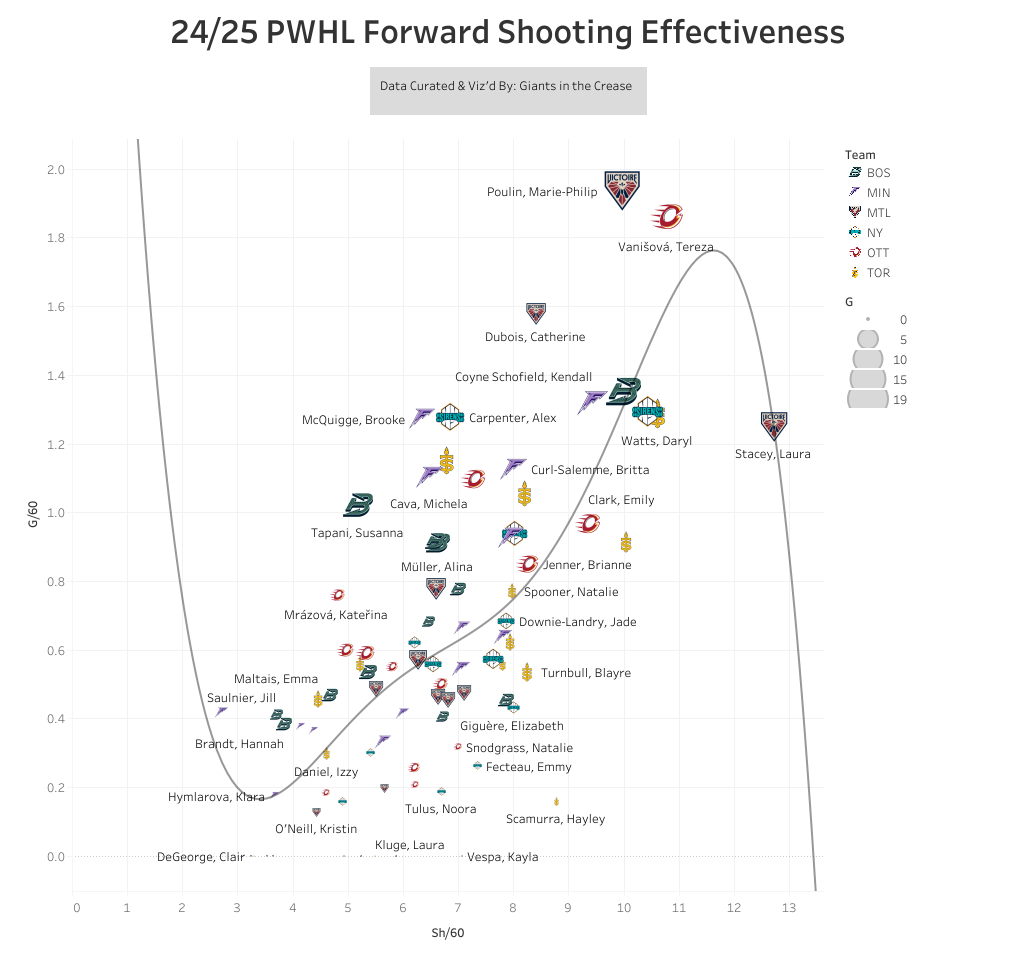
Is it likely that they repeat these performances? No, statistical regression is real (unless your name is Hannah Miller, apparently). The good news is that even should their SH%’s drop, they won’t be needed to provide elite production and can just be good players. McQuigge is a skilled player with a physical streak in her. If she just plays up to expectations, you have a mean third liner who can also play up in the line-up if need be.
Prior to joining the PWHL, Vanišová has been a productive player wherever she’s been. Vanišová provides an element of not caring who she runs over to get to the net. Sometimes you need that element, especially in a league where so many goals are scored in close. Vanišová might not score at her previous rate, but she’ll get the puck to the net. Not being relied upon to be the only scorer will help take the pressure off of her and make her tendency to “red mist”—she led the 2024-25 season in penalty minutes with 38—be less detrimental to the team.
The name everyone is keeping an eye on is Michela Cava. She’s currently on a streak of five straight championships, and since joining the SDHL, she’s proven herself to be an offensive producer. What’s even better news for Vancouver fans is that Cava has scored 13 points in 18 PWHL playoff games. She was arguably a top four contender for the 2024 Ilona Kloss Award (PWHL Playoff MVP). Cava is the definition of secondary scoring, and when it matters most, she continues to bedewerry that necessary secondary scoring.
Six players in, and if you haven’t noticed, we still haven’t gotten to Izzy Daniel, Jennifer Gardiner, Abby Boreen, and Denisa Křížová. Izzy Daniel ended up on Toronto and was buried due to their forward depth. She put up third line-type production while going between the third and fourth lines. If you look at Daniel’s numbers at Cornell in the NCAA, it’s not hard to see why she was named the 2024 Patty Kazmaier Award (NCAA MVP) winner. She does have the ability to produce points, and even if she tops out as a bottom six elite defensive winger, Daniel will still provide scoring depth.

Vancouver went and grabbed two Montreal Victoire forwards in Boreen and Gardiner. When either one spent time on the top line with Marie-Philip Poulin and Laura Stacey, they had great numbers. Gardiner spent the most time on the top line and thrived, and she had a great 2025 IIHF World Championships as well, earning 10 points in seven games. Boreen wasn’t too shabby either, finishing second in goals per 60 minutes (1.61) in 2024, having played nine games. In her first full season in 2024-25, she finishes 26th among skaters, which again is good for someone you want providing scoring depth.
Last but not least is the two-time Walter Cup champion Denisa Křížová. She’s the epitome of the veteran, defensive, scoring depth archetype that coaches love. There’s definitely a sentiment out there that Křížová has more to give offensively because her numbers in the NCAA and SDHL were great. Since coming back to North America and the PHF in 2022-23, she’s put up respectable third line-type production. You need that, and then add in a great defensive game. So even if Křížová is capped out offensively, she’s still an important player in Vancouver’s forward depth chart.
It’s with this scoring depth secured for the Vancouver forward corps that, after the Karvinen pick, Vancouver traded away a second round pick, drafted a blueliner in the third round, and then went for their next picks of Brianna Brooks, Maddy Samoskevich, and Chanreet Bassi, all more of the usual depth roleplaying types. Gardner Morey wants the fourth line depth to be guaranteed to be the try-hard types and not just the cast-offs who couldn’t secure a top nine spot, once again following the Minnesota Frost model.
While we’ve been splitting these articles up into pieces based on positions, this is hockey. Everything from the goaltending to the forwards is intertwined, the blueline and forwards especially. Cara Gardner Morey is making an interesting gamble here. She’s assembled a group of forwards that are all good, sometimes great, and rarely elite. If you have enough of those forwards does it make up for the lack of a surefire elite forward? Is having an active, puck moving blueline going to be able to provide the forwards with so many offensive opportunities that they’ll put up great to elite numbers through sheer volume?
I love that Vancouver and Seattle have taken completely different approaches to building their teams. It’s not going to prove one way or another that either way is the most effective way to build a team. This is hockey, the most random sport in the world. Turner or Gardner Morey could have done everything perfectly in building these teams, and out of nowhere something wild happens that tanks your season. At the end of the season, though, we’ll be able to look back and see what works or didn’t work for each team. This expansion process is very important for the learning experience of us hockey nerds who care about team building. And for everyone else, it’s just going to be very entertaining hockey.