The Seattle Torrent’s Phase 1 protection list was never going to satisfy everyone.
Seattle officially protected forward Alex Carpenter, goaltender Hannah Murphy and defender Anna Wilgren as part of the Professional Women’s Hockey League’s six-phase expansion roster distribution process, leaving several high-profile names exposed, including captain Hilary Knight, Hannah Bilka, Julia Gosling and Cayla Barnes.
The immediate public reaction centered on who was left unprotected, but for general manager Meghan Turner, the protection phase dictates what the Torrent need to become.
Speaking with reporters on Thursday, the day after the protections were announced, Turner repeatedly returned to three themes: establishing a long-term core, building a heavier style of play and maintaining stability at every position.
“We wanted to make sure that we had a good core group that could have some longevity,” Turner said. “What we do today will impact how our teams look in five, 10 years.”
Carpenter remains the cornerstone
Of the three protections, Carpenter was the least surprising. Seattle signed the veteran center to a three-year contract extension through the 2028-29 season before immediately using one of its protection slots on her.
Carpenter led the Torrent with 12 goals and tied Julia Gosling for the team scoring lead with 20 points in 30 games during Seattle’s inaugural season. She also dominated the faceoff circle, winning 440 draws and taking a league-leading 745 faceoffs.
Beyond the numbers, Carpenter fills several roles that expansion teams covet. She is an Olympic gold medalist, an alternate captain and one of the league’s most reliable two-way centers. Turner described the protected trio as “the spine of the roster going forward,” and Carpenter represents the most established piece of that foundation.
Her extension also provides the certainty Seattle lacked entering the offseason. While many of the organization’s biggest names were playing on expiring contracts, Carpenter now gives the Torrent a proven top-line center under team control through the end of the decade.
Why Murphy became a priority
While Seattle had other difficult decisions to make across the roster, Turner emphasized that securing a goaltender was a foundational part of the organization’s expansion strategy. Murphy’s age and performance during the inaugural season made her a key piece of Seattle’s long-term plans.
“You look at the teams that are really championship driven, and it kind of starts from the net out,” she said.
She also noted that quality starting goaltenders are difficult to replace during expansion.
“If you lose a goalie–if you don’t protect the goalie, you’re going to have to find one some other way,” Turner said. “There’s a lot of teams that need good starting goaltenders.”
This seems to be a common through process across the league. Seven of the eight incumbent PWHL teams elected to protect a goaltender during Phase 1, underscoring how scarce the position remains in women’s professional hockey.
Murphy’s protection also suggests Seattle believes her best hockey remains ahead of her.
“We felt good about Murphy’s potential and what we saw in Hannah this year,” Turner said.
Murphy backed up Seattle’s belief in her potential during her inaugural PWHL season. The 24-year-old appeared in 14 games for the Torrent, posting a 2.59 goals-against average and .914 save percentage while recording four wins and one shutout. Her save percentage ranked among the league’s better marks for goaltenders with significant playing time.
Wilgren embodies the style Seattle wants
For some fans, the Torrent’s decision to protect Anna Wilgren instead of more established names such as Barnes came as a surprise. Turner, however, did not hide her reasoning.
“We want to play a heavy game next year,” she said.
For Turner, no protected player better represents that vision than Wilgren.
The 26-year-old defender emerged as one of Seattle’s most reliable all-around blueliners during the inaugural season, appearing in all 30 regular-season games and recording three goals and six assists for nine points. Wilgren also ranked among Seattle’s most physical defenders, consistently taking on difficult defensive assignments while contributing on both special teams units. Turner highlighted her physicality, shot blocking, willingness to engage in difficult areas and growing offensive play as key factors in the decision.
“Sky’s the limit for Anna,” Turner said. “She plays like the way that we feel we want to play.”
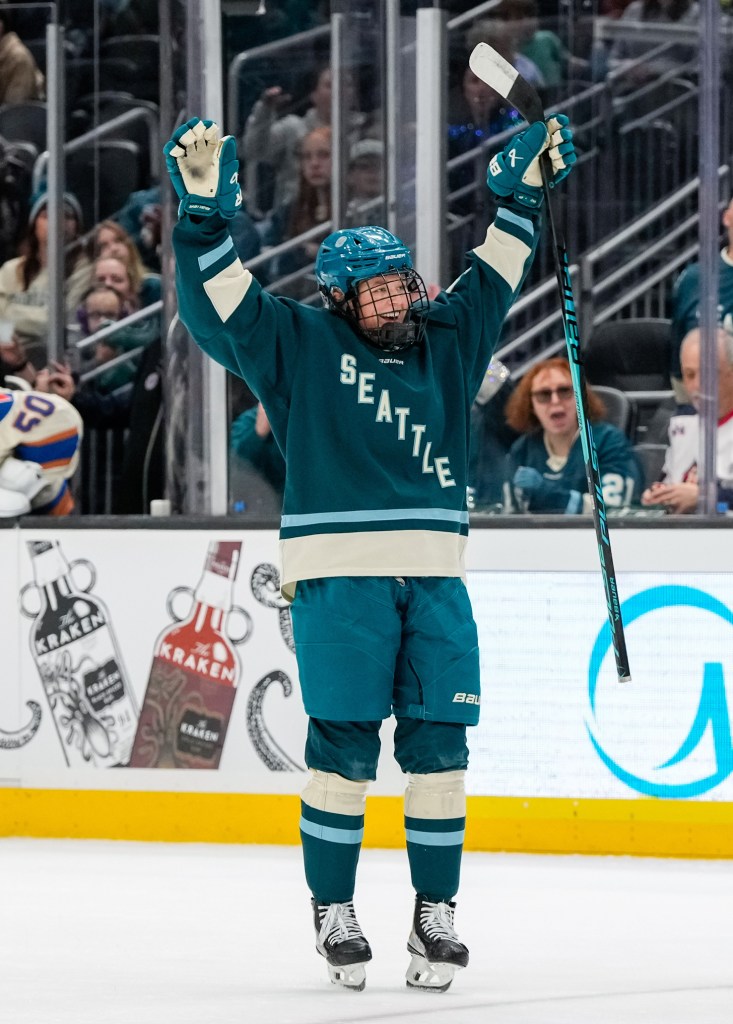
Turner described Wilgren as a defender who can transport the puck, activate offensively and still handle the hard defensive assignments.
“She’s not afraid to block shots, she’s not afraid to make checks and finish hits, she’s not afraid to get into the hard areas of the ice,” Turner said.
Just as important, Turner believes Wilgren has not yet reached her ceiling.
“I don’t think we’ve seen what she can really do in this league,” Turner said. “She’s young and has that potential.”
That combination of age, physicality and projection appears to have outweighed the star power associated with some of Seattle’s other available defenders.
The risk Seattle is willing to take
Protecting Carpenter, Murphy and Wilgren was not simply about securing three players. It was also a gamble. Knight, Bilka, Gosling and Barnes are among the most attractive players available to expansion clubs. Seattle now faces the possibility of losing some combination of established stars and emerging young talent as the process continues.
Turner acknowledged the emotional difficulty of those decisions.
“Our record aside and outcome aside, it was a really good culture and a good group,” she said. “Picking three players out of that is really difficult.”
Still, Seattle’s protections reveal an organization thinking beyond the next few weeks. Turner protected a top-line center, a young goaltender and a defender she believes embodies the identity Seattle wants to build.
“The goal is to get a Walter Cup,” Turner said. “We have to play a punishing game to other teams.”
Whether the strategy survives the remainder of expansion remains to be seen.
What is clear is that Seattle’s front office entered Phase 1 with a specific vision for the future and used its three protections to secure the players it believes fit that blueprint best.