Roughly five years ago — January 14, 2018 — I penned an editorial entitled “The NWHL and the NHL: what can women’s hockey gain — and lose?” In it, I outlined the upsides and downsides to partnering with men’s hockey, ending with the thought that if the NHL in particular can support, not “save,” women’s hockey without taking center stage, it could be a fruitful partnership.
The catch, though, is that the NHL can’t ever not take center stage, can it?
In the early-morning yawns of 2023, the now-Premier Hockey Federation and its National Team-centered counterpart the Professional Women’s Hockey Players’ Association have maintained a relative amount of stability. The PHF has announced a landmark salary cap expansion to come in 2024, doubling from $750,000 to a cool $1.5 million per team.
The PWHPA, for its part, has had some super-successful showcases across North America and doesn’t show any signs of stopping. In fact, recent announcements indicate a formation of a players’ union complete with a CBA, as well as a full-fledged league (dubbed the PWHL) to start play this coming fall.
And where has the NHL been all this time?

Not a damn clue.
I still think that with the National Hockey League’s resources, women’s hockey would be in a much different place — as any league with billions in revenue would be, let’s be real. And every time the question of a women’s league backed by the NHL comes up, top dogs get mealy-mouthed about the possibilities, indicating they would “support one league” but not doing a whole lot to indicate they’re willing to open up their sizable pocketbooks.
And honestly? That is completely okay.
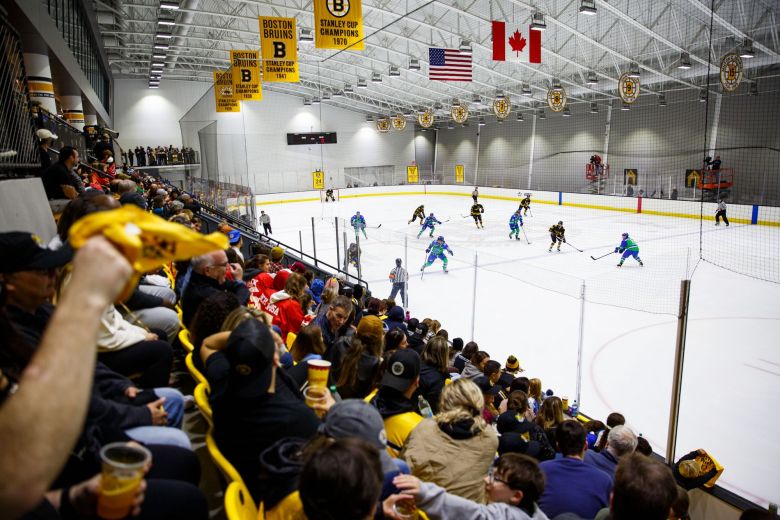
The PHF, all its flaws and stumbles over basic communication aside (more on that in a future column), is trucking along with seven teams and lots of promise. The league itself has extended partnerships and gotten national broadcasting deals. The first-place Boston Pride are enjoying a landmark deal with NESN, and the Toronto Six are signing huge names like Daryl Watts in a push to unseat them. La Force de Montreal is drawing great crowds during its barnstorming tour, and we’re seeing players across all clubs get their first taste of the pro hockey life — complete with brand partnerships, team-branded rinks, and (for some) the first living wages for pro women’s hockey. Obviously, nothing is promised fully in a women’s league, but clearly, the Board of Governors has faith in the product and wants to see it grow. At least, on the surface it seems that way.
The PWHPA, meanwhile, has historically been a little more intent on a partnership with the NHL. Whether or not that will come to pass eventually is anyone’s guess, but as of right now, they’re still going almost four years after its members broke off and formed their not-a-league league in 2019. Even with the growing uncertainty surrounding their ability to form a paid league, the PW has an idea of what it wants and has taken some steps to achieve it. Those include a partnership with the legendary Billie Jean King, amongst others. It’s moves and countermoves between each entity at this point, while the NHL stands watch.
That’s not to say the NHL hasn’t taken part in some conversations. In fact, last March they apparently brought both groups to the table to discuss a potential merger. This coming together would presumably ensure that the men’s league would be willing to put up some funds — but after a few such discussions, the PWHPA backed out and decided to go ahead on its own. Whether they didn’t like the PHF’s take or they finally realized the NHL wasn’t quite willing to give them what they want is unclear.
Honestly, the first time I heard of these meetings was the same week the PHF started its playoff series in Tampa, and to me the framing was reminiscent of a would-be father trying to bring warring siblings to an agreement. In short, it was paternalistic and annoying, and the most recent example of why I’d rather have nothing at all from this damn league.
The irony of a men’s league trying to outline what’s best for women’s hockey when both the PHF and the PWHPA were in the midst of making serious steps toward sustainability was and is not lost on me. Throughout the course of the PHF’s existence, and the existence of leagues and associations parallel to it, the NHL has existed as this sort of looming overlord unwilling to help its would-be subjects unless they capitulate to its very specific demands.
That isn’t how it works. There’s a lot more that needs to be figured out behind the scenes, especially when it comes to what’s best for the players — and, uh, correct me if I’m wrong, but the NHL definitely doesn’t have a great track record in that respect. Also, leagues and players on the women’s side have done a lot more to try and foster an inclusive environment, something the NHL has historically struggled with (see the absolutely pitiful response to the Flyers’ Ivan Provorov).
Lastly, there’s something really unnerving about giving the reins over to a men’s league that has never really sat right with me, and it’s the idea that we need them in order to make this work. We need the NHL to set the warring factions to rights and create one new, glorious, branded league that oh by the way they’re probably going to use as some sort of flimsy papier-mache example of their “commitment” to diversity and inclusion, but never market correctly or give the time and energy women’s hockey deserves.
I’ve said it before, and I’ll say it until I’m blue in the face: women’s hockey has a tremendous opportunity to do things differently. Whether it’s the PHF or the PW, or any league that comes after, there is a precedent, but there is no hard and fast rule that says you have to go the way of men’s hockey. Moreover, the women’s game has a huge opportunity to prove that it is not a charity case or a gimmick; it’s a sport with gifted players and good people, not without its own issues, but with a chance to set a different type of foundation.
Does this mean a relationship with men’s hockey isn’t welcome? Of course not. Hockey is hockey, and these players likely all know each other in a community like this. I know individual players and maybe even teams want to provide their support, and it’s fun to watch players like Ann-Sophie Bettez and Kendall Coyne Schofield participate in events like men’s All-Star Games. I’m simply saying there are ways to grow beyond hitching a wagon to the NHL’s star, or the star of any other men’s league.
This game has already done so much in spite of men’s hockey not really giving it more than a second thought. We don’t really need to worry about giving them a third.