

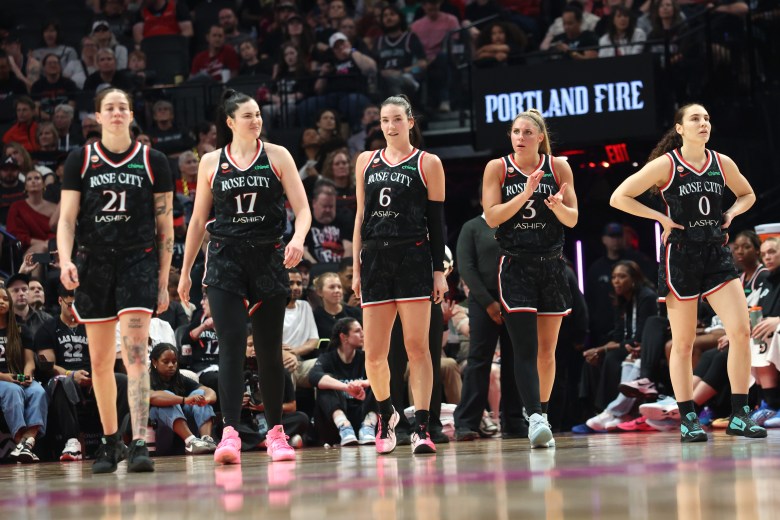
PORTLAND, ORE. — When asked what’s making the Portland Fire click this season, Megan Gustafson didn’t have to think long to find her answer.
“I mean, we’re a bunch of overlooked players, and we have a chip on our shoulder,” Gustafson told reporters May 30. “I’ve never really been respected as a basketball player until I got here.”
After teammate Emily Engstler cut in, saying, “I respect you, Meg,” Gustafson grew emotional.
“I’m thankful for this team,” Gustafson continued as her voice cracked. “This organization … they believe in me.”
Gustafson isn’t the only player who is finding a second, or even third, wind on an expansion team this season. The Portland Fire might not be decimating each and every opponent, but it’s becoming clear the team is building their culture their way — and that’s what works for the roster they have this season.
That kind of intentional reshaping of the typical expansion team storyline has roots in the Golden State Valkyries, who surprised a lot of people by finishing their inaugural season with a playoffs run. The Fire and the Valkyries have a few things in common; most notably, the Fire’s GM Vanja Černivec previously worked with Golden State. Culture has been a big topic for both teams.
But the Fire isn’t the only expansion team in the WNBA this season. The Toronto Tempo were properly introduced in 2024 and have weathered their own first-year highs and lows so far this season. Like the Fire, despite tallying more losses than not, the Tempo’s players are leaving it all on the court, game after game.
When it comes to how much players enjoy being on the Fire, it seems like something’s working.
Leadership sets the tone for the Portland Fire
Coaching is one key component of any successful team, but culture is right up there with it. From Day 1, the Fire’s coaching staff has emphasized culture nearly as much as it has emphasized playing style, something that’s paid off whether the team wins or loses.
During training camp, head coach Alex Sarama told reporters he planned to establish a kind of leadership council made of players. The group was first made up of players who were already demonstrating leadership abilities at the time, something he found useful for welcoming the team’s players from overseas.
“I think just the practice environment we have [will help],” he said. “I mean, if you guys see it, just in all the content coming out, it’s generally a really joyful one. I think that environment where we’re encouraging, you know, laughter, smiles, and it just makes it so easy for new players to step into that.”
Since then, the players have continually added to that environment. Sarah Ashlee Barker, who hit the shot that earned the team its first home win over the New York Liberty on May 12, told reporters at the team’s practice the following day that the franchise as a whole was special.
“I wouldn’t be able to do what I do if I didn’t have the organization we have,” Barker explained. “The people, the support I’ve gotten in the last 48 hours from Vanja to Alex, to every single person in this organization, I’m exactly where I want to be.”
Gustafson’s emphasis on being overlooked and undervalued isn’t unique to her or even to the Fire. In fact, a lot of Fire players, including Barker, have made similar statements all season.
“The teammates I have … none of this would be possible if it wasn’t for them,” Barker said. “So I just have so much gratitude … for exactly where I am in Portland.”
Establishing that kind of culture is the responsibility of those in charge, Golden State head coach Natalie Nakase said ahead of her team’s game against the Fire on June 2. In 2025, Nakase won Coach of the Year and led the Valkyries to the playoffs in their debut season, a first for a WNBA expansion team.
“I think it has a lot to do with a lot of thoughtfulness, a lot of intentionality, and a lot of what [Černivec] and the head coach and this coaching staff align with,” Nakase said. “I think that’s really what’s important, and so when you come in with a plan and then also pick players that fit that plan, I think that’s where you kind of build the identity.”
“Becoming Caitlin Clark” is out now!
Howard Megdal’s newest book is here! “Becoming Caitlin Clark: The Unknown Origin Story of a Modern Basketball Superstar” captures both the historic nature of Clark’s rise and the critical context over the previous century that helped make it possible, including interviews with Clark, Lisa Bluder (who also wrote the foreword), C. Vivian Stringer, Jan Jensen, Molly Kazmer and many others.
Expansion means opportunities
It’s also true that adding more teams to the league neatly results in more opportunities for women to play professional basketball in the WNBA. That was top of mind early in preseason for Engstler, who acknowledged both the “historic moment” the team’s admission into the league represented, as well what getting another shot at a dream means.
“I’m personally extremely grateful to be part of this historic moment for Portland, bringing back the Fire,” she told reporters during training camp. “It’s a great opportunity for me, but it’s also just something that I think it should be inspiring for all younger girls around the world … you got a bunch of players who, whether they’re All-Stars or didn’t really play last season … that there’s always a time and a place, and I think this is just evidence of it.”
Part of what Sarama’s coaching style means is that he’s deploying his bench players more than some teams do. In early May, he told reporters at practice that the team planned to apply a “less is more” approach to rotations; he’s followed through on the promise.
“We’re still going to be intentional with less is more, and just doing what we do really well … I think that’s important,” he said when asked about experimenting with rosters. “Just in terms of how deep we go as well. I think, especially as a young group, I think it’s important that we use our bench … it’s playing like eight players. I think for the way we want to play, we’re going to need more players. And I think that’s great, because then it gives more development opportunities too, for our young players.”
Including the preseason, the Fire’s group of starters (in addition to Barker, who began starting in June, that list has included Carla Leite, Bridget Carleton, Gustafson, Engstler, Luisa Geiselsoder, and Nyadiew Puoch at various points in the season) have averaged 157.3 minutes of playing time as a group so far this season. The rest of the roster (Teja Oblak, Frieda Bühner, Jordan Harrison, Karlie Samuelson, Serah Williams, Holly Winterburn) have averaged 73.1 minutes as a group. That’s a collective minutes difference of 84 between the frequent starters and the bench players.
That can be contrasted to a team like the Atlanta Dream, whose starters (Allisha Gray, Rhyne Howard, Angel Reese, Jordin Canada, Naz Hillmon) are averaging 160.9 minutes so far this season—while the rest of the team (Te-Hina Paopao, Madina Okot, Isobel Borlase, Sika Kone, Indya Nivar, and Aaliyah Nye) are averaging 42.7 minutes so far (a whopping 118 difference in minutes).
The Indiana Fever’s starters (a group that has included Kelsey Mitchell, Caitlin Clark, Aliyah Boston, Sophie Cunningham, Monique Billings, and Lexie Hull this season) are averaging 152.2 minutes per game collectively, and the bench (Myisha Hines-Allen, Raven Johnson, Makayla Timpson, Damiris Dantas, Tyasha Harris, and Grace VanSlooten) are avearging 56.6 (a difference of 95.4).
The reasons coaches play certain players more than others has a lot to do with strategy and game plan (and the Dream are currently ranked fourth in the league with an 8-4 record; the Fever is seventh with a 7-5 record; and after an exciting start, the Fire has plummeted to 11th with a 6-8 record). But, putting more players on the court during games may have more to do with fostering a team-led culture — exactly what a Constraints-Led Approach (CLA), the Fire’s system, is all about.
A new style doesn’t have to mean new problems
The Fire’s roster is contending with not only being a new team in the league and building a fanbase from the ground up, but also learning Sarama’s Constraints-Led Approach and applying it to games.
“When I was coming to this franchise, I knew that there was a lot of articles and stuff like that that Alex had on the books and stuff, and so I really actually went and kind of did my own research and like read it before coming to Portland,” Barker told The IX Sports on May 25. “Because I just wanted to know what I was walking into.”
One of the things about CLA is that it can feel intimidating at first, and it’s the kind of style of play that’s better experienced than read about.
“And then, obviously, you really don’t know until you’re in it,” Barker affirmed. “And then just listening to how he says things, how he does things, I’m very intentional on trying to learn, because being open to learn from other people … I’m just someone who wants to learn and … retain any information that that coach Alex says.”
The Fire’s season has so far yielded mixed results. After a strong May that ended with Sarama being named Coach of the Month, the first in the WNBA to receive that nod in their first month since Becky Hammon, the team has struggled in recent weeks and are currently ranked 10th in the league. That could be seen as a sign that something Sarama’s doing isn’t working as well as it once did, but there’s more to the story.
For example, Barker, who was something of a momentum shifter for the Fire in May, started for the first time on June 5. That moved Puoch to the bench.
The decision wasn’t one Sarama made lightly — and it wasn’t because Puoch was underperforming, but rather one he made that was in line with CLA.
That choice was based on a conversation about numbers and net ratings with the front office, he told reporters after the game. “And we felt like with that information, we wanted to take a look at it and check it out,” Sarama said. “And I think it’s tough, because Nards [Puoch] has been playing so well in terms of being that point of attack defender, but I do think she had the hardest and previously she should play, come off and sit the longest. So it’s something we’re gonna keep kind of taking a look at, keep experimenting with the more volume we get of different lineup combinations.”
He added that just because one player was starting and another was not, the same numbers experiment and conversation could influence another change. “I’ve been holding off on this so long because I feel like [Barker’s] been such a spark off the bench,” Sarama also said. “And that was the reason I pushed back earlier when we were getting some of the initial numbers, but the numbers were popping so much. I kind of had to have a think and be all right, I’ve got to reconsider this. But nothing’s set in stone.”
‘Rare Gems’ is out now!
Howard Megdal, founder and editor of The IX Basketball and The IX Sports, wrote this deeply reported book. “Rare Gems” follows four connected generations of women’s basketball pioneers, from Elvera “Peps” Neuman to Cheryl Reeve and from Lindsay Whalen to Sylvia Fowles and Paige Bueckers.
If you enjoy Megdal’s coverage of women’s basketball every Wednesday at The IX Sports, you will love “Rare Gems: How Four Generations of Women Paved the Way for the WNBA.”
A point to make is expansion has led to more opportunities, but unfortunately those are being filled by foreign players, not NCAA graduates. The Valkyries, Tempo and Fire have the largest % of foreign players who haven’t developed fan bases in college, and often use a very unfair system of being allowed to play as teenagers instead of USA born players who haven’t developed fan to be 22 or have graduated from College. How is this equitable?