


PHOENIX — If the Phoenix Mercury aren’t playing defense, they aren’t playing winning basketball. That’s how the team feels as it’s fallen to 2-4 early in the season. Despite returning seven key players from their 2025 WNBA Finals run, the Mercury haven’t been able to find the defensive identity that made them so dangerous a season ago.
“We’re nowhere near where we need to be defensively,” star forward Alyssa Thomas told reporters following a 98-90 loss to the Toronto Tempo on Tuesday. “It’s going to be a long season if we don’t get it together on the defensive end. I think it shows if you want to play on this team, you have to defend.”
Phoenix head coach Nate Tibbetts has agreed with that sentiment at multiple points this season. A variety of factors have contributed to the impression that the Mercury have looked a step behind on defense.
Help needed
At the beginning of the season, Tibbetts noted, “Any time you have a team with Alyssa Thomas on it, you’re going to be an elite-level defensive team.” But so far, that’s been far from the truth.
Currently, the Mercury’s 109.1 defensive rating is 10th in the league, meaning that they’re allowing teams to score 109.1 points per 100 possessions. They’re also giving up 87.8 points per game. Last year’s Mercury team was fifth in defensive rating at 102.5 and fourth in opponent points per game at just 80.1.
Phoenix has allowed its opponents to score 95 or more points in three of six games this season. That only happened four times in 44 games last season.
“We won a lot of games last year with our defense, and it’s going to be the same way this year,” Tibbetts said. “I thought [Thomas] and [guard Kahleah Copper] really set the tone at that end, and that is going to have to continue.”
Still, it’s a bit disingenuous to compare last season’s team to this new one, especially considering the small sample size early and the fact that key returners Monique Akoa Makani and Sami Whitcomb have yet to suit up this season. But at the same time, just how bad the defense has looked at times is alarming for a team that should have physicality and aggressiveness as its baseline.
For how good Thomas is as an individual defender — she’s a perennial WNBA Defensive Player of the Year candidate — she alone can’t solve the team’s defensive woes. There are simply too many responsibilities to put onto one player. Center Natasha Mack is a helpful rim deterrent, but no matter how much her conditioning improved in the offseason, it’s unrealistic to expect her to consistently play 30-plus minutes per game.
Kyara Linskens, the Mercury’s only other true big, has yet to find regular playing time, which has led to undersized and inexperienced forwards like Noemie Brochant, Valériane Ayayi and Marta Suárez having to play up on defense. That strategy has led to shaky results. For example, against the Los Angeles Sparks on Thursday, Suárez fouled out just nine minutes into her WNBA debut.
In that game, the Sparks scored 60 points in the first half and seemed to get whatever they wanted whenever they wanted it. Guards like Kelsey Plum led a 3-point shooting barrage, as the Sparks shot 15-for-32 from deep. And Dearica Hamby dominated in the paint, finishing with 27 points and 15 rebounds and converting from the free-throw line 11 times.
The frustration during and after the game could be seen on the faces of the Mercury coaches and players, Thomas specifically.
“Defense is a want, it’s a will,” Thomas said postgame. “It’s the point of attack. Teams are coming in and getting anything and everything that they want against this. So for us, we have to decide if we want to defend.”
“It’s about knowing personnel, knowing what the game plan is,” she added. “We have to do a better job all around. It starts with our preparation and knowing the teams and what they want to do. We have to start over with our defense, and we got to find people that want to defend.”
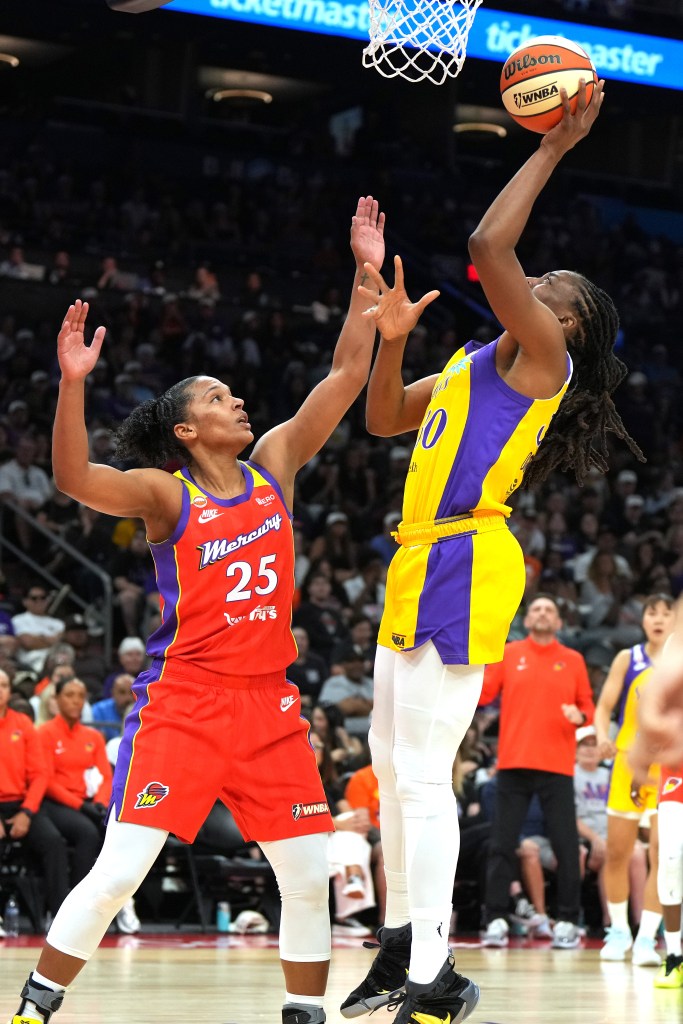
Opposing ball-handlers have too often been able to turn the corner and force the Mercury defense to rotate. When the burden shifts to help defenders, openings elsewhere on the floor put additional stress on Phoenix’s interior defense and require Thomas to cover multiple responsibilities within the same possession.
Mack being the lone consistent rim protector has become an especially difficult problem against teams with multiple physical frontcourt players, who have been able to wear down the Mercury and consistently generate traffic around the basket, leading to open threes.
“We just got to help each other,” Copper told reporters after the Toronto game. “If you know someone’s not in the right place or somebody’s getting beat one-on-one, we just got to cover for each other. We got to fly around more. I think we fell into some one-on-ones, not having each other’s back, not being in the gaps. Being better collectively [will] ultimately help our team defense.”
Listen now to The IX Sports Podcast and Women’s Sports Daily
We are excited to announce the launch of TWO new podcasts for all the women’s sports fans out there looking for a daily dose of women’s sports news and analysis. Stream on Spotify, Apple Podcasts or anywhere you listen to podcasts, and make sure to subscribe!
Can’t defend the 3
The most glaring flaw in the Mercury defense is the inability to defend the 3-pointer. The Los Angeles game was the second game in a row in which Phoenix’s opponent made 15 3-pointers on over 40% shooting. That can be chalked up to the other team simply making shots at an above-average rate, but Tibbetts pointed to something much more concerning: Teams are getting comfortable against them.
“Teams are just getting comfortable, and we’re not doing a good enough job of getting to their shooters,” Tibbetts said after the Los Angeles game. “That’s disappointing to give up 60 in the first [half]. It’s not what good defenses do. We decided to turn it up and held them to 37 in the second half, but the threes are a problem right now for sure.”
It’s a bad sign for a team that wants to thrive on making opponents feel uncomfortable. Tibbetts pointed to breakdowns in attention to detail, including an instance against Los Angeles when Phoenix failed to pick up Plum and she just walked into a 3-pointer.
That was just one of multiple occasions this season where the Mercury failed to match up on defense, leading to shooters getting free looks at the basket. Tibbetts called it “a lack of focus” after playing Toronto — a game in which Tempo guards Brittney Sykes and Marina Mabrey combined for 61 points on 10-for-22 3-point shooting.
The result is that the Mercury have allowed the second-highest opponent 3-point percentage in the league at 37.3%. Opponents have made 60 3-pointers against the Mercury, while Phoenix has made just 49.
That 33-point gap has been significant, as the Mercury’s average margin of defeat in their last three losses is just 7 points. Fewer threes allowed here and there could be the difference between Phoenix being 2-4 and being 4-2 or even 5-1.

“Becoming Caitlin Clark” is out now!
Howard Megdal’s newest book is here! “Becoming Caitlin Clark: The Unknown Origin Story of a Modern Basketball Superstar” captures both the historic nature of Clark’s rise and the critical context over the previous century that helped make it possible, including interviews with Clark, Lisa Bluder (who also wrote the foreword), C. Vivian Stringer, Jan Jensen, Molly Kazmer and many others.
On the bright side
The good news for Phoenix is that all signs point to this period being the lowest it will get defensively. That’s because the team will naturally adjust in three areas as time goes on.
For one, associate head coach Kristi Toliver is taking over the defense for the first time after spending the last two seasons focusing on the Mercury’s offense. Second, the Mercury have relied on many players who are not only new to the roster, but also new to the WNBA. And third, everyone across the league is having to adjust to changes in how the game has been officiated.
Let’s dive deeper into each of those areas.
By pretty much all accounts, Toliver is one of the top assistants in the league and it’s only a matter of time until she becomes a WNBA head coach. The learning curve she’s facing is a natural challenge to her vast basketball IQ. Now tasked with overseeing every detail of the team’s defensive game planning — from scouting opponent tendencies to identifying personnel strengths and weaknesses across the league — her process remains the same. The assignment is just different.
“It’s challenging just to change my perspective and how I’ve looked at the game, just obviously just watching offense and focusing on that side of the ball,” Toliver told The IX Sports. “When you’re coaching defense, you obviously know what your team does offensively, but now I feel really comfortable in understanding what other teams are trying to do, especially when it comes to preparing scouts or just knowing every single team, and their actions and their personnel.”
As that process of dissecting what opponents are trying to do and how Phoenix can disrupt it becomes more familiar, it’s reasonable to expect the Mercury’s defensive execution to improve, too.
Phoenix’s new players also need to adjust. Newcomers from overseas like Jovana Nogić, Ayayi, Brochant and Linskens arrived late to training camp, yet they’ve already been tasked with large responsibilities. Additionally, their learning curves include factors that make it more difficult than the typical “new player on the team.”
Linskens, for example, told reporters after a shootaround that she’s still not used to the WNBA’s defensive three-second violation, which is absent from the league she competes in overseas. Perhaps that contributes to why she hasn’t cracked the rotation as a consistent backup center. Tibbetts also pointed to the challenge that the language barrier presents for international players, specifically on the defensive end.
“We’ve added some players that speak a couple different languages,” Tibbetts said. “When we call a coverage, when we say it in English, we know it, but they’re trying to translate it at times and they may have just come from another team overseas that was calling something completely different.
“When you hear coverage called, you can’t think about it. It’s got to happen quick. I feel like we’re getting into our coverages quicker, and that just takes repetition.”
Finally, in the offseason, the WNBA made it a point of emphasis for officials to limit physicality on the court. That’s led to an uptick in fouls called across the league.
At first glance, that would seem like bad news for a Mercury team that built its identity around relentless pressure that often went unpunished by the whistle during its run to the 2025 WNBA Finals. In reality, the numbers suggest the opposite.
Phoenix is averaging 19.3 personal fouls per game. That’s the third-fewest in the league, despite playing in a game against the Minnesota Lynx that had 50 total fouls and one against the Sparks that had 49. Tibbetts has repeatedly pointed to defending without fouling as one of the primary benchmarks he uses to evaluate the team’s defense. By that measure, the Mercury have actually done their job.
Your business can reach over 3 million women’s sports fans every single month!
Here at The IX Basketball and The IX Sports, our audience is a collection of the smartest, most passionate women’s sports fans in the world. If your business has a mission to serve these fans, reach out to our team at BAlarie@theixsports.com to discuss ways to work together.
The other major benchmark Tibbetts has pointed to in assessing his defense is finishing possessions with rebounds. Again, the Mercury are doing well there. They’re only allowing opponents to grab seven offensive rebounds per game, which is fourth-best in the league.
“One of the things we’ve really talked about is just defending without fouling and finishing possessions with rebounds,” Tibbetts said. “Those have been the two major focus areas of ours.”
The issue is that Phoenix may actually be erring too far on the side of caution. If anything, Tibbetts wants his team to play with more aggression as officials, players and coaches continue to figure out what physicality is allowed and what isn’t.
“I think we can be more physical on the ball. We’re not into excuses,” Tibbetts said when asked if the higher frequency of foul calls is partly to blame for Phoenix’s poor defense. “I think [Akoa Makani] will help us. She was one of the best pick-and-roll defenders in the league last year … but it’s not just going to fall on her shoulders. Everyone’s going to have to step up, and we’ve got a lot of new players that just need to understand there’s a lot of great players in this league, and you got to guard.
“If you’re not ready to guard, we’re going to get burned, and that’s what’s happening right now.”
Phoenix’s roster doesn’t lack defensive talent; it’s simply still learning how to function together in a new system with new roles and a changing league environment. While that doesn’t excuse the poor defensive performances, it does explain why the Mercury can be confident that things will improve.
If Toliver settles into her new responsibilities, the international newcomers become more comfortable with the nuances of the WNBA game, and the league collectively adjusts to the new whistle, Phoenix has reason to believe its defensive identity is still ahead of it rather than behind it.

Dylan very well done! Incredible