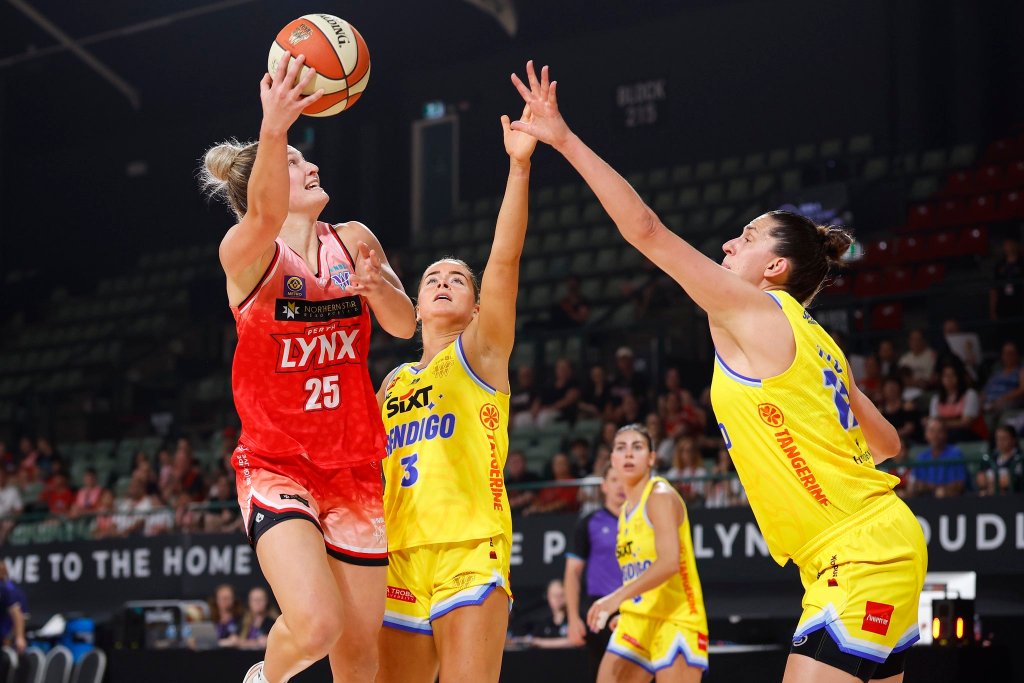
PORTLAND, Ore. — Playing basketball was technically optional for Frieda Bühner as a child growing up in Osnabrück, Germany, but it was also always at least a little inevitable. Her dad and two brothers have all played the sport, and basketball was, and is, baked into the family’s life.
Her dad, Andreas Bühner, told The IX Basketball by phone from Germany that he loves to remind Frieda and her brothers that they might have achieved a lot, but they’ve never won the Bundesjugendlager tournament like he did as a youth. Of course, that story might start to wear thin now that his daughter is playing in the biggest women’s league in the world.
Despite his own history with basketball, Andreas didn’t push the sport on his kids. “I was lucky that they were interested in doing basketball, because it’s my sport that has been my sport always, and so this is why I’m really happy about that,” he said. “They have chosen basketball, but I didn’t tell them to. They just chose it because there were some opportunities, and we have seen [that] they’re good at it.”
The family’s story in the sport continues to expand. “So the story became bigger and bigger for the kids. And of course, we as parents tried to help them wherever we could … we didn’t [ever] expect them to be as professional as successful as [they are] now.”
Her family’s roots are helpful now that Frieda is in the WNBA. Her brother Karl plays in the German second league in Cologne, which means they can relate to one another as professionals — a dynamic that’s still relatively new for the 22-year-old.
Frieda and Karl are close; her father noted that they’re only 360 days apart in age. In fact, for those five days of the year, Karl likes to point out that he and his sister are technically the same age.
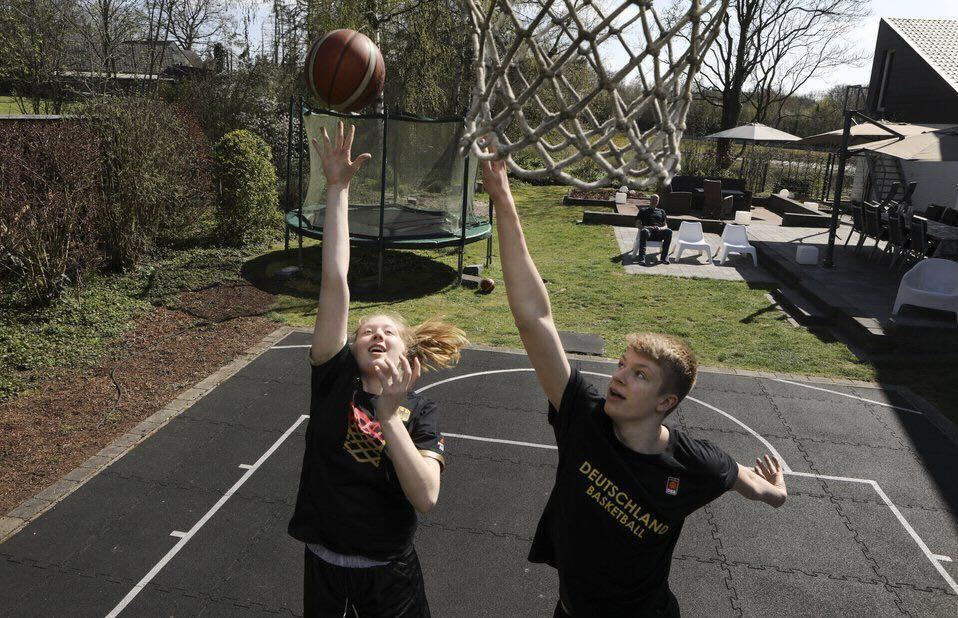
Playing basketball came easily to Frieda and her brothers, but finding courts on which to play was sometimes a challenge. Unlike the United States, where outdoor basketball courts populate countless playgrounds and schools across the country, it’s not easy to find a court outside. Andreas decided to build one himself, something that gave his kids the chance to hone their skills in a different way.
“It was important to have a perfect ground for it… to have the real basket,” he explained. “And then it was really nice time, because they met with their friends here, and had some fun outside. It was not really for doing practice here, but it was just for having fun.”
A brief stint in the US changed everything
Fun remains the whole point these days, though it’s fair to say that Frieda’s current experience in the sport is akin to being blasted into outerspace rather unexpectedly. She spent four months playing with the Florida Gators under then-head coach Kelly Rae Finley. Her decision to leave had little to do with the program, but more to do with the vision she had for herself, and what felt right.
“I just realized it’s not really the way I wanted to play … I didn’t feel comfortable with myself,” Frieda told The IX Basketball directly after the Fire’s practice Thursday. “I felt like I was kind of — it might sound corny — but losing myself, and I thought, ‘Okay, I worked so hard to get to this point, and now to have the feeling that it’s all fading away.'”
“The facilities are amazing, the professionalism is crazy [in the States],” she added. “Even on the college level, you can’t compare [it] to what’s happening in Europe. So that’s part of why I went, and I’m so happy I went, and everyone was super nice. I just [realized it] just wasn’t for me.”
At this point in the conversation, Frieda was standing directly under the Moda Center Jumbotron. She paused, and then offered, “I think sometimes you need to realize when things are not for you, [and] you also need to go through some things. Also, you have to know yourself. I think I know myself pretty well, so I made the decision. It wasn’t easy, and at first I thought, well, did I fail?”
“But no, I didn’t. It’s just a different path you’re taking.”
When asked about Frieda’s worry she might have failed in some way for leaving the program, Andreas immediately and confidently said that for himself and Frieda’s mother, Ariane, it was the opposite.
“For us as parents, in her situation — we were not worried about that at all, and we are still not worried,” he said. “She was quite adult in this situation, I would say. So she found there a situation where she realized in a short time, maybe this is not that fit for several reasons.”
For Andreas and Ariane, there was also a sense of pride that their young daughter was brave enough to stay true to herself. “She rearranged it for herself, and she made this decision for herself, and this is what still makes us, as parents, very proud, because she was very young then,” he said.
There’s also a little more to it, he added. “From everything you learn … you grow from every situation. That’s what we are convinced in, everything you do has a reason,” Andreas said. “Everything you do … if every experience you make is a good experience, or it’s a bad experience … it was a experience, and every experience you have helps you grow. It helps you.”
2026 WNBA transaction tracker
Frieda ended up in Florida by way of Alexandra Shaw, the managing director at Scorers 1st Sports Management, who happened to attend college at Northwestern alongside the team’s former coach, Kelly Rae Finley. “Alex has a really good eye for talent, and she’s just — she really knows what she’s talking about,” Finley told The IX Basketball.
“I think when she looks back [on her time at Florida], it was probably a good experience, something that made her better when she went to Spain and better able to adapt, probably in the role that she’s in now,” Finley added. “But we really, we wish we would have had her longer. We knew she was a superstar then, and so it’s exciting to see her be able to continue … She’s super productive, and the longer she plays, the better she’s going to get.”
From Spain to the WNBA
For Frieda, heading back to Europe was definitely the better option. That allowed her the opportunity to play on the German National Team in the 2024 Summer Olympic Games, and to play for Movistar Estudiantes in Madrid, Spain.
Shaw also agrees the move was the right one. “She just adapts, and she’s a sponge, and she’s such a smart player,” she said of Frieda. “People have always doubted her, but she will always prove everybody wrong. When we moved her to Spain, it was like, ‘She might not be athletic enough for this league, she might be too slow, she might be this and this’, and she proved everybody wrong.”
A lot of American basketball fans are only just beginning to understand European basketball leagues. The system is very different overseas: athletes often begin playing for professional clubs while in their early teens, which is one reason so many are ready for the WNBA when they’re only 19 or 20.
There are also broad differences between how basketball is played in different countries. While a lot of WNBA fans have a cursory knowledge of French basketball, thanks to the influx of players such as Marine Johannes, Gabby Williams and Carla Leite, the Spanish league is just as compeititive. And, unsurprisingly, it’s difficult to sum up what makes each league different in only a handful of minutes, but Frieda took a shot at it anyway.
“Spanish basketball is very quick,” she said. “You run a lot, it’s quick decisions … you get punished if you don’t make quick decisions defensively, but also offensively, it’s really just like super quick.”
French basketball, on the other hand, is more physical. “I think we’ve got a lot of size, and we are very disciplined in what we do,” in Germany, she added. And the differences don’t stop there. While playing the World Cup Qualifiers, the German team encountered others from all over the world.
“We played against the Philippines or against South Korea, and you just see these basketball styles crashing… like [the] Philippines and South Korea [are] just super quick, shooting threes the whole time, just cutting everything,” she explained. “You’re like, ‘Oh my god, like we have a size advantage, but they’re just like moving the whole time.'”
Rep The IX Sports at your next game!

Shop the logo collection or special “Women’s Sports are Front Page News” collection now on Shopify.
The WNBA is an entirely different experience.
“I think it’s a little bit of an adjustment, obviously, coming here to the States, because the basketball is different,” she said. “It’s just quicker. It’s more one against one, and more — I feel like sometimes in Europe it’s more, not in a bad way, but team first.”
When it comes to recruiting players from outside of the United States and bringing them into programs like Florida, those differences are clear — but, luckily, there’s also something all basketball players have in common.
“The language is the game, right?” Finley, who is now an assistant coach at Virginia, told The IX Basketball. “And so there’s a common language, which is basketball, which makes it really, really fun.”
There’s also an exchange of knowledge that takes place between all the players on a roster. “Learning how to adapt and play with people who are not exactly like you, that’s a skill in itself,” Finley added, “and I think in terms of the game, IQ, passing ability and skill set were really differentiators for Frida when she came over. And that’s something that you tend to see with many European players who come over.”
The Portland Fire knew Frieda was special
The Fire had to move quickly once the 2026 Collective Bargaining Agreement (CBA) was signed and it was time to put a team in place. Though they had an idea of who they wanted to draft, there wasn’t as much time available to scout as they might have liked.
But that doesn’t mean they were unfamiliar with Frieda’s game before making the decision to draft her in the second round — in fact, quite the opposite is true.
Head coach Alex Sarama and GM Vanja Černivec saw Frieda play in Lyon, when Germany took on France. “Frieda, to be honest, had a quiet night,” he told reporters Thursday, “but she was always in the right place at the right time. And I think that’s something with scouts that I think, a lot of the time, it’s those things, those traits, that are missed.”
Scouting is evolving, he added. “You’re not just looking at athletic profiles and obvious numbers, btu it’s those subtleties, which I think are really important.”
As an expansion team, the Fire’s front office and coaching staff knew things would move quickly. “We had to get a look at everyone, but I think we saw enough,” Sarama said.
Her parents didn’t meet Sarama and Černivec on that trip, Andreas said. They also didn’t travel to the States for the WNBA Draft, because no one knew if Frieda would be drafted at all. Hearing her name called during the second round was a surprise, and everything that’s happened since has been a whirlwind.
“That draft night was so incredibly exciting for us, because we obviously didn’t know when she would be picked, if she would be picked, and we clearly [had] seen there was some interest here,” he explained. European clubs were interested in Frieda, but so were the Fire.
“We didn’t talk to [the Fire], so it was all new for us, and it was, it was very exciting,” Andreas added of the moment Frieda’s name was called. “I still … I cannot, I [can’t] find the right word, the words for that, because it was just — I couldn’t really talk and say anything in this moment, I was paralyzed in this moment. It was such a huge moment for us, as [a] family.”
The Bühners stay up and watch Frieda’s games, despite the nine hour time difference between Portland and Germany, Shaw said. Her debut came during a preseason match and thrilled her family back home.
“There was this preparation game, and she came on court,” he said of the moment. “I remember the times we had Marie Gülich playing in the WNBA, and we had, before, Marleys Askamp playing in the WNBA as a German player in the late ’90s.”
Now, he added, there are are many Germans playing in the league, and his daughter is one of them. “We were looking, and we thought, ‘These are really great players.’ For us, seeing them there, playing in the W, and then realizing our daughter would be drafted and then was there, and she was playing in this first preparation game — it was incredible.”
Being drafted also gave Frieda yet another opportuity to prove people wrong, Shaw said. “Then going into the draft, it was the same thing: a lot of people doubted her, like she won’t be athletic enough for the W,” she explained. “And [now] here we go. They throw her in the game, and she performs, and I think the sky is the limit for her.”
For Frieda, the opportunity to play in the WNBA is a dream come true, literally. She scored the team’s 100th point during the Fire’s May 30 win over the Indiana Fever, a franchise first that will always be credited to her.
2026 WNBA Injury Tracker
“It’s amazing,” she said of the experience. “I mean, we were on this road trip: Indiana, Toronto and then New York, and I’m just like, ‘Wow.’ Just walking through the streets of Toronto and New York, and I’m in Portland, just living here and playing in this WNBA arena — the fans are amazing, and with all this going around, it’s just crazy.”
“I mean, there’s so much around the basketball that I didn’t have before, but what makes it even more amazing [is] you really feel like… professional, [and] you really feel like, ‘Wow.’ The way they support you here is amazing,” Frieda also said.
She’s also making friends. Frieda and teammate Nyadiew Puoch can often be spotted singing along to Destiny’s Child songs that came out before they were born (they’re both 2004 babies; the group announced their disbandment in 2005) and laughing in between firing off shots at the basket.
In fact, it would be easy to think they’d met before. Puoch, who is also playing for the WNBA for the first time, came to the league by way of Australia’s Women’s National Basketball League (WNBL), but they never crossed paths until this year.
“I just met Frieda, as well as the other girls on the team,” Puoch said Thursday. “But it’s great. She’s a rookie, I’m a rookie, but we’re having so much fun. Frieda is amazing. She’s a great person.”
Being able to share the experience of being new is important, too. “Having another rookie, we both understand,” she continued. “We really want to buy into [Sarama’s system] and work hard. I think it’s really cool.”