

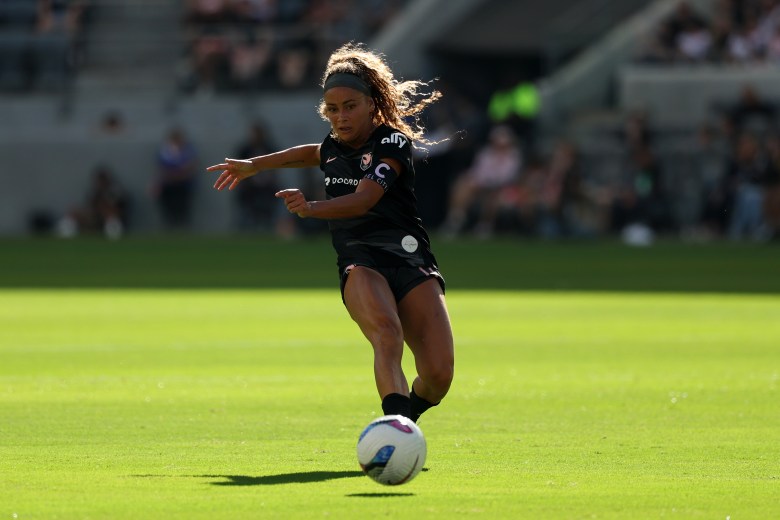
Sarah Gorden is at a bit of a crossroads. Not professionally — the defender, who was drafted by the Chicago Stars in 2018 and spent several seasons with the team before she was traded to Angel City in 2022, is doing just fine there. But her personal life is presenting a dilemma: what name will be emblazoned on the back of her jersey when she gets married?
To be fair, Gorden isn’t necessarily in any rush to walk down the aisle. She and her fiance got engaged in 2024, she noted on a Substack post published this month, but haven’t planned much. But she’s starting to think about what comes after the wedding, after guests have gone home and the honeymoon’s over. Will she become Sarah Slade?
“At the end of the day,” Gorden told The IX Sports, the decision is “complicated and very personal.” Changing a core part of one’s identity is a lot for anyone to consider, and that’s especially true for women who play professional sports. After all, spotting a player’s last name on the back of a jersey is often the fastest way for fans to identity their favorite athlete; it’s also a way that fans and athletes have connected over the years. In some ways, last names are bridges.
A lot of current NWSL players are in “an interesting position where we’ve made a living, playing soccer, and our name is on the back of our jersey, people buy those jerseys, and so we’re really, like, well known by that name,” Gorden said. “So, I think in some ways, that makes it a little bit harder of a decision as what’s right to you, but there’s obviously no wrong decision, and it’s a very personal, personal answer.”
That question, and answer, are ones that women are much more likely to wrestle with than men, Dr. Rachel Allison, Associate Professor of Sociology at Mississippi State, told The IX Sports. “I think professional women athletes have a particularly unique set of considerations compared to men, but also compared to women who aren’t in this particular job,” she said. “So there probably isn’t any other job that I can think of where your last name is broadcast to others while you are performing it.”
A name is part of an athlete’s identity well before they take to the pitch, but can become magnified as they become more well known. “Women in particular in that space have unique considerations in part because it is predominantly women that consider changing their names,” Allison added. “I was looking this morning at a 2023 Pew Research study of marital name change and they found that 79% of [cisgender] women who marry [cisgender] men still do change their last name. Alternative arrangements, including potentially men taking their wives last name or both members of a couple deciding on a new last name for the family are incredibly rare. It doesn’t happen very often. And so it really is a consideration that mostly women are making.”
For Gorden, part of the appeal of changing her name is the sense of bonding it lends to her upcoming marriage. “It’s an act of unity and love. I want my partner to feel seen and loved,” she wrote on her Substack. “‘I love you so much, that I am willing to give up this thing I’ve carried with me my entire life, to join you.’ Is this beautiful or slightly toxic…”
But that sense of unity can also be deceptive, Allison said. After all, queer couples marry one another and don’t have the same rates of name change that heterosexual couples do — a fact that doesn’t water down their unions at all.
Queer couples aren’t necessarily encountering a “social norm that establishes whether names change, who changes whose names and so on. And so inherently they’re kind of thinking about this a little differently,” Allison explained.
“I think most of us are kind of socialized from a young age, kind of see this as the norm,” she continued. “And so while the tradition of name change itself has deeply patriarchal roots — literally it signals the transfer of women ownership of women from fathers to husbands — that is not actually what it means anymore. So that is the legacy and tradition of this practice, but now it’s often been culturally resignified so that it is intended to convey a sense of union of like bringing together into one family what were previously separate individuals.”
“And in that sense, it does indicate union and love. It’s a beautiful meaning, right?” she added. “And it’s a meaning that really speaks to a lot of us [and that] has a deep emotional pull.”
Last names aren’t the only considerations that women’s professional athletes are making that their male counterparts may not. Gorden is also thinking about how having a new name on her jersey could impact her career. (It’s worth noting that Lindsey Heaps, who changed her last name after getting married in December 2024, has the number two selling jersey in the NWSL).
“That was the biggest thing to me is, seeing some of my colleagues changing their name and getting used to calling them that name or hearing their name a few times in a game and being like, ‘Wait, who is that again?'” she said. “And so obviously it does go back to marketability and I don’t know, financially … I just know that I was born with this thing and it’s the name that I was given at birth and that’s what people know me as.”
To that end, Allison believes NWSL fans are more adaptable than some might think. As a long time fan of women’s soccer, she said, “I have to like retrain my brain to recognize this new last name, but it’s not that hard. I mean, we do it in our everyday life when the people around us get married and change their names already. So it’s not like this insurmountable barrier.”
Gorden, who is a mother of one, also pointed out that there are all kinds of things she has to think about: having more children, how that might impact her season(s) with Angel City if she does, and her own marketability as a female athlete. For her, taking things one day at a time is key. “I always say at the end of the day, do what you want to do because that will have the greatest effect on you in every way, financially, emotionally,” she explained. “And I always feel like if it’s the right thing for you, it’ll work out no matter what.”
Order ‘Rare Gems’ and save 30%
Howard Megdal, founder and editor of The IX Basketball and The IX Sports, wrote this deeply reported book. “Rare Gems” follows four connected generations of women’s basketball pioneers, from Elvera “Peps” Neuman to Cheryl Reeve and from Lindsay Whalen to Sylvia Fowles and Paige Bueckers.
If you enjoy Megdal’s coverage of women’s basketball every Wednesday at The IX Sports, you will love “Rare Gems: How Four Generations of Women Paved the Way for the WNBA.” Click the link below to order and enter MEGDAL30 at checkout to save 30%!