

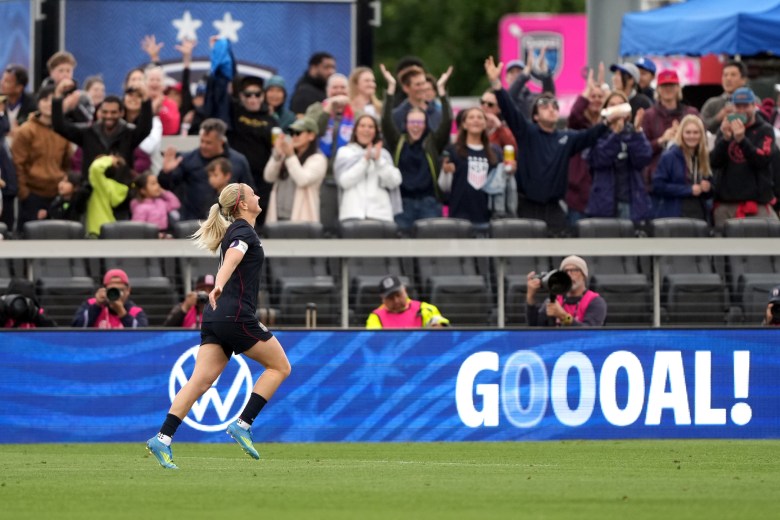
The second friendly (or, rather, unfriendly) match between the US Women’s national team and Brazil ended in chaos Tuesday night. And though the Americans took home the 1-0 victory, if anyone truly came out a winner of the match, it might be referee Paola Cebollada López, who somehow managed to keep her own cool in the face of a coach and team that seemed determined to undermine it.
Team USA’s win offered proof that this year’s national team has what it takes to beat top competition. The victory was the first for Americans on Brazilian soil since 1997, and came just three days after they suffered a 2-1 loss.
The game’s hosts were issued a total of eight red cards during the match at Arena Castelão in Fortaleza. And though the game ended in disarray, it offered some of the USWNT’s newcomers the chance to see what playing on truly hostile ground is like — Brazil made sure to deliver on that lesson.
More on that, and other takeaways from the team’s jaunt through Brazil, are below.
Michelle Cooper is Team USA’s enforcer
Cooper started Tuesday night’s game after coming in at halftime on Saturday, a decision that appeared to be part of head coach Emma Hayes’ plan to play a tougher game of soccer for the second go-around. Cooper played a full 90 minutes and showcased exactly why she’s on the USWNT right now — and why she deserves to remain there.
USWNT’s vets were invaluable
Like any national team, the USWNT is tasked with weighing the benefits of focusing on developing its young core versus being able to call upon seasoned veterans to keep games tight and focused. That was on full display last night, as Lindsey Heaps demonstrated the ability to keep both herself and her teammates from descending into chaos right alongside the Brazilian team.
“I hope that’s not what a World Cup final looks like, and I hope that there’s more football being played,” Heaps said after the game. “I hope that it’s the beautiful game again because, for me, that’s a whole different sport. I think this [Brazil] is a really good team with a lot of quality, but I just don’t think the game should be played in that type of way.”
“Becoming Caitlin Clark” is out now!
Howard Megdal’s newest book is here! “Becoming Caitlin Clark: The Unknown Origin Story of a Modern Basketball Superstar” captures both the historic nature of Clark’s rise and the critical context over the previous century that helped make it possible, including interviews with Clark, Lisa Bluder (who also wrote the foreword), C. Vivian Stringer, Jan Jensen, Molly Kazmer and many others.
Paola Cebollada López was a refereeing masterclass
The game’s refs certainly had their work cut out for them on Tuesday, and perhaps no one more than Paola Cebollada Lopez. Though she wasn’t quite as aggressive as she could have been during the first half (when she handed out four yellow cards), Lopez deftly handled things during the second and kept what was already a disruptive match from completely boiling over.
By the time things were all said and done, López had sent four Brazilian coaches and players off the field. Head coach Arthur José Ribas Elias exited around the 77th minute after he kicked the ball away, which prompted an outcry from players on the pitch. Defender Tarciane ended up elbowing Sophia Wilson in the face, in what was likely a heat-of-the-moment unforced error. Things got so bad that two more Brazilian players were issued red cards after the match ended.
Both teams have a lot to work on before 2027
Both the USWNT and Brazil have plenty to develop before next year’s World Cup, though in different ways. Although the match was gritty, Team USA demonstrated a competitive advantage. What they need to largely focus on is tightening up set pieces and capitalizing on goal opportunities. Several members of the USWNT, including Wilson, Trinity Rodman, Olivia Moultrie, Rose Lavelle and Emma Sears, all failed to finish big scoring moments, something that’s been a consistent worry and struggle for the team.
But, despite the game’s ups and downs, Team USA also showcased a determination and resilience that is exactly in line with what Hayes has hoped to instill in the national team. It took a full 63 minutes for Wilson to score the goal that won the match, but the Americans never wavered in terms of their composure and resolve.
As the event’s hosts, Brazil will be under the microscope in a way that may magnify the team’s worst traits — or may push them to be better. The team’s behavior, from the coaching staff to the players on and off the field, makes it difficult to assess what exactly went wrong for them on a skill level.
Brazil is known for playing aggressively, but Tuesday night’s game waded into a style of play that can best be described as unprofessional. Ending a match with red cards still being dispersed and police dressed in riot gear to escort refs out might make for compelling television and social media clips, but that’s not a look a top-tier team wants to display. Brazil’s roster is stacked and could dominate the landscape of women’s soccer come the 2027 World Cup, but the behavior that was on display on Tuesday indicates a program that could be closer to being in crisis mode than not.
Despite that, comments made in postgame interviews appeared to suggest that Brazil ended the game under the impression that the Americans were responsible for its chaos. “Honestly, what happened here today is a complete disgrace,” said Angelina Alonso Costantino (who is known as Angelina by the soccer world).
“The fourth official had no idea what’s going on the field, VAR doesn’t work,” she continued. “It apparently doesn’t check anything. One of our players gets stepped on and nobody reviews it. Then there’s a shove here, and the referee suddenly wants to start sending our players off. So, it’s really difficult.
“One of USWNT players gave an interview saying it was a really nice atmosphere. But on the field, she was saying we were trash, that we didn’t know how to play football,” Angelina added. “So it’s a huge lack of respect — both from the refereeing and from their players, too.”
Listen now to The IX Sports Podcast and Women’s Sports Daily
We are excited to announce the launch of TWO new podcasts for all the women’s sports fans out there looking for a daily dose of women’s sports news and analysis. Stream on Spotify, Apple Podcasts or anywhere you listen to podcasts, and make sure to subscribe!
The lack of respect started with the Brazil coach. The way he treated the refs – with disrespect in a misogynistic way – told his team and staff all bets were off and that level of disrespect for the game was OK.
lol, does Stephanie Kaloi even understand football? The reason the Brasil team was upset about the color clashing is that those issues are supposed to be handled with the 4th official BEFORE a match. It is highly unusual and unprofessional to stop play of the game for a color clash. The Brazilians, rightly, felt disrespected. Thst was not misogyny. He works with women for a living!!!!! He was upset at being disrespected. As he should have been. Even if the ref had been male, the timing of that first yellow card would have upset the Brazilians. Anyone saying this was a “masterclass” in game management is hilariously misinformed.
Also, Wilson caused a Brazilian injury in the first half, with no consequence. Then in the second half she dramatically fell to the ground after Bia barely pushed her, causing Bia to be carded, THAT is what caused the chaos!! The referee team with an obvious bias against Brazil, and an American team willing to exaggerate like Neymar, caused the Brazilians to lose their cool. I’m American, but I’m with the Brazilians on this one. Horrible refereeing, and an American squad taking full advantage of that, is what caused the chaos.
I don’t think you watched the game or even tried to research about it, because if you had, then you would have wrote something different. The simple disrespect of the ref is something that’s astounding to me. She gave the coach a yellow card for wearing black because the US was wearing it. BLACK! what is the problem with her?? Because I can see that you would give a warning or tell the goalie that if they are wearing black they have to immediately change. But that was the coach! He wasn’t even on the field playing with them. But after that, it simply escalated. everybody was rude, I’ll say that, but the US and the ref were both in a whole other level where we couldn’t play the game. This game was an insult to soccer and Brasil, and we would have won or at least scored if it weren’t for the rigged referee.