Hindsight is 20/20 right now for the New York Liberty.
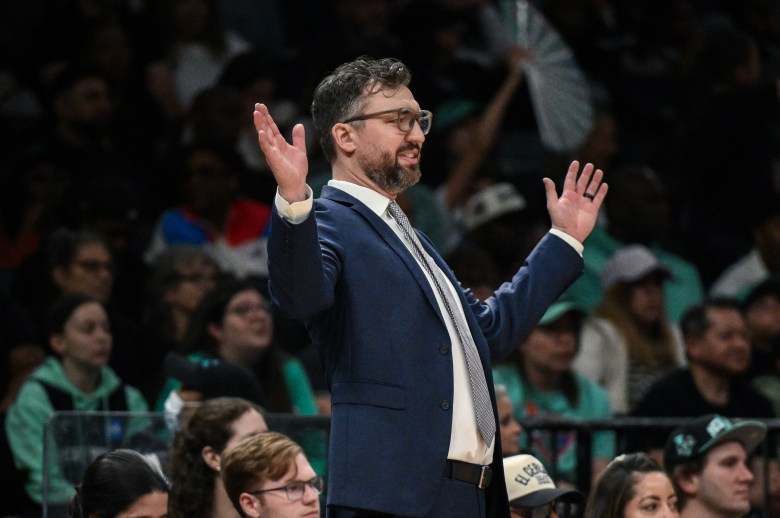
Less than a year ago, the franchise hired head coach Chris DeMarco. On Tuesday, he was relieved of his duties.
DeMarco’s lack of experience coaching women and lack of full-season head coaching experience should have caused alarm bells for a franchise desperately wanting to win another WNBA title.
One could argue that WNBA legend and three-time WNBA champion Becky Hammon had a similar lack of experience when she was hired as the Las Vegas Aces head coach in 2022. She hadn’t been a full-time head coach before, and she hadn’t coached women, either, coming from the NBA.
But Hammon played in the WNBA for 15 seasons and coached a San Antonio Spurs Summer League team to a title in 2015. She wasn’t a full-season head coach, but her work yielded a title, which would be one of many to come.
DeMarco was also a head coach at Summer League in 2017 for the Golden State Warriors. He went 2-4, with Hoops Habit’s Bernie Dailleboust writing that the losses weren’t representative of “the competitiveness [the team] displayed.” Two of those losses were by a single possession. DeMarco also coached the Bahamas men’s national team, coming up one game short of an Olympic berth.
The theme here is close, yet so far from the ultimate goal, and that’s what could be said about how DeMarco’s only season coaching the Liberty went.
While the Liberty became the first No. 8 seed to eliminate a No. 1 seed in WNBA history, they beat a flawed Minnesota Lynx team. The Lynx were missing the two-way play of Bridget Carleton and Alanna Smith and were led by rookie Olivia Miles and a still-not-100% Napheesa Collier.
Just 10 days after the Liberty looked like a version of their championship-winning selves from 2024 in that best-of-three series, they were swept in the semifinals by the Atlanta Dream.
Another standout moment from the 2026 campaign was the Liberty capturing the Commissioner’s Cup, their second in franchise history. But this came with some important caveats, too. Teams hadn’t fully scouted eventual WNBA All-Rookie selection Pauline Astier yet, and now-five-time WNBA MVP A’ja Wilson did not play for the Aces in the championship game.
But once again, hindsight is 20/20.
Reports that the team had officially dismissed DeMarco after one season broke on Tuesday, the same day that many of the team’s U.S. fans went to the polls to vote in the 2026 midterm elections. The majority sentiment was that the news was something to celebrate. One fan in the comments of the Liberty’s Instagram post wrote that the team moving on from DeMarco was part of the Democrats’ “blue wave” of election victories.
This all came exactly 409 days after the franchise wrote a letter explaining to fans that the team’s first-round playoff exit in 2025 under former championship-winning head coach Sandy Brondello was unacceptable. Signed by Liberty general manager Jonathan Kolb and CEO Keia Clarke, the letter said the loss would motivate the franchise to make sure that it would be back on top of the league and in position to win a second title.
“Our second title may have been delayed, but it will most certainly not be denied,” it read. It made a point to say that 2026, the 30th season for the organization, was going to be its “best chapter yet.”
The Liberty’s 2026 season was far from its best chapter. The franchise didn’t send a letter at the end of this season, but by firing DeMarco, the Liberty’s decision-makers admitted that he was the wrong fit for what they need going forward.
Under different circumstances, maybe DeMarco would have been retained. On paper, the Liberty didn’t have a terrible season. They won a first-round playoff series, finished the regular season 26-18 under a rookie head coach and won the Commissioner’s Cup.
Also, the roster DeMarco was given on Day 1 of training camp looked quite different from the one he finished with in October. Long-term injuries to wings Satou Sabally and Leonie Fiebich didn’t help. Betnijah Laney-Hamilton being waived midseason caused more public confusion and discord.
The failures of the DeMarco experiment are due to his potential not matching the reality of what it takes to lead a WNBA contender. His inexperience was part of why the Liberty had the season they did. Their play was inconsistent, they were disconnected, and they lacked the identity and toughness that Liberty teams of the 2020s exuded.
It begs several questions: Was it a realistic goal for the Liberty to contend for a championship in 2026 when the head coach lacked mastery of the necessary skills for high-level success?
Why did the Liberty buy what DeMarco was selling, only to uncover that the picture painted by his interviews and references didn’t match who he was in the job day-to-day?
Did DeMarco’s lengthy tenure with the Warriors, without advancing beyond an assistant role, actually reveal more about his limitations than his strengths?
Let’s look back at some of the signs that foreshadowed what would eventually come to pass, based on observations and conversations with people in and around the Liberty throughout the season.
Listen now to The IX Sports Podcast and Women’s Sports Daily
We are excited to announce the launch of TWO new podcasts for all the women’s sports fans out there looking for a daily dose of women’s sports news and analysis. Stream on Spotify, Apple Podcasts or anywhere you listen to podcasts, and make sure to subscribe!
Concerns at the beginning of the season
When Stewart arrived at Liberty training camp in April, she sat down with the media to discuss all that had taken place since she had last worn a Liberty jersey. This included topics such as her EuroLeague championship with Turkish powerhouse Fenerbahçe, the Unrivaled title she won, and her invaluable role negotiating the 2026 collective bargaining agreement.
A reporter asked if Stewart had been in contact with “CD,” referring to the nickname the Warriors had for DeMarco, or any of the staff about expectations for the season. Stewart had to interrupt the question once the confusion on her face clicked into understanding.
“You guys confused [me],” she said. “So I only have one CD, right? And that’s [UConn associate head coach] Chris Dailey. So I was like, ‘Wait.’ … But, yeah, [DeMarco] and I have kept in contact a little bit. He didn’t want to kind of put too much on me while I was with another team.”
Stewart’s confusion and immediate association with Dailey was a small but critical reminder that DeMarco hadn’t yet established the relationship or familiarity with Stewart that would make him an immediate point of reference for her.
Just because DeMarco was named head coach didn’t mean he automatically gained Stewart’s immediate respect and trust. He had to earn it, especially since Stewart wasn’t involved in the decision to move on from Brondello, someone she trusted deeply.
The way a coach earns trust is by establishing a clear and meaningful locker room culture. At first, it seemed like DeMarco was establishing some non-negotiables. An example of this was his fining system, where there were financial repercussions if players didn’t box out or show up on time to practice. It wasn’t clear if this worked or not, but DeMarco stopped doing this and there wasn’t much mention of it after a few weeks of the regular season.
So what were the expectations, standards and values that shaped the team’s culture? That also didn’t seem clear.
“I think we’re still trying to stick to our values, and we’re also still trying to, I guess, identify that,” Laney-Hamilton told reporters on May 1. When she was asked what the team’s values are, she noted that the group was “still building it.”
DeMarco did have one tagline that was revealed during an episode of the team’s behind-the-scenes video series, “Liberty Unlocked.” Assistant coach Courtney Paris brought up his phrase “No blame, just build.”
Stewart alluded to this construction metaphor on June 3, noting that May was the Liberty’s learning period as they were figuring out new basketball principles. “June is now our month to build, and really build that confidence and make sure we get better every single day.”
But this metaphor didn’t stick in a meaningful way. The messaging wasn’t communicated by the players all that often publicly. Instead, the Liberty’s Big Three of Stewart, guard Sabrina Ionescu and Jones often used “Brondello-isms,” namely “never too high, never too low,” during the 2026 season.
Struggles learning and adapting to personnel
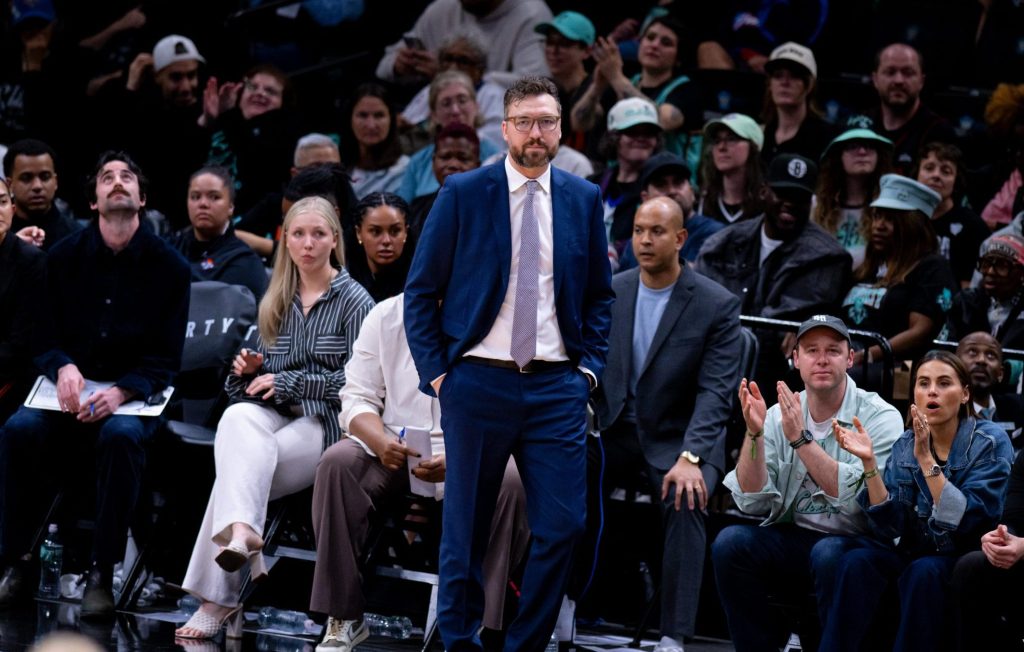
There were moments before the All-Star break when the Liberty were struggling to play with the proper effort and lost to several less talented and less experienced teams. Jones and Stewart opened up about how frustrating this was, especially since the roster wasn’t playing with enough “heart.” (Under Brondello, “heart” was a word that the Liberty used to represent the team’s values.)
During this time, Ionescu was working her way back after missing the first month of the season, and Fiebich was out, which made a lot of the regular season difficult. But there were multiple examples of moments where DeMarco and his coaching staff took too long to adapt to their circumstances.
“There’s a certain way about preparation and communication that you have to have to be a head coach,” Indiana Fever head coach Stephanie White explained in August. “There’s a certain way about being able to adjust, being able to have poise in certain situations, being able to communicate clearly, and to sometimes get out of your own way.
“We often talk about scouting reports, for example. It’s like, ‘OK, even if we think this is the best way, if it’s not working because our players can’t do it or aren’t doing it, then we have to change, right? We have to get out of our own way.'”
DeMarco struggled at times to get out of his own way, especially when it came to the defensive side of the ball, which was advertised as his calling card when he was hired. There was a period of time before the All-Star break when the Liberty were using way too much zone defense, which contributed to teams shooting well against the Liberty.
The zone was supposed to take advantage of the length the Liberty had on their roster with Jones, Stewart, Fiebich, Sabally and Laney-Hamilton. But at times, only two of those players were playing, and New York continued to use a zone that just didn’t set the rest of the roster up for success.
The Liberty weren’t only throwing out zones, though. They were also trying more NBA-style junk defenses and presses, which the returners on the roster hadn’t done in previous years.
Some of the “effort” issues came from a lack of confidence in the schemes, according to Ionescu.
“It’s kind of … overthinking in terms of where we want to be and how we want to do things,” she said. “So I think it’s more of a lack of, maybe, exactly knowing how we’re trying to execute and what we’re trying to do.”
Frustration with the defense and its lack of execution boiled over when the Liberty lost 108-88 to the Indiana Fever on the road. They turned the ball over 17 times, which resulted in 30 Fever points, including 18 fast-break points.
Stewart and Jones held themselves accountable for turning it over a combined nine times. But DeMarco only took responsibility for keeping his emotions in check rather than for the fact that the Liberty had lost four straight games. When asked what adjustments he felt like he needed to make when it came to calming the team down in the moment, he wouldn’t even go there.
“We’ll always use our timeouts when we feel like we need to, but for the most part we want the ball in our best players’ hands,” he said. Jones and Stewart didn’t even look at their head coach while he said this.
After the game, the Liberty had a players-only meeting where Stewart preached that they needed to play their game instead of “trying to do everything that the coaches want.”
When the team returned from a long West Coast road trip after the All-Star break, Stewart explained at the team’s first practice in weeks what some of her frustrations defensively had been.
“Honestly, we’ve been really kind of talking about more as of late, after All-Star break, about our foundation. … It’s been a little bit weird because we haven’t had practice,” she said. “… And it’s helpful that we have vets, so you’re able to do that. But that’s the start, and we didn’t do that in the beginning, and we should have, but we are now.”
Did DeMarco put the cart before the horse by waiting until after the All-Star break to really establish defensive principles? It’s ironic that there was such confusion on defense because Kolb noted in May that he didn’t want the Liberty to be “masters of none,” something he thought the team was during Brondello’s final season.
Defensively, this team appeared to be masters of none once again. While the issues on offense were less striking, there were also opportunities to adjust the system to better fit the Liberty’s personnel. The starkest example was the fact that Ionescu wasn’t given relief from her role having to screen for her teammates, which put much more strain on an already injured back.
“I wore like a back brace and tape and was trying … to do everything I can to brace my core, especially getting hit on some of those screens as a screener,” she told The IX Sports right before the playoffs.
After the season ended, Ionescu was able to speak more freely about how much pain she was still in. “A lot,” she said. “It was not a an easy year for me. Physically, mentally, all the above.”
Could it have been that DeMarco’s vision didn’t immediately translate to not only the Liberty’s roster, but to the WNBA in general? Stewart alluded to this prior to the playoffs. “It took him a while to get his footing to get to this point, and now he stands and backs himself on the things that he wanted to bring to the team,” she said.
Questions surrounding communication with players and leadership
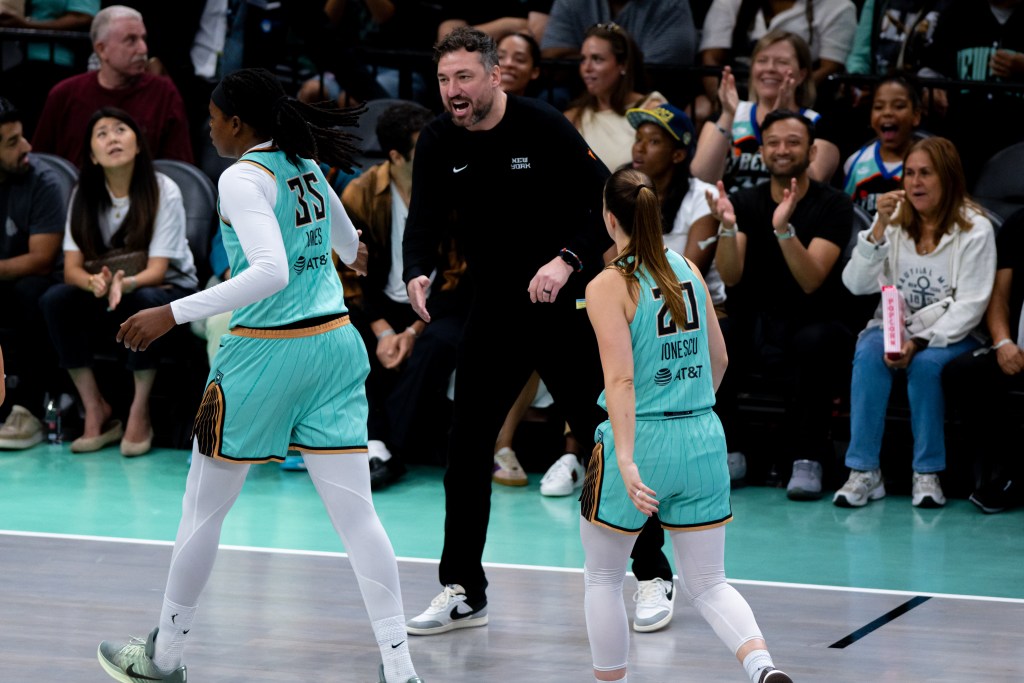
It’s time to shift the discussion to Betnijah Laney-Hamilton, one of the great mysteries of the 2026 season. It became clear that, due to multiple surgeries on her knees, she wasn’t moving the way she had circa 2023 and 2024. Since DeMarco’s system required one-on-one driving ability, Laney-Hamilton wasn’t a great fit.
She also hadn’t played organized basketball in over a year before training camp. So since her shots weren’t falling, in addition to her not moving in the way she wanted, it put a lot of pressure on her mental health and led to her confidence deteriorating. Her role kept changing without much communication from DeMarco because he and his staff wanted to be focused on winning, rather than adhering to the needs of a single player. But isn’t the job of a head coach to emotionally support players in addition to teaching them?
This emotional roller coaster led to her no longer wanting to be in New York, the place she’d won a championship and helped rebuild a fanbase. She requested a trade.
What made matters even more unfortunate was that she was benched for several weeks before the trade deadline. It happened after a game against the Toronto Tempo when she threw Jones’ shoe back to her but accidentally hit Tempo guard Marina Mabrey. That became Laney-Hamilton’s second technical foul of the game, and she was ejected.
Laney-Hamilton looked the most confident she had all season in her minutes against the Tempo, but then she was shut down. It’s unclear if the coaching staff’s decision was punitive. Was throwing a shoe the last straw? It wouldn’t have made sense for this decision to have come from Kolb because he was trying to elevate her value in the trade market. And since she wasn’t playing, other teams didn’t want to acquiesce to Kolb’s trade proposals, which were reportedly too high.
Laney-Hamilton was made to feel useless in her final weeks in New York. When she was picked up off waivers by the Washington Mystics, however, Washington found a role for her that she could have had in New York. She provided veteran leadership, used her high basketball instincts when needed, served as a connector and could play hard defensively in spurts.
When DeMarco was dealing with the situation, he didn’t seem to be able to clearly communicate to reporters how hard this was for her until after she had been waived.
“I don’t think it’s talked about enough how hard it is for players and that year off and trying to rehab, same gym, same routine,” he said. “A lot goes into it. It’s hard mentally sometimes, too.” He had public empathy afterward rather than throughout the situation.
This lack of emotional intelligence and clear communication continued in his relationships with players — even with Ionescu, who had been rumored as the player most involved in DeMarco’s hire among the Liberty’s Big Three.
There was a well-documented moment when Ionescu raised her voice at DeMarco during a game against the Seattle Storm on Aug. 3. She was asked about this interaction postgame and replied that she and DeMarco banter like siblings.
“Sometimes I just have to let him know that I was right,” she said. “So we’re just kind of bantering, but it’s really like siblings.”
While Ionescu was trying to temper the situation, her sibling comparison left reporters with questions about how much Ionescu respected DeMarco as a leader.
Ten days later, Ionescu was asked about how intentional she’d been about getting two feet in the paint to score. She credited offensive coordinator Will Sheehey for working with her on refining that skill, which was particularly difficult to do while dealing with a back injury. Then DeMarco interjected.
“[It’s] easier to pass off two feet as well,” he said with a smirk.
Ionescu was visibly turned off by that comment. She rolled her eyes horizontally and put a couple of fingers in the air to express some confusion and annoyance about why that comment was necessary. Then she turned that tension into a nervous chuckle.
Jones, too, offered a glimpse into the challenges of being led by a coach who was still learning how the league operates. After the Liberty smacked an Aces team that was without stars Wilson, Jackie Young and Chelsea Gray on Aug. 9, a reporter asked Jones how much she felt like the coaching staff had grown since the beginning of the season and how much the players had rubbed off on them.
She described how collaborative the process had been with the coaching staff but then acknowledged some growing pains.
“What I will, I guess, commend the coaching staff with is just their willingness to listen,” she said. “There’s going to be things that we can help [DeMarco with] as vets that have been in this league, and there’s going to be things that he can kind of teach us as well being on the men’s side.”
But when she explained the importance of both sides being receptive to one another, Jones offered an indication of how long it had taken for that collaboration to translate into progress.
“He’s willing to hear it out and try it and just kind of see it from our point of view,” she said. “And so I think that is finally starting to show as well.”
Jones also revealed how much pressure the Liberty had been under early in the season to be a top-three team in the league. That wasn’t anything new: Since Jones and Stewart arrived in 2023, those had been the expectations, and the team had met them for two straight seasons.
“We put a lot of pressure on ourselves, and I think that pressure turned into anxiety, and then it turned into the way that we were playing on the court where we just weren’t really moving the ball,” Jones said. “Everybody was just trying to figure it out, but we were all trying to figure it out separately, and you can see that on the court.”
Jones’ description offers a window into the emotional environment that had developed inside the locker room. It also raises questions about the influence of the coaching staff’s emotional responses to adversity.
In organizational psychology, this phenomenon is known as emotional contagion: People unconsciously absorb and mirror the emotions, behaviors and expressions of those around them. Social scientific studies have proven that coaches can play an influential role in establishing the emotional climate that players experience.
Throughout the season, there were multiple instances when DeMarco appeared unable to respond decisively to adversity. Whether it was hesitating over substitutions, failing to call timeouts when necessary or struggling to make in-game adjustments, the coaching staff often seemed to be trying to figure things out in real time alongside its players. For a team with championship aspirations, this wasn’t ideal.
Some examples include the July 18 loss to the Fever that spurned the players-only meeting, a 93-86 loss to the Chicago Sky on Aug. 18, and a 79-60 loss to the Golden State Valkyries on Aug. 27, when the Liberty had multiple practice days to prepare and Golden State was coming off a back-to-back.
Rather than providing the composure, direction and solutions that a team needs when a game isn’t going their way, DeMarco’s own struggles to find answers often reinforced the uncertainty that Jones described.
Then Game 1 of the semifinals against the Atlanta Dream offered perhaps the most visible example.
Rep The IX Sports at your next game!

Shop the logo collection or special “Women’s Sports are Front Page News” collection now on Shopify.
Besides ‘Reset-gate,’ what happened in the series against the Atlanta Dream?
Game 2 of the WNBA semifinals garnered the most attention because of the Liberty’s reset timeout confusion in overtime. But Game 1 was just as revealing.
Game 2 revolved around a situation where officials miscommunicated to Stewart about whether the Liberty had a reset timeout, and DeMarco subsequently failed to take accountability for what had transpired or publicly stand up for his star player.
But Game 1 revealed how unprepared the Liberty were for meaningful playoff basketball. It shined a light on why in-game adjustments and behavioral changes on the floor were so hard to come by all season long.
The Liberty turned the ball over 21 times and gave up 32 points off those turnovers. Nine turnovers occurred in the third quarter, and DeMarco called two timeouts. But the players continued to over-dribble, right to where the Dream wanted them to.
It was clear that when DeMarco took timeouts, he and his staff struggled to implement the appropriate adjustments so that the Dream couldn’t so easily steal the ball and score on the other end. The Liberty’s behavior stayed the same, and the turnovers continued to pile up.
They couldn’t get a pattern interrupt, which is a psychological technique that helps break a habit. That’s what timeouts are supposed to do: refocus a team and create a behavioral change on the court. The Liberty just couldn’t get refocused.
“We need to be better [at] getting into something and knowing that it’s gonna work and running it all the way through,” Stewart said about why the Liberty couldn’t adjust in Game 1. “I think that it seemed like half the side was running something, half the side was running something else, and it was just causing a little bit of chaos.”
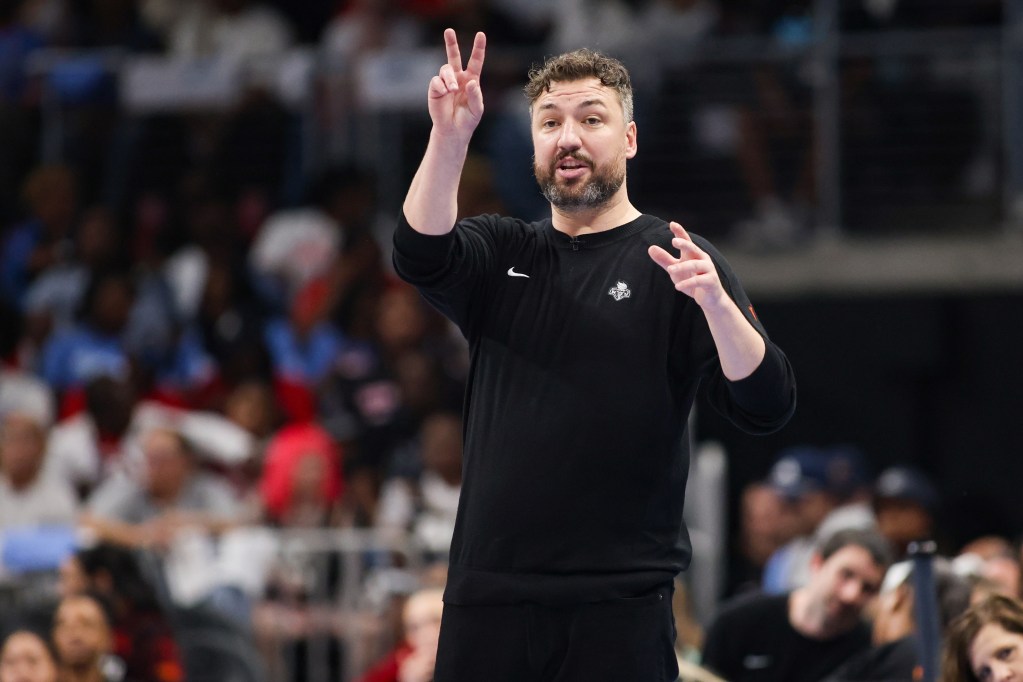
Why weren’t the Liberty’s huddles working and how did they function? Stewart helped fill in the gaps during the team’s practice before Game 2 on Oct. 6 in Atlanta.
When the Liberty took a timeout under DeMarco, the first person to address the group was Sheehey, the offensive coordinator. According to Stewart, he talked to the group about the possession battle and what’s working offensively. While Sheehey addressed the group, DeMarco was off to the side, either surrounded by the rest of the staff or alone, while he drew up the play that he wanted to run. Once DeMarco was ready, Sheehey stepped aside and DeMarco explained the play he drew up.
But something is missing here. How often did the team discuss what wasn’t working and what needed to change?
“I’ll definitely know what’s not working pretty quickly,” Stewart said in response to that question.
Asked to clarify whether she was the one vocalizing this, she said, “I mean, I think it’s collaborative, but yeah.”
Stewart’s answer showed how much responsibility had fallen on her. Stewart’s load wasn’t just the minutes she would play, but the larger cognitive load that she had to shoulder throughout a game. She was problem-solving for an entire team.
The running joke that Stewart was the team’s head coach appeared to have some basis in reality.
When DeMarco was asked about his own leadership and how he connected with the locker room, he often pointed toward and praised the leadership of Stewart, Ionescu and Jones. There’s a difference between a coach who empowers veteran players to lead and a coach who depends on those players to compensate for his own gaps.
With that in mind, should it really come as a surprise that the Liberty’s stars didn’t give him a vote of confidence to return next season moments after their season ended?

Finding the game shouldn’t be the hardest part
SheScores is the women’s sports scoreboard, making it easy to follow women’s sports with scores, schedules and where to watch — all in one place.
What lessons need to be learned?
Originally, Kolb was looking for someone who could augment a championship core and propel the Liberty back to the WNBA Finals. He was not looking for someone who would fall behind.
Stewart compared the Liberty’s 2026 situation to “cramming for a test.” Cramming is usually a result of poor planning and taking shortcuts.
But did DeMarco really have to cram? There were WNBA resources on both the front and back benches, including former players Courtney Paris and Kristen Mann and WNBA lifer and Unrivaled head coach Andrew Wade.
“I want my staff to want to come in here every day and want to be heard and have a voice and allow them to grow into themselves as coaches,” DeMarco told The IX Sports in May.
How committed to this was DeMarco actually? Multiple sources shared with The IX Sports that there was a lack of trust when it came to members of the staff who had WNBA backgrounds.
Also, there were questions about whether DeMarco’s staffing decisions set the Liberty, himself and the people he hired up for success. He came in with good intentions to try to hire more women to improve the diversity of the WNBA coaching pipeline. But good intentions aren’t enough. Some of the women he elevated into positions of responsibility lacked the expertise that those roles demanded. To be clear, this isn’t a reflection of their potential or a failure on their part.
That raises a larger question about DeMarco’s responsibility not only to diversify his staff, but to develop, prepare and support the people he entrusted with those jobs. With several of them now out of work, their experiences also invite a closer examination of what meaningful diversity, equity and inclusion policies look like in practice and within the framework of the WNBA.
What should a WNBA staff look like? According to former Liberty point guard Courtney Vandersloot, there needs to be diversity of thought and balance between WNBA experts and those who come from the NBA or college.
“People want to come in this league because this is a great place to be,” she told The IX Sports in July. “I think we should see that as a positive, but also to have people that have been around and know and understand not only the game but the players and how things work. Just having a good mix of both, just like an outside perspective on people that have been other places and what we can bring into this league, but also having people that have a really good understanding of what we do and who we are here.”
The Liberty learned valuable lessons this season about what really matters when it comes to championship-winning teams. Strong team identities and values matter. Excellent interpersonal skills matter. Deep knowledge of the league matters. Hindsight remains 20/20.